Contents
- Nauryz at a glance
- What Nauryz actually celebrates
- Nauryz kozhe and the number seven
- What happens over the three days
- Nauryz was banned, and that matters
- Nauryz, Nowruz, Navruz: how Kazakhstan’s version differs
- Visiting Kazakhstan during Nauryz: the practical picture
- What comes after
- Frequently asked questions
- Final thoughts
My first Nauryz was in Astana, in snow, at minus nine. There were yurts pitched on a boulevard, a queue of several hundred people waiting for free soup, a wrestling ring, and a man playing a dombra in a fur coat while children threw sweets at each other. Calling it a spring festival felt optimistic. Everyone assured me spring was coming, and that this was how you made sure of it.
Nauryz is the Kazakh new year, celebrated at the spring equinox on 21, 22 and 23 March, all three of which are public holidays in Kazakhstan. It marks renewal and reconciliation: houses are cleaned, debts settled, quarrels forgiven, and everyone eats nauryz kozhe, a soup made from seven obligatory ingredients. UNESCO recognises it as intangible cultural heritage.
It is, without much competition, the best week of the year to be a visitor in Kazakhstan. Yurts appear in city squares, horse games are staged in public, strangers hand you soup, and a country that can feel reserved on an ordinary Tuesday becomes conspicuously warm. Here’s how it works, what to expect, and why the number seven keeps coming up.
Nauryz at a glance
| Dates | 21, 22 and 23 March — all three are public holidays in Kazakhstan |
| What it marks | The spring equinox and the start of the new year. Renewal, and reconciliation |
| The name | From Persian: nau new, ruz day — “new day” |
| Signature dish | Nauryz kozhe, a soup with seven obligatory ingredients |
| Greeting | “Nauryz kutty bolsyn!” — Happy Nauryz |
| UNESCO | Nowruz is inscribed on the Representative List of Intangible Cultural Heritage, in a listing including Kazakhstan |
| UN recognition | 21 March is the International Day of Nowruz |
| Also celebrated in | Iran, Afghanistan, Azerbaijan, Turkey, Uzbekistan, Kyrgyzstan, Tajikistan, Turkmenistan and beyond — by an estimated 300 million people |
| Weather | Cold. Often below freezing in Astana; single figures in Almaty. Snow is normal |
| Best places to see it | Astana’s Nurzhol Boulevard, Almaty’s city squares, Turkestan and Shymkent |
What Nauryz actually celebrates
Nauryz is an equinox festival, which means it predates Islam by a very long way. Its roots are in the pre-Islamic Iranian and Central Asian world, tied to the moment the sun crosses the celestial equator and day and night are equal. From that point, light wins for six months. For a pastoral society whose entire economy depended on getting livestock through winter, the equinox was not symbolic. It was the day you found out whether you’d made it.
Kazakhs sometimes call it Ulystyn Uly Kuni — “the Great Day of the People.” The word carries the sense of a whole nation crossing a threshold together, which is why the customs are collective rather than private. You don’t celebrate Nauryz at home alone. You go out, you visit, you feed people and you get fed.
The theme running through all of it is renewal, and specifically reconciliation. This is the part I find most striking. Before Nauryz you’re expected to clean the house thoroughly, repair what’s broken, settle your debts and — the important one — resolve your quarrels. You are not supposed to carry a grudge across the equinox. Whitewashing walls, cleaning out wells and springs, planting trees: all of it is the same idea applied to different surfaces.
Nauryz kozhe and the number seven
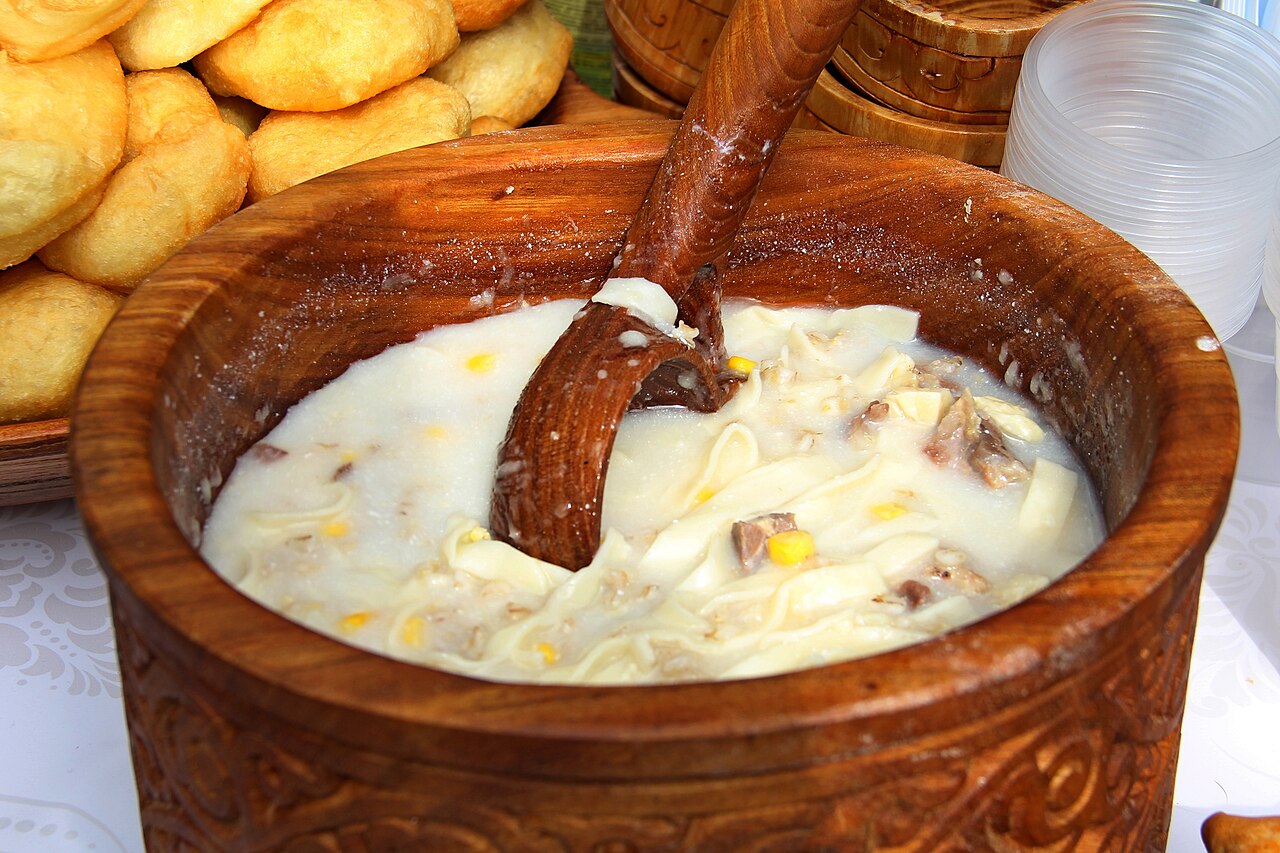
Every household makes nauryz kozhe, and it must contain seven ingredients. The standard list:
- Water — the source of life
- Meat — usually mutton, beef or horse, often kept back from the winter store
- Salt
- Fat
- Flour, in the form of noodles or dough pieces
- A cereal — millet, wheat, barley or rice
- Milk, or ayran or katyk — the fermented dairy that gives it its distinctive sourness
Each is said to stand for something: growth, prosperity, joy, success, wisdom, health, protection. The list of correspondences varies by family and region, so don’t get too attached to a single version — what’s fixed is that there are seven and that dairy is one of them.
Seven recurs everywhere in Nauryz. You should visit seven houses. You should invite seven guests. Seven bowls should stand on the table. The number maps onto the seven days of the week and, in some tellings, seven elements of life — and it connects to the wider Kazakh preoccupation with zhety ata, the seven generations of ancestors.
The taste, honestly, divides people. It’s a warm, thick, sour, milky broth with grains and lumps of meat in it, and if you’ve grown up with it, it tastes like March. If you haven’t, the sourness is startling. Have a small bowl and follow it with baursak — the little pieces of fried dough that appear at every Kazakh table and are unambiguously delicious.

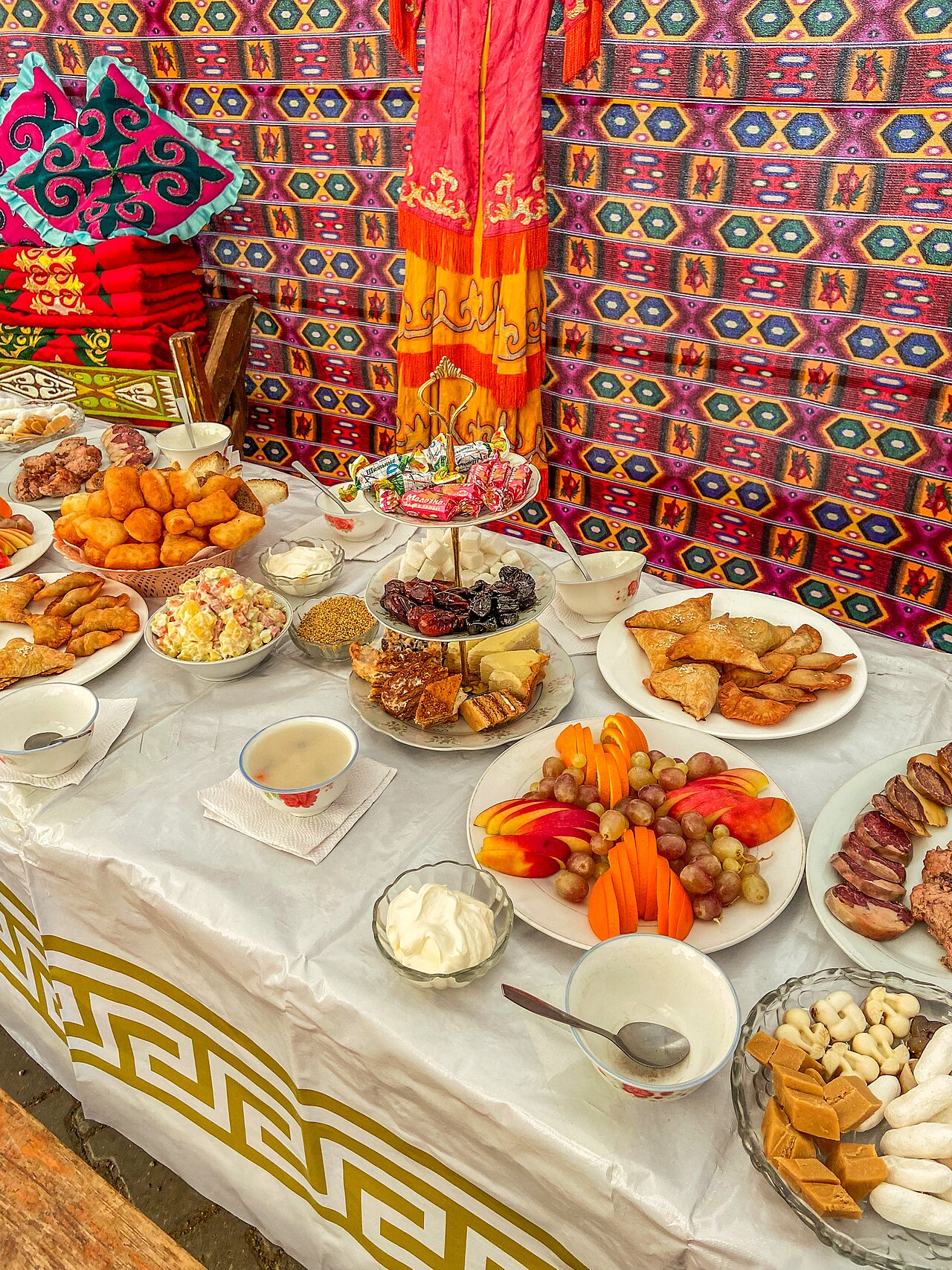
The rest of the Nauryz table is a full dastarkhan: beshbarmak, kazy horse sausage, kurt, samsa, dried fruit, sweets, and kumis or shubat if you’re lucky. Our guides to Kazakh dining etiquette, beshbarmak, traditional Kazakh dishes and kumis and Kazakh drinks cover what you’ll be handed.
What happens over the three days
Nauryz in a Kazakh city has a fairly consistent shape.
Yurts go up in the squares. This is the single most photogenic thing about it. Municipalities and organisations pitch white felt yurts in central boulevards and parks, decorate them properly with felt hangings and rugs, lay a dastarkhan inside, and invite people in. It is entirely normal to be waved into one as a foreigner and handed food. Say yes. Our guide to yurts in Kazakhstan explains what you’re looking at inside.
Free kozhe is distributed. Vats of it, from trestle tables, to long good-natured queues.
People dress up. National costume comes out — embroidered chapan coats, kimeshek head coverings, fur-trimmed borik hats. Some of it is heirloom, much of it is hired or made for the day, and it’s worn with obvious pleasure rather than self-consciousness.
The games are played. Depending on the city and the space available: kokpar, the mounted contest over a goat carcass; kures, Kazakh jacket wrestling; audaryspaq, mounted wrestling; asyk atu, the children’s anklebone game; and togyzkumalak, the nine-pebble board game, played on outdoor boards by people taking it very seriously indeed.

There is music, and there is aitys. Dombra players, folk ensembles, and — if you’re fortunate — an aitys, the improvised poetic duel between two akyns. You won’t follow a word of it, and it’s still worth standing in the cold for, because the crowd’s reactions tell you everything. It’s a roast, in verse, at speed.
The altybakan goes up. Six poles lashed into a frame with a swing hung from the middle — the name means “six poles.” Historically it was the courtship apparatus of the steppe: young people gathered around it in the evenings, took turns on the swing, sang to each other. At a modern Nauryz it’s mostly children, but the name and the setup are unchanged.
Elders are visited and blessed. Younger people call on older relatives and neighbours, ask for a bata — a blessing — and receive it. Any lingering disputes get formally put aside. This is the quiet centre of the festival, and it happens in living rooms rather than public squares.
Shashu. Sweets and coins showered over honoured guests and children, who scramble for them.

Nauryz was banned, and that matters
For most of the Soviet period Nauryz was suppressed. It was read as a religious and nationalist survival, incompatible with the new calendar, and it disappeared from official life for decades. It was revived in the Kazakh SSR in 1988, in the late-perestroika thaw, and became a proper public holiday after independence in 1991 — later extended to the current three days.
That history explains a lot about how it’s celebrated now. There’s an element of deliberate national reconstruction in the scale of it: the state-funded yurts, the formal competitions, the televised concerts. Some Kazakhs will tell you the public version is a bit official for their taste, and that the real Nauryz is the one in their grandmother’s flat with too much food and a conversation about who needs forgiving.
Both are true simultaneously, and as a visitor you get access mainly to the first. That’s fine — the public celebration is genuinely enjoyable and it’s designed to be inclusive. But if anyone invites you to a home over Nauryz, cancel your other plans.
Nauryz, Nowruz, Navruz: how Kazakhstan’s version differs
Roughly 300 million people mark this festival across a belt running from the Balkans to western China — as Nowruz in Iran and Afghanistan, Novruz in Azerbaijan, Nevruz in Turkey, Navruz in Uzbekistan and Tajikistan, Nooruz in Kyrgyzstan. UNESCO’s inscription is multinational for exactly that reason, and the UN General Assembly designated 21 March the International Day of Nowruz.
What’s distinctively Kazakh:
- Nauryz kozhe with its seven ingredients, rather than the Iranian haft-sin table of seven symbolic items beginning with the letter S. Same number, entirely different object.
- Yurts, pitched publicly and used as hospitality spaces.
- Horse games — kokpar, baiga, audaryspaq. This is the nomadic layer, and it’s not present in the Persianate versions.
- The reconciliation emphasis, and the formal visiting of elders for a blessing.
- The altybakan and the aitys, both specifically Turkic steppe traditions.
What’s shared across all of them: the equinox timing, the pre-festival cleaning, the theme of renewal, the visiting, and an enormous amount of food. Our Kazakh traditions and customs guide sets these in the wider context of hospitality and life-cycle ritual.
Visiting Kazakhstan during Nauryz: the practical picture
It will be cold
Let me be blunt about this, because “spring festival” sets the wrong expectation. Late March in Kazakhstan is not spring in any meaningful sense. Astana can be well below freezing with snow on the ground and a wind coming off the steppe that is genuinely punishing. Almaty is milder — often single figures above zero, sometimes low teens in a good year — but still cold once you’re standing around watching wrestling.
The south is your best bet for warmth: Shymkent and Turkestan run several degrees warmer than the north, and the steppe there may actually be greening. See Kazakhstan weather by month and Kazakhstan in spring before you pack, and dress as though it were winter. Standing outdoors for hours is the entire activity.
Things will be shut
Three consecutive public holidays means banks, government offices and many businesses close. Public transport runs reduced schedules. Museums may close or open oddly. Domestic flights and trains fill up, because a large part of the country travels to see family — book well ahead. Restaurants in the big cities generally stay open and are often busy with celebration bookings.
Plan a Nauryz trip around the festival itself rather than trying to combine it with a sightseeing itinerary. Our guides to things to do in Astana and things to do in Almaty will tell you what’s likely to be accessible either side of the holidays.
Where to go
| Astana | The largest official celebration, centred on Nurzhol Boulevard beneath the Bayterek tower — yurt villages, concerts, competitions. Coldest option by a wide margin |
| Almaty | City squares and parks, milder weather, and the mountains as a backdrop. Probably the best all-round choice |
| Turkestan and Shymkent | Warmer, more traditional in feel, and Turkestan pairs the festival with the Yasawi mausoleum |
| Smaller towns and villages | Less production value, more genuine. If you have a local contact anywhere rural, go there |
If you’re building a longer trip, Turkestan and an Astana itinerary both work well around the holidays, and the best time to visit Kazakhstan guide explains how late March compares with the rest of the year.
How to behave
- Accept food and drink. This is the central rule of Kazakh hospitality and it goes into overdrive at Nauryz. A token amount is fine; outright refusal isn’t.
- Learn the greeting. “Nauryz kutty bolsyn!” will earn you a delighted reaction every single time.
- Greet the eldest person first in any group or yurt you enter.
- Bring sweets if you’re invited anywhere. Never arrive empty-handed.
- Ask before photographing people, especially inside yurts and especially children.
- Expect to be photographed yourself. A foreigner eating kozhe is a popular subject.
- Don’t decline an invitation to try something — the swing, a game, a dance. Enthusiastic incompetence is the correct register.
Our full guide to etiquette in Kazakhstan covers the detail, and language in Kazakhstan will help with the handful of phrases worth having.
What comes after
If Nauryz is what brings you, stay a few weeks if you can. The genuine Kazakh spring arrives in April, and it’s spectacular in a way the equinox itself isn’t: wild tulips across the southern steppe — Kazakhstan is the ancestral home of the garden tulip — poppies, and the mountains above Almaty starting to green up.

Late April into May is also the one window when the salt flats of the west hold water and turn into mirrors, which is a very different kind of spring. See the Tuzbair salt flat and our Mangystau pillar if that appeals.
For the cultural thread, Kazakh culture is the place to start, and eagle hunting covers the other great steppe tradition you may catch at a winter or early-spring gathering.
Frequently asked questions
When is Nauryz in Kazakhstan?
21, 22 and 23 March, all three of which are public holidays. The festival is tied to the spring equinox, so the dates don’t move.
What does Nauryz mean?
“New day,” from the Persian nau (new) and ruz (day). In Kazakh it’s also called Ulystyn Uly Kuni, the Great Day of the People.
What is nauryz kozhe?
The signature dish of the festival: a thick, sour, milky soup that must contain seven ingredients — water, meat, salt, fat, flour, a cereal such as millet or wheat, and milk or fermented dairy. Each is said to stand for a quality like prosperity, health or wisdom.
Why is the number seven important at Nauryz?
Seven ingredients in the kozhe, seven guests to invite, seven houses to visit, seven bowls on the table. It’s linked to the seven days of the week and, in some accounts, seven elements of life — and it echoes the Kazakh tradition of knowing seven generations of ancestors.
Is Nauryz a religious holiday?
Not in origin. It’s an equinox festival with pre-Islamic Iranian and Central Asian roots, considerably older than Islam in the region. It’s now celebrated as a national and cultural holiday in Kazakhstan rather than a religious one.
How is Nauryz different from Persian Nowruz?
Same festival, same date, different execution. Kazakhs make nauryz kozhe with seven ingredients rather than laying an Iranian haft-sin table of seven symbolic items. Kazakh Nauryz also features yurts pitched in public, horse games like kokpar, the altybakan swing, aitys poetry duels, and a strong emphasis on reconciliation and blessings from elders.
What is an altybakan?
A swing hung from a frame of six lashed poles — the name means “six poles.” Historically it was where young people gathered on spring and summer evenings to sing and court each other. At a modern Nauryz it’s mostly children on it, but the structure and the name are unchanged.
Is Nauryz recognised by UNESCO?
Yes. Nowruz is inscribed on UNESCO’s Representative List of the Intangible Cultural Heritage of Humanity as a multinational element that includes Kazakhstan, and the UN General Assembly has designated 21 March the International Day of Nowruz.
What is the weather like during Nauryz?
Cold. Astana is frequently below freezing with snow; Almaty is usually a few degrees above zero, occasionally reaching the low teens; Shymkent and Turkestan in the south are warmest. Dress for winter — you’ll be standing outdoors for hours.
Where is the best place to experience Nauryz?
Almaty is the best all-round balance of scale and tolerable weather. Astana has the biggest official celebration and the harshest conditions. Turkestan and Shymkent are warmer and feel more traditional. A village celebration, if you have a local contact, beats all of them.
Will things be closed during Nauryz?
Yes — three consecutive public holidays close banks, government offices and many businesses, and public transport runs reduced services. Domestic flights and trains book out as people travel to family, so reserve well ahead. Restaurants in the big cities mostly stay open.
How do you say Happy Nauryz in Kazakh?
“Nauryz kutty bolsyn!” It’s worth practising — you’ll get a warm reaction every time you use it.
Do I need to be invited to join in?
No. The public celebrations are open and deliberately inclusive, the yurts in city squares welcome passers-by, and the free kozhe is for everyone. Being a visibly foreign visitor tends to get you pulled in faster rather than slower.
Final thoughts
Nauryz is the answer to anyone who says Kazakhstan is hard to get to know. For three days in March the country puts its culture out in the open — the yurts, the food, the games, the poetry, the clothes — and actively wants you to come and look at it.
The version you’ll see is partly official and partly ancient, and the seam between them is visible if you look for it. But the core of it isn’t a performance at all. It’s a society that decided the moment the light comes back is the moment to clean the house, pay what you owe, forgive whoever needs forgiving, and put a very large pot of soup on for anyone who turns up.
Dress warmer than you think you need to. Have a small bowl of the kozhe, then fill up on baursak. And learn the greeting — it’s five syllables and it will open more doors than anything else you do.
Photo credits
Nauryz kozhe in a carved wooden bowl — Photo: Игорь Улитин / CC BY-SA 4.0 via Wikimedia Commons. Golden baursak — Photo: Vidor / Public domain via Wikimedia Commons. Dastarkhan laid inside a yurt — Photo: Symbat Bolatova / CC BY-SA 4.0 via Wikimedia Commons. Kokpar riders — Photo: Rustam Uzbekov / CC BY-SA 4.0 via Wikimedia Commons. Folk dancers at a spring festival — Photo: Symbat Bolatova / CC BY-SA 4.0 via Wikimedia Commons. Wild tulips on the Kazakh steppe — Photo: Carole a / CC BY-SA 3.0 via Wikimedia Commons.