Contents
- Astana at a Glance
- Is Astana Worth Visiting? My Honest Take
- First, Get Oriented: A City of Two Banks (and a New Train)
- The Essential Things to Do in Astana: Left Bank Icons
- Independence Square and the Museum Quarter
- The New Astana: EXPO Sphere and the Grand Mosque
- Cross the River: the Right Bank and Old Astana
- An Architecture Safari: the Buildings Nobody Labels
- Culture for Pocket Change: Opera, Circus, Hockey
- Astana with Kids
- Astana in Winter: Don’t Just Survive It
- What (and Where) to Eat in Astana
- Day Trips from Astana: the Steppe Is the Point
- Suggested Astana Itineraries
- Astana Practicalities: Getting There, Around and Sleeping Well
- Astana FAQ
- Final Thoughts: Give the Weird Capital a Chance
- Explore Astana in more depth
- Related Kazakhstan travel guides
Last updated: June 12, 2026 · Written by the Kazakhstan Tourism Guide editorial team
The first time you see Astana rise out of the steppe — from a plane window or, better, from the slow build-up of a night train — it doesn’t look real. A glass pyramid, a 150-meter transparent tent, golden towers, a white-and-gold mosque the size of a stadium, all dropped onto dead-flat grassland where thirty years ago there was a modest provincial town and an awful lot of wind.
The best things to do in Astana are riding up the Baiterek Tower at sunset, standing under the world’s biggest tent at Khan Shatyr, visiting the Grand Mosque (the largest in Central Asia), digging into nomad history at the National Museum, and crossing into the Soviet-era Right Bank for mosaics, bazaars and beshbarmak. Two full days covers the essentials; three lets you add the steppe.
This guide is the Astana hub of our complete guide to things to do in Kazakhstan, and it’s built from time actually spent walking this strange, fascinating capital — in both the +30°C summer glare and the kind of January cold that freezes your eyelashes. I’ll give you the icons, the stuff most guides miss (including the brand-new LRT line that finally opened in May 2026), honest opinions on what to skip, real prices in tenge, and a workable plan for one, two or three days.
Astana at a Glance
| Essentials | The short version |
|---|---|
| Don’t miss | Baiterek Tower, Khan Shatyr, Astana Grand Mosque, National Museum, Nurzhol Boulevard at night |
| Time needed | 2 full days for the city, 3 days with a Burabay or ALZHIR day trip |
| Best months | May–September (June and August are the sweet spot) |
| Daily budget | Roughly ₸15,000–25,000 ($28–47) per person staying mid-range, eating well |
| Getting around | The new LRT line, Yandex Go rides (₸700–2,000 across the center), city buses |
| Coming from Almaty | 1.5–2 hour flight or the overnight Talgo train (around 12–16 hours) |
Is Astana Worth Visiting? My Honest Take
Travel bloggers love to dunk on Astana. You’ll read that it’s soulless, empty, a vanity project, “Dubai on the steppe” — and I understand where that comes from, because the city was conjured up by presidential decree in 1997 and built at warp speed on a riverbank that used to be best known for mosquitoes and -40°C winters.
Here’s my honest position: Astana is not Almaty, and it’s not trying to be. Almaty has mountains, century-old trees and café culture; Astana has ambition you can walk through. Nowhere else in the former USSR can you watch a nation write its own mythology in glass and titanium, in real time. The architecture is genuinely world-class weird — Norman Foster alone designed a pyramid, a tent and an orb here. Museums are huge and cheap. Food has improved beyond recognition in the last decade. And because almost no one comes, you’ll often have the marble plazas nearly to yourself.
If you only have a week in Kazakhstan, I’d still weight it toward Almaty and its mountains. But skipping the capital entirely means missing the clearest window into where this country thinks it’s going. Give it two days. It will confuse you in the best way.
First, Get Oriented: A City of Two Banks (and a New Train)
Astana splits along the Ishim River — locals call it the Yesil. Everything south of the water is the Left Bank: the planned showpiece city built after 1997, with Nurzhol Boulevard as its spine, government palaces at one end and Khan Shatyr at the other. Everything north is the Right Bank — the original town, called Akmolinsk and then Tselinograd in Soviet times, where you’ll find five-story apartment blocks, mosaics, the old train station and most of the normal, lived-in city life.
Think of it like Paris’s two banks, if one bank had been designed by a committee of sci-fi illustrators. The contrast is the whole point: see both or you’ve only seen half the story.
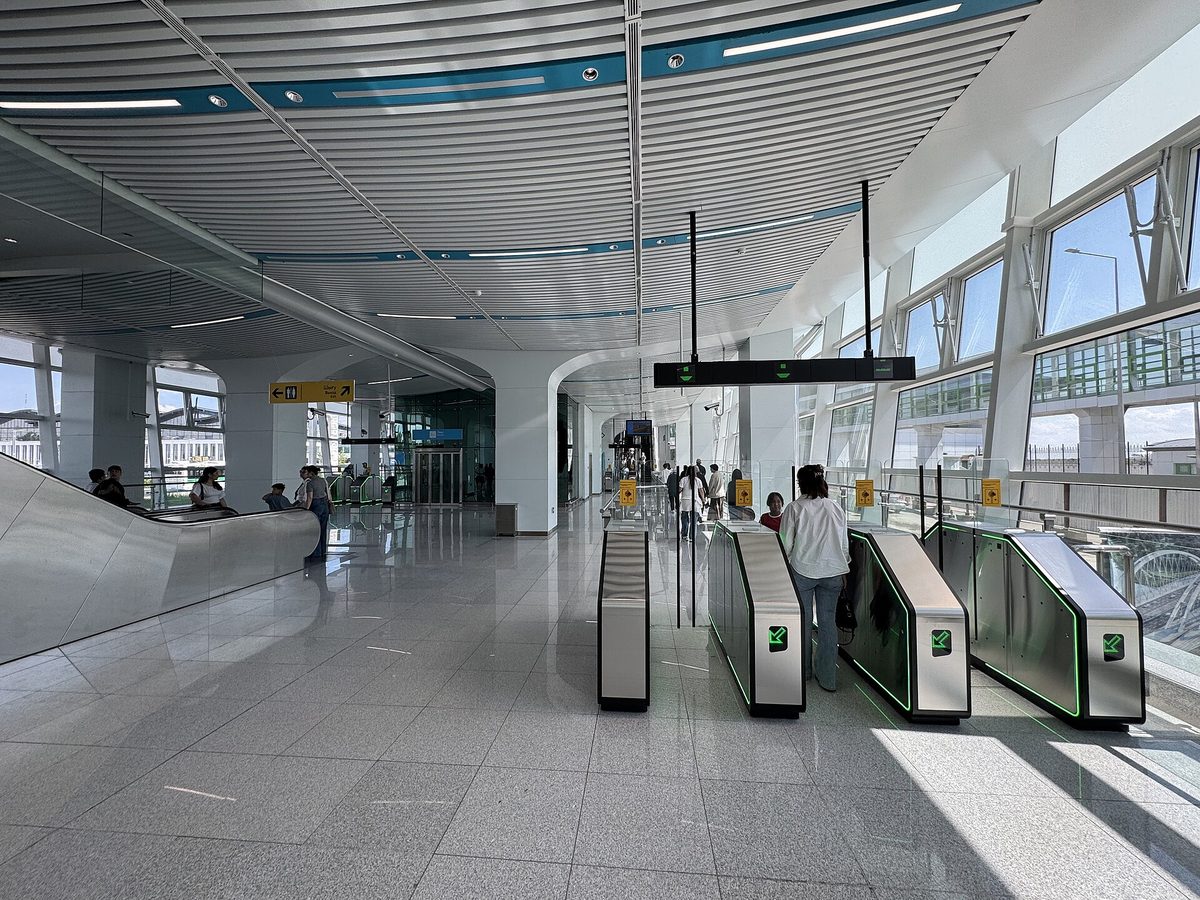
One thing every other guide on the internet is missing as I write this: Astana finally has its LRT. The elevated light-metro line — a city punchline for over a decade while its concrete pillars stood unfinished along the main avenue — opened in May 2026. It runs about 22 km from the airport past the EXPO sphere, the National Museum, Baiterek and the ministries to the Nurly Zhol railway station, 18 stations in roughly 40 minutes, with driverless trains. For a visitor it’s gold: the line strings together half the sights in this guide. Fares plug into the same transport-card and QR system as the buses; have your hotel help you set up payment, or just check current options when you land — things are still settling in.
The Essential Things to Do in Astana: Left Bank Icons
Start where everyone starts — the showpiece axis of Nurzhol Boulevard. You could walk this end to end in an hour; budget half a day if you’re actually going up things and into things. A warning from experience: distances here are deceptive. Buildings are so oversized that something “two blocks away” is a 25-minute walk. In summer carry water; in winter, do this stretch in taxi-sized hops.
Baiterek Tower — the Symbol of the City

Baiterek is Astana’s Eiffel Tower: a 105-meter white latticework trunk holding up a golden orb, built to illustrate the Kazakh legend of the sacred Samruk bird, which laid a golden egg in the branches of the tree of life. Yes, it’s on every fridge magnet in the country. Go up anyway. The observation deck at 97 meters gives you the only view that makes the city’s master plan click — the ministries lined up like chess pieces, Khan Shatyr glowing at the boulevard’s far end, and the steppe beginning abruptly where the cranes stop.
Entry runs around ₸2,000 (about $4) — it’s tripled since the late 2010s, for what it’s worth. Inside the orb you’ll find the famous gilded handprint of first president Nazarbayev; locals (and every tour guide) will encourage you to place your palm in it and make a wish. Do it for the photo, draw your own conclusions about the personality cult. Sunset is the best slot, when the golden towers below actually look golden. Expect a short queue on summer weekends.
Nurzhol Boulevard — the Walk That Explains the City
The pedestrian spine between the presidential palace and Khan Shatyr is Astana’s open-air architecture museum, and walking it is free. Heading west to east you’ll pass the twin golden cones locals call “the beer cans” (officially housing state companies), the curved KazMunayGas headquarters that frames Khan Shatyr through its arch, the lighter-shaped Transport Tower, the Northern Lights towers with their rippling blue glass, and singing fountains that run on summer evenings — the nightly fountain-and-light show near Baiterek usually kicks off around 9pm in July and August and is legitimately lovely.
Come twice: once in daylight for the scale, once after dark when everything switches on. Astana at night is a different, better city — the LED facades, the lit-up bridges, the glow of the tent on the horizon. If you only have one evening, spend it here.
Khan Shatyr — the World’s Largest Tent

Norman Foster’s 150-meter translucent marquee, opened in 2010, is engineered to keep an indoor microclimate of around +20°C even when it’s -35°C outside — and in winter, walking out of a blizzard into a warm, bright artificial canyon of cafés genuinely feels like science fiction. Inside it’s… a shopping mall. A nice one, with a flume ride and a monorail loop for kids, plus the famous Sky Beach Club on the top level: a heated artificial beach with sand shipped in from the Maldives, palm trees and a wave pool, several hundred meters from permafrost-grade steppe.
My honest advice: the building is unmissable from outside, especially lit up violet and orange at night, and worth 45 minutes inside for the spectacle and a coffee. Pay for Sky Beach only if you’re traveling with kids or visiting in deep winter, when swimming “at the beach” while it’s -30°C outside becomes one of the great absurd travel experiences. Day passes are priced like a mid-range water park, not a mall entry — check current rates on arrival.
Ak Orda Presidential Palace and the Government Quarter
At the river end of the boulevard sits Ak Orda, the president’s white-and-blue domed palace — like the White House after a growth spurt. You can’t go in, and on some days plainclothes officers will discourage even photography from certain angles; stay relaxed, use the official viewpoints across the plaza, and you’ll be fine. The ensemble around it — Senate, ministries, the glass cones of the House of Ministries — is best appreciated as a single surreal composition from the Baiterek deck or from across the river at night.
Nur-Astana Mosque — the Golden-Domed One
A gift from the Emir of Qatar, completed in 2005, with a 40-meter golden dome and minarets framing it like exclamation points. It was Central Asia’s third-largest mosque when built — Astana has since out-built it twice, which tells you everything about this city’s pace. The white-and-gold exterior against a blue prairie sky is one of the best photographs in the capital, especially from the boulevard side in late afternoon light. Non-Muslim visitors are welcome outside prayer times; dress modestly, remove shoes, women cover hair (scarves are lent at the entrance).
Independence Square and the Museum Quarter
Cross to the eastern side of the Left Bank (one LRT stop or a ₸700 Yandex ride from Baiterek) and you hit the city’s ceremonial heart: a windswept plaza ringed by some of the most important buildings in the country. You can do the whole cluster in half a day, museum included.
National Museum of the Republic of Kazakhstan

The largest museum in Central Asia, and the single best indoor thing to do in Astana, full stop. The building itself — a tumble of white marble and blue glass with a golden Samruk bird out front — contains everything from Bronze Age petroglyphs to a hall-sized animated map of the Kazakh khanates to a sobering gallery on the Soviet famine and repressions.
The non-negotiable is the Hall of Gold, home to a replica of the Golden Man — the 3,800-piece gold-armored Saka warrior who has become Kazakhstan’s national symbol — plus genuinely staggering Scythian-era goldwork excavated from steppe burial mounds. The ethnography hall, with its full-size yurt interiors, is the other highlight; it sets up everything you’ll see if you later head into the countryside.
Closed Mondays. Base entry is cheap (a few hundred tenge; the special halls like the Hall of Gold cost extra, around ₸1,000), and the whole visit will run you less than a coffee chain breakfast. Give it 2–3 hours. Signage is decent in English, but the audio guide is worth it for the gold collection.
Hazrat Sultan Mosque

Across the square gleams Hazrat Sultan, a classically Islamic counterpoint to the city’s sci-fi skyline — white marble, a 51-meter dome, space for 10,000 worshippers, and chandeliers that look like falling galaxies. From its completion in 2012 until 2022 it was the largest mosque in Central Asia; the new Grand Mosque took the title, but Hazrat Sultan remains, to my eye, the more graceful of the two, especially at dusk when the floodlights come on. Entry is free, dress code as usual; visit outside the five daily prayers and Friday midday.
Palace of Independence, Kazakh Eli and the Wall of Peace
The square’s remaining ensemble: the trapezoid-latticed Palace of Independence (its best feature is an enormous scale model of Astana’s master plan to 2030 — worth seeing to grasp how much is still to come), the 91-meter Kazakh Eli column crowned with another Samruk bird, and the arc of the Wall of Peace. It’s all very state-ceremonial, and on a normal weekday eerily quiet, which is its own experience: imperial-scale space, no crowds.
Palace of Peace and Reconciliation — Foster’s Pyramid

A ten-minute walk away stands the building that started Astana’s celebrity-architecture habit: Norman Foster’s 62-meter glass-and-granite pyramid, built in 2006 to host the triennial Congress of World Religions. You can only visit on a guided tour (they run every half hour or so, around ₸1,500–2,000; English-speaking guides available for a bit more), which takes you up through the hanging gardens to the apex conference room, where 200 stained-glass doves fly across the glass and the heads of world faiths meet around a giant sun-shaped table. It’s somewhere between profound and gloriously Bond-villain. I’d rank it behind the museum and mosques if you’re tight on time, but architecture lovers shouldn’t miss it.
The New Astana: EXPO Sphere and the Grand Mosque
Two of the city’s biggest sights didn’t exist in most guidebooks’ last update — one legacy of EXPO 2017, one opened in 2022. Both sit south of the boulevard axis and are now easy to reach: the LRT stops at the EXPO site.
Astana Grand Mosque — the Largest in Central Asia

Opened in 2022 and instantly one of the ten biggest mosques on Earth: a 68,000-square-meter colossus that can hold over 200,000 worshippers counting its courtyard, under the world’s largest dome of its type (83 meters high, 62 meters across) and four 130-meter minarets, each built in five sections for the five pillars of Islam. The interior is a wash of white, turquoise and gold, with a carpet the size of a football pitch.
Entry is free, and non-Muslim visitors are genuinely welcomed outside prayer times — robes and headscarves are lent free at the door, shoes off, photography allowed if you’re discreet. The detail almost nobody mentions: you can go up one of the minarets (around ₸2,000) for an observation deck with a view back across the whole Left Bank skyline. Mornings after first prayers or mid-afternoon, roughly 2–4pm, are the quietest slots; avoid Friday midday unless you want to witness the crowds, which is impressive in its own right.
Nur Alem — the Giant Glass Sphere

The centerpiece of EXPO 2017 is an 80-meter glass planet — the largest spherical building in the world — now running as the Museum of Future Energy. Eight floors take you from a wind-and-solar tech showcase down through water, kinetic and space energy exhibits, with the top sphere giving you skyline views through curved glass. It’s interactive, slightly utopian, great with kids, and tickets run around ₸1,500–2,000. The surrounding EXPO campus also houses the International Financial Centre and a congress hall; the whole district is the clearest statement of what Astana wants to be when it grows up.
Which Observation Deck Should You Pay For?
| Viewpoint | Height | Cost | Verdict |
|---|---|---|---|
| Baiterek Tower | 97 m deck | ~₸2,000 | The classic. Best master-plan view of the boulevard axis. Go at sunset. |
| Grand Mosque minaret | ~130 m structure | ~₸2,000 | Newest and least crowded; great skyline panorama from the south. |
| Nur Alem top sphere | ~80 m | included in ~₸1,500–2,000 ticket | Best value — a whole museum plus the view. |
If you’ll only pay for one, take Baiterek for the symbolism. If queues are long, Nur Alem gives you more for the same money.
Cross the River: the Right Bank and Old Astana
Here’s the itinerary mistake almost everyone makes: they see the Left Bank, declare Astana “finished in a day,” and leave without ever crossing the Ishim. The Right Bank is the older, scrappier, more human half of the capital — the actual town of Tselinograd that Soviet planners built as the headquarters of Khrushchev’s Virgin Lands campaign in the 1950s — and wandering it is one of my favorite things to do in the city.
Soviet Mosaic Hunting and the Old Quarter
Astana barely existed in Soviet times, so its socialist-modernist relics are rare enough to feel like trophies. The classic finds are the mosaics around the old railway station — cosmonauts and harvest scenes in chipped tile — plus a handful of preserved panels in the Saryarka district, transplanted onto newer buildings. Around them you’ll find five-story khrushchyovka blocks, grandmothers selling raspberries, and a pace of life the Left Bank’s marble plazas simply don’t have. Street art from the city’s anniversary festivals adds a newer layer — keep your eyes on gable walls.
The Riverfront and the Pedestrian Bridges
The Yesil embankment is where Astana actually relaxes: families promenading, wedding photo shoots, kids on scooters, summer beer terraces. Walk the loop between the Atyrau “Fish” Bridge — a swooping pedestrian crossing gifted by the Atyrau region, now part of a 50-plus-kilometer bike path network — and the central embankment, and you’ll get the city’s best skyline-across-the-water photographs, especially in the golden hour. River ferries also putter along in summer if your feet have given up.
Markets, the Arbat and Everyday Astana
For souvenir shopping with personality, skip the malls and head for the bazaars and the Right Bank’s pedestrianized Arbat stretch on Zheltoksan street, where buskers and artists set up in summer. The covered markets sell horse sausage, mountains of dried apricots, Korean salads and felt slippers in roughly equal measure — go hungry, haggle gently, and you’ll come away with better souvenirs (and stories) than anything from Khan Shatyr’s gift shops.
Thaw Out Like a Local: the Banya
One for cold-season visitors especially: Astana’s bathhouse culture is the real deal, and an afternoon in a proper banya — alternating between a 90°C steam room, a plunge pool, and being thrashed with birch branches (it’s wonderful, trust me) — is the single best way to understand how people survive seven-month winters here cheerfully. The big modern complexes are spotless and foreigner-friendly; a session with all the trimmings costs about what a mid-range dinner does. It beats another hour in a mall by a country mile.
An Architecture Safari: the Buildings Nobody Labels
Astana rewards the architecture nerd like almost nowhere else, because the whole city is a sculpture park of statement buildings. Beyond the headliners, keep an eye out for these as you move around — no tickets needed, just a charged phone:
- KazMunayGas headquarters — the monumental gateway building whose arch perfectly frames Khan Shatyr; the boulevard’s best photo spot after dark.
- The Transport Tower — nicknamed “the lighter” by locals, for obvious flame-shaped reasons.
- Triumph of Astana — a 2006 wedding-cake skyscraper deliberately echoing Moscow’s Stalinist Seven Sisters; surreal to find one built in the 21st century.
- Northern Lights towers — three rippling glass blades that look like a frozen aurora.
- Emerald Towers — watch them after dark, when a full-wall LED display turns one facade into a screen.
- The Circus — a flying saucer that landed on the Right Bank in the 1970s style, still hosting acrobats most weekends.
- Astana Opera — a defiantly neoclassical colonnaded hall amid all the glass, built because a capital needs an opera house.
Culture for Pocket Change: Opera, Circus, Hockey
This is the cheapest world-class culture I know of anywhere. The Astana Opera stages Verdi, Tchaikovsky and Kazakh national opera in a 1,250-seat hall with prices that start around the cost of a cappuccino — same-day tickets for a few dollars are routinely available outside peak premieres (the season runs roughly September to June; check the schedule online). Dress smart-casual or better and enjoy feeling like an oligarch on a backpacker budget.
Alternatives for other moods: the Circus does weekend shows that kids adore; Barys Astana plays top-league ice hockey at Barys Arena from September through the winter, with rowdy-friendly crowds and cheap seats; and Astana Arena hosts football under a retractable roof. For more ideas across the country, our culture and experiences guides go deeper.
Astana with Kids
Few capitals this side of Singapore are so obviously engineered for families. The hit list: the Duman Entertainment Center, whose oceanarium holds sharks two thousand kilometers from the nearest sea (a fact the city is extremely proud of); the rides, flume and monorail inside Khan Shatyr plus the Sky Beach on top; Nur Alem’s hands-on energy exhibits; the Ferris wheel and boat rentals in the Central Park; and in winter, the ice-sculpture town and tubing hills that pop up around the city. Mega Silk Way mall by the EXPO site mops up any remaining rainy (or, more likely, blizzardy) afternoon.
Astana in Winter: Don’t Just Survive It
Every guide tells you to avoid Astana from November to March. I’ll tell you something different: winter is the most Astana the city ever gets. This is the second-coldest capital on the planet (only Ulaanbaatar beats it), where -25°C is a normal Tuesday and -40°C makes the news only mildly. The city was built for it — and visiting in the cold, briefly and properly dressed, is a legitimate adventure.

The winter playbook: do your outdoor sightseeing in 30–40 minute bursts (Baiterek to the beer cans, then warm up; the riverfront at noon, then retreat), and link the indoor monuments — Khan Shatyr, the National Museum, Nur Alem, the Grand Mosque, Mega Silk Way — into a circuit by taxi or LRT. Swim at the heated indoor beach while frost flowers grow on the tent above you. Book a banya afternoon. Watch hockey. Skate at the outdoor rinks locals flood in the parks, and find the ice town of carved sculptures, usually glowing with colored lights near the boulevard. Dress like it’s a polar expedition, because it politely is: real boots, proper gloves, a hat that covers your ears, windproof everything — the steppe wind is the real opponent, not the thermometer.
If a frozen capital sounds like your kind of weird, it pairs perfectly with ski season in the south — see our Kazakhstan winter guides for the full cold-weather picture, and check the best time to visit Kazakhstan to decide if you’d rather have the sunshine.
What (and Where) to Eat in Astana
A decade ago the capital’s food scene was the punchline of every expat dinner party. Not anymore. Astana now eats well across every budget, and treating restaurants as sightseeing is entirely justified here.
Start with the national table. Beshbarmak — “five fingers” — is boiled meat (usually horse or lamb) over broad noodles in onion broth, the dish of honored guests. Kazy is horsemeat sausage, far better than you’re braced for: dense, smoky, somewhere between brisket and salami. Add manty (steamed dumplings), baursak (fried dough puffs that vanish by the basket), plov from the Uzbek south, shashlik off the coals, and — if you’re brave — kumys, fermented mare’s milk, which tastes like sour, fizzy regret the first time and oddly moreish the third. I wrote much more in our Kazakh food guides, but you can eat your way to a respectable education in one Astana weekend.
Where to do it: for a proper sit-down introduction to modern Kazakh cooking, the polished national restaurants on the Left Bank do beshbarmak and kazy with tablecloths and dombra music — expect ₸6,000–12,000 ($11–22) a head with tea. The Central Asian chains everyone recommends (Navat and its kin) are reliably good and cheaper. For atmosphere, the themed restaurant row along Turan Avenue — Uzbek dining rooms under Khiva-style domes, a Georgian tower house — is touristy and fun in equal measure. Canteen-style stolovayas on the Right Bank will feed you an enormous lunch for ₸2,000–3,000; the coffee scene (third-wave roasters with laptops and flat whites) now rivals Almaty’s. Budget meals run ₸2,000–4,000, mid-range dinners ₸5,000–10,000, and even a blowout rarely crosses ₸20,000 a person.
Day Trips from Astana: the Steppe Is the Point
Astana makes more sense once you’ve seen what surrounds it — namely, an ocean of grass. Three classic escapes, all doable in a day:
| Day trip | Distance / time | Why go | Logistics |
|---|---|---|---|
| Burabay (Borovoe) | ~250 km north, 2.5–3 hrs | Granite peaks, pine forests and lakes rising out of the steppe — “the Switzerland of Kazakhstan” is overselling it, but it’s beautiful and the locals’ favorite escape | Comfortable trains and buses run from Astana; tours bundle the viewpoints. Swim, hike Bolektau hill, boat on the lake. Book summer weekends ahead |
| ALZHIR Memorial | ~35 km west, 45 min | The most important historical site near the capital: the museum on the grounds of the Stalinist camp where thousands of women were imprisoned purely for being “wives of traitors of the motherland.” Harrowing and essential | Marshrutkas to Akmol village run from the bus station near the old train station, or a return Yandex ride is cheap. Closed Mondays |
| Korgalzhyn Nature Reserve | ~130 km southwest, 2 hrs | UNESCO-listed steppe lakes hosting the world’s northernmost pink flamingos (roughly May–September), plus pelicans and herds of saiga antelope if you’re lucky | Realistic only with a tour or hired driver; arrange a permit/guide through agencies in town. Bring binoculars and sunscreen — there is no shade on the steppe |

If you’ve got more time in the region, Burabay deserves an overnight rather than a rushed loop — and the wider north has more low-key surprises; our northern and eastern Kazakhstan guides cover them. Basing in Almaty instead? The mountain escapes there are a different league — start with our guide to the best day trips from Almaty.
Suggested Astana Itineraries
One day (or a long layover): Morning at the National Museum and Hazrat Sultan Mosque, midday LRT or taxi hop to the Grand Mosque, afternoon walking Nurzhol Boulevard from the beer cans to Khan Shatyr, up Baiterek for sunset, fountains and dinner on the boulevard after dark. Exhausting, doable, unforgettable.
Two days: Day one as above, but split the museum quarter and the boulevard between morning and evening at saner pace, adding the Pyramid tour. Day two: Nur Alem and the EXPO district in the morning, then cross to the Right Bank — riverfront walk, mosaic hunting, bazaar, Arbat — with a banya or an opera/hockey ticket for the evening.
Three days: Add a day trip — Burabay for landscapes, ALZHIR for history, Korgalzhyn for flamingos. If you’re building a longer route through the country (Astana pairs naturally with Almaty via the night train), steal one of the ready-made plans in our Kazakhstan itineraries guide or browse all our route ideas.
Astana Practicalities: Getting There, Around and Sleeping Well
Getting There
Most visitors arrive one of three ways. Flying: Nursultan Nazarbayev International Airport (NQZ) sits about 15 km south of the center, with direct flights from across Europe, the Gulf and Asia, and hourly-ish connections from Almaty (1.5–2 hours, often $40–70 if booked ahead). The train: the overnight Talgo from Almaty is the classic — roughly 12–16 hours depending on service, with a four-berth kupe ticket typically ₸15,000–25,000 ($28–47); slower trains cost less and take up to 18+ hours. Book on the national railway site or tickets.kz a few days ahead in summer. By road: intercity buses and shared taxis serve the whole region, though distances are honest — this is a country where getting around deserves its own planning session.
Visa-wise, most Western, Gulf and East Asian passports get 14–90 days visa-free; the details (and the registration rules nobody reads until they matter) are in our Kazakhstan visa guide.
Getting Around the City
From the airport, the new LRT now runs straight into the Left Bank and on to Nurly Zhol station — the single best arrival upgrade in the city’s history — while a Yandex Go ride to a central hotel costs around ₸2,000–3,500. In town: the LRT for the main axis, Yandex Go (the local Uber; cheap, cashless, no language needed) for everything else at ₸700–2,000 a hop, and the extensive bus network if you’re feeling local — fares are a few hundred tenge, paid by transport card or QR code; foreign bank cards can be temperamental, so sort payment out with your hotel’s help on day one. Two apps before you land: Yandex Go and 2GIS (the offline city map that works far better than Google Maps here).
Where to Stay
Left Bank if you want to wake up among the monuments: international five-stars (the Rixos and St. Regis tier run $150–300+) and solid four-stars from $60–100, with apartments on Nurzhol Boulevard often the best value at $40–70. Right Bank for character, older hotels and hostels (dorm beds $10–15, simple doubles $30–50), closer to the bazaars and the train station. There’s no bad-area problem here in the way you might fear — the capital is scrubbed and safe — it’s purely a question of whether you want futuristic or human-scale outside your window. Area-by-area detail lives in our where to stay guides.
What Astana Costs
| Expense | Typical price (₸) | In USD |
|---|---|---|
| Baiterek Tower entry | ~₸2,000 | ~$4 |
| National Museum + Hall of Gold | ~₸1,500–2,000 | ~$3–4 |
| Nur Alem (EXPO sphere) museum | ~₸1,500–2,000 | ~$3–4 |
| Grand Mosque / Hazrat Sultan entry | Free (minaret deck ~₸2,000) | $0 (~$4) |
| Opera ticket (same-day, standard) | from ~₸2,000–5,000 | ~$4–9 |
| Yandex ride across the center | ₸700–2,000 | $1.50–4 |
| Bus / LRT fare | a few hundred ₸ | under $1 |
| Canteen lunch / mid-range dinner | ₸2,500 / ₸8,000 | ~$5 / ~$15 |
| Night train from Almaty (kupe) | ₸15,000–25,000 | $28–47 |
Prices are mid-2026 ballparks — Kazakhstan’s tenge moves around, so treat these as planning figures and check current rates; the wider picture is in our costs and budget guides. The headline: Astana looks expensive and isn’t. This is one of the cheapest “futuristic” cities you will ever visit.
When to Come
May through September, with June and August the sweet spot — long warm days, fountains on, terraces open. July works but can hit +35°C with steppe sun and zero shade. The shoulder weeks (late April, early October) are a gamble that usually pays off. November to March is for the winter-curious only — see the winter section above and go in with your eyes (barely) open. Full seasonal breakdown in our guide to the best time to visit Kazakhstan.
Astana FAQ
Is Astana worth visiting?
Yes — for two days, with the right expectations. Come for world-class statement architecture, Central Asia’s biggest museum and mosque, absurdly cheap culture, and the surreal experience of a capital conjured from empty steppe in one generation. Don’t expect old-town charm; that’s not what this city is for.
How many days do you need in Astana?
Two full days covers the Left Bank icons, the museum quarter, the Grand Mosque and EXPO sphere, plus a Right Bank wander. Add a third for a day trip to Burabay’s lakes, the ALZHIR memorial or Korgalzhyn’s flamingos. A focused one-day layover hits the highlights but you’ll feel the sprint.
What is Astana famous for?
Futuristic architecture — Norman Foster’s Khan Shatyr tent and pyramid, the golden-orbed Baiterek Tower — plus being one of the world’s youngest and second-coldest capitals. Since 2022 it’s also home to Central Asia’s largest mosque, and it hosted EXPO 2017, whose giant glass sphere still anchors the skyline.
Which is better, Astana or Almaty?
Different species. Almaty is older, greener, backed by 4,000-meter mountains, with better food and nightlife — most travelers’ favorite. Astana is the planned showpiece: grander, stranger, emptier, fascinating in its own right. Ideally take the night train and do both; if forced to choose, Almaty wins on nature, Astana on spectacle.
Why did Kazakhstan move its capital to Astana?
Officially: Almaty was earthquake-prone, hemmed in by mountains and too close to borders, while a central capital could anchor the vast, Russian-leaning north. Unofficially, it also let a young state build a national symbol from scratch. The move was decreed in 1997, and the city has been under construction ever since.
Was Astana called Nur-Sultan?
Yes — the city has had five names. Akmolinsk under the tsars, Tselinograd in Soviet times, Akmola after independence, Astana from 1998, then Nur-Sultan from 2019 to 2022 in honor of the first president, before reverting to Astana. Locals mostly just kept saying Astana through the whole episode.
Is Astana safe for tourists?
Very. The capital is heavily policed, brightly lit and statistically calmer than most European cities of its size. Normal precautions apply — agree on taxi prices or use Yandex, watch your phone in bazaars. The genuine hazard is winter cold, which is no joke at -30°C. More in our safety and practical guides.
Is Astana expensive?
No — it just looks it. Museums cost $1–4, opera tickets from a few dollars, filling meals $5–15, taxis $1.50–4 a ride, and good four-star rooms $60–100. International five-stars and imported goods carry capital-city markups, but a comfortable visit runs ₸15,000–25,000 ($28–47) per day plus your room.
Final Thoughts: Give the Weird Capital a Chance
Astana is the easiest city in Kazakhstan to mock and the hardest one to forget. I’ve watched the sun set behind Khan Shatyr from the Baiterek orb, eaten beshbarmak within sight of a glass pyramid, and walked out of -28°C into a heated beach with Maldivian sand — and I still couldn’t tell you exactly what this city is. That’s precisely why you should see it. Pair it with Almaty on the night train, give it two open-minded days, and explore the rest of our Astana guides when you’re ready to dig deeper. The steppe capital will meet you more than halfway.
Explore Astana in more depth
Ready to turn this into a day-by-day plan? These companion guides go deeper on the capital:
- Astana in 1–2 days: a realistic itinerary — the icons, the logistics and exactly what to skip.
Related Kazakhstan travel guides
This is one piece of a much bigger Kazakhstan trip-planning series. If it helped, these companion guides are the natural next reads:
- Kazakhstan Trip Cost — real daily budgets and what things actually cost.
- Getting Around Kazakhstan — trains, flights, buses and self-driving.
- Is Kazakhstan Safe? — an honest, up-to-date safety rundown.
- Hiking in Kazakhstan — the best trails, treks and trekking logistics.
- Silk Road Kazakhstan — Turkestan, Shymkent and the historic south.
- Mangystau & the West — Bozjyra and the surreal Caspian deserts.
Photo Credits & Sources
Photos via Wikimedia Commons, used with thanks: Baiterek Tower & Nurzhol Boulevard by Ken and Nyetta (CC BY 2.0); Khan Shatyr by Bgag (CC0); Astana Grand Mosque interior by Lucha (CC BY-SA 4.0); Hazrat Sultan Mosque by t_y_l (CC BY-SA 2.0); Independence Square from the National Museum by Davide Mauro (CC BY-SA 4.0); Palace of Peace and Reconciliation by jtstewart (CC BY-SA 2.0); Nur Alem sphere by Matti Blume (CC BY-SA 4.0); frozen Ishim River by Anton Yefimov (CC BY 3.0); Zhumbaktas rock at Lake Borovoe by Olga Slotvinskaya (CC BY-SA 4.0).
Key facts checked June 2026 against visitastana.kz, the National Museum (nmrk.kz), Astana Opera, Kazakhstan Temir Zholy rail timetables and reporting on the May 2026 LRT opening. Prices in tenge move with the exchange rate — treat them as orientation, not gospel, and check current rates on arrival.


1 comment