
Contents
- Kazakhstan visa rules at a glance: find your passport
- How Kazakhstan visa-free entry actually works at the border
- The 90/180 rule, explained with actual numbers
- QazETA: the new electronic travel authorization (read this even if you’re visa-free)
- Registration and the 3-day notification: who actually has to do what
- The Kazakhstan e-visa: who needs it and how to get it
- Consular visas, fees and the paperwork that surrounds them
- Staying longer: the Neo Nomad visa, TRPs and the long game
- Notes for specific passports
- Transiting through Kazakhstan’s airports: do you need a visa?
- Arriving overland: borders, ferries and what they’re really like
- Customs, cash and the small print people skip
- Overstaying: what it actually costs
- Visa-free vs QazETA vs e-visa vs consular visa: which path are you on?
- The mistakes I keep seeing travelers make
- How Kazakhstan’s entry rules got this easy: a short timeline
- Kazakhstan visa FAQ
- Final thoughts: the easiest hard-sounding border in Asia
- Related Kazakhstan travel guides
- Explore Kazakhstan’s visa rules in more depth
Last updated: June 9, 2026
The first time I flew into Almaty, I had a folder of printouts ready: hotel bookings, onward flights, a half-translated invitation letter I almost certainly didn’t need. The border officer flipped to a blank page, stamped it, and slid my passport back in under a minute. Nobody asked for anything. All that preparation, and the hardest part of entering Kazakhstan turned out to be finding the right bus into the city.
Do you need a Kazakhstan visa? Most travelers don’t. Citizens of around 56 countries — including the US, UK, Canada, Australia and the whole EU — enter visa-free for up to 30 days per visit, capped at 90 days in any 180-day period. Everyone else applies for an e-visa through Kazakhstan’s migration portal or a consular visa, and a new electronic travel authorization (QazETA) is being phased in for visa-free visitors.
That’s the short version. The long version — the one that covers the 90/180 math, the registration rules everyone gets wrong, the new QazETA app, what actually happens at land borders, and how I’d handle a stay longer than a month — is below. I’ve kept this guide current as of June 2026, and because Kazakhstan has changed its entry rules several times in the past few years (always in the direction of easier, to be fair), I’ll flag what changed and when so you can spot outdated advice elsewhere.
Once the paperwork question is settled, the fun part starts — here’s everything worth doing in Kazakhstan once you’re in.
Kazakhstan visa rules at a glance: find your passport
Kazakhstan’s entry rules sort the world into a few tiers. Find yours here, then jump to the section that applies to you. This table reflects the rules in force in June 2026, after the expansion of the visa-free list in mid-2025.
| Your passport | Visa needed? | How long can you stay? | Fine print |
|---|---|---|---|
| USA, UK, Canada, Australia, New Zealand, all EU/EEA states, Switzerland, Japan, South Korea, Israel, Mexico, Singapore, Malaysia, Thailand, Vietnam, UAE, Qatar, Saudi Arabia, and others (~56 countries) | No | 30 days per entry | Max 90 days total in any 180-day period; unlimited entries |
| Turkey | No | 30 days per entry | Up to 90 days per 180 since August 25, 2025 (was 30 total) |
| China | No | 30 days per entry | Mutual visa-free deal in force since late 2023 |
| Russia, Kyrgyzstan, Armenia, Azerbaijan, Belarus, Georgia, Moldova, Tajikistan, Ukraine, Mongolia | No | Up to 90 days | CIS/bilateral rules; longer stays need a temporary residence permit |
| Uzbekistan | No | 30 days | Bilateral agreement |
| India, Iran | No | 14 days per entry | Max 42 days total per 180-day period |
| Hong Kong, Macau | No | 14 days | Bilateral agreements |
| Most other countries (104+ eligible) | Yes — e-visa | Per visa (tourist B12 is usually 30 days) | Apply on vmp.gov.kz; invitation required; airports only |
| A short list of remaining countries | Yes — consular visa | Per visa | Apply at a Kazakh embassy with invitation |
Two notes before you take that table as gospel. First, “30 days visa-free” means calendar days, and day one is the day you cross the border — even if you land at 11:55 pm. Second, the list shifts almost every year (Vietnam, Thailand, Malaysia, Qatar and the UAE were folded into the unilateral list in 2025; Turkey’s allowance tripled the same summer), so if your trip is months away, check the official visa-migration portal or your nearest Kazakh consulate before you fly. When rules differ between what a blog says and what vmp.gov.kz says, trust the portal.
How Kazakhstan visa-free entry actually works at the border
If you’re on the visa-free list, here’s the entire process: hand over your passport, get photographed at the booth (standard at the big airports now), receive a stamp, walk out. There is no arrival card, no fee, and — this trips up readers of older guides — no paper migration card. Kazakhstan abolished those in January 2020. Your entry stamp is the only record, and the date on it starts your clock.
I’ve cleared immigration at Almaty in under ten minutes at 4 am, and I’ve also stood in a 40-minute scrum behind three simultaneous arrivals from Delhi and Istanbul. The booths are efficient; the bottleneck is timing. Almaty’s shiny new international terminal (opened 2024) has improved things a lot.

What officers occasionally ask for, in my experience and that of travelers I’ve compared notes with: a return or onward ticket (rarely), an address for your first night (have your hotel name ready), and nothing else. I keep a screenshot of my first booking on my phone and have needed it maybe twice ever. If you’re visiting friends, the name and district of your host is enough of an answer.
What you’re allowed to do visa-free — and what you’re not
Visa-free entry covers tourism, visiting family and friends, and short-term business: meetings, negotiations, signing contracts, attending conferences and forums. It does not cover paid work, missionary activity, or — oddly specific but written into the rules — installation and repair work. If you’re coming to commission equipment for a client or preach, you need the appropriate visa, full stop. Working on a tourist stay is one of the few things Kazakhstan’s otherwise relaxed migration police take genuinely seriously: the penalty is a fine, possible short arrest, and possible deportation.
Remote work for an employer back home sits in a gray zone that, in practice, nobody bothers tourists about for a few weeks. If you want to base yourself here and work online for months, do it properly — there’s a purpose-built visa for that now (the Neo Nomad visa, covered below).

The 90/180 rule, explained with actual numbers
This is where most confusion (and most overstay fines) comes from, so let’s do the math properly. If you’re from one of the ~56 visa-free countries, two limits apply simultaneously:
- Per entry: a maximum of 30 calendar days from the date on your entry stamp.
- Cumulative: a maximum of 90 days inside Kazakhstan within any 180-day window.
The second rule is the one with teeth. Since January 27, 2023, border officers count 180 days backwards from the day you enter or exit, and add up every day you’ve spent in the country during that window. It’s the same rolling-window logic as the Schengen area. A worked example:
- You spend March in Kazakhstan (30 days), hop to Kyrgyzstan for a week, then come back for April (30 days). Total: 60 days used. Fine.
- You return in May for another 30 days. Total: 90 days inside a 180-day window. You’re at the ceiling — the next entry attempt before roughly September will be refused or cut short.
This backward-counting method exists precisely to kill the old “visa run” — the Korday border two-step where long-stayers would exit to Kyrgyzstan for an hour and come back with a fresh 30 days. The fresh 30 days per entry still works; the 90-day cumulative ceiling doesn’t reset. Once you’ve banked 90 days, you wait until enough old days fall out of the rolling window. (One more wrinkle: the official egov.kz portal also mentions a 120-days-per-calendar-year cap for visa-free visitors. The 90/180 limit is the one border systems actively track, but if you’re planning a genuinely long stretch here, plan around both numbers — or better, get a visa.)
For a trip under a month — which is most trips, even ambitious ones covering Almaty, Astana and Mangystau — none of this matters. It starts mattering for slow travelers, Silk Road overlanders looping through Central Asia, and anyone using Kazakhstan as a base. If that’s you, count your days in a spreadsheet the way you would for Schengen. Border officers here have the full record of your entries and exits on screen; “I lost track” is not a defense, though in fairness the officers I’ve dealt with have been more matter-of-fact than menacing about it.
QazETA: the new electronic travel authorization (read this even if you’re visa-free)
Here’s the 2025-2026 development that most visa guides haven’t caught up with. In July 2025, Kazakhstan launched QazETA, a mobile app (iOS and Android) that bundles e-visa applications, electronic residency services, and — the part that affects you — an Electronic Travel Authorization (ETA) for visa-exempt travelers, in the same family as the US ESTA or the UK’s ETA.
The current status, per the Ministry of Foreign Affairs: during the pilot period, getting an ETA is recommended but not mandatory for citizens of visa-free countries. After the pilot, it will be phased in as a requirement. As of this writing (June 2026) travelers are still being stamped in without it — I haven’t heard of anyone being refused boarding or entry for lacking one — but the trajectory is clear, and I’d expect it to harden into a real requirement with little fanfare. Check the app or vmp.gov.kz a few weeks before your trip.
The practical details, as the system currently works:
- Apply through the QazETA app no later than 72 hours before departure.
- You scan your passport (the app reads the RFID chip), enter trip details — entry mode, dates, region you’ll visit, flight number if flying — plus an emergency contact.
- There’s a health declaration (it asks for travel insurance policy details and recent travel history) and a customs declaration built into the application.
- It’s currently free; a paid “Standard” tier around $10 and a faster “Express” option (six-hour turnaround) have been announced.
- The authorization is valid for 180 days; your actual permitted stay is still governed by the visa-free rules above.
- An approved ETA doesn’t guarantee entry — the border officer still has the final say, same as anywhere.
My honest take: the application is a 15-minute job and the insurance question inside it is a nudge worth obeying anyway. If your trip is more than a month out, don’t bother yet — rules in pilot phases mutate — but make a note to check before you fly.
Registration and the 3-day notification: who actually has to do what
Old Central Asia hands remember OVIR offices, registration slips, and the low-grade dread of getting the paperwork wrong. Breathe out: as a traveler, you no longer register yourself in Kazakhstan. Since 2020, the obligation sits entirely with your host — the hotel, hostel, apartment owner or friend you’re staying with. They must notify the migration service of your arrival within 3 working days, electronically via the visa-migration portal or the eQonaq system.
What this means in practice:
- Hotels and hostels: done automatically at check-in when they scan your passport. You’ll never notice it happening.
- Airbnb / rented apartments: the owner is supposed to file the notification. The professional operators do; some casual landlords don’t know the rule. It’s worth a polite message — “could you register my stay on eQonaq?” — because while the fine for non-notification lands on the host (roughly ₸39,000-79,000, i.e. $75-150, scaling with repeat offenses), you don’t want the conversation at the airport.
- Staying with friends: your friend files it on egov/vmp in a few minutes with your passport details. If they move you to a different apartment or you head to another city for more than a quick trip, a new notification is technically required.
There’s no slip of paper to carry anymore and no stamp to collect. In several trips since the rule changed I have never once been asked to prove registration on exit — the system is electronic and they can see it. The traveler-side worry is gone; just don’t be the guest of someone who ignores it entirely, and don’t lose your passport, which is a different and much worse headache (police report, embassy travel document, then an exit visa — budget a week of your life).
The Kazakhstan e-visa: who needs it and how to get it
If your passport isn’t on the visa-free list — much of Africa, South Asia beyond India, parts of Southeast Asia and the Middle East — the e-visa is your route, and it’s genuinely workable now in a way it wasn’t five years ago. Citizens of 104+ countries can apply entirely online through the visa-migration portal (vmp.gov.kz) or the QazETA app. Kazakhstan issues electronic visas for tourism (category B12), business, medical treatment and investment, plus the newer digital-nomad categories.
The honest catch: a tourist e-visa still requires an invitation. Not a hotel booking — an electronic invitation filed by a licensed Kazakh tour operator, which generates the invitation number you enter in the application. Most operators sell this as a standalone service; expect roughly $30-60 on top of the visa fee, and shop around because pricing is all over the place. The invitation is lodged with the Migration Service by the operator, approved by the MFA, and then you apply.
The process, start to finish:
- 1. Get the invitation. Contact a Kazakh tour operator or visa-support agency 3-4 weeks before travel. Recent security-service rules require a gap (reportedly around 16 calendar days) between the invitation’s approval and your arrival date, so this is not a last-minute system. Build in slack.
- 2. Apply on vmp.gov.kz. Register, enter the invitation number and your passport data, upload a photo and passport scan. Your passport needs two blank pages and at least three months’ validity beyond the visa.
- 3. Pay the consular fee. $80 for a single-entry visa is the standard rate (plus small bank charges).
- 4. Wait about 5 working days. That’s the official average; the migration service reserves the right to stretch difficult cases to 30 days.
- 5. Print it. Yes, on paper. You’ll show it at check-in and at the border.
The restriction that actually bites: e-visa holders must enter and exit through international airports — Almaty and Astana above all, and the rule has been loosened from the original two-airports-only setup to cover the country’s international airports generally. What an e-visa does not let you do is roll across a land border from Kyrgyzstan or Uzbekistan. If you’re an e-visa national plotting a classic overland Silk Road run, that constraint has to shape your route — fly into Kazakhstan first, or save it for a consular visa, which has no such restriction. More on land borders below, and our Silk Road Kazakhstan hub covers the southern route in detail.
Consular visas, fees and the paperwork that surrounds them
Embassy visas still exist and still make sense in three situations: your nationality isn’t e-visa eligible, you need multiple entries, or you need a category the e-visa doesn’t cover (work, study, long family stays). Useful things to know:
- The no-invitation shortcut: citizens of 48 “economically developed and politically stable” countries (the US, UK, EU states, Japan and the like — largely the same crowd as the visa-free list) can get a single-entry tourist (B12), business (B1/B3) or private (B10) visa for up to 30 days without any invitation letter, straight from a consulate. Mostly relevant when one of those citizens has burned their 90/180 allowance and needs more time.
- Standard fees: around $80 for single-entry, $200 for a one-year multiple-entry visa. Consulates only take clean, recent-series US dollar bills or local equivalents — pedantic but true.
- For Americans specifically: there’s a reciprocal 10-year multiple-entry tourist or business visa. It caps each visit (60 days for tourist, 30 for business), but if Kazakhstan is going to be a recurring fixture in your life, it’s the premium option.
- Fingerprinting: since January 1, 2024, all foreigners 16+ get fingerprinted (dactyloscopy) when applying for visas or residence permits. For visa applications this happens at the consulate or on arrival; visa-free tourists aren’t affected.
- Visa on arrival: effectively doesn’t exist for tourists. There’s a narrow pre-arranged arrival-visa channel for citizens of countries with no Kazakh diplomatic mission (MFA pre-approval, invitation, ~$80, specific airports only). If a website is selling you a generic Kazakhstan “visa on arrival,” close the tab.

Staying longer: the Neo Nomad visa, TRPs and the long game
Kazakhstan noticed the remote-work wave and, in early 2025, launched the Neo Nomad visa (B12-1) — a genuine digital-nomad visa. The requirements are refreshingly concrete:
- Proof of $3,000/month income from sources outside Kazakhstan (six months of bank statements is the standard evidence);
- Valid health insurance covering Kazakhstan;
- A clean criminal record certificate;
- A passport with the usual validity margins.
It’s issued for one year, renewable, processed in about five working days once your documents are in order, and spouses and kids can be included. You can’t take local employment on it — the whole point is that your money arrives from abroad. Given Almaty’s coffee-and-coworking scene, mountain access (see our day trips from Almaty guide for what weekends look like here) and a cost of living that makes Lisbon look extortionate, I’m surprised it isn’t talked about more. There’s also a separate digital-nomad residency track for IT professionals that leads to a temporary residence permit — overkill for travelers, relevant for the truly settled.
CIS citizens follow a different long-stay logic (temporary residence permits rather than visas), and EAEU citizens can stay up to 90 days before needing a TRP tied to work or family. If that’s your situation, the egov.kz portal lays out the TRP process; it’s bureaucratic but well-trodden.
One thing that doesn’t really exist: extending a visa-free stay from inside the country. Tourist extensions are essentially limited to force-majeure cases (hospital, canceled flights with proof). If you’re approaching day 30, leave — or have arranged the right visa in advance.
Notes for specific passports
A few nationality-specific wrinkles that come up constantly in comments and forums:
- UK, EU, Canada, Australia, New Zealand: identical deal to Americans — 30 days per entry, 90/180 cumulative — minus the 10-year visa option, which is a US reciprocity perk. Brits sometimes ask whether post-Brexit rules differ here: they don’t.
- South Korea: visa-free, but under the bilateral agreement the cap is 30 days per visit and 60 days per 180 — tighter than the Western allowance. Plan multi-leg trips accordingly.
- Philippines and Indonesia: both on the unilateral visa-free list (30 days) — a pleasant surprise for two passports that need visas almost everywhere else in the region.
- South Africa and most of Africa: not on the visa-free list — you’re in e-visa territory, invitation and airport-entry rule included.
- Pakistan and a handful of others: excluded from the e-visa scheme entirely; it’s the consular route with a full invitation. Apply early and expect questions.
- Russians and other CIS citizens: entry is ID-card simple and stays run to 90 days, but stays beyond 30 days trigger temporary-residence-permit requirements tied to purpose (work, family, study) — a different bureaucratic universe than the tourist track.
Transiting through Kazakhstan’s airports: do you need a visa?
With Air Astana building Almaty and Astana into genuine connection hubs, this question lands in my inbox monthly. The rule is standard international practice:
- Same-ticket connection, bags checked through, staying airside: no visa, no ETA, nothing — you never cross border control. Both ALA and NQZ handle international-to-international transfers airside, though Almaty’s older transit corridors can involve some shepherding by staff.
- Separate tickets, or you need to collect and re-check bags: you’re entering Kazakhstan, even for an hour, so the normal rules apply — trivial if you’re visa-free, a real planning issue if you need an e-visa (which, remember, is single-entry).
- Long layovers: if you’re visa-free, treat 8+ hours in Almaty as a feature, not a bug. Immigration is quick, the city is 20-30 minutes away, and a mountain tram ride or a proper plov beats terminal seating. Our Almaty guide has a layover-sized shortlist.
- Visa-required nationals with an overnight connection: Kazakhstan issues a transit visa (B13) for up to 5 days, arranged like other consular visas. For a pure airport transit you won’t need it; for an airport hotel on the city side, you will.
Arriving overland: borders, ferries and what they’re really like
Kazakhstan shares land borders with Russia, China, Kyrgyzstan, Uzbekistan and Turkmenistan, plus a Caspian Sea ferry link — and for visa-free travelers, every one of them works exactly like the airport: same stamp, same rules, no extra fees. (E-visa holders: airports only, as covered above.) The crossings I’d actually plan around:

- Korday (Kyrgyzstan): the main Almaty-Bishkek road crossing, open 24/7 and the busiest in Central Asia. On foot it’s usually 30-60 minutes end to end; weekends and holiday mornings can triple that. Marshrutkas and shared taxis wait on both sides. The Almaty-Bishkek journey door to door is about 4-5 hours.
- Karkara (Kyrgyzstan): the scenic summer-only back door between the Charyn/Kegen area and Karakol. Quiet to the point of feeling abandoned — I’ve crossed with nothing but birdsong and one bored officer. Check seasonal opening before committing; it generally runs roughly May to October.
- Zhibek Zholy (Uzbekistan): a 15-minute drive from Tashkent’s edge, pedestrian-friendly, heaving with shuttle traders at dawn. Cross mid-morning on a weekday and it’s painless. Trains between Almaty/Shymkent and Tashkent are the relaxed alternative — immigration happens on board or at the station stop.
- Khorgos (China): the big China gateway near Zharkent, now with 30-day mutual visa-free travel making it actually useful for travelers, not just freight. There’s also the curious International Centre of Boundary Cooperation — a duty-free zone straddling the line that both sides can enter without leaving home, paperwork-wise.
- Russia crossings: numerous and functional, but queues have been long and unpredictable since 2022, especially for vehicles. Foot and bus passengers move faster.
- The Caspian ferry (Baku-Kuryk): the romantic option for Aktau and the weird, wonderful west — read our Mangystau guides before you commit. Sailings are cargo-first with no fixed timetable; budget a multi-day wait in Alat port and treat the crossing itself (roughly 20-30 hours) as part of the adventure.
Crossing overland, your 30-day clock and 90/180 window run identically to air arrivals, and the host-notification rule kicks in once you reach your first night’s accommodation. For route-planning across the country once you’re in, see getting around Kazakhstan — distances here re-calibrate what “nearby” means.
Customs, cash and the small print people skip
- Cash: you can bring in or take out up to $10,000 (or equivalent) undeclared. Above that, file a customs declaration. Cards work everywhere in cities; cash matters in the countryside — our costs & budget hub covers what things actually cost.
- Medication: bring prescriptions for anything containing controlled substances (strong painkillers, sleeping pills, some ADHD meds). Kazakhstan is stricter than Western Europe here; a doctor’s letter naming the compound saves arguments.
- Drones: regulated and genuinely enforced. Recreational drone use requires registration and permissions that most tourists won’t realistically obtain in advance; flying near borders, airports or government buildings is asking for confiscation. Declare it if you bring it, and do your homework first.
- Religious literature: importing quantities beyond personal use is restricted, and missionary activity without registration is an offense — a State Department warning worth taking literally.
- Border zones: a few frontier areas — the high peaks around Khan Tengri, parts of the Altai near the Chinese border, Baikonur town — require special permits arranged weeks ahead, usually through tour operators. Normal tourist destinations don’t.
- Passport condition: at least 3 months’ validity beyond your departure (6 is safer and what airlines often apply), one fully blank page minimum, no significant damage. Airline check-in desks enforce this more zealously than Kazakh border officers do.
- Insurance: not checked at the border for visa-free entry, but required for visa applications and requested inside the QazETA health declaration. Carry it anyway; Kazakh mountains have a way of testing ankles. (More on staying out of trouble in our safety & practical guides.)

Overstaying: what it actually costs
Kazakhstan publishes its overstay penalties, which I appreciate — no folklore required. Fines are set in MCI, a monthly index unit (₸3,932 in 2025; it creeps up annually), and scale like this:
| Overstay | Penalty | Roughly in money |
|---|---|---|
| Up to 3 days late | Official warning | — |
| 3-5 days | 10 MCI fine | ≈ ₸39,000 / $75 |
| 5-10 days | 15 MCI fine | ≈ ₸59,000 / $115 |
| Over 10 days | 25 MCI fine and/or deportation | ≈ ₸98,000 / $190 — plus a possible entry ban up to 5 years |
| Repeat violation within a year | 15 MCI or deportation | ≈ ₸59,000 / $115 |
The “warning” tier for up to three days is a humane touch — a missed flight won’t ruin your year. But don’t bank on charm past that: the fine is processed through a court hearing that eats a day, and a deportation record follows you around Central Asian databases for a long time. If something’s gone genuinely wrong (illness, accident), get documentation immediately; force-majeure cases can be regularized with an exit visa.
Visa-free vs QazETA vs e-visa vs consular visa: which path are you on?
| Visa-free | QazETA (ETA) | E-visa | Consular visa | |
|---|---|---|---|---|
| Who it’s for | ~56 countries (US, UK, EU, etc.) | Visa-free citizens, as a pre-travel authorization | 104+ visa-required countries | Everyone else; long/multi-entry needs |
| Cost | Free | Free now; ~$10 tiers announced | $80 + invitation (~$30-60) | $80 single / $200 multi-year |
| Lead time | None | 72+ hours | 3-4 weeks (invitation gap) | 2-6 weeks |
| Max stay | 30 days/entry, 90 per 180 | Follows visa-free rules | Usually 30 days, single entry | Per category; up to 10-yr validity for US citizens |
| Entry points | Any border | Any border | International airports only | Any border |
The mistakes I keep seeing travelers make
After years of reading border sob stories (and nearly authoring one or two), the same handful of errors accounts for nearly all Kazakhstan entry problems:
- Confusing “30 days per entry” with “30 days total.” The generous reading is correct — re-entry gets a fresh 30 — but the 90/180 ceiling still stands behind it. People burn their budget in spring and discover the math in autumn.
- Trusting pre-2023 blog posts about visa runs. The backward-counting change quietly invalidated a decade of Central Asia forum wisdom. If a guide tells you to “just nip to Bishkek and reset,” it’s dated.
- Booking flights before checking the e-visa invitation timeline. The invitation gap means a tourist e-visa is realistically a 3-4 week project. Cheap fares get eaten by reissue fees.
- E-visa holders routing themselves overland. The airport-only rule isn’t negotiable at a remote steppe crossing. I’ve read accounts of long taxi rides back the way people came.
- Letting passport validity dip below three months. Kazakh officers might let it slide; the airline at your departure gate won’t.
- Assuming the apartment host filed the arrival notification. Thirty seconds of asking beats any ambiguity — the system is electronic, and gaps are visible.
- Carrying medication without paperwork. Codeine-based painkillers and prescription stimulants need a prescription letter. This is the customs issue that actually catches ordinary tourists.
How Kazakhstan’s entry rules got this easy: a short timeline
Useful both as context and as a dating tool for other people’s advice — if a guide doesn’t mention the items from the last three years, read it skeptically:
- 2014-2019: pilot visa waivers grow from 10 countries to 54; the e-visa system launches in 2019.
- January 2020: paper migration cards abolished; registration burden shifts from traveler to host.
- January 2023: the 90/180 backward-counting method takes effect, ending visa-run resets.
- November 2023: mutual 30-day visa-free travel with China.
- January 2024: mandatory fingerprinting for visa and residence-permit applicants.
- Early 2025: the Neo Nomad digital-nomad visa launches ($3,000/month income test).
- July 2025: QazETA app launches with the pilot ETA; the unilateral visa-free list expands to ~56 countries, folding in Vietnam, Thailand, Malaysia, Qatar and the UAE.
- August 2025: Turkish citizens’ allowance grows to 90 days per 180.
- 2026: ETA remains optional-but-recommended as the pilot continues; expect mandatory status to arrive with little notice.
The direction of travel is unmistakable: every change for a decade has made entry easier or more digital. It’s one reason I tell people that planning a Kazakhstan trip on five-year-old information means over-preparing, not under-preparing — and if you’re deciding when to come, that’s a winter skiing versus summer hiking question, not a paperwork one.
Kazakhstan visa FAQ
Do US citizens need a visa for Kazakhstan?
No — Americans enter visa-free for up to 30 days per visit, with a 90-days-per-180 cumulative cap. For longer stays there’s a reciprocal 10-year multiple-entry visa (60-day visits on the tourist version). Keep an eye on the QazETA authorization as it moves from optional to mandatory.
How long can I stay in Kazakhstan without a visa?
From most Western countries: 30 days per entry, 90 days total in any rolling 180-day period. CIS citizens generally get up to 90 days; Chinese citizens 30; Indians 14 days per visit (42 per 180). Your entry stamp date is day one.
How much does a Kazakhstan visa cost?
The standard consular fee is about $80 for single-entry and $200 for a one-year multiple-entry visa. E-visas cost $80 plus the tour-operator invitation, typically $30-60. Visa-free entry and the current QazETA pilot cost nothing.
Can I get a Kazakhstan visa on arrival?
For practical purposes, no. A pre-approved arrival visa exists only for citizens of countries with no Kazakh embassy, arranged through the MFA in advance. Plan on the e-visa or a consulate instead.
Is Kazakhstan visa-free for Indian citizens?
Yes, since 2022 — 14 days per entry, up to 42 days total in each 180-day period, for tourism, business or family visits. Longer trips need an e-visa with a tour-operator invitation.
Do I need to register with migration police in Kazakhstan?
Not personally. Your host — hotel or individual — must notify the migration service within 3 working days of your arrival, electronically. Hotels do it automatically; private hosts occasionally need a reminder. There’s no paper to carry.
What is QazETA and do I need it?
It’s Kazakhstan’s new electronic travel authorization app, live since July 2025. During the pilot it’s recommended-but-optional for visa-free travelers; it’s slated to become mandatory in stages. Apply at least 72 hours before departure; it’s currently free.
Can I extend my 30 days without leaving Kazakhstan?
Realistically no — visa-free stays aren’t extendable except for documented emergencies. Exit to a neighbor and return (fresh 30 days, same 90/180 budget), or arrange a proper visa for longer plans.
Do I need travel insurance to enter Kazakhstan?
It isn’t checked for visa-free entry, but visa applicants must show it and the QazETA application asks for policy details. Get it regardless — mountain rescues and city hospitals are no place to economize.
Can I leave to Kyrgyzstan or Uzbekistan and come back in?
Yes — Kazakhstan pairs beautifully with both, and re-entry gives visa-free travelers a fresh 30-day stamp. Just remember every day still counts toward your 90/180 total, and the old reset-by-border-run trick no longer works.
Final thoughts: the easiest hard-sounding border in Asia
Kazakhstan’s reputation lags its reality by about a decade. The entry regime in 2026 is one of the most open in Asia: no visa for most readers of this site, no migration cards, no self-registration, fingerprinting only for visa applicants, and a digitized system that mostly works. The genuinely new things to track are QazETA’s slow march toward mandatory and the ever-expanding visa-free list — both reasons to glance at vmp.gov.kz the week you book flights.
Get the boring part right — count your 90/180 days, nudge your Airbnb host about notification, carry three months of passport validity — and the border becomes a sixty-second formality between you and the steppe. Where to spend those hard-won days is the better question: start with the best time to visit, sketch a route from our itineraries, and if it’s your first trip, give Almaty and its mountains the lion’s share. The paperwork is the easy part now. The hard part is leaving.

Related Kazakhstan travel guides
This is one piece of a much bigger Kazakhstan trip-planning series. If it helped, these companion guides are the natural next reads:
- Best Time to Visit Kazakhstan — what each season and month actually feels like.
- Kazakhstan Itineraries — ready-made routes from one to three weeks.
- Kazakhstan Trip Cost — real daily budgets and what things actually cost.
- Getting Around Kazakhstan — trains, flights, buses and self-driving.
- Is Kazakhstan Safe? — an honest, up-to-date safety rundown.
- Kazakh Food & Drink — what to eat, from beshbarmak to baursak.
- Kazakh Culture — nomadic traditions, music and hospitality.
- Hiking in Kazakhstan — the best trails, treks and trekking logistics.
- Kazakhstan in Winter — skiing, frozen lakes and cold-weather travel.
Sources and further reading
- Visa-Migration Portal of the Republic of Kazakhstan — official e-visa applications, invitations and arrival notifications
- egov.kz: Rules for entry and exit for foreign nationals — visa-free lists, fees and penalty tables
- U.S. State Department: Kazakhstan country information
- The Astana Times — coverage of the 2025 visa-free expansion
Explore Kazakhstan’s visa rules in more depth
For the specifics by nationality and the practical detail of entry, see our dedicated guides:
- Kazakhstan visa-free countries: who can visit and for how long
- Kazakhstan e-visa: how to apply, step by step
- Kazakhstan visa for US citizens
- Kazakhstan visa for UK citizens
- Kazakhstan visa for Indian citizens
- Kazakhstan entry requirements: border, customs & registration
- Kazakhstan’s 90/180 rule, extensions & visa runs
Photo credits
- Almaty International Airport Terminal 2 — YangApinat, CC BY-SA 4.0, via Wikimedia Commons
- Air Astana international check-in, Almaty airport — DS28, CC BY-SA 4.0, via Wikimedia Commons
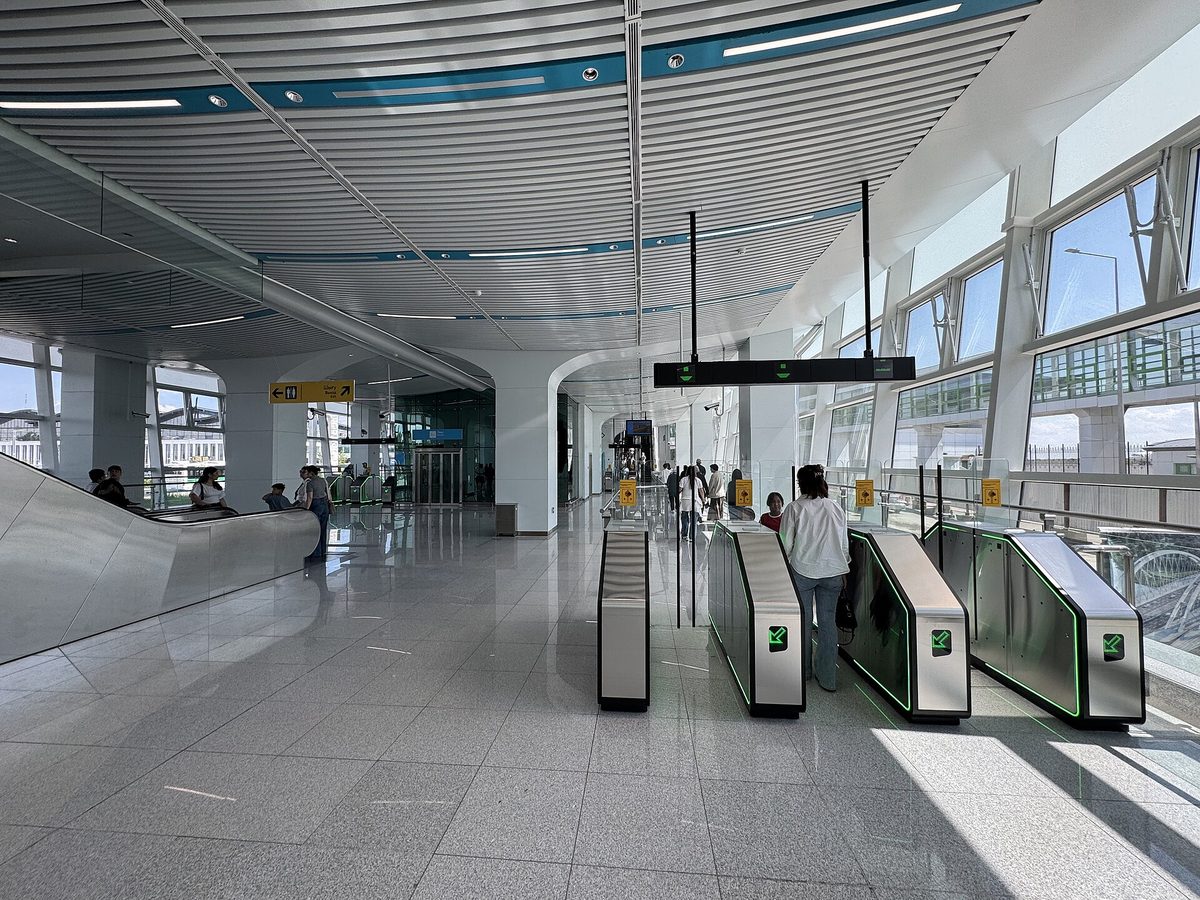
- Airport Station concourse, Nursultan Nazarbayev International Airport — Kristianmusic, CC0, via Wikimedia Commons
- Khorgos border crossing — Purplepumpkins, CC BY-SA 3.0, via Wikimedia Commons
- Russia-Kazakhstan border checkpoint at Olkhovka — Zac allan, CC BY-SA 3.0, via Wikimedia Commons
- Charyn Canyon — Bgag, CC0, via Wikimedia Commons
- Zenkov (Ascension) Cathedral, Almaty — Bgag, CC0, via Wikimedia Commons
- Esil district and Bayterek tower at night, Astana — Matti Blume, CC BY-SA 4.0, via Wikimedia Commons
- Big Almaty Lake — Nessi Gileva, CC0, via Wikimedia Commons


2 comments