Contents
- The Caspian ferry at a glance
- The ports moved. This is the single most important fact
- The timetable myth, and what “no schedule” really means
- Booking online: the correction to the correction
- What it costs
- The waiting, which is the real journey
- The direction problem: can you go Kazakhstan to Azerbaijan?
- Visas, timing and the exit trap
- Life on board
- The ports themselves have improved
- Weather, season and when it all stops
- Which ships, actually
- Should you take it at all?
- What to do when you land
- Frequently asked questions
- Final thoughts
Almost everything written in English about the Baku to Aktau ferry is wrong in at least one important way. The port it leaves from moved. The port it arrives at moved. The famous “every three to five days” is a misunderstanding. And the thing everybody tells you is impossible — booking online — has actually worked since 2016.
There is no ferry from Baku to Aktau. The Caspian crossing runs from Alat, about 70 km south of Baku, to Kuryk, about 90 km south of Aktau, and has done since 2018. These are cargo roll-on roll-off ships that take a handful of foot passengers, they sail when they’re full, there is no passenger timetable, and a foot passage costs roughly US$60–80 including meals and a cabin berth.
I want to be honest about what this article is. It’s a guide to a route where the operators publish almost nothing, where the best intelligence is a forum thread and a ship-tracking website, and where the difference between a good crossing and a nine-day wait is largely luck. What follows is everything I could verify, dated, with the gaps marked as gaps.
The Caspian ferry at a glance
| Actual route | Alat (Ələt), Azerbaijan → Kuryk, Kazakhstan. Not Baku, not Aktau |
| Alat from Baku | About 70 km south (sources give 70–80 km) |
| Kuryk from Aktau | About 90 km, roughly 1 hour 30 |
| Operator | ASCO — Azerbaijan Caspian Shipping Company, state-owned |
| Timetable | None. Officially: “the frequency of flights depends on the accumulation of cargo and weather conditions” |
| Official sailing time | 18 hours in favourable weather. Reported crossings run 16–30 hours |
| Realistic door-to-door | Around 47 hours in one documented case, including waiting, loading and customs |
| Foot passenger fare | US$60 in a six-berth cabin, US$80 in a two-berth, per ASCO’s published tariff. Meals included |
| Bicycle / motorcycle / car | Roughly US$10 / US$110 / US$300, plus port and bridge fees |
| Waiting time at Alat | 12 hours if lucky. Plan for three days. Up to two weeks is possible |
| Direction | Eastbound only, in practice. Azerbaijan’s land and sea borders remain closed to entry |
| Booking | Online reservation exists via ASCO, exchanged for a paper ticket at the port |
The ports moved. This is the single most important fact
Search “Baku to Aktau ferry” and you will find well-written, recently-dated articles that still describe arriving at the port of Aktau. Ignore them.
The Azerbaijani end is Alat (Ələt, sometimes Alyat), where the Baku International Sea Trade Port relocated. It’s about 70 km south of Baku city — one 2026 first-hand account says 80 km, another source 75 km, so call it 70 to 80.
The Kazakh end is Kuryk. Since 2018 the port of Aktau has not been used for the ferry; all sailings arrive at and depart from the newer port of Kuryk. The distance from Aktau is about 90 km, or roughly an hour and a half — and that figure is corroborated officially, since Port Kuryk lists its two pre-port truck parking areas at 89 km and 93 km from Aktau city.
Kuryk got the terminal for a specific reason: it sits in a natural bay with more favourable weather for roll-on roll-off loading. It has also been dredged to seven or eight metres, while Aktau’s average depth has fallen to about 4.5 metres against the 6.5 to 7 metres needed for full operations — a consequence of the Caspian dropping more than two metres between 2006 and 2024. Aktau port now handles grain, oil, containers and feeders, and no passenger service calls there at all.
The one Aktau connection that survives: the ticket office is in Aktau city, at microdistrict 5, building 29, office 1, operated by Ferry Management LLP. Our Aktau city guide explains how the city’s address system works, which you’ll need to find it.
Getting from Baku to Alat
A taxi runs about 40 manat and takes roughly an hour, as of early 2026. By public transport, one February 2026 crossing used bus 125 from Fəvvarə parkı, changed at the Karvansaray shopping centre onto bus 195, got off at Kotal qəsəbəsi 2 and walked about thirty minutes to the port. Older accounts describe variants via Bina Mall or Bibi-Heybat, and one source mentions a free 18:00 shuttle from the old Port of Baku — which I could not confirm for 2026. Assume taxi or the 125/195 combination.
Getting from Kuryk to Aktau
Arrange this before you need it. A traveller landing at 06:00 in February 2026 found the port completely quiet with no taxis waiting, and eventually paid 20,000 tenge for the 90 km to Aktau by asking around. There’s a documented taxi trick worth knowing: drivers offer Kuryk to Aktau, then drop you at Kuryk village 20 km away and hand you to a second driver who wants paying again. Book through the port hotel reception instead.
The timetable myth, and what “no schedule” really means
Port Kuryk’s own website says it plainly: “There is no fixed schedule for ferry transportation on the Kuryk–Alyat route. The frequency of flights depends on the accumulation of cargo and weather conditions.” It also confirms the service operates around the clock, every day.
Now, the widely-repeated line is that the ferry leaves “every three to five days.” That’s wrong, and the mistake is instructive. Port Kuryk states that in one August it received 77 ferries — about two and a half a day. Its published arrivals table for June 2026 lists roughly 21 sailings between the 2nd and the 25th.
So sailings are frequent. What’s scarce is passenger berths on a cargo sailing. These are RoRo and railway ferries carrying trucks and wagons, with a handful of cabins. ASCO’s fleet of 98 vessels includes 15 ferries and 2 RoRos. One traveller crossing in February 2026 was one of only three passengers aboard.
And there’s a grim reason the numbers stay low. The Merkuriy-2, sister ship to the Nakhichevan, sank carrying oil from Aktau to Baku in Force 8 winds and six-metre waves; of 51 people aboard, nine were saved. As one long-standing regional guide puts it, since that accident the shipping company has been reluctant to put too many people on any ferry. That is the actual constraint.
How to find out when a ship is going
The advice everyone gives is “call the port daily.” The advice that actually works in 2026 is track the ships.
- ASCO’s vessel tracker shows ship status in real time. If a ship is at port with an assigned destination, it will normally leave within a few hours. Overlanders describe this as having largely removed the guesswork.
- Port Kuryk publishes a monthly arrivals table with estimated times — the closest thing to a timetable in existence, and remarkably, nobody in the search results uses it. Caveat: when I checked on 29 July 2026, the most recent month posted was June 2026. It runs a month behind.
- MarineTraffic works too. The same February 2026 traveller watched the ferry Azerbaijan approach Alat — and then watched it sit motionless at sea for a day and a half in bad weather.
- Phoning is unreliable. The Alat ticket office number is +994 559 999 124. One 2026 traveller tried two different numbers without success. A well-known overland site describes the phones as “incredibly unreliable and that’s even if they pick up.”
- There is no public WhatsApp or Telegram departure group. I looked. The only contacts published anywhere are individual Aktau fixers’ mobile numbers. Don’t go looking for a group that doesn’t exist — the Caravanistan forum thread is the real live intelligence channel.
Booking online: the correction to the correction
Everybody tells you that you can’t book the Caspian ferry online. That was true a decade ago.
Online tickets have been available since October 2016, and confirmed working as recently as February 2026 — but what you get is a reservation, not a boarding pass. You pay in US dollars through ASCO’s site, then exchange the reservation for a physical ticket at the port. So the practical benefit over simply buying at the office is limited, which is why guides describe it as pointless and then, a few paragraphs later, as much easier. Both are true: it saves you nothing on the day, but it means you’re in the system before you arrive.
One source notes you can also buy online from the Kazakh side. Given how thin the record is here, I’d treat any “book here” link as needing a fresh check before you rely on it.
What it costs
ASCO’s published tariff, as reported in October 2024:
| Alat → Kuryk, six-berth cabin | US$60 per berth |
| Alat → Kuryk, two-berth cabin | US$80 per berth |
| Children under 5 | Free. Ages 6–12 pay 50% |
| Hand luggage | Up to 100 kg included; excess charged as deck cargo |
| Meals | Included in the fare |
| Refunds | Full refund if returned in person before sailing; remote notification allows reschedule or refund within 72 hours of departure |
| Payment | In manat at the Central Bank of Azerbaijan rate on the day of payment |
Traveller-reported fares cluster slightly higher: US$70 as of October 2023, US$70–80 including all meals in February 2026, “around US$80” from another regional source. Take US$60–80 as the range.
Vehicles, and the fees nobody lists together
Vehicle pricing is where sources genuinely conflict. You’ll see flat rates — bicycle US$10, motorcycle US$110, car US$300 — and you’ll see per-metre pricing at US$100 per metre, which for an average car works out closer to US$400. Both figures are in current circulation. Present them as a range and treat the board at the Alat office as the only authority.
Then the extras, which no single source assembles:
- Bridge or ramp fee: US$7 in one account, US$7–12 in another, US$25 for a car and US$20 for a motorbike or bicycle in a third.
- Port fee: US$20–50.
- Compulsory Kazakh vehicle insurance on arrival: 13,000 tenge for 30 days, or 9,250 tenge for the 15-day minimum. One traveller reports about US$10 for the minimum plus US$18 paid into a bank for customs.
- Westbound at Alat: a US$20 customs fee, temporary import permit free, about an hour in total (April 2026). One July 2024 report mentions a US$24 exit fee applied to some people and not others.
- Unaccompanied vehicle shipping, official 2026 figures: port dues around 30,000 tenge and freight of US$360.
On cash: at Alat you can pay in manat or dollars, and there’s a 24-hour ATM dispensing manat, USD and euros. At Kuryk, dollars, roubles, tenge and euros are accepted but Azerbaijani manat is not. Carry cash for the insurance and bridge fees — the ATM may not work and cards may not be accepted. Oddly, the Kuryk port hotel is the reverse: cards only, no cash, at 3,500 tenge per person a night. See Kazakhstan currency and money.
The waiting, which is the real journey
This is what the fare doesn’t tell you.
At Alat, one overlander waited 12 hours and called themselves lucky, noting that people camp out for three to nine days and recommending you simply expect three. Another waited three days, with a friend who waited a week. A well-regarded regional guide says that between Baku and Aktau you can wait up to two weeks if you’re unlucky. The February 2026 traveller met two people already waiting over a day, then boarded at 03:00 that same night.
The rule that matters: once you’re in the port, don’t leave. There’s a documented case of three motorcyclists told the next boat was three days away, who left, came back three days later, and learned the boat had been and gone.
Then there’s the anchorage problem, which gets one clause in most write-ups and deserves more. The ship can arrive at its destination and simply not be allowed to dock — because the port is full or the weather has turned. Waits of hours to days are reported. On the Turkmenbashi run, one traveller waited six days at anchor.
Here’s what door-to-door actually looked like for one documented crossing: turn up at 13:00, wait 12 hours, board, 24 hours at sea, five hours waiting to get off the boat, six hours through Kazakh customs. About 47 hours. Another: three days camping, boarded at 23:00, ship didn’t sail until 06:30 — seven hours of loading — 27 hours at sea, arrived 10:00, vehicles not released until 17:00.
Foot passengers clear far faster than drivers. Cyclists report being out within two hours. Vehicles are the problem: customs at the Kazakh end has a reputation as the worst part of the whole trip, with people stuck a full day, and it apparently works office hours — so foot passengers can walk off in the middle of the night while drivers cannot.
The direction problem: can you go Kazakhstan to Azerbaijan?
This is the most consequential unresolved question on the route, and I’d rather lay out the evidence than give you false confidence.
Azerbaijan’s land borders have been closed to entry since March 2020 and the closure has been repeatedly extended — most recently, per reporting dated 26 June 2026, until 1 October 2026. The ban does not apply to cargo, and foreigners who arrive by air may exit overland. Azerbaijan is described as the only country in the world whose land borders have not reopened since the pandemic.
The practical effect, as every travel source states it: you cannot enter Azerbaijan by land or sea, only by air. You can exit Azerbaijan by land, sea or air. So eastbound works and westbound doesn’t.
Except that Port Kuryk’s own 2026 page opens by telling westbound passengers that they must first apply to the Consulate General of Azerbaijan in Aktau — at microdistrict 15, 30K-1, telephone +7 (7292) 42 23 00. That reads like a case-by-case permission pathway rather than a flat ban.
What people actually do: ship the vehicle west and fly themselves. Two documented cases. In April 2026, a rider paid about US$350 to send a Yamaha Ténéré 700 from Kuryk to Alat with a notarised power of attorney costing around US$65, then flew to Baku; US$20 customs at Alat, temporary import free, the whole process about an hour, bike held 24 hours at no charge. In July 2024, another paid roughly 140,000 tenge on the Aktau side — taxi, fixer, customs, port security, port fees and ticket, plus the attorney — and about US$110 in Baku.
My advice: plan on Baku to Kuryk only. Call the consulate in Aktau if you need a definitive answer. Don’t book flights on the assumption that westbound will work for you as a passenger.
Visas, timing and the exit trap
Kazakhstan is straightforward: 30 days visa-free per entry for citizens of roughly 55 to 60 countries including the US, UK, Canada, Australia and the whole EU, capped at 90 days in any 180-day period. A valid passport is all you need. The exact country count varies by source, so check yours — see Kazakhstan visa requirements, visa-free countries and the 90/180 rule.
The Azerbaijani side contains a trap worth spelling out. You only officially exit Azerbaijan when you board the ship, not when you arrive at the port. If the ferry is delayed, you’re still legally in Azerbaijan. As one overlander put it: turning up at the port the day before your visa expires can land you in a lot of trouble if your boat doesn’t leave for another three days. Build in a week of slack. Separately, staying ten days or more in Azerbaijan requires registration, and failing to do it risks a fine and deportation.
Arrival formalities at Kuryk, from a February 2026 crossing: someone banged on the cabin door at 03:30 shouting “Kazakhstan!”, disembarkation around 06:00, then a border officer escorted the passengers to immigration. Older accounts describe passports being collected on board and returned in the common room, and Kazakh officers boarding with sniffer dogs. See Kazakhstan entry requirements.
Life on board
A cabin berth, linens and three meals a day are included in the fare — confirmed across four independent sources including ASCO’s own tariff. Meals are canteen-style with no choice; one February 2026 crossing recorded lunch as pasta with chicken and dinner as rice with chicken, served at set times with the dining area closing an hour after service.
The dissenting voice is worth quoting, because it’s the most experienced one: people have started reporting better service and even free food included, but this is not a given, every ship is different, and some travellers have seen the food run out, or got nothing at all with no cups or even water available. There is, apparently, always an emergency vodka ration.
So: bring your own water and snacks regardless. There is no shop on the ferry. Also worth packing:
- A sleeping bag or liner — mattresses and pillows are not guaranteed to be clean.
- An extra roll of toilet paper.
- Downloaded entertainment. There is no internet on board, so translation apps won’t work either.
- Cash in small notes.
Cabins are typically four-berth — two bunks — with a sink and lockers, often windowless. Women, and those travelling with them, are frequently given a private en-suite.
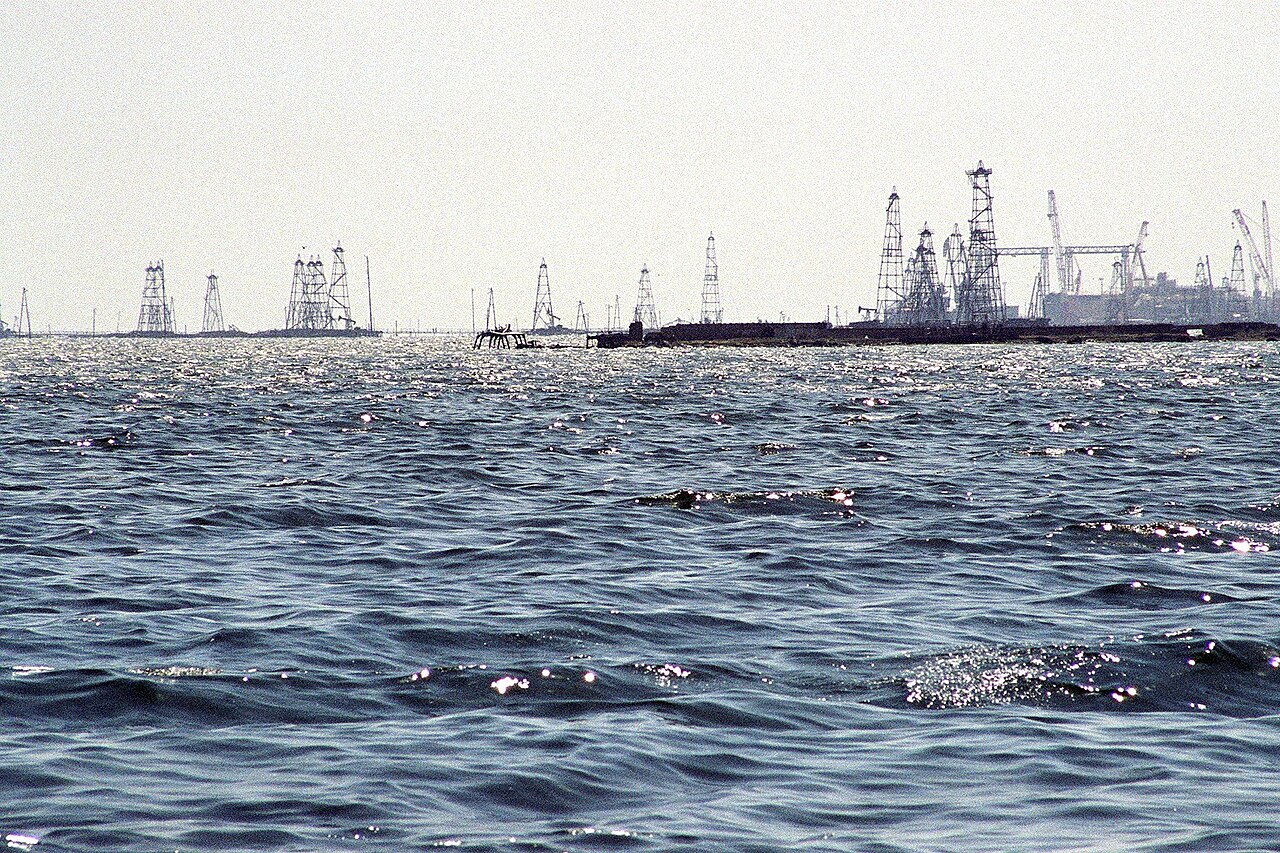
Seasickness is usually less of a problem than people fear, at least in summer: one couple who both suffer badly took no medication and describe the crossing as very smooth. Against that, the older Dagestan-class rail ferries are described as narrow, top-heavy and prone to roll in all but the calmest seas. And you’ll pass Neft Daşları — Oil Rocks — an offshore oil city of around 2,000 people built on the foundations of sunken tankers, with over 300 km of streets on trestles. It is the strangest thing you’ll see all trip.
The ports themselves have improved
This is a genuine update that older guides miss. Alat now has a proper waiting area — as of October 2023 it has cots, bathrooms, power outlets and climate control, confirmed in February 2026 as air-conditioned with plenty of seats, tables and lounge chairs to sleep on, plus a shop, a kebab stall and a bistro. There’s a café, a 24-hour shop, laundry, a diesel-only petrol station, a 24-hour ATM, free showers and wifi. Port Hotel Alat is a fifteen-minute walk, at 50 to 60 manat for a double.
If you read that you should pitch a tent in the Alat car park, that advice is out of date.
Kuryk has wifi, a working hotel at 3,500 tenge per person (card only), a canteen — eat at the Customer Service Centre where the port workers do, rather than the passenger canteen — plus ATMs and exchange. Note for your SIM: Beeline has signal at Kuryk, KCell does not. See getting a Kazakhstan SIM card.
Drivers should know that vehicles at Kuryk must join an electronic queue before the port: register at one of the private pre-port parking areas, receive an assignment when a ferry approaches, and enter the port no later than six hours before arrival. Then radiation control, weighing, inspection, port charges paid at the Kazpost desk in the customs building, customs clearance, and border control an hour before the ferry arrives.
Weather, season and when it all stops
The ferry leaves when it’s full and if weather permits. In February 2026 the Azerbaijan stopped at sea for a day and a half without moving in bad weather. A cyclist’s crossing took three days, the first day and a half spent floating fifty kilometres east of Baku in strong winds. The only wind threshold anyone quotes — over 25 knots closing the narrow exit canal — comes from a blog comment, so treat it as folklore.
Winter is a genuine hole in the record. No operator publishes seasonal reliability data, cancellation rates or any ice or lay-up window. The only hard signals are that Port Kuryk lists “winter anchoring for ships” as a formal service, and that a February 2026 crossing happened without incident. I can’t tell you whether January is worse than June, and neither can anyone else in print.
One seasonal certainty: July and August are the only time the boat sells out, because the Mongol Rally passes through — several hundred teams crossing Eurasia. The surge pricing that used to accompany it seems to have stopped, but the berths still fill.
Which ships, actually
Guides list Professor Gul, Merkuri-1, Barda and Shahdag. Port Kuryk’s own June 2026 arrivals table lists the vessels running Alat–Kuryk as: Nakhchivan, Professor Gul, Merkury 1, Azerbaijan, Agdam, Zarifa Aliyeva and Mingachevir.
Barda and Shahdag don’t appear. Karabakh, which some sources name, appears nowhere and should be dropped. Two first-hand 2026 confirmations: a February crossing on the Azerbaijan, and an April vehicle shipment on the Mercury 1.
The ships are over a quarter of a century old. Six new Kuryk–Alat ferries have been announced by the Mangystau regional administration, with two already in Caspian waters and due to start operating in the first half of 2026 and all six operational by 2028. No source says any of them carry passengers — they’re cargo vessels.
Should you take it at all?
Here’s the uncomfortable part. The most authoritative source on this route actively recommends not taking it: if you have the chance, go overland and avoid the ferry — it’s much more fun and, with a car, much cheaper. Its own minus list reads: potentially expensive with a vehicle, and a lot of frustration and lost time, especially on the Baku–Aktau line.
The alternatives:
- Fly. FlyArystan, Air Astana and Azerbaijan Airlines all connect Baku and Aktau in about two hours. See flights to Kazakhstan.
- Turkmenbashi. The Alat–Turkmenbashi run is more reliable — daily or every other day, about 17 hours, with two purpose-built passenger ferries, the Berkarar and Bagtiyar. The obstacle is Turkmenistan itself: tourists effectively need a guided tour, transit visas run five days within a three-month window, and arriving without a valid visa means deportation back to Azerbaijan, which may not let you in either. Fares conflict badly between sources.
- The Baku–Tbilisi train resumed on 26 May 2026 after six years, at an advertised minimum of 81 manat — though reporting suggests tickets have been hard to buy at that price and the return direction has effectively stopped selling. Useful westbound out of Baku only.
- Overland via Russia or Iran, which is a different set of considerations entirely.
So why take the ferry? Because it’s the only sea route between the Caucasus and Central Asia, because you’ll pass an oil city built on sunken ships, and because arriving in Kazakhstan by sea at dawn is a genuinely singular experience. If your trip has slack in it, it’s worth the gamble. If you have a flight to catch on the far side, don’t.

What to do when you land
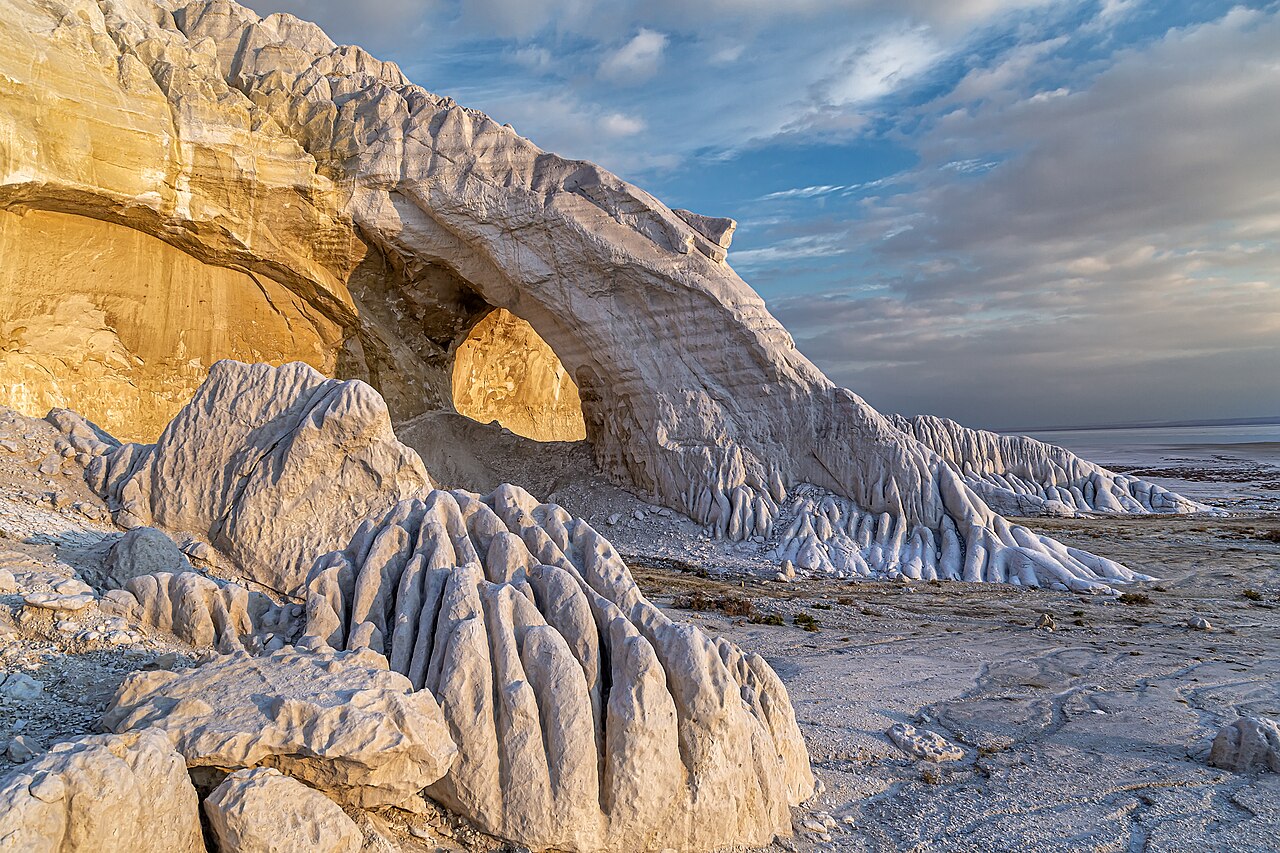
Kuryk is 90 km from Aktau and there is nothing at Kuryk. Head into the city, sleep, and then use it as the base it is — the chalk canyons of Bozzhyra, the stone spheres at Torysh, the underground mosques that UNESCO inscribed in July 2026, and the Tuzbair salt flat. Our guide to Mangystau jeep tours covers how to arrange it and what it costs, and the Mangystau and the west pillar sets out the whole region.
If the ferry is one leg of something larger, see our Central Asia itinerary and travelling from Kazakhstan to Uzbekistan. Onward transport from Aktau — including the 48-hour train to Astana — is covered in getting around Kazakhstan and Kazakhstan train travel.
Frequently asked questions
Is there still a ferry from Baku to Aktau?
Not literally. The crossing runs from Alat, about 70 km south of Baku, to Kuryk, about 90 km south of Aktau, and has since 2018. No passenger ferry calls at Aktau port itself. The route and the operator are the same; only the terminals changed.
How much does the Caspian Sea ferry cost?
ASCO’s published tariff is US$60 per berth in a six-person cabin and US$80 in a two-person cabin, meals included. Travellers commonly report US$70–80. Vehicles add roughly US$10 for a bicycle, US$110 for a motorcycle and US$300 for a car, plus bridge and port fees and compulsory Kazakh insurance on arrival.
Is there a Caspian Sea ferry timetable?
No. Port Kuryk states officially that frequency depends on cargo accumulation and weather. Sailings themselves are frequent — one August saw 77 arrivals at Kuryk — but passenger berths on those cargo ships are limited. Track ASCO’s vessel page or MarineTraffic rather than looking for a schedule.
How long does the Caspian ferry crossing take?
The official sailing time is 18 hours in favourable weather. Reported crossings range from 16 to 30 hours. Door to door, including waiting, loading and customs, one documented trip took about 47 hours.
How long will I wait at the port?
Anywhere from 12 hours to nine days at Alat, with three days a sensible planning assumption and two weeks possible in bad luck. Once you’re inside the port, don’t leave — travellers who did have missed the boat.
Can you book the Caspian Sea ferry online?
Yes, and this is the myth worth correcting. Online booking through ASCO has existed since October 2016 and was confirmed working in February 2026. But it’s a reservation, not a ticket — you still exchange it for paper at the port.
Can you take the ferry from Kazakhstan to Azerbaijan?
Assume not. Azerbaijan’s land and sea borders remain closed to entry, with the closure extended to at least 1 October 2026; you can leave overland but not arrive. Port Kuryk does direct westbound passengers to apply to the Azerbaijani Consulate General in Aktau first, so it may be possible case by case. In practice, overlanders ship the vehicle west and fly themselves.
Is food included on the Caspian ferry?
Three meals a day, a cabin berth and linens are included in the fare, confirmed by ASCO’s own tariff and several first-hand accounts. But every ship differs and there are reports of food running out or not appearing at all. There’s no shop on board — bring water and snacks regardless.
Can you take a car, motorbike or bicycle?
Yes — these are vehicle ferries first and foremost. Bicycles are cheap at around US$10; motorcycles about US$110; cars roughly US$300 flat, or US$100 per metre depending on which tariff applies. Drivers face a slower process at both ends and must join an electronic queue before Kuryk port.
Will I get seasick?
Probably not in summer — one couple who both suffer badly crossed in June without medication and found it very smooth. The older rail ferries are top-heavy and roll in rough seas, and weather can leave a ship sitting at anchor for a day or more.
Do I need a visa for Kazakhstan to take the ferry?
Most Western nationals get 30 days visa-free on arrival with just a passport, capped at 90 days per 180. The bigger risk is the Azerbaijani side: you only officially exit Azerbaijan when you board, so a delayed ferry can push you past your visa expiry while you’re still legally in the country.
Is there internet on board?
No. Download maps, entertainment and any translation you’ll need before boarding. Both ports have wifi; the ship does not.
Final thoughts
The Caspian ferry is not a transport option. It’s an expedition with a fare, and the honest way to approach it is to budget a week for something that takes 18 hours at sea.
If you do it, do it in the right order: track the ships rather than phoning, get to Alat and stay there, carry cash and water, keep a week of visa slack, and arrange your Kuryk-to-Aktau ride before you’re standing at an empty port at six in the morning. Expect the food, the cabin and the waiting room to be better than the internet told you, and the customs queue to be worse.
And when you walk off at dawn into a landscape of bare limestone with the Caspian behind you, you’ll have arrived in Kazakhstan the way traders did for a thousand years — slowly, by water, and entirely at the weather’s convenience.
Photo credits
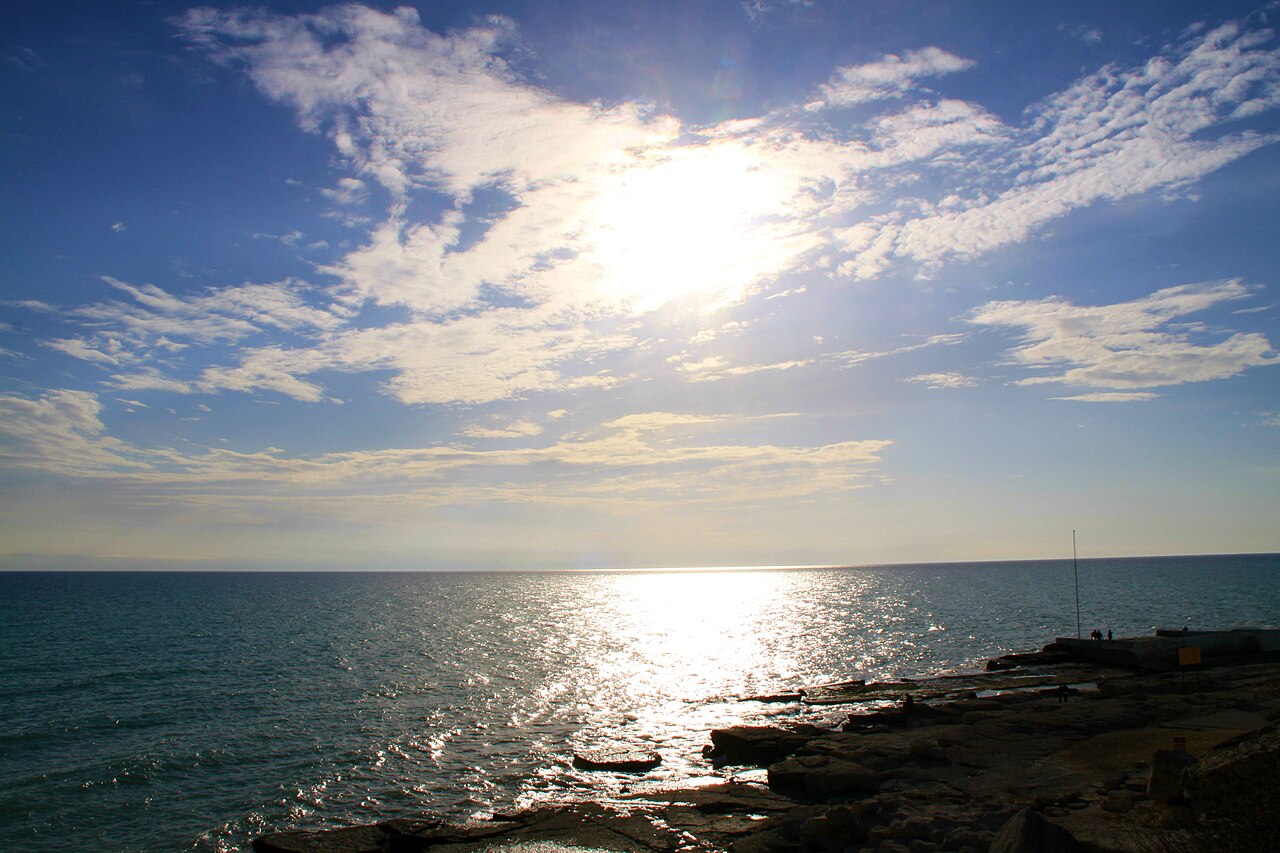
The oil derricks of Neft Daşları off the Azerbaijani coast — Photo: Bruno Girin / CC BY-SA 2.0 via Wikimedia Commons. Afternoon light on the Caspian shoreline at Aktau — Photo: Rassim / CC BY-SA 4.0 via Wikimedia Commons. Passenger train crossing the Kazakh steppe — Photo: Kabelleger / David Gubler (bahnbilder.ch) / CC BY-SA 3.0 via Wikimedia Commons.