Contents
- Kazakhstan train routes at a glance
- Why take the train in Kazakhstan?
- The operator: KTZ
- Types of train
- Train classes explained
- Lower or upper berth — which to book
- The main routes
- The platzkart experience
- What to bring
- Is train travel in Kazakhstan safe?
- Booking your ticket, in brief
- Talgo or a regular train — which should you book?
- Stations: watch which one you need
- Train, bus or plane?
- When to travel and how far ahead to book
- Frequently asked questions
- Final thoughts
There’s a moment, somewhere in the small hours on an overnight train across the steppe, when you realise this is the trip. The provodnitsa has brought the tea, someone three bunks down is sharing dried fish and stories, and the horizon outside is nothing but grass and sky. Kazakhstan makes sense from a train window in a way it never quite does from a plane.
Kazakhstan train travel is run by the national railway KTZ, and it’s one of the best ways to cross this vast country. You’ll choose between modern, fast Talgo trains and slower Soviet-style sleepers, and between classes from the open-plan platzkart carriage up to private two-berth compartments. The flagship Almaty–Astana route takes around 13–19 hours depending on the train, with fares from roughly US$15 to US$35.
This guide covers the trains, the classes, the routes and the culture of riding the rails here. Fares are converted at about 470 tenge to US$1 and should be treated as “from around” figures — check live prices when you book. (Buying tickets online has its own quirks, which we cover in a dedicated companion guide.)

Kazakhstan train routes at a glance
Here are the routes most travellers actually ride, with rough durations and fares. Talgo services are faster and have no open platzkart class; regular trains are slower, cheaper and more sociable.
| Route | Fastest train | Duration | Platzkart | Kupe |
|---|---|---|---|---|
| Almaty ↔ Astana | Talgo (overnight) | ~13.5–19h | ~US$23–25 | ~US$34–36 |
| Almaty ↔ Shymkent | Talgo | ~11–12h | ~US$14–18 | ~US$25–30 |
| Almaty ↔ Turkestan | Regular / Talgo | ~15–18h | ~US$14 | ~US$19 |
| Almaty ↔ Semey | Talgo | ~22h | ~US$18 | ~US$29 |
| Almaty ↔ Aktau | Regular | ~2.5 days | ~US$35 | ~US$60–80 |
| Almaty ↔ Tashkent (Uzbekistan) | Talgo | ~15–16h | — | ~US$40+ |
Why take the train in Kazakhstan?
Three reasons. First, scale: Kazakhstan is the ninth-largest country on Earth, and the train lets you feel those distances instead of skipping over them. Second, value: an overnight train is often cheaper than a flight and doubles as a night’s accommodation, which is a real saving on a longer trip. Third — and this is the one that surprises people — the experience. The sleeper-train culture here is warm, social and utterly unlike a Western train; it’s travel as an event, not just transit. Flying is faster, and our flights guide covers when it makes sense, but for at least one leg of your trip, take the train.
The operator: KTZ
Kazakhstan’s railways are run by KTZ — Kazakhstan Temir Zholy (Qazaqstan Temir Joly), the state railway, with passenger services under its “Passenger Transportation” arm. The network is enormous — around 16,000 kilometres of track and hundreds of stations — and it reaches almost everywhere you’d want to go, from the mountains of the southeast to the Caspian in the far west. It’s a near-monopoly, so there’s one system to learn, and once you understand the train types and classes, the whole country opens up.
Types of train
The first choice is what kind of train you’re on, because it changes the speed, the comfort and even the class names.
Talgo and Tulpar-Talgo (modern and fast)
These are the sleek, air-conditioned trains built in Astana under licence from Spain’s Talgo. They’re faster and far more comfortable than the old rolling stock, engineered to run from −50°C winters to +45°C summers, and they’re the ones to look for on the busy routes. Crucially, Talgo trains have no platzkart: your options are Tourist class (a four-berth compartment), Business class (two berths) and the top Grand/Luxe class (two berths with a private shower and WC).
Regular long-distance trains (“skory”)
These are the classic Soviet-style sleepers — slower, older, cheaper and, for many travellers, more atmospheric. This is where you’ll find the full range of traditional classes, including the famous open-plan platzkart. If you want the quintessential Central Asian train experience, ride one of these at least once.
Regional elektrichka
Slow local commuter trains serving short hops around the cities. They’re cheap but rarely useful for tourists covering long distances — you’ll almost always want a long-distance train instead.

Train classes explained
This is the part that confuses newcomers, so here’s the plain-English version for a regular (non-Talgo) train, cheapest to priciest.
Platzkart (3rd class)
An open-plan carriage of 54 bunks arranged in bays — four berths in each bay plus two more along the corridor wall, no doors, no compartments. It’s the cheapest sleeper and the most social: you’ll share tea, food and conversation with whoever’s around you. It sounds daunting and turns out to be the friendliest way to travel, and it’s what most budget travellers (and plenty of locals) choose.
Kupe (2nd class)
A lockable four-berth compartment — two lower and two upper bunks, a little table, a door you can close. More privacy and security than platzkart, for a moderate step up in price. A good middle option, especially if you value a door.
Lyux / SV (1st class)
A two-berth compartment — the most private and most expensive on a regular train. Worth it if you’re travelling as a couple and want space, overkill for most solo budget travellers.
Obshy (seated)
Seats only, no berth. Fine for short daytime hops, miserable for an overnighter — avoid it for the long routes.
Lower or upper berth — which to book
A small decision that matters more than you’d think. Lower berths double as the daytime seating for the whole bay, so during the day you’ll share your bed with your bunkmates sitting on it — sociable, but less private. Upper berths are your own perch all day, reachable by a small ladder, and give you somewhere to retreat. Frequent riders are split: lower for easy access and legroom, upper for privacy. One tip worth knowing — berth numbers follow the old Soviet convention where odd numbers are lower bunks and even numbers are upper.
The main routes
A closer look at the journeys most travellers take.
Almaty to Astana
The flagship route, linking the two big cities across roughly 1,300 kilometres of steppe. The fastest option is an overnight Talgo at around 13.5 hours; a daytime Talgo takes a bit longer, and the older regular trains 17–19 hours. It’s the perfect overnight run: board in the evening, sleep across the steppe, wake up in the capital. Pair it with our guides to things to do in Astana at the far end.
Almaty to Shymkent and Turkestan
Head southwest for the Silk Road. Talgo trains reach Shymkent in about 11–12 hours, and Turkestan — home of the magnificent Yasawi mausoleum — is an overnight ride away. This is one of the most rewarding rail journeys in the country for history lovers; see our Silk Road Kazakhstan guide.
The long hauls: Semey and Aktau
For the adventurous, the long routes are the real romance of Kazakh rail. Almaty to Semey in the northeast, along the historic TurkSib line, is about 22 hours. And the epic Almaty to Aktau on the Caspian — gateway to Mangystau — is a two-and-a-half-day crossing of the entire country, one of the great steppe train journeys anywhere.
International trains
There’s a comfortable Talgo service from Almaty to Tashkent in Uzbekistan (around 15–16 hours), a lovely way to continue a Central Asia trip. Note that some cross-border services have been disrupted in recent years, and trains to China can only be arranged through a travel agency rather than the normal booking channels — so check current status before you plan around them.

The platzkart experience
Here’s what a night in platzkart actually looks like, because it’s the thing people remember most. Each carriage has a provodnitsa (or provodnik) — the conductor who runs the wagon, checks your ticket, hands out bedding and keeps order. At the end of the carriage sits the samovar, a boiler of free hot water that is the heart of train life: it’s for tea, instant noodles, coffee and the endless cups that fuel a long journey. Bedding — a mattress roll, sheets and a pillow — is provided and included in your fare.
People come prepared to eat and share: bread, sausage, boiled eggs, tomatoes, dried fish, sweets and quite possibly a bottle of something to pass around. Accept what’s offered and offer what you have; it’s how friendships form at 70 km/h. There’s usually a restaurant or buffet car too, though as of recently the platform vendors who once boarded to sell food no longer do, so bring your own supplies for the long hauls and top up at the longer station stops.
A typical night settles into a rhythm. In the evening the provodnitsa hands out bedding and everyone makes up their bunks; there’s a flurry of tea-making and snacking; conversations start and, as often as not, someone produces a chessboard or a phone full of photos. By late evening the carriage dims and quietens to the rock of the rails and the occasional station stop. You wake to grey steppe light, the samovar already busy, and a shared breakfast of whatever’s left. It is, genuinely, one of travel’s great simple pleasures.
One practical quirk: on the regular trains the toilets are locked for about 15 minutes before and after each station stop (they empty straight onto the track), so time your visits — the modern Talgo trains don’t have this restriction. And everything runs on Astana time, the capital’s time zone, regardless of where you are in the country, which matters in the western regions where local time differs.
What to bring
- Your own mug, tea and instant food — the samovar does the rest.
- Snacks and water for the long stretches between stations.
- A power bank — sockets exist but are shared and not always near your berth.
- Flip-flops or slip-on shoes for padding to the toilet and samovar.
- Toilet paper, wet wipes and hand sanitiser — the onboard supply is unreliable.
- An eye mask and earplugs for platzkart, which is never fully dark or fully quiet.
- A little cash for the buffet car and station-platform snacks.
Is train travel in Kazakhstan safe?
Broadly, yes — Kazakh trains are safe, and solo travellers of all kinds ride them routinely. Keep your valuables close (a small bag with your passport, phone and money should stay with you, ideally tucked into your bunk while you sleep), and use the luggage space under the lower berths for the rest. For solo female travellers there’s a counterintuitive tip worth knowing: a kupe compartment can end up locking you in with three male strangers, since bookings aren’t split by gender, so many solo women actually prefer the busy, open, well-populated platzkart where there are always people around. Trust your judgement, and don’t over-worry — the overwhelming experience is of curious, kind and hospitable fellow passengers.
Booking your ticket, in brief
Tickets are sold through KTZ’s official site and app and through third-party resellers, and they go on sale weeks ahead — book early for summer and holiday travel, when the popular trains sell out. Foreign bank cards can be hit or miss on the official site, so there are workarounds worth knowing. We’ve put the whole step-by-step process, including the foreign-card issue and how far ahead tickets are released, in a dedicated companion guide to buying Kazakhstan train tickets online. For the bigger picture of moving around the country, see getting around Kazakhstan, and for how rail fares fit your overall spending, our Kazakhstan trip cost guide.
Talgo or a regular train — which should you book?
On the busy routes you’ll often have a choice between a fast Talgo and a slower regular train, and it comes down to what you want from the journey. Choose the Talgo if you value speed, air-conditioning and a modern, predictable ride — it’s the better pick in the heat of summer and for anyone who’d rather arrive sooner. Choose a regular train if you want the cheapest fare, the full platzkart experience, or simply the slower, more atmospheric version of Kazakh rail travel. My own rule: take the Talgo when I need to be somewhere on time, and a regular sleeper when the journey itself is the point.
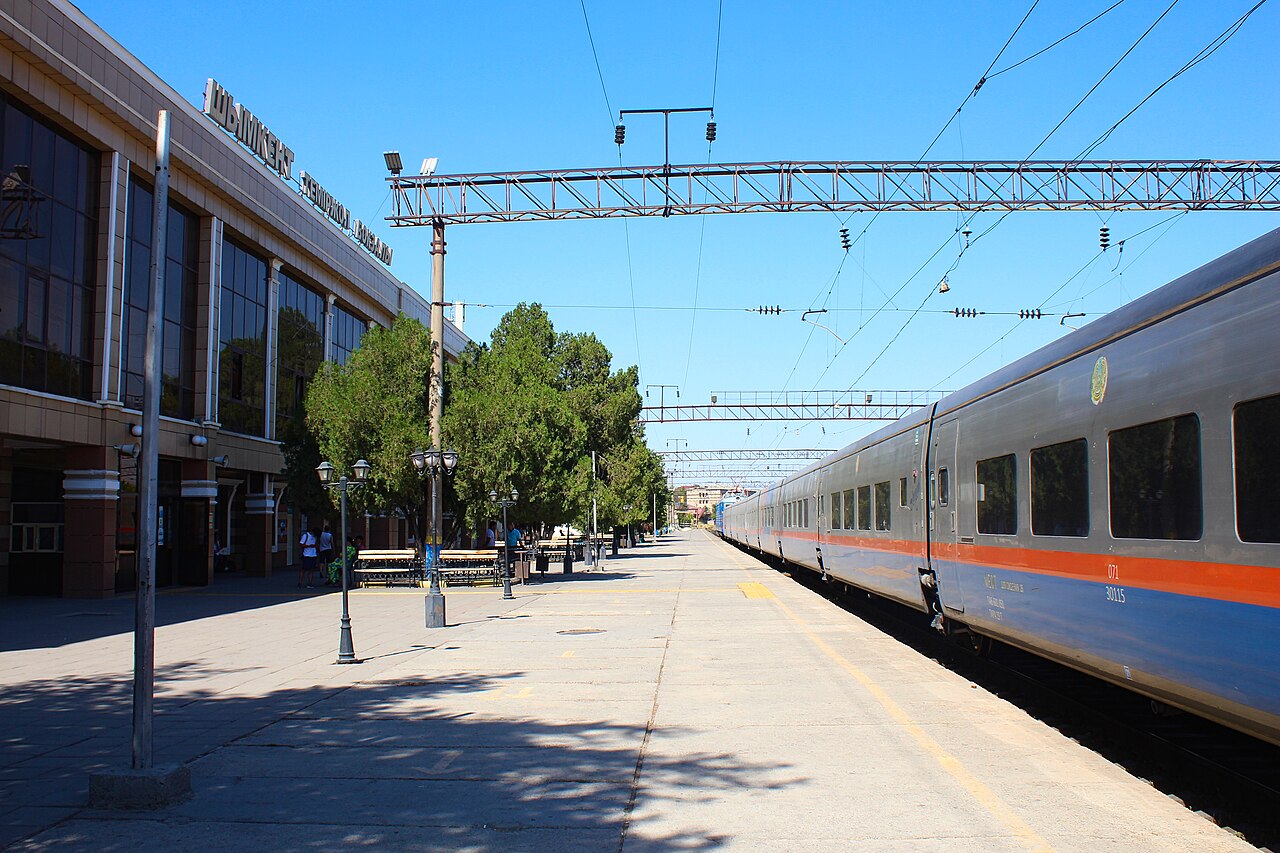
Stations: watch which one you need
A trap that catches first-timers: the big cities have two stations. In Almaty, most long-distance trains use the central Almaty-2, while Almaty-1 sits well out of the centre — turning up at the wrong one is a genuine risk, so check your ticket carefully. Astana likewise has more than one station. A second quirk lives in the booking systems, which sometimes list cities under their old Soviet names: Almaty can appear as “Alma-Ata,” Aktau as “Mangyshlak” and Shymkent as “Chimkent,” so don’t panic if the modern name doesn’t come up.
Arrive at the station with time to spare — you’ll want to find the right platform and carriage number, and the provodnitsa checks tickets and passports at the door. Most stations have left-luggage facilities if you’re killing time before an evening departure, and getting to the station is easy by metro or a cheap Yandex ride; see getting around Almaty for the city side of things.
Train, bus or plane?
How should you cross Kazakhstan? It depends on the distance and your priorities. Trains win for overnight journeys of medium length — comfortable, scenic, and they save a hotel night. Flights win for the longest distances or when time is tight: Almaty to Astana is under two hours in the air versus 13-plus by rail, as our flights guide explains. Buses and marshrutkas win on the shortest hops and to places the railway doesn’t reach. For a first trip, a good formula is trains for the classic overnight routes, a flight for the one really long leg, and buses to fill the gaps. The full comparison lives in our getting around Kazakhstan overview.
When to travel and how far ahead to book
Rail demand peaks in summer (June–August) and around the New Year holiday, when popular trains — especially the Almaty–Astana overnighters and anything heading to the lakes region — sell out days in advance. In those periods, book as soon as tickets are released. In the shoulder seasons of spring and autumn you’ll usually find berths closer to departure, and the steppe is arguably at its most beautiful. The network keeps improving, too: KTZ has been rolling out new Talgo services, including a recent Almaty–Kostanai route that slashed the old journey time. If you’re timing a rail trip, our best time to visit Kazakhstan guide helps you pick the season.
Frequently asked questions
How long is the train from Almaty to Astana?
Between about 13.5 and 19 hours depending on the train. The fastest is an overnight Talgo at roughly 13.5 hours; a daytime Talgo is a little longer, and the older regular trains take 17–19 hours. Most travellers take the overnight service and sleep through the journey.
What is the difference between platzkart and kupe?
Platzkart is an open-plan carriage of 54 bunks with no compartments — the cheapest and most social class. Kupe is a lockable four-berth compartment with a door, offering more privacy and security for a higher fare. Platzkart is great for meeting people; kupe is better if you want to shut the door.
Are Kazakhstan trains comfortable?
The modern Talgo trains are genuinely comfortable — air-conditioned, clean and reasonably fast. The older regular trains are basic but perfectly fine, with provided bedding and free hot water from the samovar. Comfort depends more on the class you book than anything: a kupe or Talgo compartment is a pleasant way to travel.
Is there food and hot water on the train?
Yes. Every carriage has a samovar providing free hot water for tea and instant meals, and most long-distance trains have a restaurant or buffet car. Bring your own snacks for the long stretches, as platform vendors no longer board the trains, and top up at longer station stops.
Do I need to book Kazakhstan train tickets in advance?
For popular routes in summer and around holidays, yes — trains sell out days ahead, so book as early as you can. Outside peak times you can often buy closer to departure. Tickets are released several weeks before travel; the details are in our companion guide to buying tickets online.
Can foreigners buy and ride Kazakhstan trains?
Absolutely. Foreigners ride KTZ trains all the time, buying tickets online or at station ticket offices with a passport. You board by showing the passport you booked with, and the e-ticket on your phone is accepted on most modern services. The main hiccup is that some foreign bank cards struggle on the official booking site, which our companion ticket-buying guide addresses.
Is there Wi-Fi and power on Kazakhstan trains?
Don’t count on Wi-Fi — coverage across the empty steppe is patchy at best, so download maps, books and entertainment before you board. Power sockets do exist but are shared and often not right beside your berth, so a power bank is close to essential for a long overnight journey.
Final thoughts
If you do just one long-distance journey in Kazakhstan, make it an overnight train. Book a platzkart or kupe berth, pack a mug and some snacks, and let the steppe unspool past the window while the samovar bubbles and your bunkmates share their dinner. It’s cheaper than flying, it saves you a hotel night, and it’s the single most memorable way to understand just how vast and quietly beautiful this country is. The plane gets you there; the train shows you the way. Book a berth for the classic Almaty–Astana overnighter, learn the word for tea, and give yourself over to the slow magic of crossing the steppe by rail — it will end up being the part of the trip you talk about for years.
Photo credits
Images via Wikimedia Commons: Tulpar-Talgo train — Matti Blume (CC BY-SA 4.0); platzkart carriage — Kalegin Michail (CC0); Almaty-2 railway station — Nikolai Bulykin (CC BY-SA 4.0).


1 comment