Contents
- Kazakhstan in spring at a glance
- Why spring is the sleeper season
- Spring month by month
- Wild tulips: Kazakhstan is the birthplace of the tulip
- Poppies and the late-spring steppe bloom
- Nauryz: the Kazakh new year on the equinox
- Spring in Almaty and the cities
- Spring wildlife and the returning birds
- What’s open and what’s not
- What to pack for a spring trip
- Sample spring trips
- Frequently asked questions
- Final thoughts
Ask most people when to visit Kazakhstan and they will say summer for the lakes or winter for the skiing. Spring gets overlooked, and I think that is a mistake. For a few weeks each year the brown steppe turns an electric green, the ancestors of every garden tulip on earth bloom on the hillsides, and the whole country throws its biggest party on the spring equinox. If you can time it, this is the season that surprises people the most.
Kazakhstan in spring (roughly April to May) is a green, uncrowded, and colourful time to visit, with mild days, blooming wild tulips, and the Nauryz new-year festival on 21–23 March. The south greens first while the northern steppe and capital Astana stay cold into April. It is a shoulder season, so prices are lower and crowds thinner — but high mountain lakes stay snowbound until late May.
Kazakhstan in spring at a glance
| Month | What it’s like | Almaty temps (approx.) |
|---|---|---|
| March | Late winter in the north, first thaw in the south; Nauryz on the 21st–23rd | 0–10°C |
| April | Green steppe, first tulips, the shoulder-season sweet spot | 7–18°C |
| May | Peak wildflowers, warm and pleasant; mountains still snow-capped | 12–23°C |
Why spring is the sleeper season
Spring works for a few reasons that rarely line up together. The landscape is at its greenest and most alive after the snowmelt. Two genuinely special draws — the wild tulips and Nauryz — happen only now. Because it is a shoulder season, airfares and hotel rates are lower than in summer and you share the sights with far fewer people. And the temperatures in April and May are simply comfortable for city-hopping and lower-elevation walking, without the fierce summer heat that bakes the southern steppe.
The trade-off is honesty about the mountains. The high country — the alpine lakes, the passes above 3,000 metres — is still locked in snow well into late spring, so spring is not the season for high-altitude trekking. Think of it as the season of the steppe, the foothills, the flowers, and the culture rather than the high peaks. Come with that expectation and spring rarely disappoints; come expecting to hike to an alpine lake in April and you will be turned back by snow.
Spring month by month
Kazakhstan is enormous, and spring arrives on a schedule that sweeps from south to north over about six weeks. Where you go matters as much as when.
March: winter’s tail and the year’s biggest party
March is a split screen. In the south around Shymkent and Turkestan the lowlands are already greening and mild, with daytime highs in the low teens. Up north, Astana is still firmly winter — average highs hover around freezing and it can snow. What unites the country in March is Nauryz, the spring-equinox new year, celebrated everywhere from the 21st. If you come in March, come for the culture and the south, not the mountains.
April: the green steppe and the first tulips
April is, for my money, the finest all-round spring month. The steppe turns green, the first wild tulips appear at lower elevations, and Almaty warms into the high teens by day. It is the shoulder-season sweet spot: comfortable weather, low crowds, and reasonable prices. Charyn Canyon is very doable, the lower foothills are walkable, and the cities are at their freshest. Do pack for changeable weather — April is also Almaty’s wettest time.
May: peak wildflowers and warmth
By May the whole country has turned. Wild tulips and red poppies carpet the grasslands, the days are warm and long, and even Astana has shaken off winter. The high mountains are still snow-capped and their lakes largely inaccessible, but everything below the snow line is glorious. May is the last and warmest of the spring months, and it flows straight into the summer season.
Almaty versus Astana: two different springs
It is worth stressing how differently spring plays out across the country. In March, you could be walking in shirtsleeves through a greening park in Shymkent while, 1,000 kilometres north, Astana is under snow with sub-zero nights. Even in April the capital only creeps above freezing. If your heart is set on spring warmth, weight your trip toward Almaty and the south; if you are heading to Astana, expect it to feel a season behind.
Wild tulips: Kazakhstan is the birthplace of the tulip
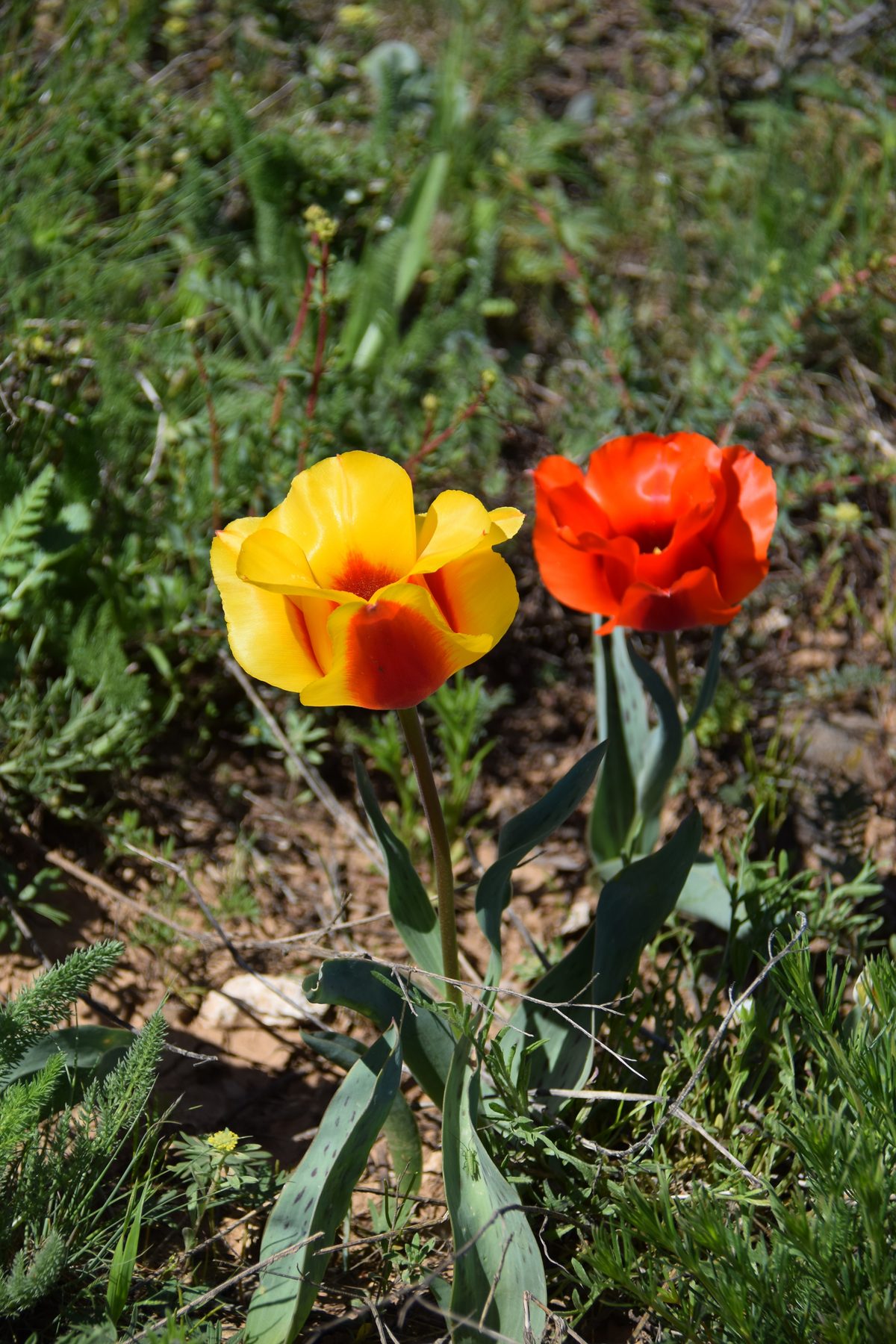
This is the fact that reframes a spring trip: the tulip is not originally Dutch or Turkish. Its wild ancestors evolved in the mountains of Central Asia, Kazakhstan very much included, millions of years ago, and only reached Europe in the sixteenth century by way of the Ottomans. When you stand on a Kazakh hillside among wild tulips, you are looking at the source of a flower the world later fell in love with.

The species to look for
Kazakhstan is home to something like 35 to 40 wild tulip species, many of them rare — over a dozen are on the national Red Book of protected species, and several are found nowhere else on earth. Three in particular did the heavy lifting for the world’s gardens: Greig’s tulip (Tulipa greigii), the kaufmann or “waterlily” tulip (Tulipa kaufmanniana), and Schrenk’s tulip (Tulipa schrenkii), which between them are the ancestors of the great majority of cultivated varieties. Greig’s tulip is the showstopper — the “king of tulips,” with large red-and-orange blooms marked by a black basal blotch, first described from Kazakhstan in 1868. Rarer still is Regel’s tulip (Tulipa regelii), endemic to the Chu-Ili mountains and one of the most ancient tulips of all.
Where and when to see them
The wild-tulip season runs from late March into June, climbing the elevations as it warms. The single best place is the Aksu-Zhabagly Nature Reserve, Kazakhstan’s oldest protected area, established in 1926, in the far south near Shymkent. Greig’s tulips bloom on its hillsides from late April into early May, and the reserve runs tulip-season tours and a festival; a local guide is mandatory, which is no hardship because they know exactly which slopes are flowering. It is roughly 100 kilometres from Shymkent and a long way — around 600 kilometres — from Almaty, so a tulip trip usually means basing yourself in the south. You can also find wild tulips closer to Almaty in the foothills, and across the Karatau range. For the wider protected-areas picture, see our guide to Kazakhstan’s national parks.
Please don’t pick them
One heartfelt request that doubles as genuinely interesting: never pick a wild tulip. A wild tulip seedling can take ten to seventeen years to flower for the first time, and many species are already threatened. Picking one bloom can set back that patch of hillside for a decade. Photograph them, stand among them, and leave them for the next person and the next spring.
Poppies and the late-spring steppe bloom

Tulips get the headlines, but they are only the opening act. As spring peaks in May, the grasslands around Almaty and across the southern steppe turn scarlet with wild poppies, punctuated by irises, alliums, and a dozen other wildflowers most travellers cannot name and will never forget. On a clear May day the foothills can look like someone spilled paint across them. You do not need a reserve or a permit for this — a drive out of Almaty into the hills at the right moment is enough, and locals treat a weekend among the poppies as one of the small joys of the year. It is fleeting, though: the bloom lasts a couple of weeks and browns off as the summer heat arrives, so if the flowers are your reason to come, aim for late April through May and stay flexible on exact dates. A few days either side can be the difference between a green hillside and a scarlet one.
Nauryz: the Kazakh new year on the equinox
If your trip can straddle late March, Nauryz is worth planning around. It is the spring-equinox new year celebrated across Central Asia for millennia, and in Kazakhstan it is the biggest holiday of the year.

When is Nauryz in 2027?
Nauryz is tied to the spring equinox, and Kazakhstan observes it as a public holiday over 21–23 March. In 2027 the 21st falls on a Sunday, so expect the holiday period to stretch across the surrounding days. It is recognised internationally too — UNESCO inscribed Nauryz (Nowruz) on its list of Intangible Cultural Heritage, and the UN marks 21 March as the International Day of Nowruz. One practical warning: domestic travel spikes around Nauryz, so book accommodation four to six weeks ahead if your trip overlaps.
What happens
Nauryz is a festival of renewal. Households clean their homes, settle debts, and make peace with neighbours; cities erect yurts in their main squares; and people turn out in traditional dress for music, dancing, and steppe games such as kokpar (a rugged horseback contest) and kyz kuu (a chase on horseback between a man and a woman). The signature dish is nauryz kozhe, a hearty soup made from seven ingredients that symbolise seven virtues, served alongside beshbarmak and piles of fried baursak dough. The best places to experience it are Almaty and Astana, where the celebrations are largest, though regional towns and ethno-villages offer a more intimate version.
Spring in Almaty and the cities
You do not have to leave the city to feel spring in Kazakhstan. Almaty, whose name means something close to “father of apples,” is a genuinely green city, and in April and May its tree-lined streets and parks come alive with apple and apricot blossom, lilac, and fresh leaf. The pavement cafés fill, the Green Bazaar overflows with the first produce and mountains of dried fruit and nuts, and the snow-capped Tian Shan rising directly behind the greening city is one of the great urban backdrops anywhere. It is a lovely time to simply wander, sit outside, and watch a mountain city shake off winter.
Astana tells a different story. The capital’s spring is short and comes late — March is still winter and April only tentatively warmer — so if you are visiting the north early in the season, plan around indoor attractions and dress warmly, then let the city’s wide plazas and futuristic architecture do the work. By May, though, even Astana is pleasant, and the nearby Korgalzhyn wetlands are alive with returning birds. Pairing a warm-south flower trip with a cooler northern city break is very doable with a short internal flight, and it shows you two Kazakhstans in one visit.
Spring wildlife and the returning birds
Spring is a wildlife season as much as a floral one. Out on the central steppe, the Tengiz-Korgalzhyn wetlands — a UNESCO World Heritage site a couple of hours from Astana — host the most northerly flamingos on the planet, which arrive from late March and are joined by huge numbers of migrating waterbirds, with the birding peaking in May and June. Also in May, the critically endangered saiga antelope, that oddly snouted survivor of the Ice Age, migrates across the steppe; Kazakhstan holds the overwhelming majority of the world’s saiga. Down south, Aksu-Zhabagly shelters everything from marmots and argali to the vanishingly rare snow leopard. Our guide to northern and eastern Kazakhstan covers the steppe-and-wetland side of the country.
What’s open and what’s not
Spring rewards realistic planning. Charyn Canyon is accessible and lovely, with April temperatures in the comfortable low-to-high teens, and it makes an excellent day trip from Almaty. The southern reserves are in their prime for flowers. But the high mountains keep their own calendar: roads to places like Big Almaty Lake typically only open from late May, and the Kolsai and Kaindy lakes and the high passes stay snowbound and largely off-limits until early summer. Rural tracks can be muddy during the thaw, so a higher-clearance vehicle helps for backroads. In short: plan spring around the steppe, the foothills, the flowers, and the cities, and save the alpine lakes for a summer return.
What to pack for a spring trip
Spring in Kazakhstan asks you to pack for two or three seasons at once, because the days swing widely and the weather is unstable. The core is layering: a warm base layer and a fleece for cold mornings and northern cities, lighter clothes for warm southern afternoons, and a packable waterproof for spring showers — remember April is Almaty’s wettest month. Footwear matters more than usual, because the thaw turns rural tracks and reserve trails to mud; bring shoes or light boots you do not mind getting dirty, with decent grip. Do not underestimate the sun, either: at elevation the spring UV is strong even when the air is cool, so pack sunglasses, sunscreen, and a hat. If you are heading to Astana or anywhere in the north in March or early April, treat it as a winter trip and add a proper coat, hat, and gloves. The golden rule is to plan for a warm afternoon and a near-freezing dawn on the same day, because in spring you will often get both.
Sample spring trips
A few shapes work well. For flowers, base in the south: fly to Shymkent, spend a few days at Aksu-Zhabagly for the tulips, and add Turkestan’s Silk Road heritage nearby. For a city-and-culture trip, time it to Nauryz in Almaty or Astana and fold in Charyn Canyon and the foothills around Almaty. Or combine the two with an internal flight. Our Kazakhstan itinerary guide has route ideas by length, and the wider list of things to do in Kazakhstan will fill any gaps.
If spring does not fit your dates, summer and autumn each make their own case, and our guide to Kazakhstan weather by month compares all twelve.
Frequently asked questions
Is spring a good time to visit Kazakhstan?
Yes, especially April and May. You get green landscapes, wild tulips, the Nauryz festival, comfortable temperatures, lower shoulder-season prices, and thinner crowds. The main limitation is that the high mountain lakes and passes remain snowbound until late spring, so spring suits the steppe, foothills, flowers, and cities rather than high-altitude trekking.
What is the weather like in Kazakhstan in April and May?
In Almaty, April runs roughly 7–18°C and May about 12–23°C, both pleasant if changeable, with April being the wettest month. The southern cities are warmer and the northern capital Astana noticeably colder — barely above freezing in early April. Expect warm days and cool nights, and pack layers.
When do wild tulips bloom in Kazakhstan, and where can I see them?
Wild tulips bloom from late March into June depending on elevation, with the famous Greig’s tulips flowering on the hillsides of the Aksu-Zhabagly Nature Reserve near Shymkent from late April into early May. The reserve runs tulip tours with mandatory guides. You can also spot wild tulips in the foothills near Almaty and across the Karatau range.
When is Nauryz celebrated?
Nauryz is the spring-equinox new year, observed in Kazakhstan as a public holiday over 21–23 March; in 2027 the 21st is a Sunday. Cities fill with yurts, music, traditional dress, horseback games, and the seven-ingredient soup nauryz kozhe. Almaty and Astana host the largest celebrations, and you should book accommodation well ahead as domestic travel surges.
Can I visit the Kolsai Lakes or Big Almaty Lake in spring?
Usually not in early spring. The road to Big Almaty Lake typically opens only from late May, and the higher Kolsai and Kaindy lakes stay snowbound and hard to reach until early summer. Charyn Canyon, by contrast, is accessible throughout spring. If alpine lakes are your priority, plan a summer trip instead.
Is March a good time to visit Kazakhstan?
March is a mixed bag. The south is greening and mild, and the Nauryz festival on the 21st–23rd is a real draw, but the northern steppe and Astana are still cold and snowy, and the mountains are deep in winter. Come in March for the culture and the south rather than for nature or the high country; April and May are the stronger all-round spring months.
Is spring cheaper than summer in Kazakhstan?
Generally yes. Spring is a shoulder season, so airfares and hotel rates tend to be lower than in the summer peak, and the sights are far less crowded. The exception is the Nauryz period in late March, when domestic demand spikes and accommodation can be scarce, so book well ahead if your trip overlaps the holiday.
Where can you see flamingos in Kazakhstan?
At the Tengiz-Korgalzhyn wetlands, a UNESCO World Heritage site about two hours from Astana, which host the most northerly flamingo population in the world. The birds arrive from late March and stay into October, with birdwatching at its best in May and June, when huge numbers of migrating waterbirds pass through alongside them.
Final thoughts
Spring is Kazakhstan’s quiet triumph — green steppe, the world’s original wild tulips, and a new-year festival that turns city squares into fields of yurts, all at shoulder-season prices. Come in April or May, weight your route toward Almaty and the south, respect the tulips by leaving them where they grow, and accept that the high lakes are a summer pleasure. Time it to Nauryz if you can, book ahead around the holiday, and you will see a side of the country that the summer and winter crowds miss entirely.
Photo credits
Wild Greig’s tulips, Aksu-Zhabagly: V.A. Kovshar (CC BY-SA 4.0) via Wikimedia Commons. Wild tulips on the steppe: Carole a (CC BY-SA 3.0) via Wikimedia Commons. Nauryz spring festival: Symbat Bolatova (CC BY-SA 4.0) via Wikimedia Commons.


