Contents
- Kazakh traditions at a glance
- Hospitality: the tradition that explains the others
- The dastarkhan and how to eat at one
- The yurt, and why it has a floor plan
- The life-cycle traditions
- Kazakh wedding traditions
- Music, poetry and the dombra
- Dress, ornament and the meaning in the pattern
- Horses, eagles and the games of the steppe
- Belief: Islam, Tengri and the layer underneath
- What the twentieth century broke, and what came back
- How to be a good guest: the short version
- Where to actually see this
- Frequently asked questions
- Final thoughts
The first time I was handed a sheep’s head at a Kazakh table I did the wrong thing, which was to look around for help. The right thing — I learned about ninety uncomfortable seconds later — is to accept it, carve a piece and pass it on, because being given the head is an honour rather than a test. Almost every Kazakh tradition works like that. It looks like etiquette, and underneath it’s a system for surviving on open steppe where a stranger might be the only person you see for a week.
Kazakh traditions grew out of nomadic pastoral life and are built around hospitality, respect for elders, and the extended family. The core customs a visitor will meet are the dastarkhan shared table, the yurt and its rules, shashu and other blessing rituals, and a life cycle marked by ceremonies from shildehana at birth to tusaukeser at first steps to a three-stage wedding. Much of it is still practised, not performed.
That last distinction matters. A lot of what you’ll read about Kazakh culture describes it in the past tense, as though it ended with collectivisation. Some of it did. But a Kazakh wedding in Almaty in 2026 still involves a bride-price negotiation, a face-unveiling song and a mother-in-law being shown respect in a specific and non-optional way. This guide separates what’s alive from what’s museum.
Kazakh traditions at a glance
| Root of it all | Nomadic pastoralism — seasonal migration with herds across open steppe |
| Central value | Qonaqjaylylyq, hospitality. A guest is sent by God, and refusing one was historically shameful |
| The shared table | Dastarkhan — a low spread everyone eats from together |
| National dish | Beshbarmak, “five fingers” — boiled meat over flat noodles, eaten by hand |
| The dwelling | The yurt (kiiz úy, “felt house”), with a fixed internal geography |
| Instrument | The dombra, a two-stringed lute |
| Big festival | Nauryz, 21–23 March — the spring new year |
| Religion | Predominantly Sunni Islam, layered over older Tengri beliefs and ancestor veneration |
| Languages | Kazakh (state language) and Russian, widely both |
| Biggest visitor mistake | Declining food or drink. Take at least a token amount |
Hospitality: the tradition that explains the others
Start here, because nearly everything else derives from it.
On open steppe, a traveller who was turned away might not survive to the next settlement. So Kazakh custom made hospitality close to sacred: a guest arrives from God, and turning one away brought real shame on a household. There’s a specific old provision called konakasy — the obligation to feed and shelter a traveller — and another, konakkade, the host’s right to ask a guest to sing or play in return. You gave food and lodging; the guest gave news, a story or a song. It was an exchange, not charity.
What this means for you in 2026 is simple and slightly overwhelming: you will be fed far more than you want, and refusing is the rude option. If someone invites you in, expect tea within a minute and food within ten. Take a small amount of everything. “I’m full” is understood; “no thank you” as an opening gesture is not.
The other pillar is respect for elders, which shapes seating, speaking order, who is served first and who is deferred to. Greet the oldest person present first. Don’t interrupt. If an older person stands, stand. This isn’t formality for its own sake — in a society organised around extended family and the zhety ata, the seven generations of ancestors every Kazakh was traditionally expected to be able to name, age carries authority as a matter of structure.
The dastarkhan and how to eat at one
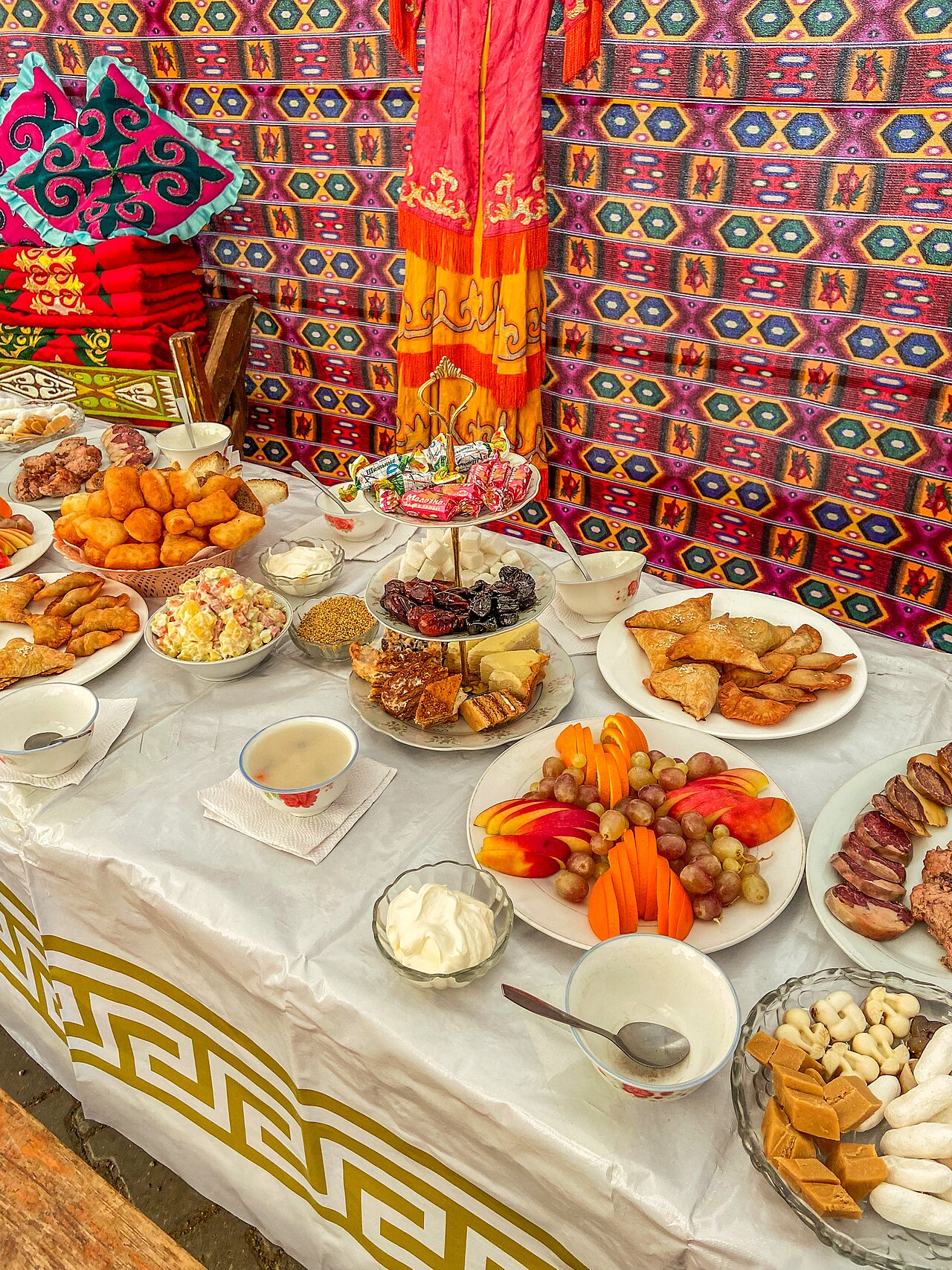
The dastarkhan is both the cloth and the occasion: a low table or a spread on the floor, everyone seated around it, dishes shared rather than plated. It typically opens with tea, bread, baursak — small pieces of fried dough — dried fruit, nuts, kurt (hard salted curd balls), sweets and cured meats, before hot food arrives.
The rules that matter:
- Bread is respected. Don’t put it upside down, don’t throw it away, and tear it rather than cutting it where that’s the practice at the table.
- Eat with your right hand when eating by hand.
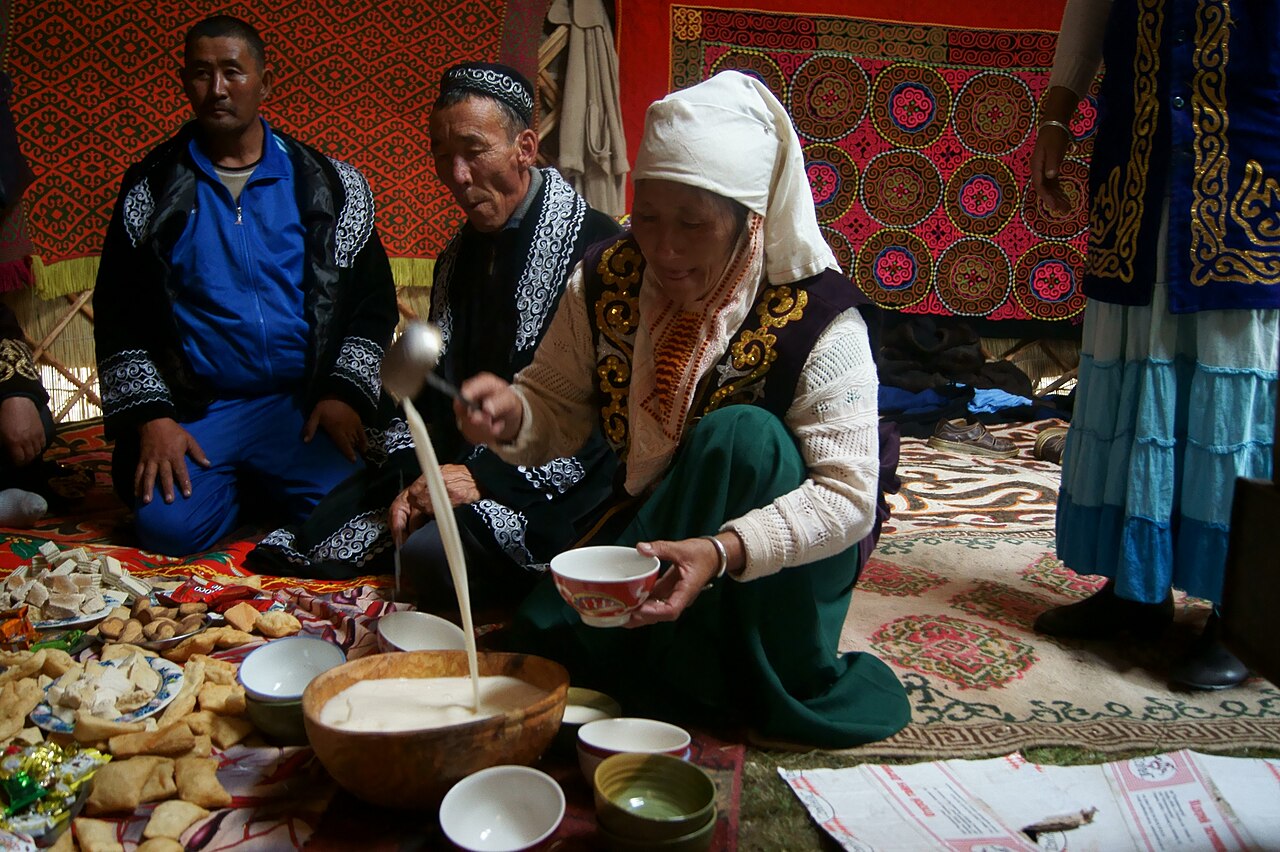
- Your tea bowl will be filled half-full, deliberately. A full bowl can read as a hint that you should drink up and go; a half bowl means stay, and it keeps the tea hot. Don’t ask for more in the cup.
- Accept with both hands, or with the right hand supported at the wrist by the left.
- Wait for the eldest to begin.
- Take a token amount of anything offered, even if you don’t want it.
The signature dish is beshbarmak — literally “five fingers,” because it’s eaten by hand: boiled mutton, beef or horse meat laid over wide flat noodles, with onion sauce and a bowl of sorpa, the broth, served alongside. Our guides to beshbarmak and Kazakh dining etiquette go into the mechanics; traditional Kazakh dishes covers the wider repertoire.
The sheep’s head
At a formal meal the boiled sheep’s head, bas, is presented to the most honoured guest. If that’s you, don’t panic and don’t decline. The expected sequence is to accept it, cut small pieces and distribute them to others at the table according to who should get what — the ear to a young person so they’ll listen and learn, and so on. If you don’t know the customs, saying so and asking the host to guide you is entirely acceptable and generally delights everyone.
Kumis and shubat
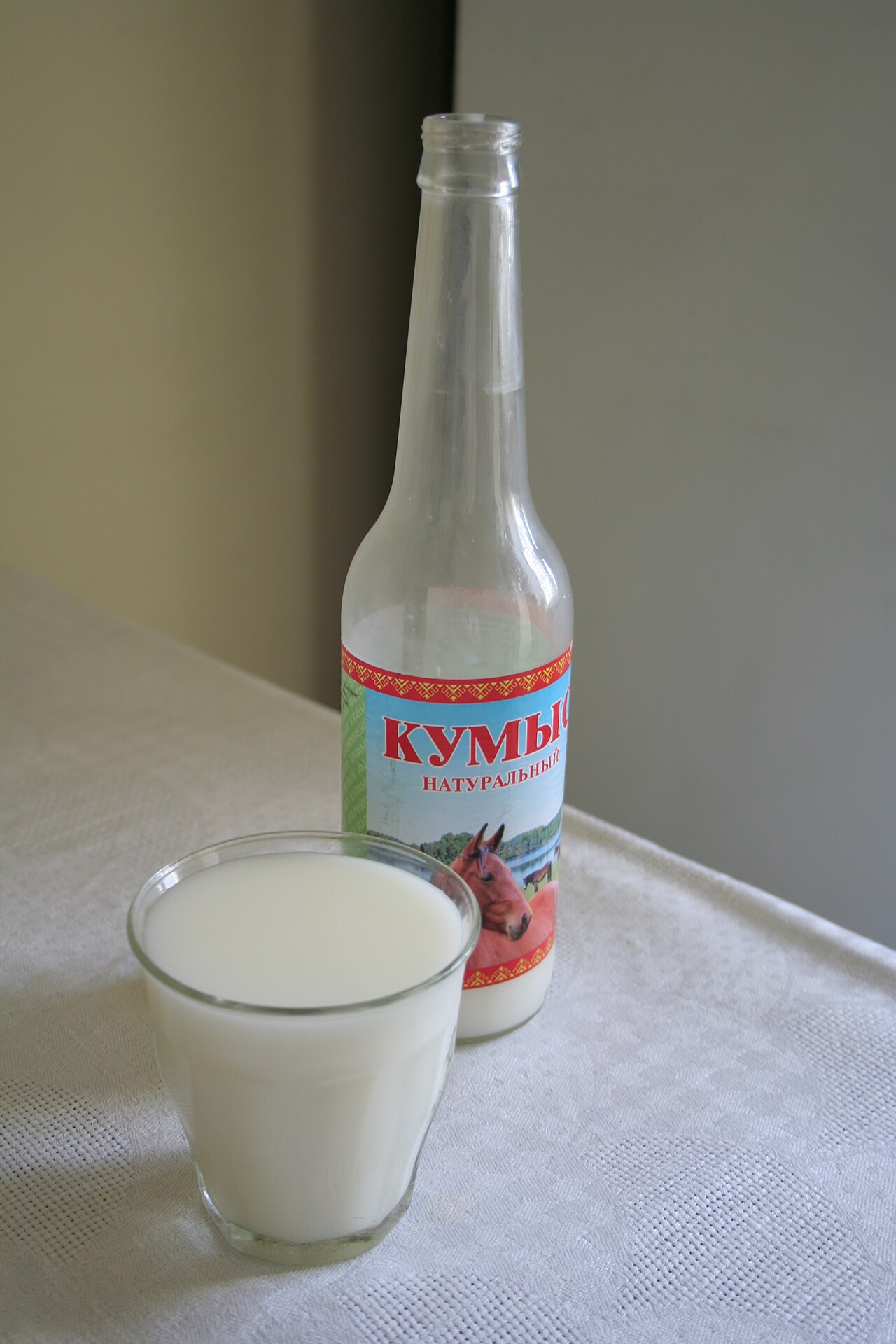
Kumis is fermented mare’s milk; shubat is fermented camel’s milk. Both are genuinely traditional rather than tourist props, both are mildly alcoholic, and both taste — to most first-timers — sharply sour. In Mangystau, camel country, shubat is the regional one. Take a sip even if you don’t finish it. Our guide to kumis and Kazakh drinks explains what you’re drinking and why it mattered nutritionally on the steppe.
The yurt, and why it has a floor plan
The Kazakh yurt is a kiiz úy — felt house. A collapsible lattice frame (kerege) with roof poles (uyk) rising to a circular crown (shanyrak), the whole thing covered in felt and pitched or struck in a couple of hours. It’s an engineering answer to a specific problem: how to live well while moving four times a year.
What surprises visitors is that the interior is not improvised. It has a fixed geography:
- The tor, the place opposite the door, is the seat of honour. Guests and elders sit there. Don’t take it uninvited.
- The right side from the entrance is traditionally the men’s side, holding harness, saddles, hunting and herding gear.
- The left side is the women’s side, with kitchen equipment, food stores and household goods.
- The centre was the hearth.
- The shanyrak, the roof crown, is more than a smoke hole — it’s a symbol of family continuity, passed down through generations, and it appears on Kazakhstan’s national flag.
Two practical courtesies: don’t step on the threshold as you enter, and follow your host’s lead on shoes. If you’re offered the honoured seat, a brief show of reluctance before accepting is the correct choreography.

You can still stay in one, and it’s the single best cultural experience available to a visitor — see staying in a yurt in Kazakhstan for where and how.
The life-cycle traditions
This is where Kazakh custom is most obviously still alive. A child born in Almaty this year will very likely go through most of these.
| Shildehana | The celebration of a birth, with guests, food and congratulation |
| Besikke salu | Placing the baby in the besik, the traditional wooden cradle, with blessings sung over it |
| Tusaukeser | The first-steps ceremony. Coloured cords are tied loosely round the child’s ankles and cut by a respected person, so the child will walk freely through life. Often followed by a small race for children to a prize |
| At qoyu | Name-giving, traditionally by an elder or respected guest |
| Sundet toi | The circumcision celebration for a boy, usually a substantial party |
| Kyz uzatu | The bride’s farewell party, held at her family’s home before the wedding |
| Betashar | The unveiling of the bride’s face at the groom’s home, performed as a sung improvisation |
| Toi | Any large celebration — and Kazakhs have a great many of them |
Tusaukeser is the one I’d watch for if you get the chance. The image is lovely and the logic is transparent: you literally cut the bindings from a child’s legs so nothing will trip them later. It’s also the kind of ritual that survived the twentieth century precisely because it costs nothing and involves everyone.
Kazakh wedding traditions
A traditional Kazakh wedding is not one event but a sequence, and the sequence is still broadly followed even in urban, secular families.
Kudalyk — the matchmaking. The groom’s family visits the bride’s to negotiate. Historically this settled the qalyn mal, the bride-price, paid in livestock. Today it’s usually money and gifts, and the visit is as much about the two families formally meeting as about the terms.
Kyz uzatu — the bride’s send-off, hosted by her family. It’s emotional by design: this is the party where she leaves her parents’ household. In the old pattern she would not return for a long time, which is why the songs are what they are.
Betashar — the face-opening. At the groom’s home the bride arrives veiled, and a singer performs an improvised verse introducing her to each of her new husband’s relatives in turn, naming them and their standing, with the bride bowing to each. Relatives respond with gifts or money. The veil is lifted at the end. A skilled betashar performer is genuinely funny and slightly merciless, and it’s one of the best pieces of living oral art in Central Asia.
Shashu — the showering. Sweets, coins and small treats are thrown over the newlyweds — or over any guest of honour, or a child taking first steps — as a blessing. Children scramble for them. If you’re on the receiving end, smile and let it happen.
Then the toi itself: a large hall, a great deal of food, speeches in strict order of seniority, dombra music, and dancing that goes late.
One tradition you may read about and should understand as history rather than practice: alyp qashu, bride kidnapping. It existed, sometimes consensually as an elopement device and sometimes not. It is illegal in Kazakhstan today, and it is not a custom a visitor will encounter as a living practice. Treat any romanticised presentation of it with scepticism.
Music, poetry and the dombra
Kazakh culture is fundamentally oral, and its central instrument is the dombra — a two-stringed lute with a long neck and a pear-shaped body, played with the fingers. There’s also the kobyz, a bowed two-stringed instrument with a distinctly eerie tone that was historically associated with shamans and healing.

The performers to know:
- Akyn — an improvising poet-singer. Two akyns competing in extemporised verse is an aitys, a contest that is part poetry slam, part roast, and still broadcast on Kazakh television.
- Zhyrau — an epic reciter, carrying long narrative poems.
- Küy — an instrumental piece for dombra or kobyz, usually programmatic: each one tells a story.
The figure who looms over all of it is Abai Qunanbaiuly (1845–1904), poet, composer and philosopher, whose Book of Words is the closest thing Kazakh culture has to a secular scripture. His name is on the Almaty opera house, half the streets in the country and the national curriculum. If you want one book to read before visiting, that’s the one.
Dress, ornament and the meaning in the pattern
Traditional Kazakh dress is heavily embroidered and unmistakable: the chapan, a long padded coat; the saukele, the tall conical bridal headdress, often extraordinarily ornate; the kimeshek, a white head covering worn by married women; the takiya and the fur-trimmed borik for men; and ushanka-style hats in the far north where winter means business.

The ornament isn’t decorative filler. The recurring motifs — the ram’s horn koshkar muiz, the ram’s horn spiral, solar circles, the tree of life — carry meanings tied to herds, fertility and protection. You’ll see the same vocabulary on felt tush kiiz wall hangings inside a yurt, on syrmaq floor felts, on saddlery and on modern Kazakh graphic design. Once you can read a couple of the motifs, the whole visual culture of the country opens up.
Horses, eagles and the games of the steppe
You cannot separate Kazakh tradition from the horse. Kazakhs were among the earliest horse-riding peoples, horse meat and kazy sausage are prestige foods rather than poverty foods, and kumis is horse milk. Horses were transport, wealth, food, drink and status.
The games that came out of that are still played:
- Kokpar — mounted teams contesting a goat carcass, fast and genuinely rough. The Central Asian cousin of buzkashi.
- Kyz kuu — “girl chase,” in which a young woman rides off and a young man must catch her; if he fails, she gets to whip him on the way back.
- Audaryspaq — mounted wrestling, the object being to pull your opponent off his horse.
- Tenge alu — picking coins off the ground at a gallop.
- Baiga — long-distance horse racing across open country.
- Kazakh kures — jacket wrestling, on foot, now a formalised competitive sport.
- Asyk atu — a children’s game with sheep anklebones, played rather like marbles.
- Togyzkumalak — “nine pebbles,” a two-player board game of the mancala family, played seriously and competitively.

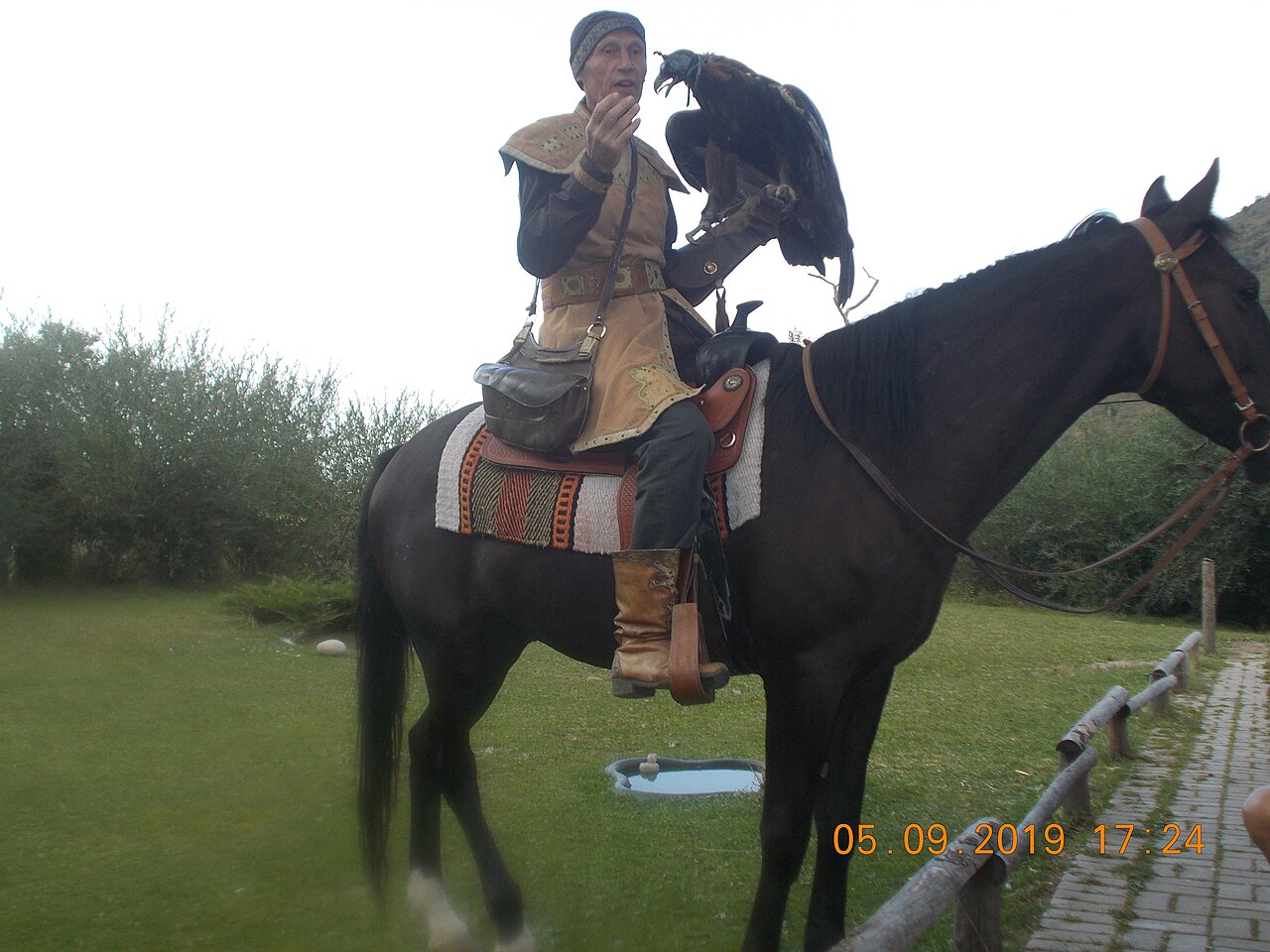
And then there is berkutchi, hunting with golden eagles from horseback — a tradition that survives in the Kazakh Altai and is now also performed for visitors near Almaty. It’s a substantial subject on its own, and we’ve covered it in our Kazakh culture pillar.
Belief: Islam, Tengri and the layer underneath
Kazakhstan is predominantly Sunni Muslim, and it is also a country where you will watch a woman circle a sacred tree praying for a child, or tie a ribbon to a shrine, or pass her hands through the smoke of a brazier and wash her face with it.
None of that is a contradiction. Before Islam arrived, Kazakhs followed Tengrism — the veneration of Tengri, the sky, along with ancestor spirits (aruakh) and the sacredness of particular places. When Sufi Islam spread across the steppe, largely through the tradition of Khoja Ahmed Yasawi, it absorbed rather than erased that older layer.
UNESCO put this rather well when it inscribed Mangystau’s rock-cut mosques in July 2026, describing sites where “Islamic Sufi spirituality organically continued and transformed more ancient practices related to ancestor worship, the sacredness of the landscape and the role of spiritual leaders.” That is the single most accurate sentence about Kazakh religious culture I’ve read. Our guides to the underground mosques of Mangystau and the Mausoleum of Khoja Ahmed Yasawi show you where to see it.
Practically, Kazakhstan is a relaxed and secular-feeling country. Alcohol is sold openly, dress in cities is Western, and Ramadan observance varies enormously. But at shrines, in mosques and in older rural households, cover up, speak quietly and follow instructions.
What the twentieth century broke, and what came back
An honest account of Kazakh tradition has to include the rupture. Soviet collectivisation forcibly settled a nomadic society in a handful of years, and the resulting famine of the early 1930s killed a catastrophic share of the Kazakh population and much of the livestock the whole culture rested on. Nomadism as a way of life ended. Religious practice was suppressed. The alphabet changed twice. Russian became the language of advancement.
What survived did so inside families: the food, the hospitality, the life-cycle ceremonies, the respect for elders, the poetry. Since independence in 1991 there’s been a deliberate revival — Nauryz restored as a public holiday, Kazakh reinstated as the state language, the yurt and the shanyrak elevated to national symbols, traditional sports formalised and funded.
Which means you’ll encounter Kazakh tradition in two registers, and it’s worth being able to tell them apart. There’s the living kind — a wedding betashar, a half-filled tea bowl, a grandmother’s insistence that you eat more — and the staged kind, at ethno-villages and festival grounds, which is enjoyable and educational but is a performance. Neither is fake. They’re just different things. Our Kazakh culture pillar and the guide to language in Kazakhstan go further into how the country holds both.
How to be a good guest: the short version
- Greet the eldest person first. A slight bow of the head is plenty.
- Accept food and tea. Token amounts are fine; refusal outright is not.
- Bring something. Sweets, fruit, tea, or something from your own country. Never arrive empty-handed.
- Use your right hand. Give and receive with the right, or both.
- Respect bread. It’s not just food.
- Take shoes off in homes, unless clearly told otherwise.
- Don’t photograph people, especially at shrines, without asking.
- Dress modestly at religious sites — women should carry a scarf.
- Learn two words. Rakhmet (thank you) and salemetsiz be (hello, formal) will get you a very long way.
- Expect toasts. If there’s alcohol, there will be speeches, in seniority order, and you may well be asked to give one.
Our full guide to etiquette in Kazakhstan covers the situational detail — business, gifts, mosques, homes.
Where to actually see this
Traditions aren’t evenly distributed. Where to go:
- Nauryz, 21–23 March, anywhere in the country. Yurts in city squares, kokpar, wrestling, and enormous quantities of nauryz kozhe. It is by far the best single window into Kazakh custom, and we’ve covered it in depth separately.
- A yurt stay near Kolsai, in the Altai or on the steppe — see yurt stays in Kazakhstan.
- The National Museum in Astana, for the Golden Man and the ethnography halls — see the National Museum of Kazakhstan.
- Turkestan, for the Sufi tradition at its source — Turkestan.
- A market. Almaty’s Green Bazaar is a working cultural site as much as a shopping one — Green Bazaar.
- Any invitation to a home or a toi. Say yes. This is the one that matters.

Frequently asked questions
What are the most important Kazakh traditions?
Hospitality above all — the obligation to feed and shelter a guest — along with respect for elders, the shared dastarkhan table, the yurt and its internal order, and the life-cycle ceremonies from shildehana at birth through tusaukeser at first steps to the three-stage wedding.
What is a dastarkhan?
Both the cloth and the gathering: a low spread where everyone eats from shared dishes. It opens with tea, bread, baursak, kurt, dried fruit and cured meat before hot food arrives. Eat with your right hand, wait for the eldest, and treat bread respectfully.
Why is my tea cup only half full?
On purpose, and it’s a compliment. A half-filled bowl keeps the tea hot and signals that you’re welcome to stay; filling it to the brim can imply the host would like you to finish and leave.
What happens at a Kazakh wedding?
Four stages, broadly. Kudalyk, the families’ matchmaking negotiation, historically settling a bride-price. Kyz uzatu, the bride’s farewell at her own family’s home. Betashar, the sung unveiling of her face at the groom’s home, introducing her to each new relative in turn. Then the toi — a large party with food, speeches in order of seniority, dombra music and dancing.
What is shashu?
The showering of sweets, coins and small treats over newlyweds, an honoured guest or a child taking first steps, as a blessing. Children scramble to collect them. If you’re on the receiving end, just let it happen.
What should I do if I’m offered the sheep’s head?
Accept it — it’s an honour given to the most respected guest. Cut small pieces and pass them to others at the table. If you don’t know the conventions, say so and ask your host to guide you; that’s a perfectly good answer and usually goes down well.
What is the significance of the shanyrak?
It’s the circular wooden crown at the top of a yurt, where the roof poles meet. Beyond letting smoke out and light in, it symbolises family continuity and was passed down through generations. It appears on the Kazakh national flag.
Are Kazakh traditions still practised today?
Many are, genuinely. Weddings still follow the traditional sequence, first-steps and cradle ceremonies are common, hospitality and respect for elders are everyday realities, and Nauryz is a major national holiday. Nomadism itself ended with Soviet collectivisation, and what you see of it at ethno-villages is a performance rather than a way of life.
Is bride kidnapping still a Kazakh tradition?
No. It existed historically, sometimes as a form of consensual elopement and sometimes not, and it is illegal in Kazakhstan today. It isn’t something a visitor will encounter as living practice, and romanticised accounts of it should be treated with caution.
What religion do Kazakhs follow?
Predominantly Sunni Islam, arriving largely through the Sufi tradition of Khoja Ahmed Yasawi, layered over older Tengri beliefs and ancestor veneration that were absorbed rather than erased. In practice the country feels secular and relaxed, while shrines and mosques call for modest dress and quiet.
What is a dombra?
A two-stringed long-necked lute, the central instrument of Kazakh music, played with the fingers. Instrumental pieces for it are called küy and are usually programmatic — each one tells a story. The bowed kobyz is its older, eerier companion.
What should I bring if I’m invited to a Kazakh home?
Sweets, fruit, good tea or something distinctive from your own country. Never arrive empty-handed. Expect to be fed considerably more than you planned, and to be offered tea within a minute of sitting down.
Final thoughts
What strikes me about Kazakh traditions is how practical they are underneath the ceremony. Half-filling a tea bowl keeps it hot. Cutting cords from a toddler’s ankles gets a whole extended family into a room to celebrate a child. Naming seven generations of ancestors was, among other things, a way of avoiding marrying a cousin across a population spread thin over an enormous grassland.
You don’t need to master any of it. Kazakhs are forgiving of foreigners and will find your attempts endearing rather than clumsy. What they notice is whether you accept what’s offered, whether you greet the oldest person in the room, and whether you turn up with something in your hands.
Do those three things and you’ll be fed until you can’t move, which is exactly the outcome the tradition is designed to produce.
Photo credits
Dastarkhan laid inside a yurt — Photo: Symbat Bolatova / CC BY-SA 4.0 via Wikimedia Commons. Tea poured at a dastarkhan — Photo: Altaihunters / CC BY-SA 3.0 via Wikimedia Commons. Kumis, fermented mare’s milk — Photo: A.Savin / CC BY-SA 3.0 via Wikimedia Commons. Interior of a Kazakh yurt — Photo: Nurken / CC BY-SA 4.0 via Wikimedia Commons. Performer in Kazakh national dress — Photo: Graphique38 / CC BY 4.0 via Wikimedia Commons. Kokpar riders — Photo: Rustam Uzbekov / CC BY-SA 4.0 via Wikimedia Commons. Playing the dombra — Photo: upyernoz / CC BY 2.0 via Wikimedia Commons. Beshbarmak — Photo: upyernoz / CC BY 2.0 via Wikimedia Commons.