Contents
- The National Museum of Kazakhstan at a glance
- The short answer — is it worth your afternoon?
- What is the National Museum of the Republic of Kazakhstan?
- The building — a “waving flag” of blue glass and white marble
- The halls — what you’ll actually see
- The Hall of Gold and the Golden Man (Altyn Adam)
- Practical info for 2026
- What’s nearby — the Independence Square cluster
- Frequently asked questions
- Final thoughts
I have walked into plenty of national museums that promise the whole story of a country and hand you three tired rooms and a gift shop. This is not one of those. It is the largest museum in Central Asia, barely a decade old, and it gave me one of the better museum afternoons I have had anywhere in the region. Whether it earns a slot in your short Astana schedule comes down to what you came for.
The National Museum of Kazakhstan, on Independence Square in Astana, is the largest museum in Central Asia and, for most visitors, well worth two to three hours. Its star draw is the Golden Man, a Saka warrior’s gold-covered costume. Expect a modern, multimedia-heavy building; basic tickets are cheap, though the gold rooms cost noticeably more.
The National Museum of Kazakhstan at a glance
| Opened | July 2014, on Independence (Tauelsizdik) Square, Astana |
| Where | Independence Square, beside Hazrat Sultan Mosque and the Palace of Peace and Reconciliation |
| Size | Around 74,000 m² across seven blocks up to nine storeys — the largest and youngest museum in Central Asia |
| Halls | Around 18–20 exhibition halls; a collection of more than 175,000 items |
| Star exhibit | The Golden Man (Altyn Adam) — a Saka gold-covered warrior costume, shown as a reconstruction |
| Tickets | Basic admission from roughly 500–1,000 tenge; with the Gold Halls, up to about 4,000 tenge (verify on Ticketon) |
| Hours / closed days | Roughly Tue–Sun 10:00–18:00 (ticket office to about 17:00); closed Mondays and the last Tuesday of each month |
| Time needed | About 2–3 hours |

The short answer — is it worth your afternoon?
Yes, for most people, and I do not say that about every museum. If you have a full day or two in the capital and you are already ticking off the big sights, this belongs on your list of things to do in Astana. It is well laid out, it is not exhausting to walk, and it does something a lot of national museums fail at — it actually tells you who Kazakhs are, from Bronze Age nomads to the space age, without drowning you in dates.
The honest caveat: it leans hard on screens and reconstructions. If you are the kind of traveller who wants to stand in front of the genuine, dug-out-of-the-ground artefact and nothing else, parts of this place will feel a touch like a very expensive visitor centre. The single most famous thing in the building — the Golden Man — is a replica, and I will get to why that is not the scandal it sounds like.
Who should probably skip it? If you have one afternoon in Astana and you have to choose, and you would rather be up a tower looking at the skyline than reading about Saka burial mounds, go climb Baiterek Tower instead and come back to the museum next time. Everyone else: keep reading.
What is the National Museum of the Republic of Kazakhstan?
The National Museum of the Republic of Kazakhstan opened in July 2014, which by museum standards makes it an infant. It was built under the state “Cultural Heritage” programme — a national push in the 2000s and 2010s to restore monuments, fund archaeology and, essentially, assemble a coherent story of the country after independence. This museum was meant to be the flagship of that effort, and it shows in the budget.
The numbers are genuinely large. The collection runs to more than 175,000 items, and the building is the biggest of its kind in Central Asia. It covers the sweep you would expect from a national institution: prehistory and the Bronze Age, the Saka and other early nomads, the medieval Turkic states and the Silk Road, the Kazakh Khanate, the Russian and Soviet centuries, and then independence and the building of a new capital. It is a lot of country to fit under one roof, and the curators mostly pull it off.
Not to be confused with the Almaty museum
One thing to get straight before you go. This is the National Museum in Astana, opened in 2014. It is a different institution from the older Central State Museum of Kazakhstan down in Almaty, which has its own long history and its own collection. Both are worth visiting and both, confusingly, display a version of the Golden Man. When you are searching for tickets, hours or reviews, make sure you are reading about the Astana museum on Independence Square, not the Almaty one. People mix them up constantly, and the practical details do not carry over.
The building — a “waving flag” of blue glass and white marble
Before you see a single exhibit, you see the building, and it is worth a minute of your attention. The architect Vladimir Laptev worked to a design concept described as “a waving flag” — you can read the sweeping, slightly restless lines of the facade as folds of cloth caught mid-motion. The exterior mixes blue glass with white marble, and on a bright day the glass throws the sky straight back at you.
The scale is hard to grasp from photos. The complex is roughly 74,000 square metres spread across seven interconnected blocks, some rising to nine storeys, with something like 14,000 square metres of that given over to actual exhibition space. That ratio tells you something honest about the place — a lot of it is atrium, circulation and grand gesture rather than dense galleries. It feels spacious rather than cramped, which after a few hours on your feet you will be grateful for.
If modern buildings are part of why you came to the capital, the museum slots neatly into a wider walk through Astana’s architecture, which swings from Norman Foster’s pyramid to the golden-egg silhouette of Baiterek within a couple of kilometres. This is a city that decided, more or less from scratch, what it wanted to look like, and the museum is one of the more restrained results.
The halls — what you’ll actually see
There are, depending on which source you trust, somewhere around 18 to 20 halls, and you will not give equal time to all of them. Here is what is actually inside and where I would spend the minutes.
Ancient and Medieval History
This is where the real archaeology lives — petroglyphs, Bronze Age tools, weaponry, and the material culture of the early nomads who crossed these steppes long before there was a Kazakhstan to speak of. If you have any interest in the deep past of Central Asia, slow down here. A lot of what later became national symbols starts in these rooms.
The History hall
The main History section carries the story forward through the Turkic khaganates, the medieval Silk Road cities, the Kazakh Khanate and into the modern era. It is a natural companion to a wider read on Silk Road Kazakhstan, because so much of the country’s medieval wealth and connection to the wider world ran along those trade routes. Expect maps, models of caravanserais and trading towns, and enough context to make the ruins you might visit later actually mean something.
Ethnography — the yurt
For me this was the emotional centre of the museum, more than the gold. The Ethnography hall reconstructs the world of the nomad, and its centrepiece is a full-scale yurt you can look into — the felt walls, the painted wooden frame, the layered carpets and the arrangement of a home built to be packed onto a horse and rebuilt by evening. There are costumes, saddlery, jewellery and the everyday tools of a mobile life.
If you want to understand Kazakh culture beyond the postcard version, this is the room that does it. The whole logic of Kazakh hospitality, kinship and craft grew out of the practical demands of moving with the seasons, and standing next to a properly assembled yurt makes that click in a way no wall text can.
The Hall of Astana — the city in miniature
The Hall of Astana is a little bit of civic theatre, and I mean that kindly. Its highlight is a large, illuminated scale model of the capital, and it is genuinely useful early in a trip — you get an aerial sense of how the new city was planned along its central axis before you go out and walk it. If you are still shaping your route, it pairs well with an Astana itinerary, because you can literally point at where you are going next.
Independent Kazakhstan
The Hall of Independent Kazakhstan covers the years since 1991 — the founding of the modern state, the move of the capital north, and the national symbols and projects of the independence era. It is the most overtly official part of the museum, heavy on statehood and nation-building. Interesting for context; not somewhere you need to linger unless modern political history is your thing.
Contemporary and Modern Art
There is a Contemporary and Modern Art section too, showing Kazakhstani painting and sculpture. It is a decent palate cleanser after all the archaeology and statecraft, and it gives you a sense of how the country’s artists are thinking about identity right now. Quieter, usually emptier, and pleasant for it.
The multimedia floor, holograms and the kids
This is the part that divides people. The museum leans heavily on technology — a media floor lined with hundreds of monitors, a big curved screen, holographic displays and a multimedia guide offered in three languages. When it works, it is genuinely impressive and a great way to travel with kids, who tend to switch off in front of glass cases but light up in front of a hologram. There is also a dedicated children’s museum designed to keep younger visitors busy.
When it does not work — a screen down for maintenance, a hologram looping the same 40 seconds — it can feel like the substance has been swapped for spectacle. My advice is to enjoy the multimedia as seasoning, not the main course, and to make sure you also spend real time in the archaeology and ethnography halls where the actual objects are.
The Hall of Gold and the Golden Man (Altyn Adam)
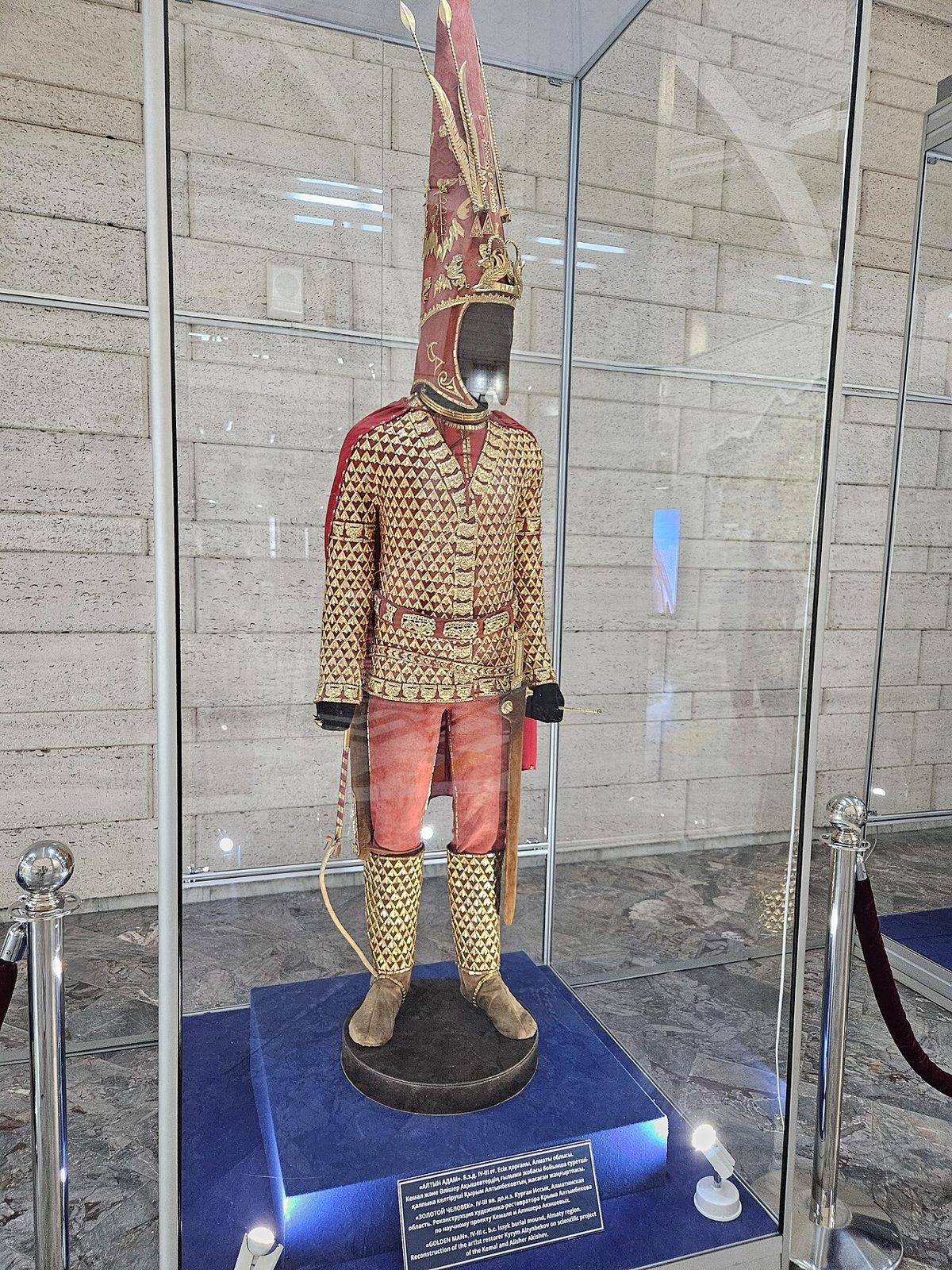
If you only remember one thing from this museum, it will be this. The Hall of Gold — often signposted as “Altyn” — brings together Scythian and Saka gold recovered from burial mounds across Kazakhstan, and its undisputed headline is the Golden Man.
Who was the Golden Man?
The Golden Man — Altyn Adam, sometimes translated as the Golden Warrior — is the ceremonial costume of a Saka (Scythian) individual, entirely covered in something on the order of 4,000 pieces of worked gold. The remains were found in the Issyk kurgan, a burial mound roughly 50 kilometres from Almaty, and the discovery is credited to the archaeologist Kemal Akishev in 1969. The burial is usually dated to around the 4th to 3rd century BC.
The detail that stops people is the headdress — a tall, pointed cap carrying roughly 150 individual gold ornaments: winged horses, a snow leopard, mountain goats, birds and stylised trees. It is a whole cosmology worn on the head, and it is why the figure became a national symbol of Kazakhstan, reproduced on monuments and in official imagery across the country. One honest note: the sex of the person buried at Issyk is debated among scholars, so “Golden Man” is a convention as much as a certainty.
Original or replica? The honest answer
Here is the thing nobody tells you until you are standing in front of the case: the Golden Man you see in Astana is a reconstruction, not the original gold. And that is not a con. The genuine artefacts are extraordinarily valuable and fragile, and the original gold is kept secured in a state vault, with faithful replicas displayed here and at the Issyk museum near where it was found.
Does that ruin it? Not for me. You are still looking at a meticulous, full reconstruction of one of the most important archaeological finds in Central Asia, assembled from thousands of gold elements exactly as the warrior would have been dressed. If you walked in expecting to press your nose against 2,300-year-old metal, adjust your expectations before you go and you will not feel cheated. If that distinction matters enormously to you, at least you now know before you buy the pricier ticket.
The separate Gold ticket
Worth knowing before you queue: the Hall of Gold usually sits behind an upgraded “Gold” ticket at a separate, higher tariff, rather than being included in basic admission. So if the Golden Man and the Scythian gold are the whole reason you are coming, make sure you buy the ticket that actually gets you into those rooms. I have watched visitors realise at the door that their cheap ticket does not cover the gold, and it is an avoidable annoyance.
Practical info for 2026
Everything below changes — prices creep, hours shift with the season, halls close for maintenance. Treat these as a planning guide and confirm the current details on the official ticketing site (Ticketon) before you go.
Tickets and prices
Basic admission is cheap by international standards — figure on somewhere from around 500 to 1,000 tenge. Add the Gold Halls and the ticket climbs to roughly 4,000 tenge. In mid-2026, with something like 470 tenge to the US dollar, that works out to around two dollars for basic entry and up to about eight and a half dollars with the gold. Children under seven generally go free. Be aware that the reduced local and student rates you may see advertised usually do not apply to foreign visitors, so budget for the full tariff.
Hours and closed days
Opening hours run roughly Tuesday to Sunday, about 10:00 to 18:00, with the ticket office typically closing an hour or so before the museum itself, near 17:00. The two closures that catch people out: it is shut on Mondays, and it is also shut on the last Tuesday of each month for maintenance. If your one free day in Astana is a Monday, plan around it — do not walk across Independence Square expecting to get in.
How long to allow
Give it about two to three hours. Two if you move at a decent clip and mostly want the highlights — ethnography, the Astana model and the gold. Three or more if you read the panels, watch the multimedia and take the archaeology seriously. It is large enough that trying to see literally everything in one visit will leave you glazed over, so pick your priorities.
Guided tours, audio guides and languages
The museum offers a multimedia guide in three languages, and guided tours are generally available — worth it here, because the collection spans so much history that a good guide turns a walk past objects into an actual narrative. Signage is stronger in Kazakh and Russian than in English in places, so if you want the full story rather than the headlines, a guide or the multimedia guide genuinely adds value. Ask at the desk about tour times and languages when you buy your ticket.
Getting there
The museum sits on Independence Square, right next to Hazrat Sultan Mosque and the Palace of Peace and Reconciliation. City buses serve stops near here — look for the “Grand Astana” or “National Museum” stops — and it is an easy taxi or ride-hail from anywhere central. It is also walkable from Baiterek if the weather is kind, which ties the visit neatly into a wider loop of the Left Bank sights. Astana winters are brutally cold, so in January that pleasant walk becomes a taxi.
Photography, accessibility and families
The building is modern, step-free in the main routes and easy to move through with a stroller or wheelchair, which is not something you can say about every museum in the region. Photography is generally fine in most halls, though rules can be stricter around the gold — check the signs and ask if you are unsure. For families, the multimedia displays and the children’s museum are real assets; this is one of the more kid-tolerant afternoons you can plan in the capital.
What’s nearby — the Independence Square cluster
One of the best things about this museum is that you do not have to make a special trip for it. It anchors a whole cluster of sights on Independence Square, so you can build a half-day around it without repeating your steps.

Directly beside the museum is Hazrat Sultan Mosque, one of the largest mosques in Central Asia and a striking piece of white-and-blue architecture in its own right — dress modestly and you can usually look inside outside prayer times. The Palace of Peace and Reconciliation, Norman Foster’s glass pyramid, is a short walk away, as is the Kazakh Eli monument. From the square it is a straightforward stroll or quick hop over to Baiterek Tower and the main axis of the Left Bank, so the museum slots into a broader day of the capital’s showpiece architecture rather than standing alone.
Frequently asked questions
How much are tickets to the National Museum of Kazakhstan?
Basic admission is inexpensive — expect somewhere around 500 to 1,000 tenge (roughly two US dollars in mid-2026). Adding the Gold Halls, where the Golden Man and the Scythian gold are displayed, pushes the price up to about 4,000 tenge, or around eight and a half dollars. Children under seven are generally free. Reduced local and student rates usually do not apply to foreign visitors. Prices change, so confirm the current tariff on Ticketon before you go.
What are the opening hours, and is it open on Mondays?
No — it is closed on Mondays. Otherwise it opens roughly Tuesday to Sunday, about 10:00 to 18:00, with the ticket office shutting around 17:00. There is one more closure to watch for: the museum also shuts on the last Tuesday of each month for maintenance. If your only free day is a Monday, plan a different sight and save the museum for another day.
What is the Golden Man of Kazakhstan?
The Golden Man, or Altyn Adam, is the ceremonial costume of a Saka (Scythian) warrior covered in around 4,000 pieces of gold, found in the Issyk kurgan about 50 kilometres from Almaty and unearthed in 1969 by the archaeologist Kemal Akishev. It dates to roughly the 4th to 3rd century BC, and its tall pointed headdress carries some 150 gold ornaments. It has become a national symbol of Kazakhstan.
Is the Golden Man the original or a replica?
The Golden Man on display is a replica — a faithful reconstruction rather than the original gold. The genuine artefacts are extremely valuable and are kept secured in a state vault, with high-quality replicas shown here in Astana and at the Issyk museum near the find site. It is still a remarkable thing to see, but go in knowing it is a reconstruction so you are not caught out.
How long do you need to visit?
Allow about two to three hours. Two hours covers the highlights — the ethnography hall and yurt, the Astana city model and the gold. Three or more lets you take in the archaeology, read the panels and enjoy the multimedia properly. It is a big building, so it is better to choose your priorities than to try to see every hall in a single visit.
How do you get to the National Museum in Astana?
The museum is on Independence Square, next to Hazrat Sultan Mosque and the Palace of Peace and Reconciliation. Buses stop nearby — look for the “Grand Astana” or “National Museum” stops — and taxis and ride-hailing apps are cheap and easy across the capital. It is walkable from Baiterek Tower in good weather, though Astana’s winter cold makes a taxi the sensible choice for much of the year.
Is the National Museum of Kazakhstan worth visiting?
For most visitors, yes. It is the largest and most modern museum in Central Asia, it tells the country’s story clearly, and the ethnography and gold halls are genuinely memorable. It is well rated by visitors and easy to combine with the other sights on Independence Square. The main caveats are the heavy reliance on multimedia and the fact that the star Golden Man is a replica — know that going in and you will enjoy it.
Final thoughts
I left the National Museum of Kazakhstan pleasantly surprised, and I do not surprise easily in national museums. It is spacious, coherent and refreshingly un-dusty, and in two or three hours it gives you a real handle on where Kazakhs came from — from steppe nomads packing a yurt onto a horse to a country that built a brand-new capital from the ground up.
Who is it for? Anyone spending more than a day in Astana, families who want somewhere the kids will not revolt, and travellers who like to understand a place before they wander it. Who might pass? If you have a single afternoon and you would rather be up a tower or inside a mosque, this can wait for a return trip. But if you have the time, buy the ticket that includes the gold, give yourself the full two to three hours, and treat it as the opening chapter of your capital visit rather than an afterthought. It is one of the more rewarding indoor afternoons Astana has to offer.
Keep exploring with beautiful places in Kazakhstan and the best cities in Kazakhstan.
Photo credits
National Museum of Kazakhstan: Davide Mauro (CC BY-SA 4.0). The Golden Man reconstruction: Nurken (CC BY-SA 4.0). Hazrat Sultan Mosque next door: t_y_l (CC BY-SA 2.0). All via Wikimedia Commons.