Contents
- One day or two: which should you choose?
- Astana at a glance: what to expect
- Getting into the city from the airport
- One day in Astana: the essential axis and Independence Square
- Two days in Astana: the Expo south and the green city
- Best day trips if you have extra time
- Practical planning: fees, hours and what’s open when
- How much a visit costs
- Astana in winter: a survival plan
- Where to stay and what to eat
- Combining Astana with the rest of your trip
- Frequently asked questions
- Final thoughts
Astana is unlike anywhere else you’ll visit in Central Asia — a whole capital city conjured out of the bare steppe in a single generation, all glass towers, giant tents and golden spheres. Most travellers pass through in a day or two, either side of a flight, and the good news is that’s genuinely enough to see the best of it. Planning an Astana itinerary just needs a plan that accounts for the one thing photos don’t tell you: this city is far more spread out than it looks.
Here’s the short version. A realistic Astana itinerary is one full day for the essential Left Bank landmarks — Khan Shatyr, the Bayterek Tower, and the museums and mosques across the river — and a second day for the Expo sphere, the Grand Mosque and the city’s parks and riverfront. One day covers the icons; two lets you slow down and go inside them. Below is the hour-by-hour plan, with fees, opening times and honest advice on what to skip.

I’ve done Astana in a rushed day and in an unhurried two, and two is the sweet spot if you can spare it. This guide is the itinerary companion to my wider things to do in Astana pillar — there I list everything; here I stitch the highlights into a plan that actually works on the ground.
One day or two: which should you choose?
Be honest with yourself about your pace. One day suits a stopover or a stayover between flights — you’ll see the icons from the outside and the best one or two from the inside, but you’ll be moving briskly and skipping the Expo sphere. Two days is what I’d recommend if you can spare it: the same icons at a human pace, plus time inside the Nur-Alem sphere and the Grand Mosque, an evening on the riverfront, and a little of the city’s greener, everyday side. Astana is a city of set-piece buildings, and set pieces reward being lingered over rather than rushed past. If you’re slotting the capital into a bigger trip, one or two days is exactly what my 7-day and 10-day Kazakhstan routes allow for it.
Astana at a glance: what to expect
A little orientation saves you a lot of confusion. First, the name: the city is Astana again, having briefly been called Nur-Sultan from 2019 to 2022 — plenty of older signs, maps and blog posts still say Nur-Sultan, but locals and officialdom use Astana. Second, and more important for your planning: Astana looks compact on a map but isn’t. The monumental core straddles the Yesil River (also called the Ishim), and the landmarks are strung out over a couple of kilometres, with the Expo sphere and the Grand Mosque a taxi ride beyond that. You can walk the central axis, but you’ll be taking taxis between the further sights, so don’t plan to do it all on foot.
Third, the season matters enormously. Astana is often called the second-coldest capital on earth, and it earns it: winters plunge to −30°C or −40°C, while summers are warm and pleasant, sometimes topping 35°C. The comfortable window to visit is May to September; come in deep winter and you’ll be dashing between heated interiors. More on timing in my guide to the best time to visit Kazakhstan.
It helps to know what you’re looking at, too. Astana became Kazakhstan’s capital in 1997, when the government moved north from Almaty, and almost everything you’ll see has been built since — this is one of the youngest capital cities in the world, deliberately designed as a showcase of an independent, forward-looking Kazakhstan. The Japanese architect Kisho Kurokawa master-planned the new city, and a roll-call of international architects, Norman Foster among them, filled it with landmark buildings. That’s why Astana feels less like an organic old town and more like a gleaming statement of intent, closer in spirit to a Gulf capital than to anywhere else in Central Asia. Knowing that, the theatrical scale of the place makes sense — it was always meant to impress.
Getting into the city from the airport
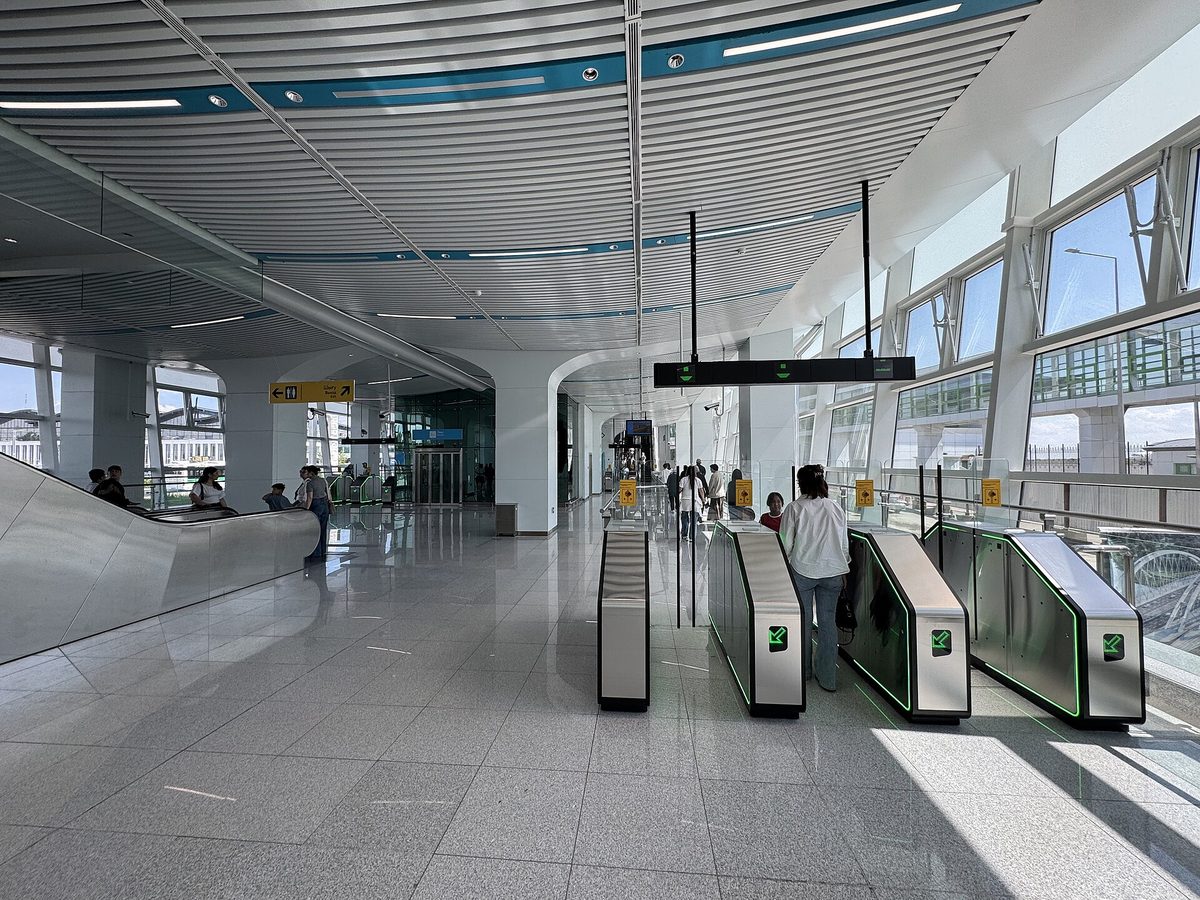
Nursultan Nazarbayev International Airport (airport code NQZ) sits about 17 kilometres south of the centre. A taxi or ride-hail takes around 30 minutes and costs roughly 2,000–4,000 tenge — use the Yandex Go or inDrive apps for a fair, fixed fare, as metered street taxis are often refused and drivers may quote high. Budget buses (routes 10, 12 and the express 100) run into the centre for around 180 tenge if you’re travelling light. Once you’re in town, the same ride apps handle getting around, and the central axis is walkable; download 2GIS for offline city navigation. For the bigger picture on moving around the country, see getting around Kazakhstan.
Within the city, your main tools are simple: walk the central boulevard, and ride-hail everything else. Yandex Go and inDrive give fair fixed fares and are cheap — a cross-town hop is usually a couple of dollars — so there’s little reason to work out the bus network for a short visit, though buses are there if you want them. Distances between the further sights (the Expo sphere, the Grand Mosque, ALZHIR) are real, so factor a few taxi rides into your day rather than assuming you’ll stroll between everything. Traffic is generally manageable outside rush hour, and the grid layout makes navigation easy once you’ve got 2GIS loaded.
One day in Astana: the essential axis and Independence Square
If you have a single day, this route hits the icons in a logical arc, walking the central boulevard in the morning and crossing the river in the afternoon.
Morning — Khan Shatyr to Bayterek. Start at the western end of Nurzhol Boulevard at Khan Shatyr, Norman Foster’s 150-metre translucent tent — the world’s largest — which opened in 2010 and holds a shopping mall, a monorail and, improbably, a top-floor beach with sand shipped from the Maldives. From there, stroll east down the landscaped boulevard, flanked by the golden “Emerald Towers” and government ministries, to the city’s symbol: the Bayterek Tower. Its observation deck sits at 97 metres — marking 1997, the year the capital moved here — inside a golden sphere atop a white lattice; total height with the orb is about 105 metres. Go up early to beat the crowds; entry is around 700–1,000 tenge, and at the top you can place your hand in a gilded imprint of the first president’s and make a wish.

Midday — Ak Orda and lunch. Continue to the eastern end of the axis for the Ak Orda Presidential Palace, with its blue dome and spire, best admired from the outside across the plaza (it’s a working seat of government, not a museum). Grab lunch on or near the boulevard — there are cafés and food courts in the towers and in Khan Shatyr.
Afternoon — cross the river to Independence Square. The other great cluster of sights sits across the Yesil River: the National Museum of Kazakhstan, whose Hall of Gold displays dazzling Scythian “Golden Man”-era treasures (open Tuesday–Sunday, closed Mondays, around 1,700 tenge); the vast Hazrat Sultan Mosque, opened in 2012 with a 51-metre dome and four 77-metre minarets; and the Palace of Peace and Reconciliation, Foster’s 62-metre glass-and-stone pyramid, visitable by guided tour. A taxi hops you across in a few minutes.

Evening — the riverfront. As the light softens, head to the Yesil embankment. In summer, the boulevard’s musical fountains run and the towers light up; it’s the best time to appreciate how theatrical this city is after dark. If you only have this one day and you’re running short, the two things I’d cut are the pyramid interior (guided-tour slots can eat time) and the second museum, keeping Bayterek, Khan Shatyr and the riverfront as your non-negotiables.
Two days in Astana: the Expo south and the green city
A second day lets you reach the sights beyond the central axis and go inside more of them.
Morning — Nur-Alem and the Expo district. Start at Nur-Alem, the extraordinary 80-metre glass sphere left from Expo 2017, now the Museum of Future Energy and the largest spherical building on earth. Its eight floors of interactive energy exhibits are genuinely good, and the views from the top are the best in the city. The surrounding Expo district is a pleasant, futuristic wander.

Midday — the Astana Grand Mosque. A short ride away stands the Astana Grand Mosque, opened in 2022 and now the largest mosque in Central Asia, with a colossal 83-metre dome, 130-metre minarets and room for tens of thousands of worshippers. It’s a genuinely awe-inspiring space; dress modestly and remove your shoes to go inside. This has taken over the “largest in Central Asia” title from Hazrat Sultan, so older guides that still credit Hazrat Sultan are out of date.

Afternoon and evening — parks, culture and the river. Spend the rest of the day on the city’s greener, gentler side: the Astana Botanical Garden or Central Park in warm months, or the acclaimed Astana Opera and the National Museum’s other halls in any weather. Round off with a relaxed dinner of Kazakh classics — beshbarmak, plov, grilled meats — and one more turn along the illuminated riverfront. For where to eat and stay, see below.
Best day trips if you have extra time
With a third day, a couple of worthwhile trips lie within reach of the capital. The ALZHIR Memorial, about 40 kilometres out at Akmol, marks a Stalin-era labour camp for the wives of “enemies of the state” — a sobering, powerful half-day (closed Mondays). In summer, the Korgalzhyn Nature Reserve is famous for its pink flamingos on the salt lakes, best from June to September and needing a 4×4 and guide. And a couple of hours north lies Burabay (Borovoe), a lake-and-granite resort area that’s a beloved Kazakh holiday spot; it deserves an overnight rather than a rushed day, and it features in my guide to northern and eastern Kazakhstan.
Practical planning: fees, hours and what’s open when
A few logistics smooth the trip. Here’s a quick reference for the main paid sights (prices in tenge, always worth double-checking on arrival as they drift):
| Sight | Rough entry | Notes |
|---|---|---|
| Bayterek Tower | ~700–1,000 | Observation deck; go early |
| Nur-Alem sphere | ~2,000–4,000 | Museum of Future Energy; allow 2–3 hrs |
| Palace of Peace (pyramid) | ~1,000 | Guided tour only, roughly hourly |
| National Museum | ~1,700 | Closed Mondays; Hall of Gold is the highlight |
| Hazrat Sultan & Grand Mosque | Free | Modest dress; remove shoes |
| Khan Shatyr | Free to enter | Beach and rides ticketed separately |
The one closure to plan around is the National Museum on Mondays (and ALZHIR too). If you’re here in winter, build an indoor-heavy route — Khan Shatyr, Nur-Alem, the museum and the mosques are all warm refuges, and you can move between them by taxi without lingering in the −30°C air. For the mosques, both women and men should dress modestly (covered shoulders and knees; women may want a headscarf), and you’ll remove your shoes at the door.
How much a visit costs
Astana is an easy city on the wallet for sightseeing, even if hotels can be pricier than elsewhere in the country. The landmark entry fees are small — most sights are a couple of dollars, the mosques are free, and even the Nur-Alem sphere is only a few dollars — so a full day of sights costs very little. Your bigger expenses are accommodation (a wide range, from budget guesthouses to smart business hotels) and the taxis that stitch the day together, though at a dollar or two a hop those add up gently. Two days of sightseeing, mid-range hotel and meals included, is comfortable on a modest budget; my guide to what a Kazakhstan trip costs puts it in context. On entry formalities, most Western visitors arrive visa-free — the details are in my Kazakhstan visa guide.
Astana in winter: a survival plan
If your trip falls between November and March, don’t cancel — just plan for the cold, because Astana in winter is genuinely one of the harshest capital climates on earth, regularly −20°C to −40°C with a wind that finds every gap in your clothing. The trick is to build an indoor-hopping route: Khan Shatyr (warm, and with that indoor beach if you want a surreal thaw), the Nur-Alem sphere, the National Museum and the two great mosques are all heated and worth hours each, and you can taxi between them so you’re only ever outside for a minute or two. Dress in serious layers with a proper hat and gloves, keep your phone warm (batteries die fast in the cold), and lean into it — the frozen Yesil River and the snow-dusted towers have a stark beauty, and the city is built to keep its people comfortable through the deep freeze. Winter is also low season, so hotels are cheaper and the sights quieter.
Where to stay and what to eat
Base yourself near Nurzhol Boulevard on the Left Bank if you want the landmarks on your doorstep and the lit-up boulevard for evening strolls; the area has a good range from smart international hotels to mid-range options. The older Right Bank has cheaper stays and a more lived-in feel, a short taxi from the sights. On the plate, Astana does hearty Kazakh cooking well — seek out beshbarmak (the national dish of meat and flat noodles), plov, grilled shashlik and horse-meat specialities — alongside a surprisingly cosmopolitan café and restaurant scene befitting a capital. My guides to where to stay in Kazakhstan and Kazakh food have more.
Combining Astana with the rest of your trip
Very few people visit Astana on its own, and it’s better as part of a bigger Kazakhstan trip. The most common pairing is with Almaty, the country’s largest city, a 1.5-hour flight south — the two capitals, old and new, make a natural contrast and are easily combined in a week. From Astana you can also reach the lakes and granite hills of Burabay to the north, or use the city as the northern anchor of a longer loop that takes in the Silk Road city of Turkestan and the Almaty region. Because Astana’s airport is well connected domestically, it works equally well as your first stop (fly in, then head south) or your last (a final day of futuristic skyline before flying home). However you sequence it, one or two days is the right dose — enough to be impressed, not so long that you run out of things to do. My Kazakhstan itineraries show exactly where the capital fits.
Frequently asked questions
How many days do you need in Astana?
One full day is enough to see the icons — Khan Shatyr, Bayterek, and the museums and mosques across the river — while two days lets you add the Nur-Alem sphere, the Grand Mosque and the city’s parks, and go inside the landmarks rather than just past them. A third day opens up trips to ALZHIR, the Korgalzhyn flamingos or the Burabay lakes. For most travellers, two days is the sweet spot.
Is one day enough for Astana?
Yes, for the highlights. In a single well-planned day you can walk Nurzhol Boulevard from Khan Shatyr to Bayterek, cross the river to the National Museum, Hazrat Sultan Mosque and the Palace of Peace pyramid, and finish on the illuminated riverfront. You’ll be taking a taxi or two and moving briskly, but the icons are very doable in a day.
Is Astana a walkable city?
Partly. The central axis along Nurzhol Boulevard — roughly Khan Shatyr to the Ak Orda palace, with Bayterek in the middle — is a pleasant two-kilometre walk. But the city is spread out and car-oriented, and the Expo sphere and Grand Mosque are a taxi ride from that axis, so plan to combine walking the centre with short ride-hail hops for the rest.
How do you get from Astana airport to the city centre?
The airport (NQZ) is about 17 kilometres south of the centre. A taxi or ride-hail via the Yandex Go or inDrive apps takes around 30 minutes for roughly 2,000–4,000 tenge; agree a fixed fare rather than relying on a meter. Budget buses (10, 12 and express 100) run into the centre for around 180 tenge if you’re travelling light.
What is Astana famous for?
Its futuristic, purpose-built architecture. Astana became Kazakhstan’s capital in 1997 and has since been filled with landmark buildings — the Bayterek Tower, Norman Foster’s Khan Shatyr tent and Palace of Peace pyramid, the Nur-Alem sphere from Expo 2017, and the Grand Mosque, the largest in Central Asia. It’s a showcase of ambitious modern design rising straight from the steppe.
Is Astana worth visiting?
Yes, if you know what to expect. Astana isn’t an ancient old town — it’s a bold, purpose-built capital, and its appeal is precisely that audacity: a skyline of tents, spheres and pyramids conjured from bare steppe in a generation. Give it a day or two, and it’s a striking, unusual city stop and the perfect contrast to Almaty’s leafy calm or the Silk Road cities of the south.
What is the best time to visit Astana?
May to September, when the weather is warm and pleasant and the fountains and riverfront come alive. Summer can reach the mid-30s°C but is comfortable; the shoulder months of May–June and September are ideal. Winter (November–March) is bitterly cold — often below −30°C — and best only if you plan an indoor-focused route between the heated landmarks.
Why is Astana sometimes called Nur-Sultan?
The city was renamed Nur-Sultan in 2019 in honour of the former president, then changed back to Astana in 2022. You’ll still see “Nur-Sultan” on older maps, signs and websites, but the current and official name is Astana, which is also what locals use.
Final thoughts
Astana rewards travellers who arrive with a plan and a taxi app. Give it one focused day and you’ll tick off the icons; give it two and you’ll actually enjoy them, going inside the sphere and the mosques and lingering on the riverfront at dusk. Remember that the city is bigger than it looks, that Mondays close the museums, and that the season makes or breaks the experience. Do that, and this improbable steppe capital — beamed in from a more optimistic science-fiction film — turns out to be one of the most memorable city stops in Central Asia. To fit it into a bigger trip, see how it slots into my 7-day and 10-day Kazakhstan itineraries.
Photo credits
Images via Wikimedia Commons: Bayterek Tower by Ken and Nyetta (CC BY 2.0); Khan Shatyr by Bgag (CC0); Palace of Peace pyramid by jtstewart (CC BY-SA 2.0); Nur-Alem sphere by Matti Blume (CC BY-SA 4.0); Astana Grand Mosque by Lucha (CC BY-SA 4.0). Reused under their respective CC0 / CC BY / CC BY-SA licences.


1 comment