Contents
I still remember my first landing at NQZ — jet-lagged, squinting at a line of drivers waving laminated cards with prices that made no sense. It took me a couple of trips to work out the calm, cheap way into town. Now, with a driverless light-metro finally running from the terminal, getting into Astana is easier than ever.
Astana airport (Nursultan Nazarbayev International, code NQZ) sits about 16–17 km southeast of the city centre, roughly a 25–30 minute drive. Your ways into town are the new LRT light-metro, a Yandex Go or inDrive taxi (around 1,300–2,600 tenge), public buses 10 and 12, or a pre-booked transfer.
Astana airport at a glance
Before we get into the detail, here is the whole picture in one table. Treat every figure as approximate and worth a quick check against current info before you travel.
| Airport name | Nursultan Nazarbayev International Airport, serving Astana |
|---|---|
| Codes | IATA NQZ · ICAO UACC |
| Distance to centre | About 16–17 km southeast |
| Drive time | Roughly 25–30 minutes in normal traffic |
| Terminals | Terminal 1 (international, opened 2017) · Terminal 2 (domestic, opened 2005) |
| Main airlines | Air Astana and FlyArystan, SCAT; plus Turkish, Lufthansa, FlyDubai, Pegasus, Air China, Wizz Air |
| Airport-to-city options | LRT light-metro, taxi (Yandex Go / inDrive), buses 10 and 12, private transfer, car rental |
| Best way in | The LRT if its luggage setup suits you, otherwise a Yandex Go taxi |
The name, cleared up
This is the thing that trips up first-timers, so let me sort it out early. The airport’s official name is Nursultan Nazarbayev International Airport, and it serves the Kazakh capital, Astana. You will see it written as NQZ — the IATA code — on your boarding pass and luggage tags, and as UACC, the ICAO code, on flight-tracking sites.
Here is where it gets tangled. The city was called Astana until 2019, then renamed Nur-Sultan in honour of the country’s first president, then changed back to Astana in September 2022. The airport, though, kept the “Nursultan Nazarbayev” name and the NQZ code through all of it.
So do not be thrown if your ticket, a booking site, and the road signs all seem to say slightly different things. NQZ, Nur-Sultan, and Astana all point to the same place: the capital’s airport. Once you are through it, the city rewards you — our full guide to things to do in Astana covers the Baiterek tower, the museums, and the giant mosque waiting on the other side of arrivals.
The terminals
Astana airport runs two passenger terminals, and knowing which one you need can save you a cold walk in the wrong direction.
Terminal 1 — international
Terminal 1 handles international flights and opened in 2017, timed for the Expo the city hosted that year. It is the bright, glassy building, and it is where you will land if you are flying in from Istanbul, Frankfurt, Dubai, Beijing, or anywhere else abroad. Passport control, baggage claim, and the customs hall are all here, so this is where your Kazakhstan trip really begins.
Terminal 2 — domestic
Terminal 2 is the older building, opened in 2005 and designed by the late Japanese architect Kisho Kurokawa, whose master plan also shaped much of modern Astana. This is where domestic flights come and go — to Almaty, Shymkent, Aktau, and the rest of the country. The two terminals sit close together, but check your boarding pass, because several bus stops and pickup points cluster around Terminal 2 rather than Terminal 1.
There is also a separate business-aviation terminal for private flights, which you can safely ignore unless you happen to be arriving by private jet.
Getting from Astana airport to the city: all your options
This is the part everyone actually needs, so let me lay out every route into town, roughly what it costs, and which one I would pick. The short answer for most people is a booked taxi or the new metro; the longer answer depends on your budget, your luggage, and the hour you land.

The new LRT light-metro
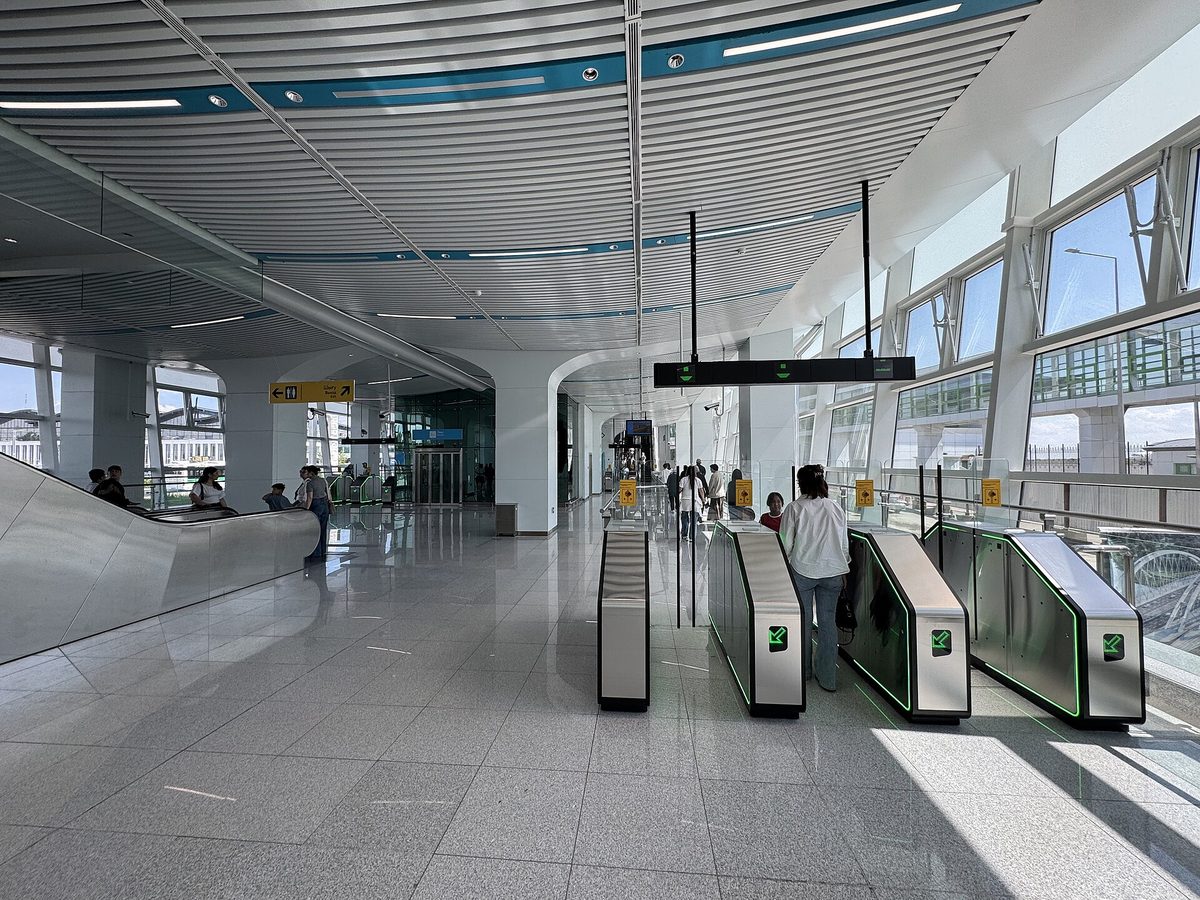
The big news for 2026 is the Astana LRT — an elevated, driverless light-metro that finally opened on 16 May 2026 after years of stop-start construction. Line 1 runs from the airport (the station is signed “Äuejai,” which simply means “airport”) all the way to the Nurly Zhol railway station: about 22.4 km, 18 stations, and roughly 40 minutes end to end.
What makes it genuinely useful for a visitor is the route. It threads along the spine of the city, passing near Baiterek, the National Museum, and the Grand Mosque, so for a lot of central hotels it can drop you within walking distance of your bed. Trains run roughly every 5–6 minutes, from about 06:00 to 23:00, and the fare has been reported at around 200 tenge — well under a dollar — paid by transport card, bank card, an NFC tap, or a QR code.
One honest caveat, because this line is brand new: when you land, check that the walk from the terminal to the LRT platform, and the luggage setup on the trains themselves, actually suit you before you commit — especially if you are hauling big suitcases or travelling with kids. It is a fantastic option in principle and probably the cheapest way in, but give it a look with your own eyes on arrival rather than assuming. For the bigger picture of trains, planes, and buses across the country, our guide to getting around Kazakhstan is worth a read before you go.
Taxi and ride-hailing
My default, honestly, is a ride-hailing app. Download Yandex Go or inDrive before you fly — both work well in Astana — and book from the app rather than accepting a ride from anyone who approaches you in arrivals. In the app you will usually pay somewhere around 1,300–2,600 tenge, roughly 3 to 5.50 US dollars, to the centre, and you see the exact price before you confirm the ride.
The official airport-rank taxis are a different story. Expect around 4,000–4,500 tenge — roughly 8.50 to 9.60 dollars — and sometimes more if you do not agree the fare first. The drivers who walk up to you offering a “good price” are the ones to be wary of: smile, say no thanks, and open your app instead. If your eSIM has not kicked in yet, the terminal has free Wi-Fi you can use to book your first ride.
Public buses 10 and 12
If you are travelling light and counting tenge, city buses 10 and 12 stop near Terminal 2 and run into the centre, passing landmarks like Khan Shatyr and Baiterek on the way toward the Astana-1 railway station. Reckon on about 45 minutes and a fare of around 200 tenge — the cheapest ride into town by a wide margin.
The catch is payment, which I will come back to in a moment: Astana’s buses do not take cash at all. You will need to tap a Transcard, use the Avtobys app, or carry a tourist transport card. It is a great budget option once you are set up, but do not count on hopping aboard with a fistful of coins.
Private transfers and hotel pickups
Plenty of hotels will arrange an airport pickup if you ask when you book, and there are private transfer companies that meet you at arrivals holding a name board. You will pay more than a Yandex Go — often somewhere around 8,000–12,000 tenge depending on the vehicle — but for a late-night arrival, a first trip to Kazakhstan, or a group with luggage, that certainty can be worth every extra tenge. I have used a pre-booked transfer after a brutal red-eye and been very glad not to think about anything at all.
Car rental
There are car-rental desks at the airport, and Astana is easy to drive in — wide, flat, gridded streets and generally light traffic by big-city standards. That said, I rarely bother inside the city, because taxis are cheap and a parked car you do not need is just a hassle. Rent one if you are planning to drive out to Burabay or explore the steppe under your own steam; otherwise, skip it and use apps.
Cost and time compared
Here is the quick version. Everything below is approximate, in tenge, and worth double-checking against live prices when you arrive.
| Option | Approx. fare | Time to centre | Notes |
|---|---|---|---|
| LRT light-metro | ~200 tenge | ~40 min end to end | Cheapest; brand new, check luggage setup |
| Taxi via Yandex Go / inDrive | ~1,300–2,600 tenge | ~25–30 min | Best all-rounder; book in the app |
| Airport-rank taxi | ~4,000–4,500 tenge | ~25–30 min | Pricier; agree the fare first |
| Bus 10 or 12 | ~200 tenge | ~45 min | No cash on board; needs a transport card |
| Private transfer | ~8,000–12,000 tenge | ~25–30 min | Meet-and-greet; good for late arrivals |
| Car rental | Varies | ~25–30 min | Only worth it for trips out of town |
Your first hour in Astana
The stretch between the baggage carousel and your hotel bed is where most trips wobble. Here is how to smooth it out, step by step.
SIM cards and eSIM
The easiest move is to sort a data plan before you even land. An eSIM from a provider like Airalo or Yesim gets you online the moment you clear passport control, which means you can book a taxi and message your hotel straight away. If you would rather buy a local physical SIM — Beeline, Kcell/Activ, and Tele2 are the big names — you can pick one up in the city, usually with your passport, and it is cheap. For a short visit, though, an eSIM saves you the queue and the fuss.
Money, Kaspi, and ATMs
Kazakhstan’s currency is the tenge, and in mid-2026 you are looking at roughly 470 tenge to the US dollar — handy for quick mental math, since you just divide the price by about 470. There are ATMs in the terminal; I would take out a modest amount of cash for incidentals and lean on cards for everything else.
One thing worth understanding early: locals run almost everything through Kaspi, a payments super-app that is woven into daily life here. As a visitor you generally cannot sign up without a local number and ID, but you rarely need to — international Visa and Mastercard are widely accepted, and contactless works in most places. The one spot where plastic-or-nothing bites is public transport, so read the next section before you try to board a bus.
Passport control and visa-free entry
Many nationalities enter Kazakhstan visa-free for stays of up to 30 days, which makes arrival refreshingly simple: you clear passport control and you are through. Rules do change and they vary by nationality, so confirm your own situation before you fly using our up-to-date Kazakhstan visa guide. Have your hotel’s address handy in case you are asked at the desk, and hang on to any registration paperwork your hotel gives you afterwards.
Paying for transport
This one trips up a lot of first-timers, so file it away now. Astana uses the Transcard / Avtobys system — a tap card or a phone app — for its buses and the new LRT. It is not the Onay card; that is Almaty’s system, and the two do not mix. And there is no cash on buses at all, full stop.
The good news for 2026 is that tourist multi-trip transport cards are now sold at the airport. Last I checked, they ran about 1,550 tenge for 5 trips, 2,110 for 10, and 2,650 for 15. Grab one on your way out if you plan to touch a bus or the metro, and you have skipped the whole payment headache in one go.
Getting around Astana
Once you are settled, Astana is an easy city to move around — flat, orderly, and now with a proper rail spine down the middle of it.

The LRT
The same Line 1 that brings you in from the airport is also your fast way along the city’s main axis. If your day runs between the Left Bank government district and the Nurly Zhol station, the LRT is quick and cheap. It is brand new, so services and stations are still bedding in, but it is already the most painless way to cover that central stretch.
City buses
Astana’s bus network is genuinely extensive and cheap — around 200 tenge a ride — and it reaches everywhere the metro does not. Use a maps app with transit directions, tap your Transcard or the Avtobys app, and you are away. Buses are how most locals get around, and once you have the payment sorted they are hard to beat for value.
Taxis: Yandex Go and inDrive
Inside the city, ride-hailing stays cheap. Yandex Go and inDrive are the two apps to keep on your phone. inDrive lets you name your own price and haggle a little, while Yandex Go is more point-and-go. Short hops across the centre often come in under 1,000 tenge, and I lean on these constantly — especially when it is cold and I would rather not wait outside.
Is there a metro?
Not in the traditional sense. Astana has no old-style underground heavy metro. The new elevated LRT is the rail option, and it is the closest thing the city has to a metro line. So if someone tells you to “take the metro,” they almost certainly mean the LRT.
Walking Nurzhol Boulevard
For all its size, central Astana is walkable, and the showpiece stroll is Nurzhol Boulevard — the landscaped pedestrian axis running between Baiterek and the Ak Orda, lined with fountains and the city’s signature architecture. On a decent-weather day it is the nicest way to see the Left Bank on foot. Pair it with our Astana itinerary to string the highlights together, and when hunger hits, our roundup of where to eat in Astana points you to the good tables.
Bikes and e-scooters
In the warmer months you will find bike-share stations and app-based e-scooters around the centre, which are a fun way to cover the wide boulevards. They vanish in winter for obvious reasons, so treat them as a summer perk rather than a plan you build your day around.
Getting around in winter
Speaking of which — Astana winters are no joke. This is one of the coldest capital cities on earth, with long spells well below freezing and a wind that finds every gap in your coat. My rule from November to March is simple: do not stand waiting at a stop. Book a taxi from inside a warm lobby using the app, or duck straight into the LRT, and keep your outdoor waits short. Dress for it properly — real layers, a proper hat — and the cold becomes part of the adventure rather than a misery.
Onward travel and day-trip hubs
Astana is a natural launch pad for the rest of the country, and the airport is far from your only way out of the city.

Nurly Zhol railway station
Nurly Zhol is the capital’s grand main railway station — and, conveniently, the eastern terminus of the LRT, so you can ride the metro straight from the airport to your train. From here, Kazakhstan’s Talgo and Tulpar-Talgo trains fan out across the country: overnight to Almaty, west toward Aktobe, and well beyond. The trains are comfortable, affordable, and a genuinely pleasant way to cover the country’s vast distances. It is one of my favourite things about travelling in Kazakhstan.
Intercity buses
For shorter hops, intercity buses run to popular spots like Burabay — also spelled Borovoe — the lakes-and-pines resort area a few hours north that locals escape to on weekends, and to nearby Kosshy. Buses are cheaper than the train and run frequently, if less scenically. If Burabay is on your list, it makes an easy overnight or a long day trip from the capital.
Practical tips
A few last things I have learned, mostly the hard way:
- Book your ride in the app before you leave the arrivals hall — not after a stranger offers you one.
- Buy a tourist transport card at the airport if you will touch a bus or the LRT; cash does not work on board.
- Set up an eSIM before you fly so you land already online and can order a taxi immediately.
- Keep the airport’s free Wi-Fi in mind as a backup for booking that first ride.
- Treat every fare and timetable here as approximate, and check current prices and hours — this city changes fast, and the LRT especially is still very new.
- Screenshot your hotel’s address in Cyrillic to show a driver if there is any language gap.
- In winter, wait indoors and time your outdoor dashes; the cold is real and unforgiving.
- Flying onward via Almaty? Our Almaty airport guide covers that end of the trip.
Frequently asked questions
How do I get from Astana airport to the city centre?
You have five main options: the new LRT light-metro, a ride-hailing taxi via Yandex Go or inDrive, public buses 10 and 12, a pre-booked private transfer, or a rental car. For most visitors I would book a Yandex Go — around 1,300–2,600 tenge and 25–30 minutes — or try the LRT if its luggage setup suits you on the day.
How much is a taxi from Astana airport to the city?
Booked through Yandex Go or inDrive, expect roughly 1,300–2,600 tenge, about 3 to 5.50 US dollars, to the centre. The official airport-rank taxis charge more — around 4,000–4,500 tenge — and drivers who approach you in arrivals often charge more still, so book in the app and skip the touts. Prices are approximate, so check the app for your live fare.
Does the Astana LRT go to the airport?
Yes. Line 1 of the Astana LRT, which opened in May 2026, runs directly from the airport station (“Äuejai”) to the Nurly Zhol railway station — about 22.4 km and 18 stations, roughly 40 minutes end to end, for a fare of around 200 tenge. Because it is brand new, check the terminal-to-platform walk and the luggage arrangements before you rely on it.
How far is Astana airport from the city centre?
Astana airport is about 16–17 km southeast of the city centre. By car that is roughly 25–30 minutes in normal traffic, though it can stretch out in rush hour or rough winter weather. The LRT covers the wider route across the city in about 40 minutes end to end.
What is the airport code for Astana?
The IATA code is NQZ and the ICAO code is UACC. The airport’s full official name is Nursultan Nazarbayev International Airport. It kept both that name and the NQZ code even after the city changed its own name back from Nur-Sultan to Astana in September 2022.
Is there a bus from Astana airport, and how do I pay?
Yes — city buses 10 and 12 stop near Terminal 2 and run into the centre in about 45 minutes for around 200 tenge. There is no cash on board: Astana uses the Transcard / Avtobys system, a tap card or the Avtobys app, not Almaty’s Onay card. Tourist multi-trip cards are sold at the airport, so buy one before you try to board.
Does Astana have a metro?
Not a traditional underground one. Astana’s rail option is the new elevated, driverless LRT light-metro, which opened in 2026 and runs from the airport across the city to Nurly Zhol station. So when locals say “metro,” they mean the LRT — there is no old-style subway here.
Final thoughts
Astana can feel daunting on paper — an unfamiliar capital, a language written in Cyrillic, temperatures that swing from summer heat to a deep-freeze winter — but the airport-to-city journey is one of the easiest parts of the whole trip. Sort an eSIM, download Yandex Go or inDrive, grab a transport card if you will ride the buses or the shiny new LRT, and you will be checking into your hotel within half an hour of clearing passport control. Everything else — the towers, the steppe, the trains out to the rest of the country — is the fun part. Land, take a breath, and go enjoy the capital.
Next, sort out getting around Almaty too, and slot the capital into a full Kazakhstan itinerary.
Photo credits
Airport rail-link concourse: Kristianmusic (CC0). Air Astana aircraft: Aeroprints.com (CC BY-SA 3.0). Tulpar-Talgo train: Matti Blume (CC BY-SA 4.0). Astana at night: Matti Blume (CC BY-SA 4.0). All via Wikimedia Commons.


1 comment