Contents
- Almaty airport at a glance
- The two terminals — which one will I use?
- Arrivals step by step
- Getting a SIM card at Almaty airport
- Money — currency exchange and ATMs
- Getting from Almaty airport to the city
- Arriving late at night
- Practical arrival tips (a checklist)
- Frequently asked questions
- Final thoughts
I’ve landed at Almaty several times now, and I still remember the first arrival: a flight touching down past midnight, a slow passport queue, and a knot of men by the exit murmuring “taxi, taxi, cheap price, my friend.” I got out fine — but only because I’d done my homework on the plane. This guide is that homework.
Almaty airport (code ALA) sits about 15 km north-east of the city centre. The easiest way in is the Yandex Go or inDrive app — roughly 2,500–7,500 KZT (around US$5–16) and about 35 minutes to the centre. There’s also the number 92 bus, or an official taxi desk if you’d rather skip the app.
Almaty is Kazakhstan’s largest city and its former capital — the political capital is Astana, up north, with its own separate airport — but Almaty is where most visitors land, and it’s the natural launch pad for the wider list of things to do in Almaty. Get the arrival right and the rest of the trip flows from it.
Almaty airport at a glance
| Getting to the city | Rough price | Time to centre | Best for |
|---|---|---|---|
| Yandex Go / inDrive app | 2,500–7,500 KZT (US$5–16) | ~35 min | Almost everyone — cheapest reliable door-to-door |
| Official airport taxi desk | Around 9,000 KZT (US$19) | ~35 min | No app, no SIM, fixed price up front |
| Airport bus 92 (day) / bus 3 (night) | ~100–120 KZT with Onay card | ~40–45 min | Budget travellers, light luggage, daytime |
| Pre-booked private transfer | From ~US$20–30 | ~35 min | Groups, late flights, wanting a name-board pickup |
Approximate exchange rate throughout: around 475 KZT to US$1. Prices in Kazakhstan move and surge pricing is real, so treat every number here as a ballpark, not a promise, and check current fares in the app when you land.
A few quick facts to orient you. Almaty International Airport is the busiest in Kazakhstan and in all of Central Asia — it handled somewhere around 11.4 million passengers in 2024 — and it’s run by the Turkish operator TAV, which also runs a string of airports across the region. It’s the main hub of Air Astana, the national carrier, so if you’re flying in from Europe, the Gulf, Istanbul, or elsewhere in Asia, there’s a decent chance this is where you’ll touch down. The three-letter code ALA is the one to punch into flight searches; don’t confuse it with the capital’s airport up in Astana.
The airport is close to town by the standards of most big cities — 15 km is nothing — but Almaty traffic can be genuinely awful at rush hour, so that “35 minutes” figure stretches to an hour or more if you land at 6pm on a weekday. Off-peak, especially in the small hours when a lot of long-haul flights arrive, the roads are empty and you’ll be at your hotel fast.
The two terminals — which one will I use?
This trips people up, so let’s be clear. Almaty airport now has two terminals sitting right next to each other, and which one you use depends entirely on whether your flight is international or domestic.
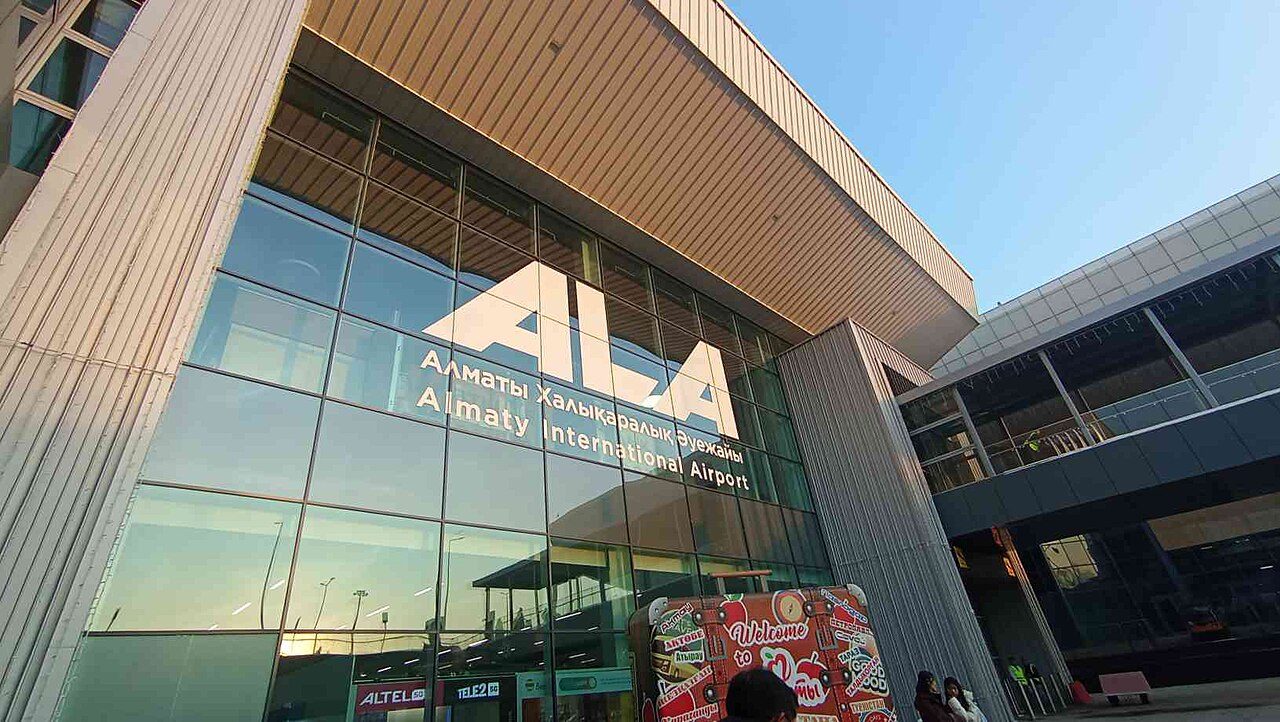
Terminal 2 is the shiny new one. It opened on 1 June 2024 and handles all international flights — so if you’re flying in from abroad, this is where you’ll arrive. It’s a proper modern building: 50 check-in desks, around 20 passport-control booths, and a handful of automated e-gates. After years of Almaty’s cramped old international hall, this was a huge upgrade, and it shows the moment you walk in. Bright, high-ceilinged, air-conditioned, with clear signage in Kazakh, Russian and English.
Terminal 1 is the older building, dating from 2003, and it now handles domestic flights only — Astana, Shymkent, Aktau, Atyrau and the rest of the internal network. If you’re connecting onward to another Kazakh city, or you arrive on a domestic hop, this is your terminal.
The good news: the two terminals sit side by side and are joined by an indoor bridge, so moving between them is a short covered walk rather than a shuttle bus across the tarmac. If you land internationally in Terminal 2 and have a domestic connection out of Terminal 1, you can walk it in a few minutes — though do leave a sensible buffer, because you’ll re-clear security for the domestic leg.
For a first-time international visitor, the practical takeaway is simple: you arrive in Terminal 2, and everything in the next few sections — passport control, baggage, SIMs, the taxi rank — happens there.

Arrivals step by step
Here’s exactly what happens between the aircraft door and the taxi, in order, so nothing surprises you.
Passport control
You’ll follow the “Arrivals” signs down to passport control. There are automated e-gates in Terminal 2, but — and this matters — they aren’t open to all foreign nationalities yet, so unless you’re told otherwise, expect to queue for a staffed booth. The officer scans your passport, sometimes takes a photo, occasionally asks where you’re staying, and stamps you in. It’s usually quick and undramatic. On a busy bank of arrivals, though — when three wide-body flights land within half an hour of each other, which happens a lot late at night — the queue can build. Allow for it.
One thing worth knowing: there’s no paper arrival card to fill in. Some countries still hand you a little immigration form on the plane; Kazakhstan doesn’t. You just present your passport.
Baggage and customs
Past passport control you collect your checked bags from the carousel, then walk out through customs. Like most airports it’s a green channel / red channel system: if you have nothing to declare — no large sums of cash, no goods over the duty limits — you walk straight through the green channel and nobody stops you. If you’re carrying something declarable (a big wad of foreign currency over the reporting threshold is the usual one), you take the red channel. For the vast majority of tourists, it’s green, and you’re out.
Do I need a visa?
For a lot of travellers, no. Citizens of around 80 countries — all of the EU, plus the USA, UK, Canada, Australia, Japan, South Korea and many more — can enter Kazakhstan visa-free for 30 days. You just turn up with a valid passport and get stamped in. US citizens have a specific rule to note: 30 days maximum per entry, and no more than 90 days total in any 180-day period.
Visa rules change, and they’re nationality-specific, so please check your own country’s current status before you fly — our full Kazakhstan visa guide lays out who’s covered and what the exceptions are. Don’t take my word for it against your actual passport; verify.
The registration rule (good news)
Here’s one that used to genuinely stress people out, and no longer should. It used to be that on arrival you had to register yourself with the Migration Police within a few days — a bureaucratic errand that ate half a day. Since January 2020, that self-registration requirement is gone for most visitors. Now your hotel or host reports your arrival to the authorities (they have three working days to do it), so as long as you’re staying in a hotel or a properly registered guesthouse, it’s handled for you and you do nothing.
The only wrinkle is if you’re staying somewhere informal — with friends, or in a private rental where the host doesn’t register you — in which case you may need to sort registration yourself. If in doubt, ask your accommodation directly when you check in whether they’ll register you. Most hotels do it automatically.
How long should I allow?
For a busy international arrival — the passport queue, waiting for bags, walking out — allow about an hour from wheels-down to stepping outside. Off-peak it can be half that. If someone’s meeting you or you’ve booked a transfer, tell them to expect you roughly an hour after landing rather than the moment the plane touches down.
Getting a SIM card at Almaty airport
Get a local SIM and everything else on this list gets easier — the taxi apps, the maps, the translation, all of it runs on mobile data. Almaty airport makes this straightforward: you can buy a SIM right there in the Arrivals hall.
The three carriers you’ll see are Kcell, Beeline and Tele2, usually as staffed counters and sometimes vending machines. Any of them is fine for a tourist; coverage in Almaty and the main cities is good and 4G in town is genuinely fast. Expect to pay somewhere around US$4–12 for a starter package with a chunk of data, depending on how much you want.
The one thing you must have: your passport. Kazakhstan requires SIM cards to be registered to an ID, so the counter staff will scan your passport and register the SIM to you on the spot. It only takes a couple of minutes, but you cannot get a working SIM without your passport in hand — so don’t pack it away at the bottom of your bag before you reach the counter.
If your phone supports it, an eSIM bought before you fly is a great alternative. You install it at home, land with data already working, and skip the counter entirely — which is especially handy on a late arrival when you just want to open the taxi app and go. Providers like Airalo and others sell Kazakhstan eSIMs; buy it a day before you travel and test it. If you go the eSIM route, you can walk straight past the SIM counters.
Money — currency exchange and ATMs
You’ll want some tenge in your pocket before you leave the terminal, if only for a bus fare or a bottle of water. Almaty airport has both currency-exchange desks and ATMs in the Arrivals area, and they run 24/7, so even a 3am landing is covered.
The catch — and it’s the same at airports the world over — is that airport exchange rates are usually worse than city banks. My rule is to change just a little at the airport to get moving (enough for a taxi and the first day), then change more, or simply use ATMs, once I’m in town where the rates are better. Almaty has plenty of bank branches and exchange kiosks with sharper rates.
At the ATMs, one small trick that saves real money: when the machine asks whether to charge in tenge or in your home currency, always choose tenge. If you let the ATM convert to your home currency (“dynamic currency conversion”), it uses a lousy rate and you lose a few percent. Choosing tenge lets your own bank do the conversion, which is nearly always better. This applies everywhere in the country, not just the airport.
Cards are widely accepted in Almaty — it’s a surprisingly cashless city — so you don’t need a fat stack of tenge. Enough to cover transport and the odd cash-only spot is plenty.
Getting from Almaty airport to the city
This is the section most of you came for. The good news is that getting from Almaty airport to the city is cheap and easy if you know the drill — and there’s one big trap to avoid, which I’ll flag loudly. Here are your options, best first.

Yandex Go and inDrive (the app you want)
For most travellers, Yandex Go is the answer — think of it as the region’s Uber. It’s cheap, reliable, and it removes all the haggling. inDrive is the popular alternative, where you can even name your own fare and drivers accept or counter. Either app will get you from the airport to the city centre for roughly 2,500–7,500 KZT (around US$5–16), in about 35 minutes depending on traffic and surge. That’s a fraction of what the touts will quote you.
To use it you need mobile data (see the SIM section above) and the app installed. Order the car, note the plate and the driver’s name, and walk out to the pickup point — the app will show you where. In practice the airport has a designated ride-hailing pickup area; follow the app’s map and any signage. If you’ve sorted an eSIM, you can order your ride before you’ve even left the baggage hall.
These same apps are what you’ll use to get around the city for the rest of your stay, so it’s worth getting comfortable with one on day one. Our guide to getting around Almaty goes deeper on Yandex, the metro, buses and the Onay card once you’re settled in.
The official taxi desk — and the touts (read this)
If you don’t want to deal with an app, there’s an official airport taxi desk where you book a car at a fixed, posted price — expect around 9,000 KZT (roughly US$19) to the centre. It’s more than the app, but it’s legitimate, the price is agreed up front, and there’s no surprise at the other end. Perfectly fine if you’ve just landed with no SIM and no patience.
Now the warning, and I mean this one. As you walk out of Arrivals, men will approach you offering a taxi — “taxi? city? cheap, my friend.” Ignore them. These touts routinely quote several times the going rate to a fresh-off-the-plane foreigner, and there are stories of fares ballooning further mid-ride. This is the single most common way visitors get fleeced at Almaty airport. Don’t engage, don’t get talked into “a special price,” and don’t follow anyone to an unmarked car in the car park.
Instead, do one of two things: book through Yandex Go / inDrive, or use the official taxi desk inside the terminal. Both are safe and priced honestly. This isn’t scaremongering — it’s the one bit of arrival savvy that separates a smooth landing from an annoying one. For a broader picture of common scams and staying street-smart, our guide on whether Kazakhstan is safe covers the taxi-tout trick and a few others worth knowing.
Airport bus 92 and night bus 3
If you’re travelling on a budget with light luggage, the public bus is almost comically cheap. The number 92 bus runs from the airport into the centre — it heads to Abay Avenue, a central spine of the city — and takes about 40–45 minutes. There’s a night service, bus 3, that covers the route in the evening hours. The fare is only around 100–120 KZT — that’s a quarter of a US dollar to get into town.
The one thing you must sort first: Almaty buses take the Onay card only, and they don’t take cash. The Onay app rejects most foreign bank cards, so the move is to buy a physical Onay card at the airport kiosk before you board, and load it with a little credit. Then you just tap on. Without an Onay card you can’t pay the fare, so don’t skip this step and end up stranded at the bus stop.
Be honest with yourself about luggage, though. Wrestling two big suitcases onto a city bus, possibly standing, is no fun after a long flight — the bus shines for solo travellers or couples with a backpack each. The same Onay card carries over to buses and the metro across the city, so it’s a worthwhile buy either way if you’re staying a while. More on that in our getting around Almaty guide.
Pre-booked private transfers
If you’d rather have someone waiting with a name-board — no queue, no app, no haggling — you can pre-book a private transfer through your hotel or an online service. It costs more than the app (from around US$20–30, depending on the vehicle and provider), but for a group splitting the cost, a very late arrival, or a first trip where you just want zero friction, it can be money well spent. Your hotel is often the easiest place to arrange one; ask when you book the room. If you’re still sorting where to base yourself, our guide to where to stay in Kazakhstan can help you pick a neighbourhood before you lock in a transfer.
Arriving late at night
You should assume you might. A lot of flights into Almaty — especially long-haul and connecting services — land after midnight. My first arrival was gone 1am, and that’s completely normal here. So plan for it.
The reassuring part: Yandex Go and inDrive still work through the night. The apps run 24/7, and because the roads are empty at that hour, the ride into town is quick — often the fastest transfer of the day, even if surge pricing nudges the fare up a little. This is the main reason a pre-installed eSIM is so handy on a late flight: you land, open the app, order, and you’re gone.
The thing that does not run late is the airport bus. The number 92 and night bus 3 stop running in the evening — last departures somewhere around 21:00–23:00, though timings shift, so don’t bank on catching a bus after a midnight landing. If you’re arriving late, plan on a taxi (app or official desk), not the bus.
A few late-night pointers: have your accommodation address saved offline and, ideally, written in Russian or Kazakh to show the driver; keep a little tenge for emergencies even if you plan to pay by app; and if you’re heading to a guesthouse, message ahead to confirm someone can let you in at that hour. Sorted in advance, a 2am arrival in Almaty is genuinely smooth.
Practical arrival tips (a checklist)
Everything above, boiled down to the things I actually do on the plane and in the terminal:
- Before you fly: check your nationality’s visa-free status; consider buying a Kazakhstan eSIM and testing it; save your hotel address offline in Russian/Kazakh.
- Keep your passport out until you’ve cleared passport control, bought a SIM, and reached your accommodation — you’ll need it for the SIM registration especially.
- Allow about an hour to clear a busy arrival; tell anyone meeting you to expect you an hour after landing.
- Get connected first: buy a Kcell/Beeline/Tele2 SIM at the counter (passport required), or switch on your eSIM.
- Change a little money at the 24/7 exchange or ATM to get going — pick “charge in tenge” — then more in town.
- Buy an Onay card at the kiosk if you plan to use the bus or city transport.
- Ignore the taxi touts. Book Yandex Go / inDrive, or use the official taxi desk. Never follow a stranger to an unmarked car.
- Late arrival? Assume the bus has stopped; plan on an app taxi and confirm your check-in time with the hotel.
Do those eight things and you’ve handled 95% of what can go sideways on arrival. Once you’re through the doors, the fun part starts — and if you’re still shaping your days, our Almaty itinerary and the broader things to do in Kazakhstan will point you at the good stuff. For onward travel between cities, the getting around Kazakhstan guide covers trains, domestic flights and the long-distance options.
Frequently asked questions
How do I get from Almaty Airport to the city centre?
The easiest way is the Yandex Go or inDrive app — roughly 2,500–7,500 KZT (US$5–16) and about 35 minutes to the centre. You’ll need mobile data, so grab a SIM or use an eSIM. Alternatively, use the official taxi desk for a fixed fare, or the number 92 bus for around 100 KZT if you have an Onay card and light luggage.
How much does a taxi cost from Almaty Airport to the city?
Via the Yandex Go or inDrive apps, expect roughly 2,500–7,500 KZT (about US$5–16) to the centre, depending on traffic and surge pricing. The official airport taxi desk is pricier at around 9,000 KZT (US$19) for a fixed, agreed fare. Ignore the touts inside the terminal, who routinely quote several times the going rate to arriving foreigners.
Is there public transport from Almaty Airport to the city?
Yes. The number 92 bus runs to Abay Avenue in the centre in about 40–45 minutes, with a night service (bus 3) in the evening hours. The fare is only around 100–120 KZT, but buses take the Onay card only — no cash — so buy a physical Onay card at the airport kiosk first, as the app rejects most foreign bank cards.
Is Almaty airport modern?
The international side certainly is. Terminal 2 opened on 1 June 2024 and handles all international flights — a bright, modern building with 50 check-in desks, around 20 passport booths and some automated e-gates. The older Terminal 1, from 2003, now handles domestic flights. The two sit side by side, joined by an indoor bridge, so connecting between them is a short covered walk.
Do I need to register my SIM card in Kazakhstan?
Yes — SIM cards in Kazakhstan must be registered to a passport or ID. When you buy one at the airport from Kcell, Beeline or Tele2, the counter staff scan your passport and register it on the spot, which takes a couple of minutes. So keep your passport handy at the counter. An eSIM bought before you fly skips the queue entirely if your phone supports it.
Can I exchange money at Almaty airport at night?
Yes. The currency-exchange desks and ATMs in the Arrivals area run 24/7, so even a 3am landing is covered. Airport rates are usually worse than city banks, though, so change just a little to get going and do the rest in town. At ATMs, choose “charge in tenge” rather than your home currency for a better rate.
How long does it take to get from Almaty airport to the city?
By taxi or ride-hailing app it’s about 35 minutes to the centre, since the airport is only around 15 km out. That said, Almaty’s rush-hour traffic can stretch it to an hour or more, while a late-night run on empty roads is quicker. The number 92 bus takes a bit longer, roughly 40–45 minutes, with stops along the way.
Where do I get a taxi at Almaty airport?
Use the Yandex Go or inDrive app and walk to the designated ride-hailing pickup point the app shows you, or book at the official taxi desk inside the terminal for a fixed fare. Do not accept rides from the touts who approach you in Arrivals — they overcharge heavily. Only use the app or the official desk, and never follow a stranger to an unmarked car.
Final thoughts
Almaty airport is an easy arrival once you know the shape of it, and it’s come a long way — the new Terminal 2 is a genuinely pleasant place to land, and the whole process from plane to taxi is quicker and calmer than the reputation of the old hall might suggest. The essentials never change: keep your passport out, get connected with a SIM or eSIM, change a little money, and know how you’re getting into town before you walk out the doors.
And if you remember only one thing from this whole guide, make it this — ignore the taxi touts, and use Yandex Go, inDrive, or the official desk instead. That single habit saves the most money and the most hassle of anything here. Do that, and Almaty welcomes you properly.
From the terminal, the city opens up fast. Our things to do in Almaty guide has the highlights, the Almaty itinerary maps out your days, and getting around Almaty takes over exactly where this guide leaves off. Welcome to Kazakhstan — you picked a good place to start.
Photo credits
Images via Wikimedia Commons: Almaty airport terminal by YangApinat / CC BY-SA 4.0; Airport check-in hall by DS28 / CC BY-SA 4.0; Almaty skyline by Dauren Nabijan (CC0). Reused under their respective CC0/CC BY/CC BY-SA licences.