Contents
- Kazakhstan etiquette is not one thing — it is three
- Greetings
- Visiting a Kazakh home
- Tea, and the half-full cup
- Beshbarmak and the sheep’s head
- Respect for elders, and how you hold your body
- Religion in practice: Muslim, secular, and both at once
- Bread: the rule nobody will explain to you
- Photography etiquette
- What not to do in Kazakhstan
- Business and social norms
- Frequently asked questions
- Final thoughts
Almost every guide to Kazakh etiquette I have read makes the same mistake. It takes a set of customs — some universal, some rural and ceremonial, some genuinely archaic — flattens them into a single list of rules, and hands it to you as though twenty million people across a country the size of Western Europe all behave identically. They do not. A grandmother in a village outside Turkestan and a twenty-four-year-old barista in Almaty share a culture, not a rulebook.
The direct answer: Kazakhstan etiquette rests on three things — respect for elders, extraordinary hospitality toward guests, and shoes off at the door. Greet the oldest person first, arrive with something small in your hands, accept the tea, and do not be surprised when your cup is only half full. That is deliberate, and it is a kindness.
| Situation | What to do |
|---|---|
| Meeting someone | Handshake between men, often two-handed; greet elders first |
| Greeting a woman | Let her offer her hand first; a nod is fine if she does not |
| Entering a home | Shoes off; slippers will be offered |
| Bringing a gift | Sweets, fruit, cake or tea. Never arrive empty-handed |
| Where to sit | Wait to be seated — the seat furthest from the door is for elders and guests |
| Tea | Accept it. Half-full cup is correct. Hand over the cup to signal enough |
| Bread | Tear it, never turn it upside down, never bin it in front of anyone |
| Photographs | Ask first, especially with older people and at religious sites |
| At a mosque | Shoulders and knees covered, shoes off, headscarf for women (usually provided) |
Kazakhstan etiquette is not one thing — it is three
Before the rules, the framework. It will save you from being the visitor who solemnly performs a custom nobody in the room has practised for thirty years.
What everyone does, everywhere
Shoes off in homes. Respect for elders — greeting them first, letting them speak first, giving them the good seat. Feeding guests, immediately and abundantly. Not refusing hospitality outright. Treating bread with a small, automatic reverence. These hold in a Nauryzbay high-rise and a Kyzylorda village equally.
What you will only meet at a celebration or in the countryside
The full ceremonial apparatus: the sheep’s head and the distribution of its parts, the blessing recited by the eldest at the end of a meal, the yurt taboos, the toastmaster running a wedding with an iron hand. These are real and alive, and you will encounter them at a toy — a family celebration — or as a guest in a village. You will not encounter them over lunch in a Almaty café.
What a young Almaty professional finds charmingly old-fashioned
Some of the customs in the older guidebooks — the elaborate rules about which cut of meat goes to which relative, the specific superstitions, the strict gendered greeting protocol — sit in the same cultural drawer as a British person’s knowledge of which fork to use. Known, respected, occasionally deployed, mostly dormant.
Regional variation is real and measurable. The 2021 census put Kyzylorda region at 96 per cent Muslim and Turkistan region at 92 per cent — but North Kazakhstan region at 39 per cent Muslim and 55 per cent Christian. Almaty city sits at around 58 per cent. Same country, very different rooms.
Greetings
The handshake
The standard greeting between men is a handshake, frequently with both hands — your right hand shaking, your left resting on top or on their forearm. The grip is gentle rather than firm; a crushing handshake reads as aggressive, not confident. Shake again when you leave, and again each time you meet the same person during a day.
You will often see the handshake accompanied by the left hand placed over the heart and a slight bow. When men are not shaking hands at all — passing an elder in the street, giving thanks, saying farewell across a room — the gesture is the right hand on the chest with a small nod. It is a lovely, economical gesture and entirely appropriate for a visitor to use.
Which greeting to say
Сәлеметсіз бе (sa-lem-et-SIZ be) is the respectful form to one person — use it with anyone older than you, and in shops. Сәлеметсіздер ме is the plural. Сәлем (sa-LEM) is the casual “hi” between friends and peers. Assalaumagaleikum, with the reply Wa-alaikum as-salam, is widespread, particularly man to man and toward elders. Our guide to language in Kazakhstan has more phrases and the Russian equivalents.
Greeting women
In more traditional and observant households, men often do not offer their hand to a woman. The convention is that the woman extends her hand first if she wishes to shake, and no offence is meant if a handshake is not returned. Women greeting women verbally is normal; close friends and relatives hug and kiss on the cheek.
Important caveat, because most guides omit it: in professional settings in Almaty and Astana, mixed handshakes are entirely routine. Read the room rather than the rulebook.
Elders first, always
If you walk into a room with several people in it, greet the oldest person there first. A man entering a home may shake hands with every man present, working from eldest down. Older men are called aksakal — “white beards” — and the deference shown to them is genuine rather than performative. Getting this one right will do more for you than any other item on this page.

Visiting a Kazakh home
If you are invited into a Kazakh home, accept. It is the best thing that will happen on your trip, and refusing an invitation without a real reason is genuinely impolite.
Shoes and gifts
Shoes come off at the door. House slippers are usually offered; if not, socks are fine. Wear socks without holes — this is not a joke, it is the single most common piece of advice Kazakhs give visitors.
Never arrive empty-handed. Sweets, fruit, a cake, good tea, or a small souvenir from your own country all work perfectly. If there are children in the house, bring something for them. The gift is not about value; it is about not walking in with your hands swinging.
Where to sit
Wait to be seated. The seat of honour is at the head of the table, furthest from the entrance, and it goes to elders or to the honoured guest. Younger family members sit nearer the door. Guests are placed by a quiet calculus of age, standing and relationship, and your host has already done the maths — let them direct you.
Worth noting, because it differs from some neighbouring cultures: men and women sit at the same table in Kazakhstan. Children may have their own table or join the adults.
How the meal unfolds
A Kazakh feast comes in stages, and knowing the shape of it stops you filling up in the first twenty minutes.
- Tea and the dastarkhan. The low table is laid with baursak, kurt, salads, sweets, jam, dried fruit and bread. This looks like the meal. It is not the meal.
- The meat course. Beshbarmak, or plov, or a plate of boiled meat with kazy. This is the meal.
- Clearing, then dessert with more tea.
Pace yourself at stage one. On Fridays, expect shelpek — round fried flatbread traditionally made that day. If the host breaks off a piece and hands it directly to you, do not refuse it.
Bata, the blessing that closes the meal
At the end, the eldest person present may recite a bata — a short blessing. Guests cup their hands in front of them, bow their heads slightly, and at the end draw their palms down over the face as if washing. Copy what everyone else does; nobody expects you to know the words.
Sarkyt: you are going home with food
When the feast ends you may be handed a parcel of food to take with you, or given a bag and invited to fill it from the table. This is sarkyt, and it is not a polite gesture you should decline. Take it.
Tea, and the half-full cup
This is my favourite thing about Kazakh hospitality and almost nobody explains it properly.
Why your cup is only half full
You will be handed a piala — a small handleless bowl — with tea in the bottom half of it. It looks, to a Western eye, like meanness. It is the opposite.
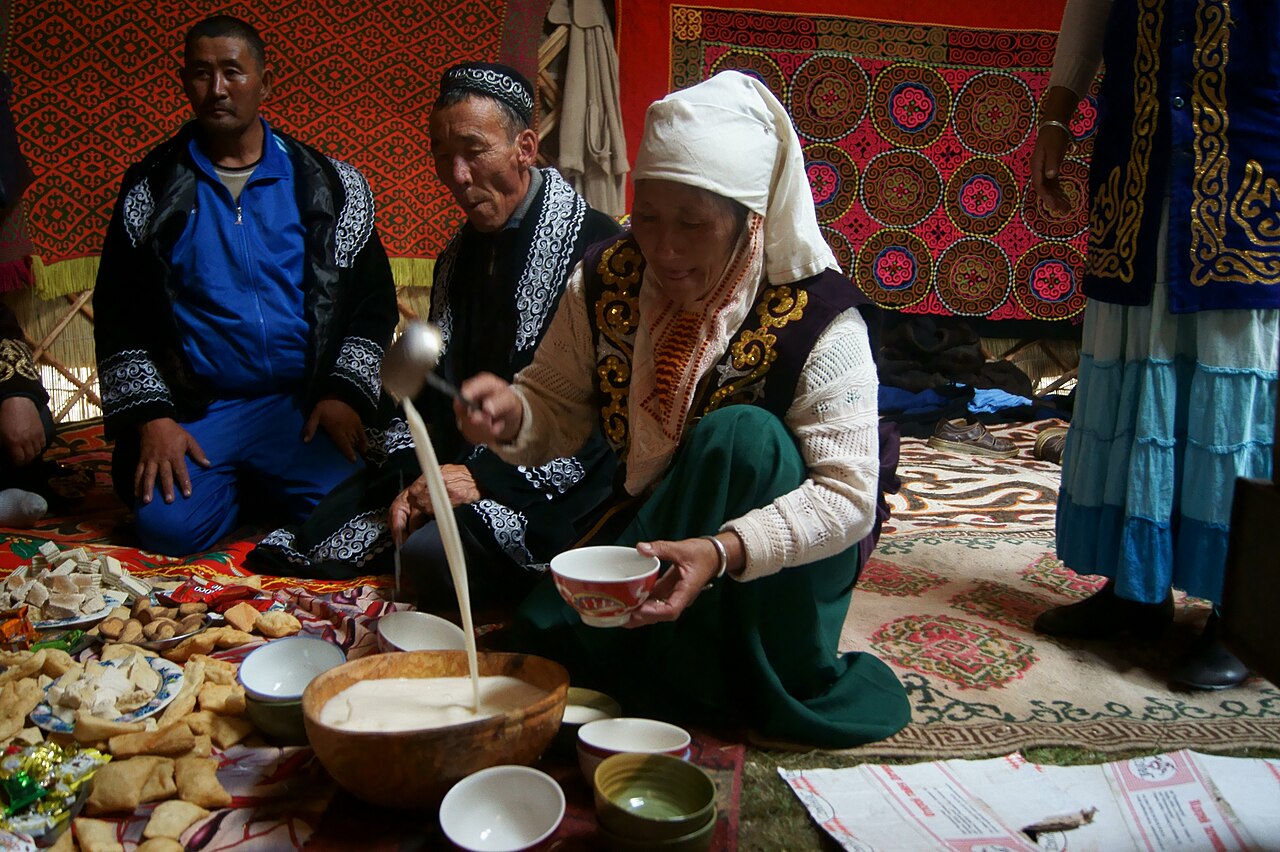
The explanation given in Kazakhstan is care. A small pour means frequent refills, so your tea stays hot and fresh rather than going cold in your hand. It means the bowl is not too hot to hold, and you do not scald your lips. And it means the host keeps coming back to you, which is the point — the refill is the relationship.
Kazakhs call it “pouring tea with respect”. A long-term British resident quoted in the Kazakh press said that when he is genuinely thirsty he now jokes: “without respect, please.”
The other version of the story
You will also read that a cup filled to the brim means the host wants you to leave. That is real, and widely repeated — but it appears mostly in older and foreign-facing guides, while sources inside Kazakhstan lead with the refill explanation. Both are part of the same idea. I would not read a full cup as a hint to go; I would read a half cup as a compliment.
Who pours, and how to stop
Tea is traditionally poured by a woman of the household, often an experienced one; at big gatherings the hostess has help. Pass your empty bowl back to her to be refilled. Asking for more is encouraged. Refusing tea altogether reads as cold.
To signal you have had enough, place your hand over the bowl. You will also read that turning the bowl upside down is the signal — that is traditional, but the hand-over-the-cup gesture is what you will actually see used.
Regional and practical notes
Bowl sizes vary by region — smaller ones in the south and west, larger elsewhere, with hotter regions favouring small, half-filled cups for obvious reasons. Black tea is the default, often with milk; brewed strong with milk it is called kyzyl shai, “red tea”. The kettle is kept hot. Kazakhs do not drink lukewarm tea, and a cooled cup will simply be tipped out and repoured.
Beshbarmak and the sheep’s head
If you are at a serious celebration, the food carries protocol. Our dining etiquette guide goes deeper; here is what you need at the table.
Who portions the meat
When beshbarmak arrives, the eldest member of the family portions the meat out. The guest of honour gets the largest and best pieces. You do not serve yourself from the communal platter until you are given a portion.
The bas — an honour, not a test
The boiled sheep’s head is the highest honour a Kazakh host can offer, and it goes to the most senior or most honoured guest, who then distributes its parts. Foreign visitors are, contrary to what several travel blogs claim, not usually asked to do the distributing — that falls to the eldest person at the table. If you are handed a knife, take a breath and follow instructions; you will be told what to do.
Different cuts carry different meanings: the ears go to children so they will listen; the tongue to children for eloquence; the eyes to a single honoured guest — and specifically not split between two people, because it is believed the two would then quarrel. You will find older sources giving contradictory versions of this, including one that says the eyes go to two close friends. Where sources disagree, I would trust the version told inside Kazakhstan today.
And in most homes, most of the time, the head does not appear at all. Beshbarmak is usually just meat, noodles and kazy, the horse-meat sausage.
Kumys and the polite sip
If you are offered kumys — fermented mare’s milk — or a shot of something stronger, and you do not want it, at least take a sip. Outright refusal of an offered drink lands badly. A sip and a thank-you is entirely sufficient and nobody will push further. For what these drinks actually are, see our guide to kumis and Kazakh drinks.
Respect for elders, and how you hold your body
A cluster of small physical conventions all point the same way.
- If you have to cross a room, walk behind people rather than in front of them — and never in front of an elder.
- Sitting on floor cushions, sit cross-legged rather than with your legs stretched out, and do not cross your legs in front of older people.
- Do not put your feet up on furniture in company.
- Young people generally do not drink or smoke in front of elders.
- Belkoterer — bringing soft, good food to elderly relatives and neighbours — is a named custom, not just a habit.
Religion in practice: Muslim, secular, and both at once
Kazakhstan is roughly 70 per cent Muslim by the 2021 census — 69.3 per cent, against 17.2 per cent Christian — and constitutionally secular. Kazakh Muslims are overwhelmingly Hanafi Sunni, there are around 3,000 mosques, and both Kurban Ait (Eid al-Adha) and Orthodox Christmas on 7 January are national holidays. That last fact tells you most of what you need to know about how the country handles religion.
Alcohol at the table
Alcohol is a normal part of social life for many Kazakhs, including many who identify as Muslim. Only the strictest abstain. Over the course of a week here you may well be poured vodka by one host and meet another who does not drink at all — and neither is unusual. Take your cue from the table. Pork is avoided by observant Muslims but is widely available because of the large Christian population.
Mosque etiquette
Kazakhstan’s flagship mosques welcome visitors. Standard practice:
- No shorts, short skirts or bare shoulders — men and women alike.
- Women wear a headscarf in the prayer areas; most large mosques lend one at the door.
- Shoes off before the main prayer hall.
- Do not walk in front of anyone praying, and never stand on a prayer rug.
- Keep your voice down, and avoid visiting during Friday prayers.
At the Hazrat Sultan Mosque in Astana, entry is free and shawls are provided; non-Muslim visitors are generally asked to stay outside prayer times. At the Mausoleum of Khoja Ahmed Yasawi in Turkestan — a UNESCO World Heritage Site and a live pilgrimage destination — dress modestly and behave as you would in any working place of worship. It is not a museum with worshippers in it; it is a shrine that also has visitors.
One correction worth making, because it appears in the most-quoted English source on Kazakh customs: the claim that Central Asian mosques are “often closed to women” does not describe Kazakhstan. It does not describe Hazrat Sultan, the Astana Grand Mosque or the Yasawi complex.

Bread: the rule nobody will explain to you
Bread carries weight here. Serving bread to a guest is itself an act of respect, and you will be given tea and bread even if you turned up unannounced and were not staying for a meal.
The conventions: tear flatbread by hand rather than cutting it; never place a loaf upside down; never put bread on the ground; and do not bin bread in front of people. In a properly laid dastarkhan the bread sits at the centre of the table and is never inverted. None of this will be explained to you, and breaking it will produce a small, quickly-suppressed wince rather than a comment — which is exactly why it is worth knowing.
Photography etiquette
Ask before photographing people, particularly older people and particularly in rural areas. A gesture at the camera and raised eyebrows works fine without language; a smile and a rakhmet afterwards works better still.
Do not photograph military installations or government buildings — this is penalised and the rule is enforced. At mausoleums, cemeteries and inside mosques, treat these as active places of worship: no flash, no posing in front of people praying, and put the camera away if anyone looks uncomfortable.
In late 2025 the Ministry of Culture and Information proposed amendments clarifying the rules on filming individuals without consent, framed as clarification rather than a ban and with exceptions for public events. Whether it has passed is not something I can confirm as of writing. The practical advice does not change: ask.
What not to do in Kazakhstan
Small superstitions
- Do not whistle indoors. It is bad luck — the Russophone version is that you whistle your money away, and it is taken half-seriously across Kazakhstan.
- Do not take food with your left hand. Serve, pass and receive with the right.
- Give flowers in odd numbers. Even numbers are for funerals. This is observed universally and getting it wrong is a genuine gaffe.
- Do not sit on or step over a threshold in a traditional home.
Yurt taboos, if you get the chance
Staying in a real yurt at a family camp is a highlight of a trip here, and it comes with its own rules. Do not knock — you call out. Do not step on the threshold; it is equated with stepping on the owner’s neck. Do not touch the central pole. Do not throw rubbish in the fire. Enter and go to the left; the host family sits on the right. Sleep with your feet pointing toward the door. And do not roll your sleeves up — traditionally, that signals you want to fight.
Conversations to tread lightly around
Politics, religion, personal finances and ethnicity are best left for your host to raise. Beyond ordinary awkwardness, there are subjects here that are painful rather than merely sensitive: the Asharshylyk, the famine of the early 1930s that killed a devastating share of the Kazakh population; the Soviet deportations and repressions; Kazakhstan’s relationship with Russia since 2022; and the January 2022 unrest, known as Qandy Qantar, “Bloody January”. If a Kazakh brings any of these up, listen. Do not open with them.
Ethnic jokes and stereotypes are strictly off. So is talk of death or illness in a social setting.
And please, no Borat
You will be tempted. Do not. It is not that Kazakhs cannot take a joke — many will make the reference themselves, and the tourism board eventually leaned into it. It is that after twenty years it is the single least original thing a visitor can say, and it lands somewhere between tiresome and rude depending on who is listening. Say something about the mountains instead.
Business and social norms
Punctuality cuts two ways. For business, arrive ten minutes early. Socially, Kazakhs joke about “Kazakh punctuality” — arriving comfortably late — but as a guest you should still turn up at the agreed time, and phone if you are going to be more than half an hour behind.
Names. Use titles and surnames until invited to do otherwise. Professional and academic titles are used in business. Most Kazakhs have a first name and a patronymic.
Toasts. Where alcohol is served, expect a great deal of toasting, and expect to be asked to make one. Have something short ready: thank the host, say something true about the place, wish everyone health. Weddings and big celebrations are run by a tamada — in Kazakh, asaba — a professional toastmaster who makes the key toasts and calls on guests. Refusal is not really accepted.
Gifts. There is little formal protocol; gifts are usually opened when received. Check before giving alcohol. Kazakh has specific names for gift customs: suyinshi (a reward for bringing good news), korimdik (a gift on first seeing a new baby or a new daughter-in-law) and baigazy (a gift to someone who has acquired something new).

Frequently asked questions
What should you not do in Kazakhstan?
Do not whistle indoors, do not hand or take food with your left hand, do not give flowers in even numbers, do not photograph military or government buildings, do not refuse hospitality outright, and do not make Borat jokes. Avoid opening conversations about politics, the 1930s famine or the January 2022 unrest.
Do you take your shoes off in Kazakhstan?
In homes, always. Slippers are usually offered at the door. You also remove shoes before entering the prayer hall of a mosque. In restaurants, offices and shops you keep them on, though some traditional restaurants with raised seating platforms will ask you to remove them.
How do you greet someone in Kazakhstan?
Men shake hands, often with both hands, and greet the eldest person present first. Сәлеметсіз бе (sa-lem-et-SIZ be) is the polite greeting; Сәлем is casual. Many Kazakh men will not offer a hand to a woman first — she extends hers if she wishes to shake.
Why do Kazakhs only fill the tea cup halfway?
Because it keeps the tea hot, keeps the bowl comfortable to hold, and means the host refills it often — which is the real point. It is called “pouring tea with respect”. A brim-full cup is traditionally read as a hint that the visit is over.
Is it rude to refuse food in Kazakhstan?
Refusing outright is, yes. Leaving a little food on your plate signals you have had enough; clearing it suggests you want more. If you cannot eat or drink something, take a small taste and thank the host warmly. If a host tears off a piece of bread and hands it to you personally, accept it.
Is Kazakhstan a Muslim country?
Around 70 per cent of the population is Muslim, overwhelmingly Hanafi Sunni, and the state is constitutionally secular. In practice it is one of the more relaxed Muslim-majority countries you will visit — alcohol is normal at many tables, dress is Western in the cities, and both Kurban Ait and Orthodox Christmas are public holidays. Observance rises sharply in the south and west.
What should I wear in Kazakhstan?
Ordinary Western clothing is fine everywhere in the cities — Almaty in particular is noticeably well dressed. Cover shoulders and knees at mosques and mausoleums, and carry a scarf if you are a woman planning to visit either. In rural areas, more modest dress is appreciated. Practical footwear matters more than modesty in the mountains.
Do women have to cover their hair in Kazakhstan?
Not in daily life. Kazakhstan is secular and most Kazakh women do not cover their hair. A headscarf is expected in the prayer areas of mosques and at shrines such as the Yasawi mausoleum, and these places usually lend one at the entrance.
Can you drink alcohol in Kazakhstan?
Yes. Alcohol is legal, widely available and a normal part of social life for a large share of the population, including many Muslims. Some hosts do not drink at all. Take your cue from the table, and do not press anyone who declines.
What do you bring when visiting a Kazakh home?
Sweets, fruit, a cake, good tea, or a small item from your own country. Something for the children if there are any. Value is not the point — arriving with something in your hands is.
Final thoughts
None of this is a test. Kazakh hospitality is generous enough to absorb any number of small foreign fumbles, and the person hosting you is far more interested in whether you are enjoying yourself than in whether you sat cross-legged correctly. I have got things wrong here and been laughed at kindly and had my cup refilled.
What actually matters is smaller than the rulebook: notice who the oldest person in the room is and greet them first, take your shoes off, arrive with something, and accept the tea. Everything else is detail, and your hosts will fill it in for you as you go — usually while pressing more food on you than you can possibly eat.
If you want to go deeper, the Kazakh culture pillar covers the traditions behind the manners, dining etiquette handles the table in detail, and safety and practicalities covers the ground rules for travelling here. For the food itself, start with the Kazakh food guide and beshbarmak.
Photo credits
Kazakh yurt interior — Nurken, CC BY-SA 4.0, via Wikimedia Commons. Kazakh tea poured at a dastarkhan (photographed in a Kazakh community in the Altai) — Altaihunters, CC BY-SA 3.0, via Wikimedia Commons. Hazrat Sultan Mosque, Astana — t_y_l, CC BY-SA 2.0, via Wikimedia Commons. Spring festival celebration — Symbat Bolatova, CC BY-SA 4.0, via Wikimedia Commons.