Contents
- The Kazakhstan digital nomad visa is two programmes, not one
- Neo Nomad Visa requirements in full
- How to apply, step by step
- How long can you stay, and can you renew?
- Nobody is using it, and that is worth knowing
- The honest alternative: just go visa-free
- Tax: read this before you assume ten per cent
- Remote-work reality in Almaty and Astana
- What a month actually costs
- Banking: the IIN, Kaspi, and what tourists cannot do
- Frequently asked questions
- Final thoughts
Kazakhstan has two remote-work visas and almost every English-language article about them treats them as one thing. They are not. They have different applicants, different application channels and completely different outcomes, and the confusion has produced a page of search results in which the top article tells you to apply online for a visa that the government’s own site says is issued at embassies.
The direct answer: yes, the Kazakhstan digital nomad visa exists. It is formally the B12-1 tourist visa, known as the Neo Nomad Visa, it requires bank statements showing stable monthly income of over 3,000 US dollars, and it is issued by Kazakh embassies and consulates for up to one year, multiple entry. For stays under three months, though, most people are better off simply entering visa-free.
| Neo Nomad Visa (B12-1) | Digital Nomad Residency (B9-1) | |
|---|---|---|
| Who it is for | Any remote worker or freelancer | IT and in-demand specialists |
| Legal type | Sub-category of the tourist visa | Visa for permanent residence |
| Where you apply | Kazakh embassy or consulate | Astana Hub portal, then eGov.kz |
| Income requirement | Over 3,000 USD per month | Not stated officially |
| Validity | Up to 1 year, multiple entry | Leads to a 10-year residence permit |
| Processing | Reported 5–7 working days | 45 calendar days |
| Prerequisites | Passport, documents below | IIN and a digital signature first |
The Kazakhstan digital nomad visa is two programmes, not one
The Neo Nomad Visa (B12-1)
This is the one most people mean. Kazakhstan’s e-government portal lists it as the “B12-1 tourist visa (Neo Nomad Visa)” — legally a sub-category of the ordinary tourist visa, not a work visa. It was added to the visa rules in late 2024 and is aimed at remote workers employed or contracted outside Kazakhstan.
Crucially, egov.kz states that it is issued by foreign institutions of the Republic of Kazakhstan — embassies and consulates. Several widely-read guides tell you to apply through the e-visa portal. That is the other programme.
The Digital Nomad Residency (B9-1)
A separate category, formally a “visa for permanent residence, B9-1 category (Digital Nomad Visa)”, for people in in-demand professions who intend to obtain a permanent residence permit. The programme launched in March 2025 at the president’s instruction, piloted in Astana and Almaty. You apply on the Astana Hub portal for a petition from the Ministry of Digital Development, then apply on eGov.kz. Review takes 45 calendar days and the outcome is a ten-year residence permit.
It requires an IIN — Kazakhstan’s individual identification number — and a digital signature before you can even start. Secondary sources report no income requirement, though I could not confirm that on an official page. One guide claims the pilot ran only to the end of 2025; I could not verify whether it was extended into 2026, so check with Astana Hub directly if this is your route.
Neo Nomad Visa requirements in full
The income test
The official wording is a bank statement for the past six months confirming stable monthly income of over three thousand US dollars. Note “over”, not “at least” — exactly 3,000 may not clear the bar. The currency is specified as USD on the government’s own page.
For context on what that means locally: Almaty’s average monthly net salary sits around 676 US dollars. The threshold is roughly four and a half times the local average wage, which tells you the programme is aimed at well-paid remote professionals rather than backpackers with a laptop.
The four documents
- Bank statement for the past six months showing stable monthly income over 3,000 US dollars.
- A tax return from the tax authority in your country of nationality.
- A criminal record certificate.
- Medical insurance covering the full validity period you are requesting. See our guide to travel insurance and health cover for Kazakhstan for what a policy should include.
The invitation exemption
Citizens of 48 listed countries are exempt from the invitation requirement for B12-1. The list includes the United States, United Kingdom, Canada, Australia, New Zealand, Japan, South Korea, Singapore, Malaysia, Israel, Brazil, the UAE, Qatar, Saudi Arabia, Switzerland, Norway, Iceland and all 27 EU member states. If you hold one of those passports, you apply directly without a sponsor.
Family
Dependants receive the same validity period as the main holder. They may not work and may not engage in religious activity while on the visa.
How to apply, step by step
Where you apply
At a Kazakh embassy or consulate. This is the single most commonly reported error about this visa — egov.kz is unambiguous that B12-1 is issued by Kazakhstan’s foreign missions, not through the online e-visa system. Contact your nearest mission before assembling documents, because individual consulates sometimes ask for extras beyond the published list.
Fees
Kazakhstan’s published consular schedule sets a single-entry visa at 80 US dollars and a multiple-entry visa valid up to one year at 200 US dollars. Since the Neo Nomad is a multiple-entry visa valid up to a year, 200 dollars is the applicable rate. I want to be precise here: egov.kz does not label that line “Neo Nomad”, so treat it as the applicable schedule rate rather than a named fee. You will also see a figure of around 220 dollars circulating on nomad blogs; that is not from an official source.
For in-country extensions, issuing or extending a multiple-entry visa costs 30 MCI. The 2026 MCI is 4,325 tenge, so that is 129,750 tenge — roughly 273 US dollars at July 2026 rates. Note that the egov fee table still displays an older MCI figure in places, so state which year’s MCI you are working from when you budget.
Processing time
Reported at five to seven working days by immigration practitioners. egov.kz does not publish a figure, so build slack into your plans.
After you land: the three-day rule
This catches people and it is not in most guides. The receiving party — your host, hotel or landlord — must notify the migration service within three working days of your arrival. This applies on visa entry and visa-free entry alike, and it is filed through vmp.gov.kz, on paper, or via eQonaq.kz. Late filing means a fine of 10 to 20 MCI on the host.
Hotels and hostels do this automatically. If you are renting an apartment from an individual, confirm explicitly that they are going to file it. See our entry requirements guide for the wider registration picture.
How long can you stay, and can you renew?
The visa is multiple-entry and valid for up to one year. Extension is handled by the territorial police authorities of the Ministry of Internal Affairs on your petition, for a period of no more than one year at a time. egov.kz does not state a cap on the number of extensions.
Here the secondary sources contradict each other. A major global immigration firm reported the visa as one year with the possibility of three renewals, giving four years in total. Another well-regarded guide says it is renewable once, for a two-year maximum. Neither matches anything published officially. The honest position: each extension may not exceed one year, and the total is somewhere between two and four years depending on which reporting you believe. If a multi-year stay is the plan, get this confirmed by the consulate in writing before you commit.
Nobody is using it, and that is worth knowing
By late September 2025 — roughly ten months after launch — just 27 foreign citizens from 14 countries had received the Neo Nomad Visa, most of them Americans, Canadians and French. The separate Digital Nomad Residency programme issued its first ten-year permit in September 2025, with over 270 applications from 20 countries submitted.
Those are very small numbers, and I include them because they tell you something useful. This is a young programme with limited institutional experience behind it. Consular staff may not have processed one before. Budget extra time, be patient, and expect to explain what you are applying for.

The honest alternative: just go visa-free
I would be doing you a disservice if I did not say this plainly. For a very large share of people reading this page, the Neo Nomad Visa is unnecessary.
The visa-free rules
Fifty-four countries have unilateral visa-free access to Kazakhstan for 30 calendar days per entry, on a passport alone. The cap is two-part, and almost every guide omits the second half:
- Total stay must not exceed 90 calendar days in each 180-day period, and
- not more than 120 days in one calendar year.
That 120-day annual ceiling is real and it is the one that catches people who assume 90-in-180 rolls indefinitely. Our explainer on the 90-in-180 rule works through the arithmetic.
The grey area
Working remotely for a foreign employer while on a tourist entry sits in the same legal fog it does almost everywhere. Kazakhstan’s rules do specify penalties for carrying out work activities without a work permit, or for activity that does not match the purpose stated in your visa: 25 MCI, ten days’ arrest, or deportation. In practice, nobody is being deported for answering emails in an Almaty café. But it is not zero-risk and I am not going to pretend otherwise.
When the visa is genuinely worth it
- You want to stay more than 90 days in a 180-day window.
- You want to come and go repeatedly without counting days.
- You want a documented legal basis for being here — for a landlord, a bank, or your own peace of mind.
- You are working toward residency and want the record.
If you are here for two months of winter skiing with a laptop, save yourself the paperwork.
Tax: read this before you assume ten per cent
Almost every article about Kazakhstan for nomads says the country has a flat 10 per cent personal income tax. As of 2026 that is out of date.
The 2026 rates
Kazakhstan now operates a two-band personal income tax: 10 per cent on income up to 8,500 MCI, and 15 per cent above it, applied to the slice rather than as a cliff. At the 2026 MCI of 4,325 tenge, 8,500 MCI is roughly 36.8 million tenge — about 77,400 US dollars a year. So a well-paid remote worker who becomes tax-resident here could easily cross into the upper band.
The 183-day rule is rolling, not calendar
This distinction matters and most blogs miss it. You become a Kazakh tax resident by spending 183 days or more in Kazakhstan within any rolling twelve-month period ending in the reporting period, counting arrival and departure days. Not “in a calendar year”. Rolling.
Centre of vital interests
You can also be treated as resident on fewer than 183 days via the centre-of-vital-interests test — but only if all three conditions apply simultaneously: you hold Kazakh citizenship or a residence permit; your family or close relatives live in Kazakhstan; and you or your family own available real estate there. Most short-stay remote workers fail all three, which is protective.
What this means practically
Residents are taxed on worldwide income; non-residents only on Kazakhstan-source income. A remote worker staying under 183 days with purely foreign-source income generally has no Kazakh personal income tax liability. If you want to rely on a treaty-based non-residence position, that typically requires an apostilled foreign tax residency certificate with a notarised Russian or Kazakh translation, filed by 15 September of the following year.
I am not a tax adviser and this is not tax advice. If you are planning to spend more than a few months here on real income, pay an accountant who knows Kazakh law. The cost of that conversation is trivial next to the cost of getting it wrong.
Remote-work reality in Almaty and Astana
Internet
Better than you expect. Ookla’s Speedtest Global Index for late 2025 placed Kazakhstan 45th in the world for mobile internet with an average download of 94.5 Mbps, with Astana at 132 Mbps and Almaty at 131. Fixed broadband is weaker — 89th globally, averaging 82.5 Mbps — but perfectly workable. Home fibre in either city runs roughly 100 to 500 Mbps for 4,000 to 8,000 tenge a month, around 9 to 19 US dollars. 5G is live in both city centres.
For mobile data, see our guide to SIM cards and eSIMs — and note the IMEI registration rule in there, which specifically affects anyone staying past 30 days on a local SIM. It is the most common practical trap for long-stay remote workers in Kazakhstan.
Coworking
Almaty has a real coworking scene. SmArt.Point on Baizakov Street is the big one — a very large space with hourly rates starting around 500 tenge. FIFTY FOUR runs about 4,000 tenge a day; City Hub is around 40,000 tenge a month, roughly 80 dollars. In Astana, Astana Hub runs its own coworking space in the Mangilik El district, alongside Bagyt, DC Lab, Praktik Office and Spaces, the only international chain operating in the country.
The overall range is about a dollar an hour for a drop-in to 80 to 100 dollars a month for a dedicated desk — cheap by any international standard.
Café working is also viable, particularly in Almaty, where the coffee culture is genuinely good. Our Almaty eating guide covers the better spots.
Time zone: one zone, UTC+5, no daylight saving
Kazakhstan has been a single time zone at UTC+5 since 1 March 2024, and there is no daylight saving — it was abolished in 2005. A 2024 petition to reverse the single-zone decision was formally rejected. Several nomad guides still say UTC+6 and build overlap tables on it; they are wrong.
What UTC+5 gives you in practice:
| Working with | Your overlap from Almaty |
|---|---|
| UK (summer time) | 13:00–21:00 local covers a full 09:00–17:00 UK day |
| Central Europe | 13:00–20:00 local covers 10:00–17:00 CEST |
| US East Coast | 18:00–23:00 local covers 09:00–14:00 EDT — workable but late |
| India | 30 minutes ahead. Effectively the same day |
| Singapore / Hong Kong | 3 hours ahead |
For anyone working European hours, this is close to ideal: your mornings are free for the mountains, and your afternoon lines up with a full European day.
Almaty or Astana?
Almaty, for almost everyone. It has the mountains, the food, the coffee, the greenery, the milder climate and the larger creative scene. Astana has the newer infrastructure, the government and tech institutions, and a brutal winter on open steppe. If your work ties you to Astana Hub, live in Astana; otherwise live in Almaty and visit.
The one genuine mark against Almaty is winter air quality — the city sits in a basin and traps pollution in January. Living uphill in the southern districts helps considerably. Our where-to-stay guide explains the uphill-downhill logic.
What a month actually costs
Numbers below are Almaty, mid-2026, converted at roughly 475 tenge to the US dollar.
| Item | KZT / month | USD |
|---|---|---|
| One-bed apartment, city centre | ~338,000 | ~712 |
| One-bed apartment, outside centre | ~238,000 | ~502 |
| Three-bed, city centre | ~641,000 | ~1,351 |
| Utilities, 85 m² | ~29,700 | ~62 |
| Home internet, 60+ Mbps | ~5,900 | ~12 |
| Mobile, 10 GB+ | ~3,800 | ~8 |
| Coworking desk | ~40,000 | ~80 |
| Monthly transit pass | ~7,200 | ~15 |
| Cappuccino | ~1,140 | ~2.40 |
| Inexpensive restaurant meal | ~4,000 | ~8.40 |
A comfortable single-person month in central Almaty — decent apartment, coworking, eating out several times a week, some travel — lands somewhere around 1,200 to 1,700 US dollars. You can do it for considerably less outside the centre. See also Almaty prices and what a Kazakhstan trip costs.

Banking: the IIN, Kaspi, and what tourists cannot do
Kazakhstan runs on Kaspi.kz to an extent that is hard to convey until you are here. Kaspi QR is on the counter of every bazaar stall, every taxi, every corner shop. Getting a Kaspi card is the difference between living here and visiting.
To open one you need: a Kazakh mobile number, a valid passport, an IIN obtained from a public service centre (TSON), and proof of legal stay — a visa, an EAEU border stamp, temporary registration, work permit or student card. Holders without a residence permit must appear in person at a branch, and the card is valid for one year before it must be reissued. The National Bank has confirmed it imposes no restrictions on foreigners opening accounts.
Rules have tightened, though. A March 2025 draft resolution introduced two-factor identification including a periodic passport photo, limited foreigners to one active payment card, banned remote issuance and reissuance, and imposed three months of transaction monitoring after issuance. Treat the process as tightening-in-progress and verify at the branch rather than relying on any blog, including this one.
The good news for short stays: foreign cards work fine across Kazakhstan for payments and ATM withdrawals, so a visitor does not need Kaspi at all. It is the long stay where it starts to matter. Our money and currency guide covers cards, cash and ATMs.
Frequently asked questions
Does Kazakhstan have a digital nomad visa?
Yes — two of them. The Neo Nomad Visa (B12-1) is a one-year multiple-entry tourist sub-category for remote workers earning over 3,000 US dollars a month, applied for at an embassy or consulate. The Digital Nomad Residency (B9-1) is a separate route for IT specialists, applied for through Astana Hub, leading to a ten-year residence permit.
What is the income requirement?
For the Neo Nomad Visa, a bank statement covering the past six months showing stable monthly income of over 3,000 US dollars. The word “over” is used in the official text, so treat 3,000 exactly as the floor rather than a qualifying figure.
How long is the Neo Nomad Visa valid?
Up to one year, multiple entry. It can be extended in-country by the migration police for periods of no more than one year at a time. Reported total limits vary between two and four years depending on the source; the official page does not state a cap.
Can I work remotely in Kazakhstan on a tourist entry?
Millions of people effectively do, and enforcement against remote workers on foreign payroll is not something I have seen reported. Formally, activity that does not match the stated purpose of your entry carries a penalty of 25 MCI, ten days’ arrest or deportation. For stays under 90 days the visa-free route is what most people use.
Do digital nomads pay tax in Kazakhstan?
Only if you become tax-resident, which happens at 183 days within any rolling twelve-month period. Residents are taxed on worldwide income at 10 per cent up to 8,500 MCI and 15 per cent above. Non-residents are taxed only on Kazakhstan-source income. Get professional advice before assuming your position.
Can I open a bank account in Kazakhstan as a foreigner?
Yes. You need an IIN from a public service centre, a Kazakh mobile number, your passport and proof of legal stay, and you must appear in person if you do not hold a residence permit. Rules have been tightening, so check current requirements at the branch.
How fast is the internet in Kazakhstan?
Good. Mobile averages around 94 Mbps nationally with Almaty and Astana both above 130 Mbps; fixed broadband averages around 82 Mbps. Home fibre costs roughly 9 to 19 US dollars a month. 5G is live in the city centres.
How much does it cost to live in Almaty as a digital nomad?
Roughly 1,200 to 1,700 US dollars a month for a comfortable central life including a one-bedroom apartment, coworking and eating out regularly. Considerably less outside the centre or in a shared flat.
Can I bring my family on the visa?
Dependants receive the same validity period as the main holder. They are not permitted to work on it.
Is Kazakhstan a good place for digital nomads?
For the right person, unusually so: fast cheap internet, a very low cost of living, a full European working-hours overlap, real mountains twenty-five minutes from the city, and a food scene that punches well above its reputation. Against that: limited English, a young and thinly-used visa programme, and a genuinely difficult winter for air quality in Almaty and cold in Astana.
Final thoughts
Kazakhstan is one of the more interesting under-the-radar bases in this part of the world, and Almaty in particular has the ingredients — cheap fast internet, good coffee, an eighty-dollar coworking desk, and a gondola to 3,200 metres that runs from a suburb of the city. The time zone alone makes it worth considering for anyone working with Europe.
The visa, though, is optional for most people. Twenty-seven grants in ten months is not a programme with momentum, and for a stay of under three months the visa-free route is simpler, free, and does exactly the same job. Get the Neo Nomad Visa if you want to stay longer than 90 days, want to come and go freely, or want the documentary certainty. Otherwise, fly in, buy a SIM, and see whether you like it before you commit to the paperwork.
One last practical note, because it trips up almost everyone who stays past a month: read the IMEI registration section of our SIM card guide before you arrive. Rules and fees move quickly here, so verify anything decision-critical directly with a Kazakh consulate or Astana Hub before you book flights.
Related reading: the Kazakhstan visa guide, things to do in Almaty and getting around the country for the weekends.
Photo credits
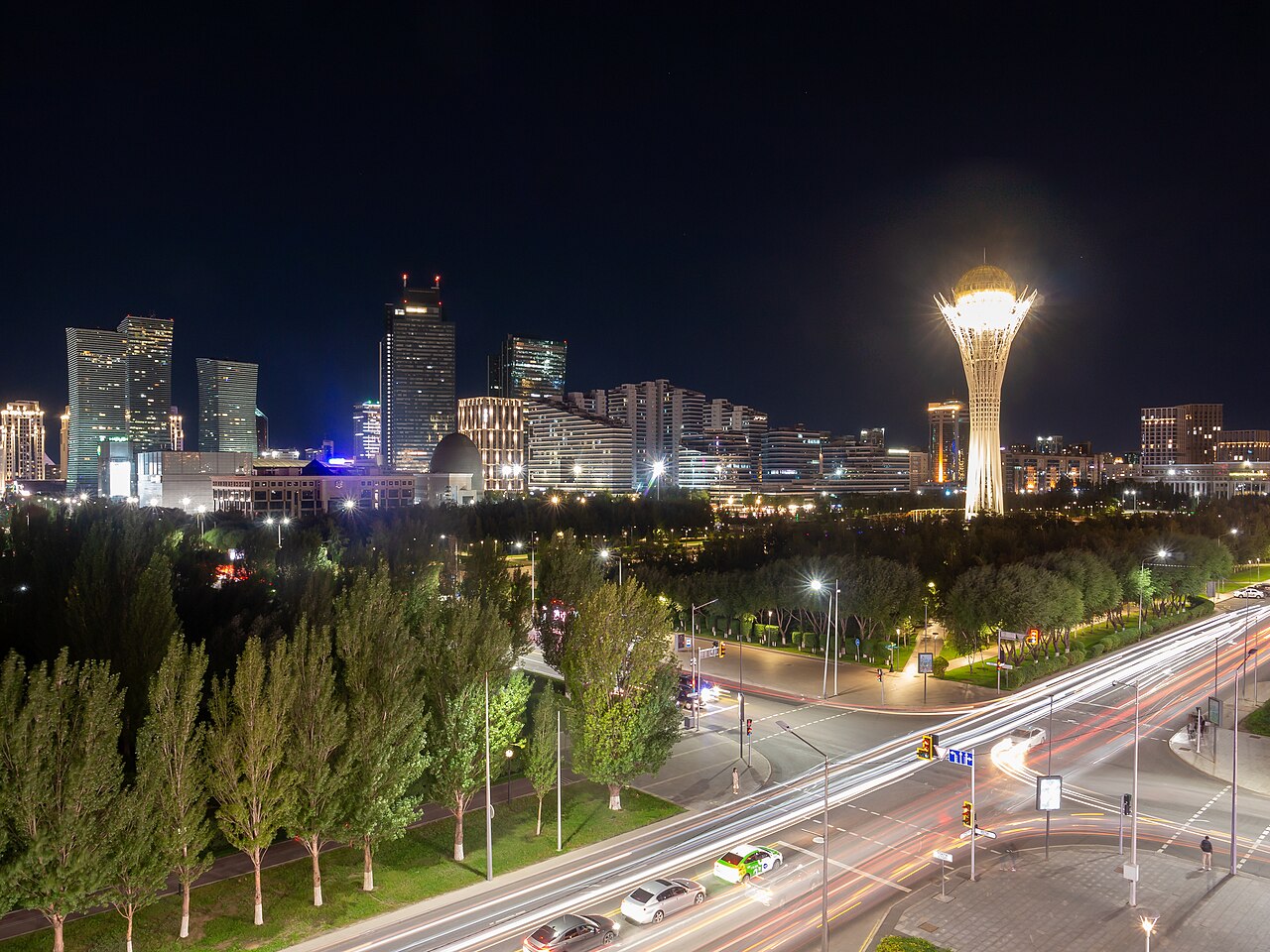
Almaty skyline beneath the Tian Shan — Dauren Nabijan, CC0, via Wikimedia Commons. Astana Esil district at night — via Wikimedia Commons. Kazakhstani tenge banknote — National Bank of Kazakhstan, CC0, via Wikimedia Commons.