Contents
- Kokpar at a glance
- What kokpar actually is
- How kokpar is played: the rules
- Kokpar vs buzkashi vs kok boru
- Is kokpar UNESCO heritage? The honest answer
- The other horse games of the steppe
- The horses
- Is kokpar cruel? The welfare and safety question
- Where to actually see kokpar and the horse games
- Kokpar’s comeback
- Frequently asked questions
- Final thoughts
The first thing you notice is the sound. Not the crowd — the hooves. Forty of them hitting packed earth at once, then the wet slap of leather changing hands, then a rider going sideways out of the saddle and somehow not falling.
Kokpar is Kazakhstan’s national horse sport: two teams of riders fight over a heavy goat carcass — now usually a weighted leather dummy — and try to drop it into a round goal at the far end of a field about 220 metres long. It is the Central Asian ancestor of every rough team game you can think of, and in Kazakhstan it is currently in the middle of a genuine revival.
This guide covers what kokpar actually is, how the modern rules work, how it differs from Afghan buzkashi and Kyrgyz kok boru, the other steppe horse games you will see alongside it, and — the part almost nobody online will tell you — where a visitor can realistically watch any of it.
Kokpar at a glance
| What it is | Team horse game; riders contest a goat carcass or weighted dummy and score in a round goal |
|---|---|
| Name | Kazakh kökpar, often glossed as “grey wolf” or “blue wolf”; the team format is also called ulak |
| Field | Roughly 220 m long by 70–75 m wide in the regulated version |
| The goal | Kazandyk (a depression in the ground) or tai kazan (a raised ring, like a giant cauldron) |
| Team size | Squads of 10–12; typically four riders per side on the field at once, substituting constantly |
| Match length | Two or three periods of about 20 minutes |
| The object | Historically a headless goat carcass around 40 kg; modern regulated play increasingly uses a weighted leather dummy |
| Best chance of seeing it | Nauryz (21–23 March); hippodrome fixtures in the warm half of the year; ethno-village shows near Almaty year-round |
| UNESCO status | Kazakhstan’s kokpar is not inscribed. Kyrgyzstan’s kok boru was inscribed in 2017 |
What kokpar actually is
Strip away the romance and kokpar is simple. There is a heavy object. Two teams want it. One team wants it in that goal, the other team wants it in the opposite goal. Everyone is on a horse, moving fast, and nobody is wearing much in the way of protection.
The heavy object is the point of the whole thing. A real goat carcass — headless, drained — weighs somewhere around 40 kilos, and the rules say you may only hold it with one hand. Try to picture that: leaning out of a moving saddle, one hand on the reins, the other hauling forty kilos of dead weight while four other riders lean into you and try to peel your fingers off it. The physical demand is why squads carry ten or twelve players and rotate four onto the pitch at a time. Nobody lasts a full match.
The goal is the other half of the character. In the older Kazakh version it is the kazandyk — a scooped-out depression in the ground that you have to get the carcass into. That design has been quietly abandoned in a lot of places because riders and horses kept getting hurt on the lip of it. The alternative is the tai kazan, a raised circular wall like an enormous cooking pot, and this is where the modern game gets interesting: the wall height and the material change the whole sport.
Why “grey wolf”?
The name is usually glossed as “grey wolf” or “blue wolf” — kök is the awkward Kazakh-Turkic colour word that covers both blue and green and sits behind a lot of names in this part of the world. The story attached to it is that winter wolf-hunters, having killed a predator that had been taking their livestock, would fight each other on horseback over the carcass on the ride home. Later the wolf was replaced by a goat or a sheep, which was more available and considerably less bad-tempered when cornered.
You will also hear it framed as riders imitating wolves attacking a flock, or as a re-enactment of dragging a wounded comrade off a battlefield. There are at least three origin stories in circulation and no way to adjudicate between them. Treat them as folklore rather than history and they are all worth hearing.
How kokpar is played: the rules
The pitch and the goal
The regulated field is around 220 metres long and 70–75 metres wide — roughly two football pitches end to end, and much wider than you would guess from photographs. Scoring circles sit near each end. If the goal is a tai kazan, the rider generally has to get the carcass over the wall, which in practice often means leaping bodily off the horse and into the ring with it. It is not subtle.
The wall material matters more than you would think. Kyrgyz kok boru uses a concrete tai kazan. One of the Almaty clubs driving the Kazakh revival builds its goal out of hay instead — softer, slower to score in, which gives the defence time to organise and makes the game less of a sprint. Kazakhstan’s official format, by contrast, has in places simply drawn a circle on the ground, which the same club’s organiser bluntly describes as too easy to score in. There is a live argument here about what the sport should be, and it is playing out in the shape of the goal.
Teams, periods and substitutions
A squad is ten to twelve riders. Four per side are on the field at any moment in the standard format, with substitutions running more or less continuously because the work rate is brutal. The match runs in two or three periods of about twenty minutes, closer to ice hockey than to football, and there are free throws and sending-off provisions. Deliberately injuring an opponent is prohibited — a rule which tells you something about what the game was like before it existed.
Formal codified rules are a twentieth-century invention. What preceded them was a free-for-all: village against village, aul on aul, with accounts of up to a thousand riders on the field at once, every man playing for himself, and whoever got the carcass home keeping it. That version has not entirely vanished — it still happens at rural celebrations, and it is a completely different spectacle from the codified match.
Real carcass or dummy?
This is the question Western readers actually want answered, so here it is plainly: modern regulated kokpar in Kazakhstan increasingly uses a weighted leather dummy, not an animal.
Reporting on the Almaty club scene in 2025 described riders charging at “a stuffed leather sack, roughly the size of a goat,” and listed the dummy alongside a smaller field and softer goals as the specific changes the Kazakh version has made. The dummy at that club weighs 25 kg. Earlier attempts at substitution failed because the fake was awkward to grab at speed; the current generation apparently works, and has been accepted even by Kyrgyz kok boru players, who are not famous for softening their sport.
As a rough guide to weights: a real carcass runs about 40 kg, and the club dummy is 25 kg. Rural and festival games may still use a real animal, and if one is used, it is skinned and cooked afterwards for everyone who played. Nothing is wasted. Whether that reassures you or not is a personal matter, but it is the honest picture.
Kokpar vs buzkashi vs kok boru
These are three national versions of the same game, and travel writing conflates them constantly. The distinctions are real.
| Kokpar | Kok boru | Buzkashi | |
|---|---|---|---|
| Country | Kazakhstan | Kyrgyzstan | Afghanistan, Tajikistan, northern Uzbekistan |
| The object | Carcass or dummy; team format called ulak | Ulak — carcass, or a mould in modern play | Buz (goat) — traditionally a real carcass |
| The goal | Kazandyk depression or tai kazan ring | Concrete tai kazan | Often a marked circle or a designated post |
| Format | Codified team match; rural free-for-alls survive | Highly organised, semi-professional leagues | Frequently a mass individual scramble |
| UNESCO | Not inscribed | Inscribed 2017 | Not inscribed as buzkashi |
The practical upshot for a traveller: if you have watched kok boru at Kyrgyzstan’s World Nomad Games, you have seen a close cousin, not the same thing. The Kazakh game is on a slightly different trajectory — deliberately safer, deliberately more television-friendly. If you are weighing up the two countries generally, our comparison of Kazakhstan and Kyrgyzstan as travel destinations goes into this further.
Is kokpar UNESCO heritage? The honest answer
No — and a startling number of pages claim otherwise, so it is worth being precise.
Kyrgyzstan’s kok boru was inscribed on UNESCO’s Representative List of the Intangible Cultural Heritage of Humanity in 2017. Kazakhstan has no equestrian-games element on that list at all. UNESCO’s equestrian-games theme covers Akhal-Teke horse breeding from Turkmenistan, Morocco’s Tbourida, camel racing from the UAE and Oman, Iran’s Chogān, Azerbaijan’s Chovqan, Kyrgyz kok boru and others, and Kazakhstan appears in none of them.
UNESCO’s own text for kok boru is also useful because it confirms the dummy independently: two teams manoeuvre “a goat’s carcass (replaced with a mould in modern-day games), or ‘ulak’.” The Kyrgyz nomination also describes a class of respected elders called Kalystar who guarantee fair play, and credits a national federation founded in 1998 — that federation is Kyrgyz, and it is regularly and wrongly attributed to Kazakhstan.
Kazakhstan does have plenty of recognised heritage; it just is not kokpar. Our guide to Kazakhstan’s UNESCO sites covers what actually is listed, and Kazakh traditions looks at the customs that shape daily life.
The other horse games of the steppe
Kokpar rarely appears alone. At a festival or a hippodrome programme it comes as part of a run of events, and several of the others are better spectator sport for a first-timer.
Kyz kuu — “catch the girl”
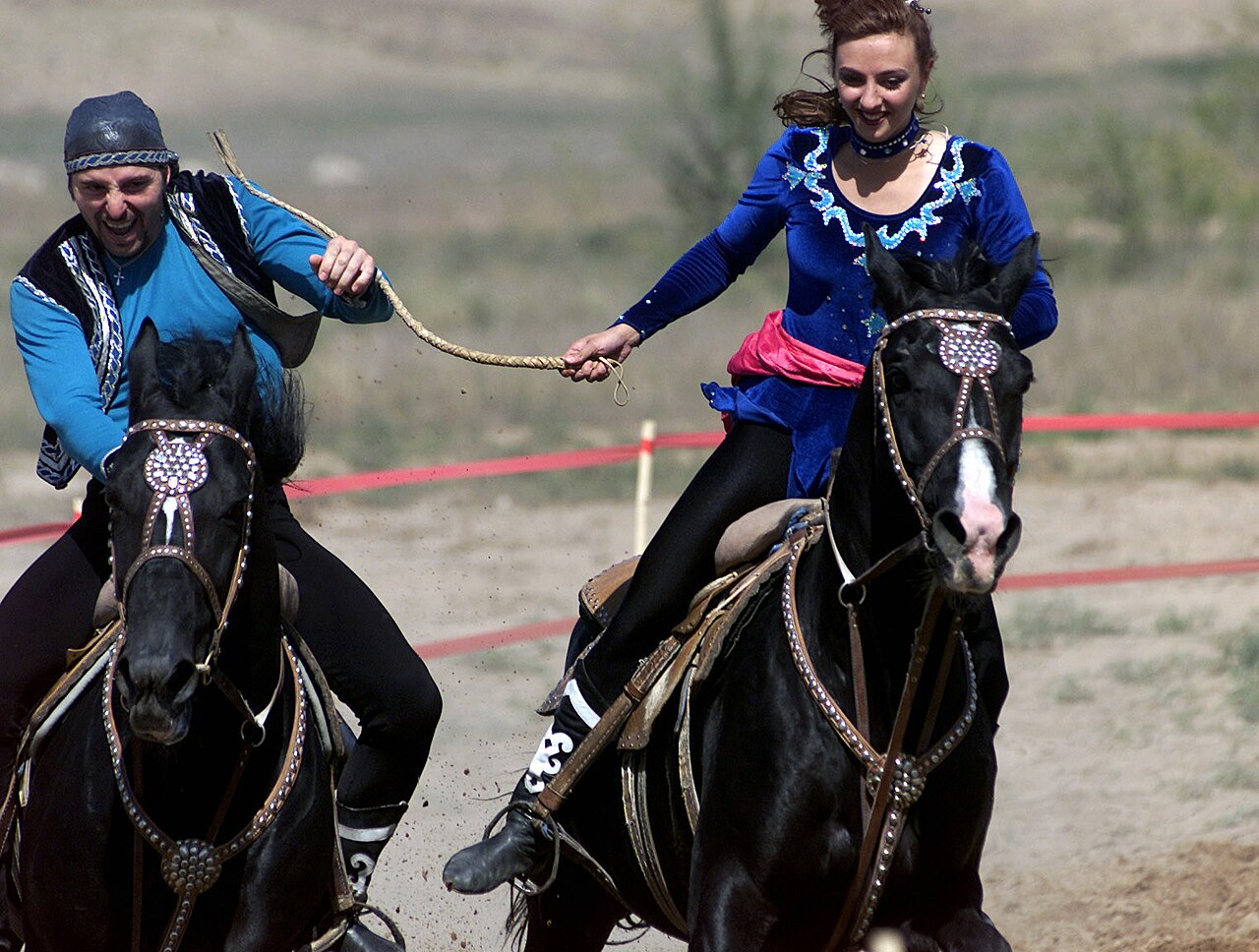
The most photographed of the lot, and the easiest to follow. A woman in full embroidered costume starts riding; seconds later a man sets off after her, and has to catch her and kiss her before the finish line. If he fails, she turns around and chases him back to the start, whipping him. The chase distance is usually 400–500 metres each way. Origin is attributed to a Saka-era custom in which a suitor had to catch his bride on horseback to prove he could ride.
It is played for laughs and it lands. The woman generally has the better horse.
Audaryspak — wrestling on horseback
Two riders lock up chest to chest and try to lever each other out of the saddle. First man on the ground loses. A century ago this was considered mandatory training rather than entertainment, with boys practising on foals, rams and bulls, and specialists whose entire job was picking out the strongest and nimblest horses for it.
Tenge alu and kume alu — picking up the coin
Small objects — coins wrapped in scarves, originally silver ingots — are laid out in a line. Riders gallop the line and scoop up as many as they can. Most collected wins. The photograph everyone wants is the rider hanging almost inverted alongside the horse’s shoulder with fingertips brushing the turf, and it is genuinely as difficult as it looks.
Tymak uryp zhygu — knocking down the hat
The strangest one, and a crowd favourite. A tymak — a fur hat — is set on a pole a little over two metres high. The rider studies its position, is blindfolded, handed a whip, put on a horse and spun around several times. Then they get three attempts to knock the hat off. They can earn three more attempts by performing a song or a dance. Very little of this is dignified.
Alaman baiga, baiga and the racing events
Baiga is straightforward horse racing, and it carries more prestige in Kazakhstan than any of the games. Alaman baiga is the endurance version: historically 30, 50 or even 100 kilometres across open country, in an era when not all the horses survived the distance. Today it is generally run at hippodromes over about 30 km, which is still a long way to ask a horse to gallop.
Shorter baiga distances are split by the horse’s age, and the published numbers do not agree. One widely used breakdown gives 2 km for horses under three, 5 km for horses under four, and 9 km for horses of five and over. Classical ethnographic accounts name the age classes — kunan baiga at 1.2–2 km for horses no older than three, donen baiga at 2.5–4.8 km up to four, and baiga proper at 5–8 km for five-year-olds and up — with prizes going to the first three to five riders home. Expect the distance on the day to be whatever the local programme says.
The horses
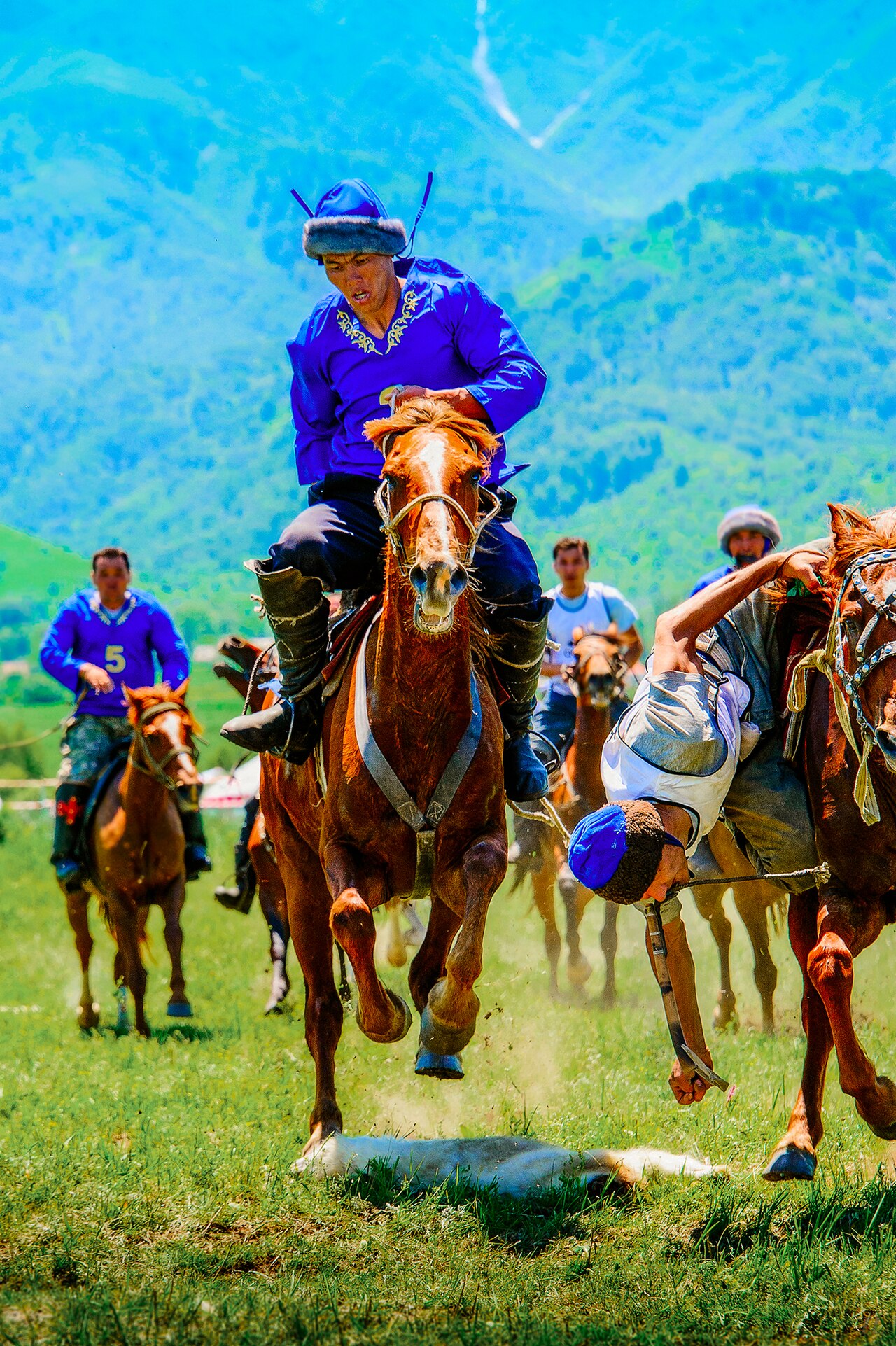
Horses are specially bred for the game by crossing different breeds, and that a 2025 report from an Almaty club identified the horses in use there as Karabair — conventionally an Uzbek breed, which is itself interesting.
The change that people who know the sport actually talk about is size. An anthropologist at Nazarbayev University, Ulan Bigozhin, puts it directly: the dynamic of the game has changed since Soviet times and it is more aggressive now, partly because the horses are bigger. That is a more useful observation than a breed list. A bigger horse hits harder.
Is kokpar cruel? The welfare and safety question
Two separate questions get tangled together here, so let us take them apart.
The animal question. Regulated Kazakh kokpar has largely moved to a weighted dummy, and that shift has been accepted across the region, including by Kyrgyz players. Where a real carcass is used, it is a slaughtered goat that is then cooked and eaten — which is not different in kind from what happens to most goats in a country where meat sits at the centre of the food culture. If the idea still bothers you, ask before you go: an ethno-village show will almost certainly be using a dummy.
You should also know that the Soviet-era record is contested. One account has kokpar forbidden under the USSR on cruelty grounds. The better-supported academic account is that it was never officially banned — collectivisation cut private horse ownership and nomads were resettled into towns, and the game simply withered for lack of horses and lack of villages to play it in. That is a less dramatic story and probably the true one.
The rider question is the more serious one. A Kyrgyz player died in 2025 after a horse crashed into him — the third such fatality in seven years. Concussions, trampling and high-speed collisions are ordinary occurrences. Kyrgyz players have actively resisted safety reform because the danger is part of the appeal; the president of Kazakhstan’s kokpar federation, Aidarbek Khodzhanazarov, who is also a member of parliament, summarised the culture after a disputed 2024 final with the line “this is kokpar, not ballet. If you want to play, do not complain about being hit with a whip.”
Watch it with that in your head. It changes how the leaning and the whip-work reads.
Where to actually see kokpar and the horse games
Here is the gap in every other article on this subject: none of them tell you when or where. We cannot give you a fixed bookable schedule either, because as far as we can establish one does not exist. What we can do is rank your realistic options honestly.
1. Nauryz, 21–23 March — by a distance your best chance
If you can time a trip to the spring new year, do. Nauryz is when the horse games come out across the country as a matter of course, at hippodromes and on town squares and on any flat ground a community can find. It is also simply the best few days to be in Kazakhstan. Our guides to Nauryz and to Kazakhstan in spring cover the practicalities, and the best time to visit page puts March in context against the rest of the year.

2. The hippodromes
Almaty’s central hippodrome is a large complex on the edge of the city with racing tracks, a stand seating a few thousand, and — reportedly — a dedicated kokpar field, which makes it remarkable that no travel page about the sport mentions it. Racing runs in the warm half of the year, roughly May to October, on a small number of days each month. Astana has a hippodrome at Kazanat, in the Nura district, which stages kokpar, baiga, zhamby atu and audaryspak.
Be warned that we could not get either venue’s official site to load, and neither publishes a foreigner-friendly English fixture list. If you are in Almaty and want to try, ask your accommodation to check the Kazakh-language ticketing sites for you on the day — that is genuinely how this works, and our page on getting around Almaty will get you out there once you have a date.
3. Ethno-villages near Almaty — the reliable option
The Huns ethno-village in the Talgar district, about 40 km from Almaty, bills itself as Kazakhstan’s first ethnographic village and runs horse shows including kyz kuu and acrobatic riding, alongside felt-making and archery. A day trip through a local operator was priced in 2026 at 40,000 KZT and up for a group departure, or on a private sliding scale from about 115,000 KZT for one person down to roughly 46,000 KZT per head at six — transport, guide, the show, master classes and a buffet lunch included. Nomad Stan and Gunny are two other names to look at; ask what their programmes include before you book.
Manage your expectations here. What an ethno-village stages is a demonstration — short, choreographed, for an audience, often with a dummy and always without a league table. It is not a match. It is still a genuinely good way to see riders who can do things you did not know were possible on a horse, and it is the only option that works on a random Tuesday in October. Consider it alongside the other day trips from Almaty, and pair it with a night in a yurt if you want the full version.
4. The tournament calendar
The World Nomad Games, launched in 2014, run the largest kokpar championship. The 2024 edition was held in Kazakhstan; the 2026 edition was held in Kyrgyzstan, based at Bishkek and Cholpon-Ata. Dates and hosts move between editions, so check the organisers’ own announcements before you build a trip around the next one.
A national kokpar league has been announced as an intention by the federation president rather than as a running competition, and we found no official Kazakh federation website. Regional and city tournaments do happen annually — they are just not advertised to foreigners.
What to expect if you get there
Stand behind the barrier, not beside it. Horses come off the field of play at speed and without warning, and the carcass gets dropped. Photographers get a lot of dust and a lot of blurred frames; a fast shutter and a long lens beat a phone comfortably. Nobody will mind you being there — foreign spectators at Kazakh sporting events are a novelty rather than an intrusion, and someone will probably try to explain the rules to you whether or not you share a language.
Kokpar’s comeback
The revival is real and it is being driven by a handful of people. Daniyar Daukey, who runs one of the Almaty clubs, has shortened the field, cut teams to three-a-side and built his goal out of hay — all deliberate attempts to make the game watchable and survivable. In 2019 he took ten teammates to a hunting festival at Fontainebleau in France and played in front of 17,000 people. His club has more than 50,000 social media followers and now draws participants from as far as the UAE and the United States.
Behind that sits a patronage structure that will be familiar to anyone who follows sport anywhere: local governments fund the games, local businessmen sponsor the teams. Kokpar has real institutional standing too — Kazakhstan issued a commemorative 500-tenge silver “Kokpar” coin in 2014, and the theme runs through the work of writers and musicians. The game remains overwhelmingly male.
Whether it becomes a professional spectator sport with a fixture list a tourist can plan around is an open question. Right now it sits in the awkward middle: too organised to stumble across, not organised enough to book.
Frequently asked questions
What is kokpar?
Kokpar is Kazakhstan’s national horse game. Two teams of riders contest a heavy goat carcass — increasingly a weighted leather dummy — and try to deposit it in a round goal at the opposing end of a field roughly 220 metres long. Squads of ten to twelve rotate four riders at a time through periods of about twenty minutes.
Is kokpar the same as buzkashi?
They are close relatives rather than the same game. Buzkashi is the Afghan and Tajik version and is often played as a mass individual scramble. Kokpar is the Kazakh version and is codified as a team match. Kyrgyz kok boru is a third variant with a concrete ring goal and organised semi-professional leagues.
Is kokpar still played with a real goat?
In regulated Kazakh competition, increasingly not — a weighted leather dummy has largely replaced the carcass, and the substitution has been accepted across the region. Rural and festival games may still use a real animal, in which case it is cooked and eaten afterwards.
Is kokpar a UNESCO heritage sport?
Not in Kazakhstan. Kyrgyzstan’s kok boru was inscribed on UNESCO’s Representative List in 2017; Kazakhstan has no equestrian-games element on the list.
Where can I watch kokpar in Kazakhstan?
Your best chance is Nauryz, 21–23 March, when the games are staged across the country. Otherwise: hippodrome fixtures in Almaty and Astana during the warm half of the year, or a year-round demonstration at an ethno-village near Almaty. There is no published foreigner-facing fixture list.
Is kokpar dangerous?
For the riders, yes. Concussions, trampling and collisions are routine, and a Kyrgyz player died in 2025 in the third fatality of its kind in seven years. Spectators are safe behind the barriers, but stay behind them.
What are the other Kazakh horse games?
Kyz kuu (a chase between a man and a woman on horseback), audaryspak (wrestling in the saddle), tenge alu and kume alu (picking objects off the ground at gallop), tymak uryp zhygu (knocking a fur hat off a pole blindfolded), and the racing events — baiga over 2 to 9 km and alaman baiga over 30 km or more.
Final thoughts
Kokpar is one of those things that is more interesting for being genuinely awkward to see. It has not been packaged. There is no stadium tour, no season ticket, no gift shop. What there is instead is a real sport in the middle of working out what it wants to be — arguing about goal materials and dummy weights and how much danger is the right amount — and a country where a very large number of people can ride better than you.
If you can only manage a staged demonstration at an ethno-village, take it and enjoy it. If you can time your trip to Nauryz, do that instead, and go and stand at a hippodrome barrier in the cold spring wind with several thousand people who understand exactly what they are watching. For more on the culture this comes out of, start with our guide to Kazakh culture, then read about eagle hunting — the other steppe skill that survived — and kumis, which is what people will hand you afterwards.
Photo credits
Kokpar match: Rustam Uzbekov (CC BY-SA 4.0) via Wikimedia Commons. Spring festival: Symbat Bolatova (CC BY-SA 4.0) via Wikimedia Commons.
Kyz kuu in Kazakhstan: Catchthegirl by Jeremy T. Lock, Public domain, via Wikimedia Commons.
Riders and horses charging across a meadow in a kokpar match: Kokpar game of nomads by Igor Larikov, CC BY-SA 4.0, via Wikimedia Commons.