Contents
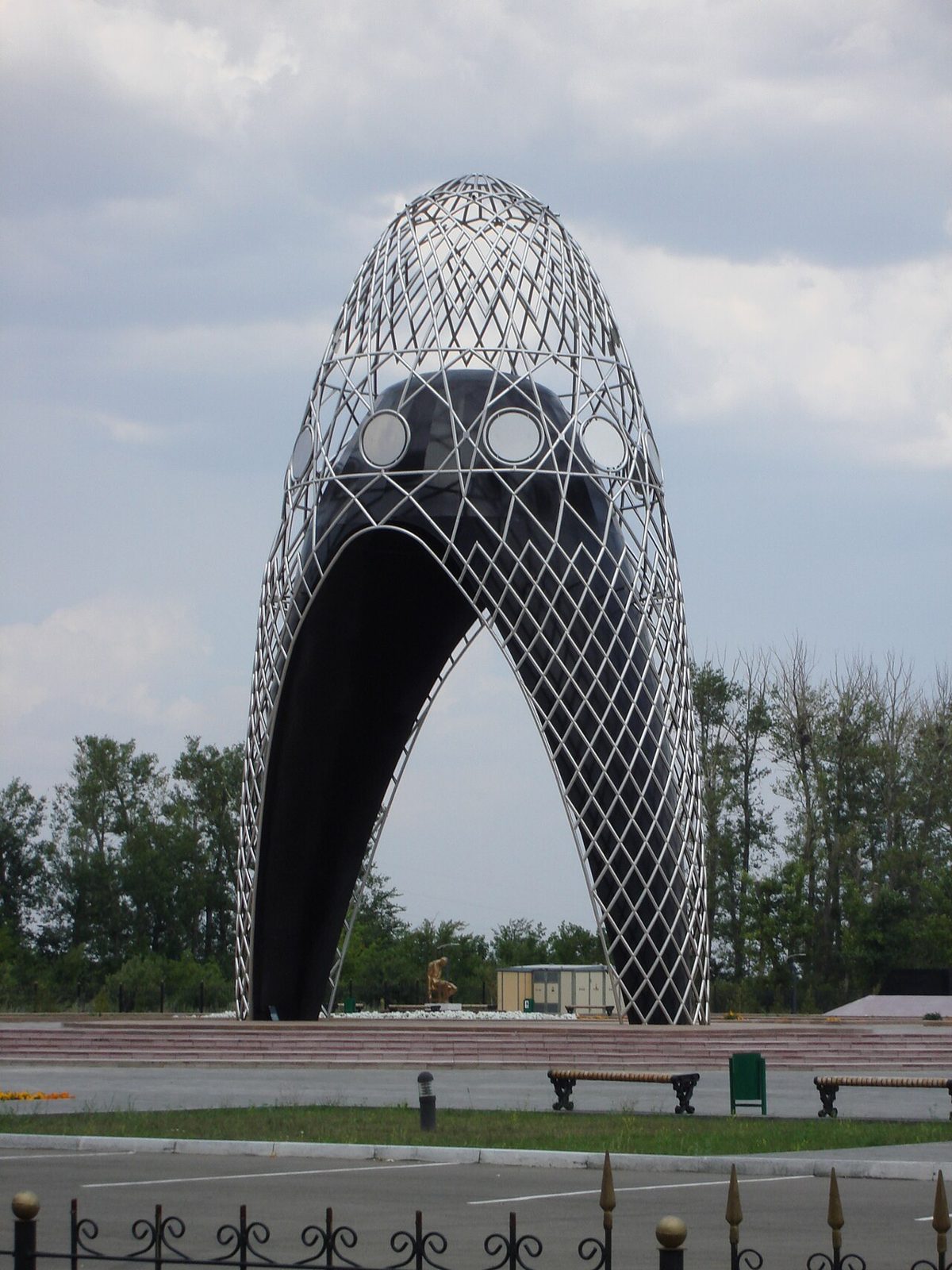
There is a particular quality to the silence at Akmol. The Arch of Sorrow is visible from a long way off across flat ground, and by the time you have parked and walked to it you have had several minutes to think about what you are about to look at. That is deliberate, and it works.
Kazakhstan dark tourism means visiting the memorials to Soviet repression on the Kazakh steppe: the ALZHIR camp for the wives of “traitors” near Astana, the Karlag gulag headquarters at Dolinka near Karaganda, and the Semipalatinsk nuclear test site in the east.
Two things to say before we go further. First, a practical one: do not assume you can reach the western part of the Semipalatinsk Polygon, including Opytnoe Pole where the first Soviet bomb was tested. Most of what you will read online still describes visiting Ground Zero in the present tense. If your trip is built around standing there, get current written confirmation from the National Nuclear Centre in Kurchatov before you book anything else.
Second, on tone. This is living memory. Kazakhstan’s own rehabilitation commissions concluded that almost every family in the country witnessed something connected to the repressions. The people beside you at these sites may be looking for a grandmother’s name. Kazakhstan has done more to memorialise this history than any other former Soviet republic and it plainly wants foreigners to come and learn it — the ask is only that you arrive having done the reading.
The sites at a glance
| Site | Where | Getting there | Time needed | English? |
|---|---|---|---|---|
| ALZHIR Memorial Museum | Akmol village, about 40 km SW of Astana | Bus, taxi or tour from Astana | Half a day | Ask when you book |
| Karlag Museum | Dolinka, outside Karaganda | Bus 121 or a taxi, or a guided excursion | Half to a full day | Check with the museum |
| Spassk memorial cemetery | Near Karaganda | Normally combined with Dolinka | Same day as Dolinka | Limited |
| Semipalatinsk Polygon | West of Semey; base at Kurchatov | Through an operator; confirm access first | Ask your operator | Depends on the operator |
| Famine memorials | Astana, Almaty, Pavlodar | Walk-up, city centre | An hour | Signage varies |
| Zheltoksan monument | Republic Square, Almaty | Walk-up | Twenty minutes | Kazakh only |
Check prices and opening hours with each museum before you travel. Assume admission is low — a few hundred tenge — and assume a photography fee.
Why this history is here
Kazakhstan got the camps because it had space and nobody with the power to object. The steppe was the Soviet Union’s dumping ground: for prisoners, for whole deported nations, for nuclear tests, for anything that needed to happen a long way from anywhere that mattered.
The scale is difficult to hold in your head. Eleven camps were built in Kazakhstan. Collectivisation and the resulting famine of 1930–1933 killed somewhere between 1.3 and 2.3 million people, reducing Kazakhs from about 60 per cent of the republic’s population to 38 per cent. Crimean Tatars, Volga Germans, Muslims from the North Caucasus, Poles from eastern Poland and Koreans from the Soviet Far East were deported here, and their descendants are still here. Between 1949 and 1989 the Soviet Union conducted 456 nuclear explosions on Kazakh soil.
Our traveller’s history of Kazakhstan sets this in the longer story. What matters for a visit is that the memory work is recent, official, and still being argued about.
31 May
31 May is Kazakhstan’s Day of Remembrance of Victims of Political Repression and Famine. Two milestones sit behind it: the rehabilitation law passed after independence, and President Tokayev’s decree of 24 November 2020 establishing a State Commission for the Full Rehabilitation of Victims of Political Repressions.
If you visit on or around 31 May the sites will be busy, ceremonial and full of families. That is either exactly what you want to see or exactly what you should stay away from, depending on your reasons for coming. Decide honestly.
ALZHIR Memorial Museum, Akmol
What ALZHIR was
ALZHIR is an acronym: the Akmolinsk camp for wives of traitors to the motherland. It was the 26th point of the Karlag system, and it existed because of NKVD Order 00486 of 15 August 1937, which authorised the mass arrest of women whose husbands had been condemned. Their crime was marriage.
More than 18,000 women passed through, from 62 nationalities and ethnic groups, in the fifteen years the camp operated, from 1938 to 1953. The work was sewing army uniforms, livestock, agriculture and construction, on rations of porridge, cabbage and potatoes. Young children of “betrayers of the homeland” were frequently taken from their mothers permanently and put up for adoption.
These women were not inmates in any meaningful sense and the museum’s own framing rests on that. Even the guards, by some accounts, understood it.
What you will see
The complex was inaugurated on 31 May 2007. The Arch of Sorrow marks the entrance — a silver metal lattice dome enclosing a solid black inner dome, with a tall walk-through arch. A sign at the base asks visitors to duck their heads to pay tribute. The site’s own explanation of the form is that it alludes to a traditional Kazakh woman’s headdress; you will also see it described as a woman mourning her husband and children. Both readings are in circulation.
Around the Arch stand fourteen marble plaques, each placed by the embassy of a country the prisoners came from. There is no Russian Federation plaque, despite the great majority of the women being Russian or from Russian territories. It is the single most eloquent thing on the site and no other guide mentions it.
Elsewhere outdoors: a deportation cattle wagon you can climb into, a mock watchtower, bronze sculptures, a long wall of names, and the Memorial to the Victims of Political Repression relocated here from central Astana. The museum building itself is a conical structure, with its exhibits arranged around a central atrium.
Ask at the ticket desk which languages the tours and labels cover on the day. The museum also screens a documentary, The Fierce Cold of ALZHIR.
Beyond the museum complex
This is where a visit becomes something more than a museum trip, and almost nobody does it.
A short walk away are the original memorials: a half-rusted metal structure spelling out “ALZHIR,” and a monument carrying a large fractured red star, unveiled at the height of glasnost, on 18 October 1989, at a reunion attended by former prisoners and their children. The architect Nikolay Yurashevich designed it, with support from Ivan Sharf, and it predates the museum complex by eighteen years.
On the edge of the village is one of the mass graves — unsigned, littered, enclosed by a metal fence, with stone monoliths marking anonymous women. The contrast with the polished museum a kilometre away is the most honest thing at Akmol.
Practicalities
Akmol — formerly Malinovka — sits about 40 km south-west of Astana, just off the R-2 towards Korgalzhyn.
Getting there: bus routes out to Akmol change, so check the current service with Astana’s city transport operator before you rely on one. There are no taxis in Akmol — if you take a taxi out, negotiate the return fare and the waiting time before you leave Astana. A guided day trip is the low-friction option; see our guide to day trips from Astana.
Leave time for the museum, the film and the outdoor memorials as well as the drive; a half-day round trip is a sensible plan. ALZHIR normally operates a no-photography policy. Ask; do not assume.
Karlag and Dolinka
What Karlag was
Karlag — short for Karagandinsky Lager — was not a camp but a system of hundreds of sub-camps spread across an enormous area of central steppe. It was founded in 1931 (some sources say 1930) and disbanded in 1959. At its peak it held up to 66,000 prisoners at once.
More than a million prisoners passed through Karlag over the whole life of the camp system. Being careful with numbers here is not minimising — it is what makes the rest of the account trustworthy.
Who was sent: political prisoners from across the USSR. Alongside the camps ran the deportations of whole peoples to Kazakhstan, the Volga Germans among them. Karaganda’s industrial growth was bound up with camp labour, and Dolinka today is still populated in part by the children and grandchildren of deported Germans, Poles and Koreans.
The museum
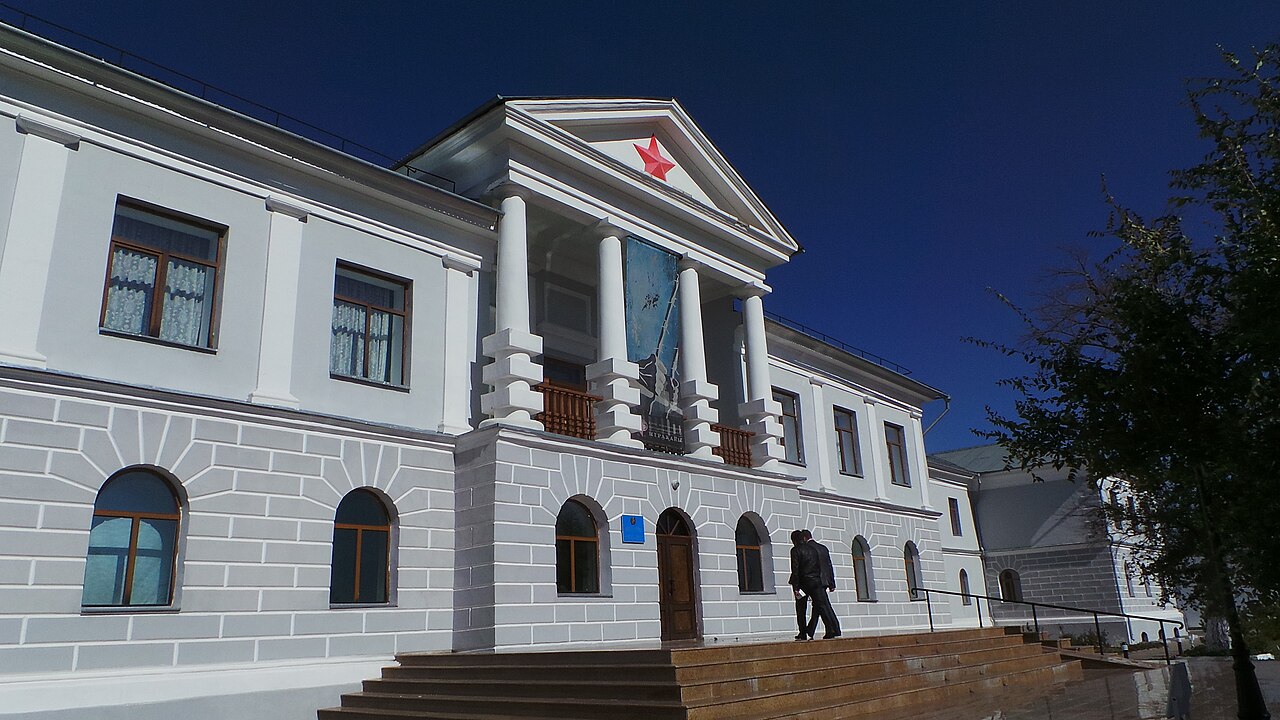
The museum occupies the restored former Karlag main administration building, built by prisoners in 1933–1935. It was designed to be intimidating and it still is. The museum itself was established in 2001 and spent its first decade in a former clinic, moving into the administration building in 2011. There are roughly thirty exhibition spaces, all but one devoted to the camp.
Be clear about what the basement is. The interrogation and torture rooms downstairs are reconstructions, and two independent sources say so plainly: there is no documentary evidence that such activities took place in those specific rooms. Locals said they could hear screams; no documents support it. The basement also holds a reconstructed punishment pit and a room of barrels, presented with the account that corpses were stored in salt over winter until the ground thawed enough for burial.
We are telling you this not as a gotcha but because it is the more interesting fact, and because you will walk through those rooms differently knowing it. The atrocity is documented at the level of the system. The staging is staging.
Both this museum and ALZHIR also carry a national-story overlay — Karlag’s exhibition ends in a room of national colours and presidential imagery, and independent assessments note a partly uncritical framing with more contemporary cases of political repression left out. Worth knowing as you walk through. It does not diminish the fact that Kazakhstan has done this work at all, with state endorsement and funding that Russia’s gulag memorials do not enjoy.
Mamochkino and Spassk
Near Dolinka is Mamochkino — the “mothers'” cemetery. It is a fenced grass plot over mass graves holding an unknown number of children who died in the Karlag system. There are several small monoliths placed by the church and by private individuals, about a dozen old metal crosses put up by relatives, and a trilingual interpretive sign added during maintenance work.
Treat it as a cemetery, not a curiosity. No close-ups of individual graves. No people in shot.
Spassk is a memorial field of graves and memorial stones, less developed than Dolinka and normally combined with it in one day.
Also in Dolinka: the former single-storey museum building with a surviving white Lenin statue in winter dress; genuine ex-gulag barracks, some derelict and some still lived in with satellite dishes on the walls; and — handle this carefully — a working prison, fenced, wired and with manned watchtowers, which you pass on the way in. Do not photograph it.
Practicalities
Dolinka is a village outside Karaganda, close enough for a day trip by bus, taxi or tour.
By bus: route 121 runs between Karaganda and Shakhtinsk and is the one to take for Dolinka. Check the current timetable and the stop before you set out, and ask the museum how to cover the last stretch from the main road; a taxi from Karaganda saves the walk.
Guided: Nomadic Travel runs an eight-hour Dolinka-plus-Spassk excursion with English guiding. Its shorter Dolinka excursion is listed at 27,060 KZT per person for a group of five, including transport, an English-speaking guide and the visits; confirm the quote when you book. An Armantour agent interviewed for a 2025 academic study called transport one of the main challenges: “visitors often complain about the difficulty of reaching Karlag.”
Getting to Karaganda: the train from Astana takes roughly three to four hours depending on the service. Our guides to train travel and buying tickets cover the booking.
Labelling is partly trilingual and partly Russian and Kazakh only; original documents are untranslated. Budget two hours in the museum and about four hours door to door from Karaganda. Expect a photography permit fee and expect it to be enforced.
The Polygon: the Semipalatinsk nuclear test site
Start here: what you can and cannot visit in 2026
Do not plan around the western part of the Polygon until you have it in writing. Opytnoe Pole — the Experimental Field, where the first Soviet bomb was fired and where the surviving measuring towers stand — is the place most visitors want to see. Ask the National Nuclear Centre to confirm current access, and which permit you need, before you commit. Gamma readings at the actual test site are described as extreme.
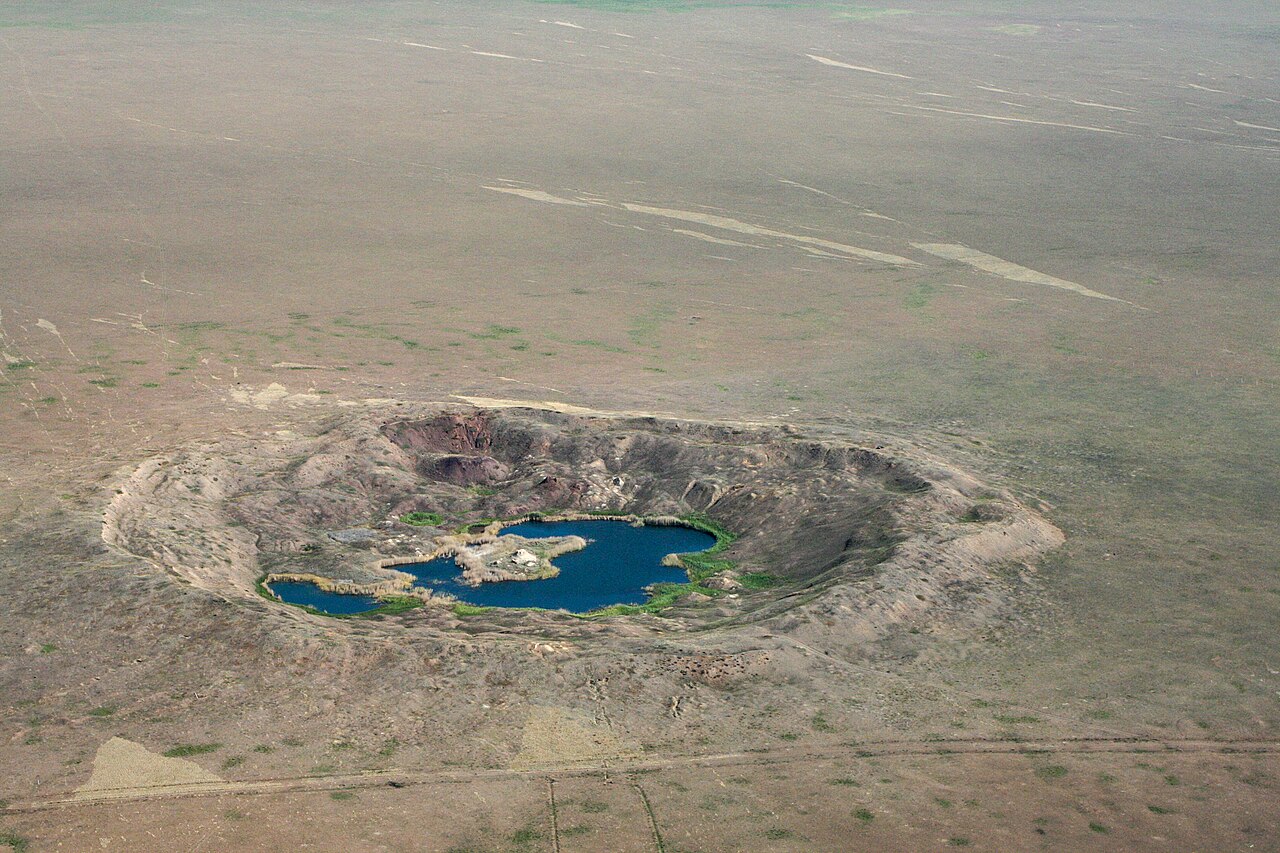
What remains visitable, in the eastern Polygon: the flooded Chagan crater — the Atomic Lake — a former underground command base, and missile testing silos. That is a real trip and worth taking. It is not the same as standing at Ground Zero, so settle exactly what your permit covers before you pay for anything.
Confirm current access with your operator before you commit to anything. This is a situation that changes.
What happened here
Lavrentiy Beria selected the site in 1947 and declared its 18,000 square kilometres — an area the size of Wales — uninhabited. It was not. People lived within and beside it, and the city of Semipalatinsk, home to about 150,000 people in 1959, was close by.
Between 1949 and 1989 there were 456 nuclear explosions here: 340 underground and 116 atmospheric. Roughly a quarter of all nuclear tests in history. The first — RDS-1, “First Lightning,” about 22 kilotons, a plutonium implosion device closely modelled on the American design — was fired from a tower on 29 August 1949. In November 1955 RDS-37 became the world’s first air-dropped hydrogen bomb, also at Opytnoe Pole.
The Atomic Lake came from the Chagan test of January 1965, a shallow-buried “peaceful nuclear explosion” that broke the surface, threw up a crater over 400 metres across and 100 metres deep, partly dammed a river as intended, and scattered fallout detected as far away as Japan — prompting a US protest that it breached the 1963 Partial Test Ban Treaty. It is now a lake.
Testing was suspended in 1989 and the site was formally closed by presidential decree on 29 August 1991. (You will see 1994 given in one otherwise good source; it is wrong.) The Nevada–Semipalatinsk movement, founded in 1989 by the poet Olzhas Suleimenov, mobilised mass opposition to the tests and helped build the pressure that ended them. On 8 September 2006 Kazakhstan and its four Central Asian neighbours signed the Central Asian Nuclear-Weapon-Free Zone Treaty — and they signed it at Semipalatinsk, fifteen years after the site closed.
The human cost, and why the numbers are contested
Kazakh expert estimates put around 1.5 million people as exposed to fallout. That figure is disputed on the grounds that the resident population of the immediate area was a fraction of that. What is not disputed is that children of people who lived here in the 1950s and 1960s show markedly higher rates of birth defects, cancers and solid tumours, and that the legacy is still visible in the region’s health statistics.
Radiation, honestly
The IAEA has concluded that over most of the Polygon radiation levels are low enough to pose no significant health hazard. There are confirmed pockets of dangerous residual contamination, particularly at vented boreholes and where surface detonations melted rock. Contamination is uneven, which is why the dosimeter your guide carries matters more than any figure you read beforehand.
The practical distinction that matters: gamma dose is a function of how long you stand there, whereas beta particles mean radioactive dust. That is why operators issue protective overalls, double overshoes and masks near craters. Do not touch or pick up anything. Removing anything from the Polygon is illegal, and there is an ongoing problem with scrap scavengers digging trenches and extracting rebar from contaminated concrete. Do not become a tidier-looking version of that.
Permits and operators
Permits are mandatory for the Polygon and, officially, for Kurchatov itself. The National Nuclear Centre in Kurchatov is responsible for the site; ask it, or your operator, how guiding currently works and how long the permit takes. Reckon on a few hundred euros for vehicle, driver and guide before anything else.
Operators offering Polygon access include Nomadic Travel in Karaganda; Koryo Tours; a Dutch operator, Kazakhstan Tours; and Against the Compass, whose next Kazakhstan departure is scheduled for June 2027. Our page on Kazakhstan tours covers what organised trips generally cost here.
Kurchatov and Semey
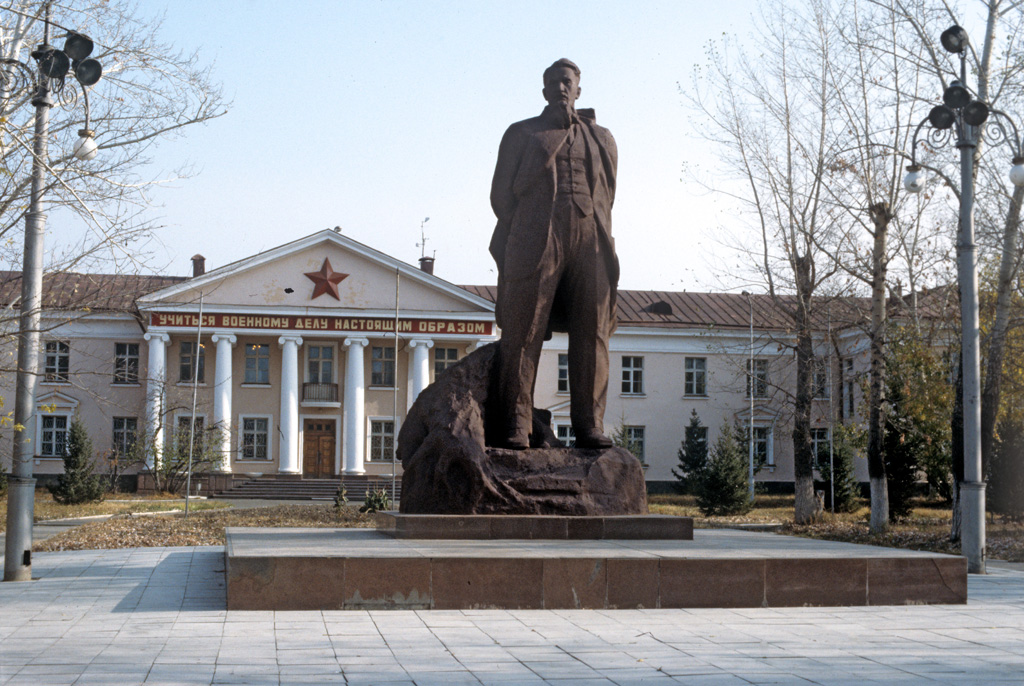
Kurchatov was founded in 1947 as the closed headquarters of the test programme and named after the physicist Igor Kurchatov. Today it is semi-abandoned. In town you can see the Kurchatov statue, and a local guide can show you what survives from the closed-city years. The National Nuclear Centre still operates two research reactors and runs radiation-distribution surveys.
One correction to older guides: the Museum of the Semipalatinsk Test Site in Kurchatov is reported to be closed, at least to foreign tourists. Several sources still describe it as a highlight. Confirm with your operator.
Semey — formerly Semipalatinsk — is the base city. You can reach it by train from Astana (check the timetable with KTZ, the national railway) or on FlyArystan’s direct flights from Almaty. In town: the Dostoevsky house-museum, from the years the novelist spent here in enforced military service, and the “Stronger than Death” monument, whose message is unmissable. How long a Polygon visit takes depends on what you can get access to, so settle the route and the timing with your operator.
One thing not to count on: the Anatomical Museum of Semey, with its collection of deformed foetuses, belongs to Semey Medical University, and whether visitors are let in is the university’s decision, so ask it before you build a day around the museum. Some claim the specimens are a result of radiation and the museum denies it. Treat the place as a cautionary tale about sensationalism rather than a hidden gem.

Other sites of Soviet memory
The famine memorials
There are three. The Astana monument was unveiled on 31 May 2012 and shows a mother with her arms raised to the sky and a child beside her. Pavlodar‘s also dates from 2012. The Almaty statue, from 2017, is a roughly three-metre figure of an emaciated woman holding a starving boy, on a site where a foundation stone reading “the monument to the victims of the 1931–1933 famine will be built here” had lain since 1992. Twenty-five years is a long time for a foundation stone to wait, and that gap is part of the story.
Zheltoksan, Almaty
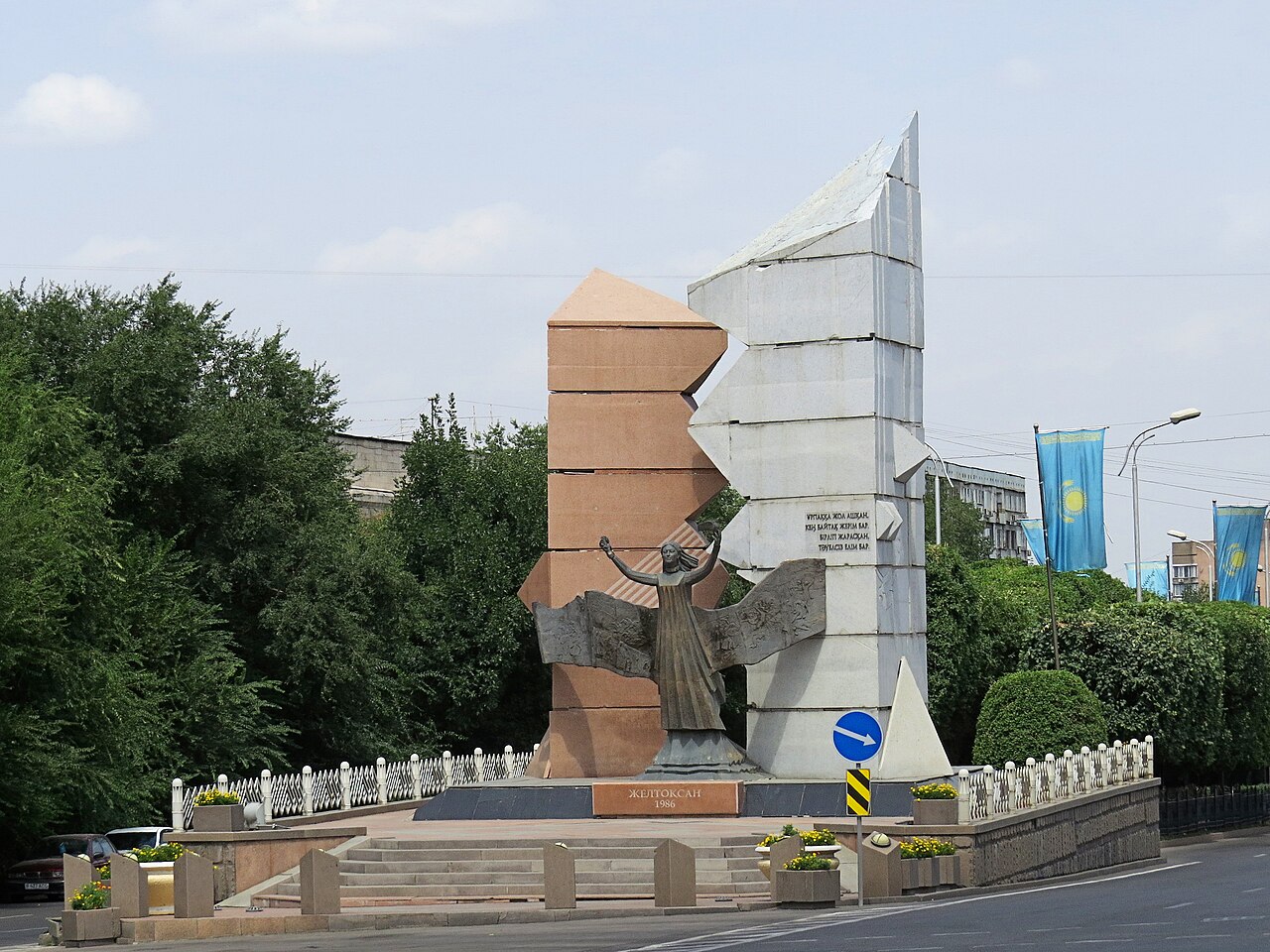
On 16 December 1986 Moscow appointed an outsider, Gennady Kolbin, as the republic’s party leader. The next morning, 17 December, students gathered on what is now Republic Square to protest. The demonstrations were put down by force, the number of dead is still disputed, and it was a major confrontation with Soviet authority. The “Dawn of Freedom” monument was opened in 2006 for the twentieth anniversary.
This one is different in kind from the others, and it is worth ending a Soviet-memory itinerary here. It is bright, civic, on a busy street, and it commemorates people who acted rather than people who were acted upon. Zheltoksan is also covered inside both the ALZHIR and Karlag exhibitions if you cannot get to Almaty. Our guide to things to do in Almaty places it in the city.
Shymkent
There is a third repression museum, in Shymkent — the Museum of Victims of Political Repression, opened on 2 November 2001 and one of the first in Kazakhstan devoted to the 1937–38 repressions. It ends in a “Hall of Sorrow” listing local victims. Labelling is not in English. It is absent from the travel internet entirely. See our guide to Shymkent for the city.
What you will read about and cannot visit
People ask about Vozrozhdeniya Island in the Aral Sea and the Soviet biological weapons site at Aralsk-7. The Aral’s retreat turned the island into a peninsula, and the bulk of it, including the Kantubek site, lies on the Uzbek side of the border, so it is not a place to plan a visit around. Likewise the ship cemetery near Aralsk: there are longstanding reports that most of the beached hulls were cut up for scrap, and blogs still promote it. Check the current condition before you build a day around it.
How to visit respectfully
This section is the one every other page on this subject leaves out, and it is not a disclaimer. It is instructions.
The material below comes from a paper published in the journal Tourism and Hospitality in January 2025, based on twelve interviews with residents, visitors, tour operators and community leaders at ALZHIR and Karlag. The quotes are theirs.
A tourist at ALZHIR: “Seeing some people taking selfies near the barracks felt disrespectful. There must be stricter guidelines on behavior here.” A community leader at the same site: “This museum is not just tourist spot. It is memorial. We need to ensure visitors understand that and treat them with respect.” A resident near the Karlag museum: “The visitors bring business to our small cafes and shops, but sometimes it feels like they are intruding on something very private and painful.”
And, from the other direction, a visitor: “It is not a museum; it is a piece of our history which teach us to not repeat mistakes of the past.”
The study’s own finding was that local people had a much stronger emotional connection to these places than outsiders did, and that while community leaders support responsible tourism, residents raised real concerns about privacy and the potential exploitation of sensitive sites.
The short list
- No smiling selfies. No group photos at the barracks or the cemeteries. This is the specific complaint that memorial visitors actually make.
- Ask before photographing anywhere. Expect a permit fee, expect it to be enforced, and expect to be told no — ALZHIR normally does not permit photography at all.
- Never photograph other visitors. The person two metres away may have just found their grandmother’s name.
- Keep your voice down and let families move through ahead of you.
- Do not pick anything up in the Polygon. A “souvenir” here means carrying contaminated metal, and it means joining the looters.
- Say “people,” not “victims,” where you can — and never “inmates” for the ALZHIR women. They had committed no crime.
- Around 31 May, expect ceremonies and crowds and yield space to them.
Talking about it
Kazakhs are, in our experience, more willing to discuss this history than foreigners expect and less interested in performing grief about it than foreigners expect. If a guide or a driver wants to tell you about their family, listen. If they do not, do not fish. Our guide to etiquette in Kazakhstan covers the general register, and language in Kazakhstan will help you follow a conversation that switches between Kazakh and Russian mid-sentence, as this one often will.
Suggested itineraries
Two days from Astana
Day one: ALZHIR at Akmol in the morning, the 1989 monuments and the mass grave afterwards, back to Astana for the famine memorial in the afternoon. Day two: early train to Karaganda, Dolinka and Spassk with a guide, evening train back. This is the version most travellers should do, and it requires no permits.
Six to seven days, adding the Polygon
The two days above, then the train from Astana to Semey, two days based in Semey and Kurchatov with an escorted Polygon trip, then fly out from Semey. Ask your operator about current permit requirements and lead times before you book, and confirm what is currently accessible. Our itinerary guide and northern and eastern Kazakhstan page cover the wider region.
Best time of year
Ask your operator which months they run Polygon trips. Late spring and early autumn for the museums. Winter is bleak, which some visitors find appropriate and which makes the outdoor sections at Akmol and Dolinka genuinely hard going. See the best time to visit.
Frequently asked questions
Can you visit the Semipalatinsk test site?
Partly. The eastern sector — the Atomic Lake, an underground command base and missile silos — can be visited on an escorted trip with a permit from the National Nuclear Centre. Do not assume you can reach the western sector, including Opytnoe Pole: get written confirmation of access from the National Nuclear Centre first.
Is the Polygon still radioactive?
Most of it poses no significant hazard according to the IAEA, but there are confirmed contaminated pockets, particularly at vented boreholes and surface detonation sites. Operators issue protective clothing near craters. The real risk is radioactive dust, which is why you do not touch or remove anything.
What was the ALZHIR camp?
The Akmolinsk camp for wives of traitors to the motherland, the 26th point of the Karlag system, through which more than 18,000 women passed between 1938 and 1953. Their offence was being married to a man the state had condemned.
How do I get from Astana to the ALZHIR memorial?
Akmol is about 40 km south-west of Astana, on the road to Korgalzhyn. There are no taxis in Akmol, so if you take one out, arrange the return before you leave. A guided half-day trip is the simplest option; if you go by bus, confirm the current route before you set out.
How many people passed through Karlag?
More than one million, according to the Shakhtinsk library’s history of the camp, with a peak of up to 66,000 prisoners at any one time, reached in January 1949.
What is 31 May in Kazakhstan?
The Day of Remembrance of Victims of Political Repression and Famine. The memorials hold ceremonies and are busy with families.
Is dark tourism in Kazakhstan ethical?
Kazakhstan built these museums to be visited, and between 2018 and 2022 foreign tourists made up only a small share of Karlag’s visitors. Nobody is asking outsiders to stay away. The ethical part is entirely in how you behave once you are there.
Final thoughts
The two gulag sites are the harder and better half of this subject. The Polygon has Cold War glamour attached to it and it will pull your attention if you let it — 456 nuclear tests, a lake made by a nuclear weapon, a closed city with two research reactors. ALZHIR and Dolinka are about ordinary families, sewing workshops and children’s graves, and they are the reason to come.
Kazakhstan has done something unusual here. It has set up a museum about crimes committed by the state that governed it, created by presidential order in 2001 and housed since 2011 in Karlag’s former administration building at Dolinka, and it marks 31 May as a Day of Remembrance for the victims of repression and famine. Then it has more or less waited to see whether anyone turns up.
Come, and come prepared. For the century behind all of this, read our short history of Kazakhstan; for the culture that survived it, Kazakh culture.
Photo credits
ALZHIR Arch of Sorrow: Tosa1 (CC BY-SA 3.0) via Wikimedia Commons. Karlag museum at Dolinka: Yakov Fedorov (CC BY-SA 4.0) via Wikimedia Commons. Nuclear test crater: The Official CTBTO Photostream (CC BY 2.0) via Wikimedia Commons. Kurchatov statue: Alexander Liskin / RIA Novosti archive (CC BY-SA 3.0) via Wikimedia Commons. Semey bridge: Иван Быков (CC BY 3.0) via Wikimedia Commons. Zheltoksan monument: Alexandru Panoiu (CC BY 2.0) via Wikimedia Commons.