Contents
- Mangystau tours at a glance
- What you’re actually buying: the distances
- The pricing, decoded
- One day, three days or a week?
- Camp or hotel? There isn’t much of a choice
- Guided or self-drive?
- Questions to ask before you book
- When to go
- Getting to Aktau, and the paperwork
- One more reason to go sooner rather than later
- Frequently asked questions
- Final thoughts
The first quote I ever got for a Mangystau day trip was US$495. The second, for what looked like the same day, was 25,000 tenge — about US$52. Both were real, both were from established operators, and the difference wasn’t a scam. It was two entirely separate markets that happen to sell the same desert.
A Mangystau jeep tour runs from Aktau into the chalk deserts of western Kazakhstan. Local group day tours cost roughly 15,000–45,000 tenge per person, private local trips 40,000–60,000 tenge per vehicle per day, and international operators US$180–495 per person per day. Three days covers the core sites; everything needs a 4×4, and there is no public transport whatsoever.
This guide is about choosing well rather than cheaply. What the price actually buys, where the day-tour maths falls apart, why a fourth passenger sometimes costs more per head than a third, when camping beats a hotel, and the specific things worth asking an operator before you hand over cash in a city with no ATMs outside the ring road.

Mangystau tours at a glance
| Base city | Aktau. Everything starts and finishes here |
| Local group day tour | 15,000–45,000 KZT per person (about US$31–94), mid-2026 |
| Local private day tour | Roughly 100,000–160,000 KZT per vehicle for up to four people |
| Driver plus 4×4, per day | 40,000–60,000 KZT |
| International private day tour | US$495 solo, US$260 each for two, US$180 each for three |
| Two-day local trip | 60,000–120,000 KZT per person including a night camping |
| Three-day northern loop | From about US$370 per person with an international operator |
| Self-drive 4×4 | From 25,000–30,000 KZT a day locally; US$230–280 from expedition outfitters |
| Minimum realistic trip | Three days for the core sites. Five for everything |
| Best months | April–May and September–October |
| Permits | None except Karynzharyk, inside the Ustyurt Nature Reserve |
| ATMs beyond Aktau | None. Draw cash before you leave |
What you’re actually buying: the distances
Mangystau tours are priced on fuel, vehicle wear and driver days, and the reason they cost what they do is visible in one table. Approximate one-way distances from Aktau:
| Karagiye depression | ~50 km, about an hour |
| Torysh (Valley of Balls) | ~170 km, 2–2.5 hours |
| Sherkala and Airakty | ~170–180 km, about 3 hours |
| Shakpak-Ata | ~130 km north |
| Tuzbair salt flat | ~250–270 km, 4.5–5 hours, last 40 km dirt |
| Shopan-Ata | ~250 km |
| Bozzhyra | ~270–300 km, 4–5 hours |
| Beket-Ata | ~280 km, about 5 hours |
| Kyzylkup and Bokty | ~230–300 km, via Zhanaozen |
Look at Bozzhyra. A day trip there is a 590 km round trip — roughly 530 km of asphalt plus 60 km off-road — which is nine or more hours of driving. Operators are selling you a driver’s whole day and a vehicle’s whole day, and there’s a limit to how far that can be discounted before something is being skipped.
The other thing the table tells you: there is no public transport to any of it. Buses and shared taxis link Aktau with Zhanaozen, Shetpe and Fort-Shevchenko, and stop there. No marshrutka goes to Bozzhyra. If you don’t have a vehicle and a driver, you don’t have a trip.
The pricing, decoded
All figures below are dated, because tenge prices move. The rate I’m using is roughly 477 tenge to the US dollar and 542 to the euro, as quoted in Aktau in late July 2026.
The local market
Kazakh-language and Russian-language operators, often a driver-guide with one vehicle, sometimes a small agency. Prices as of mid-2026:
- Group day tour, per person: 15,000–45,000 KZT. You share a vehicle with strangers.
- Private day tour, per vehicle: around 100,000–160,000 KZT for up to four people.
- Driver plus 4×4, per day: 40,000–60,000 KZT. You’re hiring transport, not necessarily interpretation.
- Two-day trip with a night in tents or a guesthouse: 60,000–120,000 KZT per person.
For historical perspective, a one-day off-road trip started at 80,000 tenge per car — around US$180 — in July 2023. The market has moved a long way in three years, and mostly upward.
The international market
Foreign-facing operators, English-speaking guides, online booking, insurance, and someone answering email in your timezone. A private Bozzhyra day tour published for 2026:
| 1 person | US$495 |
| 2 people | US$260 each |
| 3 people | US$180 each |
| 4 people | US$235 each |
Notice the fourth row. Four people cost more per head than three. That isn’t a typo and it isn’t greed — most operators cap a vehicle at three passengers plus guide and driver, so a fourth booking triggers a second car. If you’re a group of four, you’re paying for two vehicles. Groups of three are the sweet spot in this market, and groups of five or six get the second-vehicle cost spread more sensibly again.
Multi-day international pricing: a two-day northern trip taking in Torysh, Kok-Kala, Sherkala, Airakty and Karaman-Ata starts around US$370 per person. Three-day pilgrimage-focused tours covering Shakpak-Ata, Shopan-Ata and Beket-Ata run roughly US$380–650 per person.
Which should you pick?
Honestly: it depends on one question — do you need to book before you arrive?
If yes, or if you want an English-speaking guide who can explain what a sor is and why you shouldn’t drive on it, pay the international rate. It’s three to four times the local price for broadly the same day, and what you’re buying is bookability, language, insurance and recourse if something goes wrong.
If you’re relaxed, have a few days in Aktau and can negotiate through a hotel or hostel, the local market is dramatically better value. Aktau hostels are the best place to find a shared vehicle and split it — dorm beds run 5,000–10,000 KZT and the noticeboards do a lot of work. Our hostels in Kazakhstan guide covers what to expect, and Kazakhstan trip costs sets these numbers against the rest of the country.
One day, three days or a week?
The one-day problem
A single day from Aktau to Bozzhyra and back is technically possible and I’d gently steer you away from it. The typical schedule has you arriving between 12:30 and 13:30 and starting back by about 16:00 — which is the harshest, flattest light of the day, at the end of a four-hour drive, for perhaps ninety minutes on the rim.
A one-day trip does work for the northern cluster. Torysh, Kok-Kala, Sherkala and Airakty are all within about 180 km and cover geology, a medieval fortress site and a valley of eroded castles. That’s a genuinely good day out. Our guide to Torysh and Sherkala covers it in detail.
The standard three-day loop
This is what most operators sell and it’s well designed:
- Day 1: Aktau → Torysh → Kok-Kala → Sherkala → Airakty. Camp at Airakty, which is where the sunset is.
- Day 2: Airakty → across to Bozzhyra for the plateau-rim viewpoints. Camp on the lower valley floor.
- Day 3: The Fangs at first light → Mount Bokty → Kyzylkup → lunch in Zhanaozen → Aktau.
It gets you both tiers of Bozzhyra in good light, which a day trip cannot, and it puts Kyzylkup on the way home rather than as a detour.
Four to five days
The fourth day is where Tuzbair fits. It sits in the northern half of the region and doesn’t slot into the standard loop at all — approaching it from a Sherkala or Airakty overnight cuts the drive to about 150 km, which is the workaround. Day five typically adds the underground mosques: Shopan-Ata and Beket-Ata in the south, or Shakpak-Ata and Sultan-Epe in the north.
A week
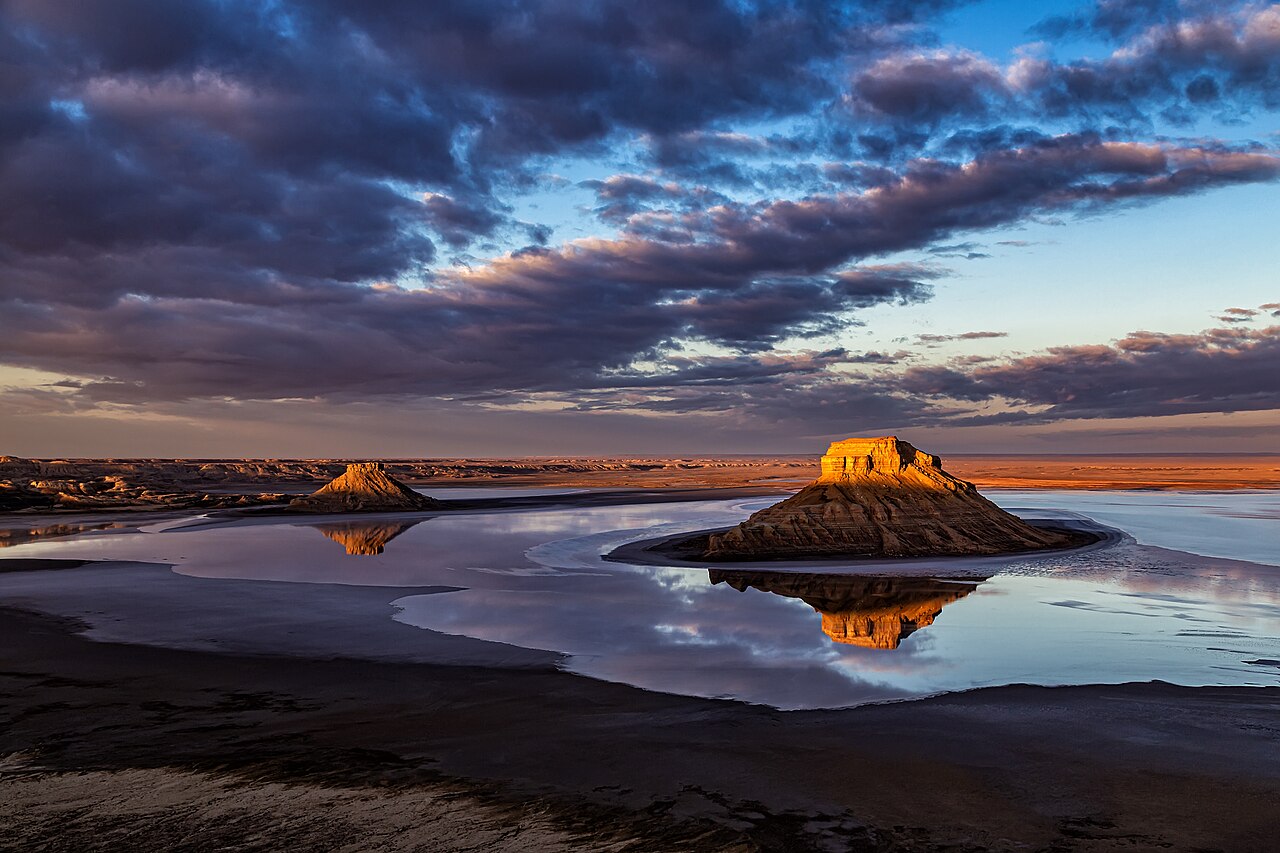
A week opens up Karynzharyk, the depression with the Three Brothers outliers, which needs an Ustyurt Nature Reserve permit that operators arrange in advance. It also lets you slow down — and slowing down is the actual luxury out here. Five to seven days total, with one or two in Aktau at either end, is the shape most people land on.
Camp or hotel? There isn’t much of a choice
Let me be plain: in the interior of Mangystau, camping is essentially the only option, and every multi-day tour is built around it. The exceptions are worth knowing about because they’re few.
| Wild camping | Free, permitted, and how it’s done. Usual pitches: Airakty valley, the Bozzhyra rim near Dragon’s Crest, the Bozzhyra basin floor. Campfires are prohibited — bring a stove |
| Kogez ethno-village | About 5 km from Sherkala. Roughly fifteen yurts with real beds, a small restaurant, showers, toilets and horse riding. The only proper accommodation in the northern cluster |
| Beket-Ata pilgrims’ guesthouse | Free, with separate air-conditioned halls for men and women. You’re expected to help with tea and cooking, and to bring food for the shared table |
| Shetpe / Zhanaozen | Basic hotel beds in both. Shetpe serves the north, Zhanaozen the south |
| Bozzhyra, from 2026–27 | A visitor-centre campsite with toilets and showers was completed in April 2026; 17 glamping pavilions and 50 hotel rooms are targeted for 2027. Don’t plan around either yet |
If a yurt night appeals as an experience rather than a fallback, our guide to staying in a yurt in Kazakhstan covers what it’s actually like. For the towns at either end, see where to stay in Kazakhstan.
Aktau itself has the full range — hostel dorms from 5,000 KZT, mid-range hotels 25,000–60,000, and a couple of five-stars. Our Aktau city guide names the properties that check out.
Guided or self-drive?
Self-drive is possible and a minority of travellers do it. Here’s the honest balance.
What guided buys you: recovery gear, spare fuel, someone who knows which track exists this month, and the ability to find sites that have no signage of any kind. Also permits for Karynzharyk, and — if you take a pilgrim-facing operator — an introduction at the mosques that you would not get alone.
What self-drive buys you: your own schedule, which in a landscape that only looks good at dawn and dusk is worth a great deal.
The sites that genuinely require 4WD, according to the most reliable regional source: Bozzhyra, Kyzylkup, Airakty, Tuzbair and Karynzharyk. Torysh and Sherkala are pointedly absent from that list — the tarmac gets close and the dirt sections are short, so a high-clearance crossover manages them in dry weather.
If you self-drive, the non-negotiables:
- Fuel. Zhanaozen is the last fuel for the south; Shetpe for the north. Carry a spare can.
- Water. Three to five litres per person per day. There is no source anywhere in the interior.
- Offline maps and coordinates, not a route line. There is no mobile signal.
- Recovery kit and a checked spare tyre.
- Tell someone your route before you lose signal.
- Read your rental contract. Aktau agreements have strong opinions about off-road use, and driving on salt flats will usually void your cover.
See renting a car in Kazakhstan before you commit, and planning a Kazakhstan road trip for the wider practicalities.

Questions to ask before you book
Prices are quoted loosely here and inclusions vary a lot. Get answers to these:
- Is it per person or per vehicle? The single biggest source of confusion. A “100,000 tenge day tour” is excellent value per car and poor value per head.
- How many passengers per vehicle? Three is typical. Ask what happens if you’re four.
- Is food included, and who cooks? On camping trips, usually yes and usually the guide. Confirm.
- Is camping equipment provided? Tent, mat, sleeping bag. Don’t assume.
- How much drinking water is carried, per person per day? If they can’t answer this, walk away.
- Does the guide speak English? In the local market, frequently not. That may be fine; know in advance.
- Is the Karynzharyk permit arranged? Only relevant if it’s on the itinerary.
- Cash or card? Many local operators are cash-only, and there are no ATMs outside Aktau.
- What’s the wet-weather plan? Rain closes Kyzylkup, Tuzbair and parts of Bozzhyra outright. Ask what they substitute and whether you get money back.
On that last point — the bentonite clay in the south becomes genuinely uncontrollable when wet, to the extent that a prepared jeep can lose steering entirely, and no recovery vehicle is coming. A good operator will cancel. Treat a willingness to drive into it as a red flag rather than commitment.
Nothing about Mangystau tourism is notably scammy in my reading of it, but the usual sensible habits apply — see common scams in Kazakhstan — and paying a deposit rather than the whole sum up front is reasonable with an operator you found on a noticeboard.
When to go
April–May and September–October. Daytime temperatures around +15 to +25 °C, workable tracks, and in spring a briefly green and flowering steppe.
Spring has one specific prize: it’s the only realistic window for Tuzbair’s mirror, when snowmelt and rain flood the pan. It’s also the wettest part of the year, so the same water that makes the reflection can close the road to it. Autumn is drier and the tracks are at their most reliable, which is why I’d pick late September if I could only go once.
Summer means up to +45 °C with no shade at any site and no water. If you’re locked into July or August, insist on pre-dawn starts and accept you’ll be finished by late morning. Winter brings sub-zero nights and gale-force winds that can wipe out the viewpoints entirely — one traveller in November got about five minutes at Dragon’s Crest before the weather closed in.
See the best time to visit Kazakhstan, plus spring and autumn in detail.
Getting to Aktau, and the paperwork
Aktau International (SCO) is well connected — Air Astana, SCAT and FlyArystan from Almaty and Astana, plus FlyArystan, Pegasus and Azerbaijan Airlines from Istanbul, Dubai, Doha, Baku and elsewhere. See flights to Kazakhstan and domestic flights in Kazakhstan.
Most nationalities need nothing more than a passport for a 30-day visa-free stay — check Kazakhstan visa requirements. Pick up a local SIM at the airport for the drive to and from the desert, even though it won’t work in it: our SIM card guide covers the networks. And draw cash in Aktau — genuinely, there are no ATMs beyond the city. See Kazakhstan currency and money.
One more reason to go sooner rather than later
In July 2026 UNESCO inscribed five of Mangystau’s rock-cut mosques — Beket-Ata, Shopan-Ata, Karaman-Ata, Shakpak-Ata and Sultan-Epe — on the World Heritage List. It’s Kazakhstan’s first inscription in more than twenty years, and it will change this region’s tourism economics quickly.
Bozzhyra already receives something in the order of 40,000 visitors a year, and the regional development plan for 2025–2029 budgets around a billion tenge for three formal viewing platforms and graded trails by 2027, plus a sealed 14.9 km access road already under construction. All of that is good — these landscapes need managing, and the mosques deserve protection. But the version you can see now, with no fences, no ticket booths and a guide who cooks your dinner on a camp stove, is finite.
Our Mangystau and the west pillar sets out the whole region, and Kazakhstan’s UNESCO sites covers the new inscription in context. For the wider country, organised tours in Kazakhstan compares operators and styles nationally, and Mangystau anchors our list of Kazakhstan off the beaten path.
Frequently asked questions
How much does a Mangystau tour cost?
Local group day tours ran 15,000–45,000 tenge per person in mid-2026, and private local trips roughly 100,000–160,000 tenge per vehicle. International operators charge US$495 for a solo traveller, about US$260 each for two and US$180 each for three. Multi-day international tours start around US$370 per person for two days.
Do you need a tour to visit Mangystau?
You need a vehicle and a driver, one way or another — there is no public transport to any of the natural sites. Self-drive is possible in a 4×4 if you carry spare fuel, water, recovery gear and offline maps, but the tracks are unsigned and there’s no phone signal.
How many days do you need in Mangystau?
Three days covers the core loop: Torysh, Sherkala, Airakty, both tiers of Bozzhyra, Bokty and Kyzylkup. Four or five adds Tuzbair and the underground mosques. A week lets you include Karynzharyk and stop rushing.
Is a one-day Bozzhyra tour worth it?
Marginally. You’ll spend nine or more hours driving for perhaps ninety minutes on the rim, arriving in the worst light of the day. A one-day trip works much better for the northern cluster — Torysh, Kok-Kala, Sherkala and Airakty — which is a genuinely satisfying day.
Do you need a 4×4 for Mangystau?
For Bozzhyra, Kyzylkup, Airakty, Tuzbair and Karynzharyk, yes. Torysh and Sherkala are reachable by a high-clearance crossover in dry weather, since the asphalt runs close and the dirt sections are short. In wet weather nothing is reliable — the clay in the south becomes genuinely dangerous.
Where do you sleep on a Mangystau tour?
Camping, almost always — it’s free, permitted and how every multi-day itinerary is built. The exceptions are the Kogez yurt village near Sherkala, the free pilgrims’ guesthouse at Beket-Ata, and basic hotels in Shetpe and Zhanaozen. Glamping and hotel rooms at Bozzhyra are targeted for 2027.
Why do four people sometimes cost more than three?
Because most operators cap a vehicle at three passengers plus guide and driver. A fourth booking triggers a second vehicle, and you pay for it. Groups of three get the best per-person rate; groups of five or six spread the second car more sensibly.
Do you need permits for Mangystau?
Only for Karynzharyk, which sits inside the Ustyurt Nature Reserve near the Turkmen border. Bozzhyra, Torysh, Sherkala, Airakty, Tuzbair, Kyzylkup and the underground mosques all have no fee, no ticket office and no permit requirement.
What is the best time of year for a Mangystau jeep tour?
April–May or September–October, at around +15 to +25 °C. Spring is the only chance of Tuzbair’s mirror but also the wettest season; autumn has the most reliable tracks. Summer exceeds +40 °C with no shade; winter brings sub-zero nights and gales.
Can you pay by card?
In Aktau, usually. On tour, often not — many local operators are cash-only, and there are no ATMs at all beyond the city limits. Draw tenge in Aktau and carry more than you expect to need.
Is Mangystau safe?
The region is safe in the ordinary sense. The real hazards are environmental: unfenced hundred-metre cliff edges in friable chalk, +45 °C summer heat with no water, no mobile signal, and the nearest help often 70–100 km away. Those are managed by going with someone competent and carrying enough water.
Final thoughts
The trap with Mangystau is treating it as a checklist. There are perhaps a dozen named sites and it’s tempting to buy the tour that hits the most of them, which is how people end up doing nine hours in a car to look at Bozzhyra in flat midday light.
The better approach is fewer places, more time, and light that works. Three days, two nights camping, the Fangs at dawn and Airakty at sunset. Pay the international rate if you need to book from home; find a shared vehicle through an Aktau hostel if you don’t. Ask how much water is in the car. And go before the viewing platforms arrive.
Photo credits
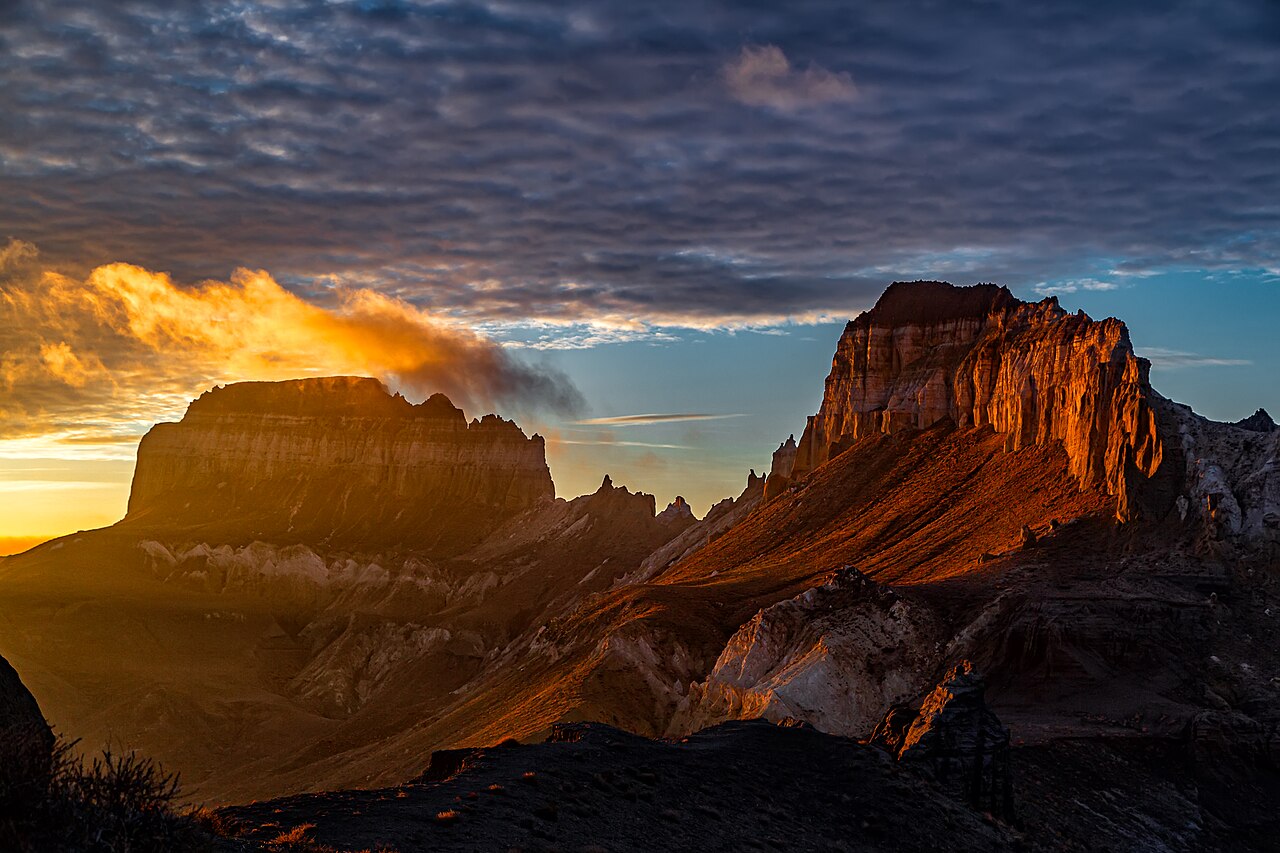
Limestone cliffs and peaks of Bozjyra — Photo: Berik Aday / CC BY-SA 4.0 via Wikimedia Commons. The Three Brothers reflected in the Karynzharyk depression — Photo: Astrobond / CC BY-SA 4.0 via Wikimedia Commons. Remote Bosjira valley in Mangystau — Photo: Ezra Sheyner / CC BY-SA 4.0 via Wikimedia Commons. Airakty-Shomanay at sunset — Photo: Astrobond / CC BY-SA 4.0 via Wikimedia Commons.