Contents
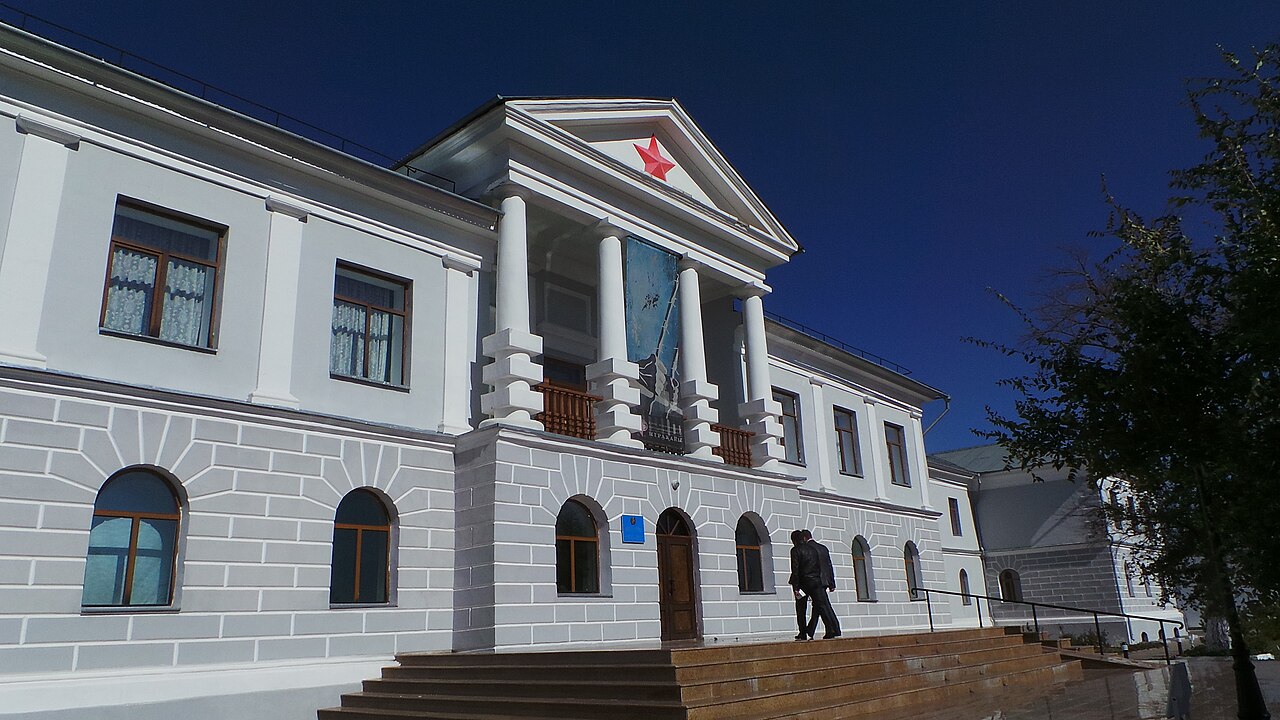
Forty kilometres southwest of Karaganda, in a village called Dolinka, there is a grey colonnaded building with a red star still fixed above the entrance. Prisoners built it in 1935 to house the administration of the camp system that was imprisoning them. It is now a museum, and it is the most important thing to see in central Kazakhstan.
Karaganda is a coal city of roughly half a million people about 230 kilometres southeast of Astana, and a base for visiting Karlag — one of the largest camp administrations in the Soviet Gulag, which operated from 1931 to July 1959 and held more than a million prisoners over its history. The Museum of the Memory of Victims of Political Repression in Dolinka opened in 2011 in the former Karlag headquarters.
This guide gives you the current museum hours and prices, plus the three-site memorial geography, the city itself, and an honest note on how the museum presents its material.
Karaganda at a glance
| Population | Roughly half a million. Fell 14% in the 1990s, since partly recovered |
| Founded | Coal found 1833; village 1931; city status 1934 |
| From Astana | ~230 km by bus or train; check the day’s timetables before you travel |
| Airport | Sary-Arka (KGF) |
| Karlag operated | 1931 to 27 July 1959 |
| Karlag size | 1,780,650 hectares; 26 branches, 192 camp points |
| Prisoners | Peak ~65,000–66,000; over 1 million passed through |
| Museum, Dolinka | Shkolnaya St 39, ~50 km southwest. Closed Mondays |
| 2026 tickets | 1,000 KZT entry · 2,000 with excursion · 3,000 private |
| January average | −13.4 °C. July 20.0 °C. Best months May and September |
Karaganda in brief: the city coal built
From a shepherd’s coal seam to a Soviet city
In 1833 a shepherd named Appak Baizhanov found coal at the surface here. Small-scale mining followed, but the transformation came with Soviet industrialisation, which turned the Karaganda basin into a major coalfield. A village was declared in 1931 and city status granted in 1934.
By 1939 the city held about 100,000 people, and roughly half of them were prisoners. That statistic is the key to understanding Karaganda: it is a city that was built by, and largely of, the Gulag.
A city of deported nationalities
The population arrived by force. In 1941 the Volga Germans were deported to Kazakhstan and Siberia, and Karaganda became home to a large German community.
Germans were not the only deported people: Koreans, Chechens and Ingush, and Poles from Ukraine were sent to Kazakhstan too. Layered underneath all of it is the famine of the early 1930s, which killed an estimated 1.5 million people — around a quarter of Kazakhstan’s population.
From the 1990s large numbers of ethnic Germans left for Germany, part of an exodus that cut Karaganda’s population by 14 per cent between 1989 and 1999. The German legacy is still visible — most obviously in the Catholic cathedral.
“Where? In Karaganda!”
Worth explaining properly, because you will hear it. In Russian, if someone asks a question you consider stupid — где?, “where?” — the stock retort is в Караганде!. It works because in the locative case, Karagande rhymes with gde, and also, conveniently, with an obscenity. Karaganda stood for the middle of nowhere.
The city has embraced it: a monument to the phrase was unveiled in May 2011. There is also a widely repeated claim that the phrase originated with released Karlag prisoners using “Karaganda” to explain gaps in their employment history. It is a good story, but treat it as folklore rather than fact.
Karlag: what it was
Scale, dates and structure
The Karaganda Camp — Karlag — was founded in 1931 and reorganised into the regional detention administration on 27 July 1959. It covered 1,780,650 hectares, organised into 26 branches and 192 camp points, spanning roughly 300 kilometres north to south by 200 east to west. Museum guides describe the total territory with its branches as comparable in size to France.
Peak prisoner population was around 65,000 to 66,000. More than a million prisoners passed through it over its history. It was, in effect, an agricultural and industrial enterprise run on forced labour — feeding the coal basin, farming the steppe, and staffing workshops and laboratories.
Who was sent here
Peasants swept up in dekulakisation. Deported nationalities. Political prisoners. Scientists and engineers whose expertise was put to use inside the camp. And the wives and children of men declared enemies of the state.
Work, science and the children of the camp
Karlag ran research stations; some prisoners were academics who continued working under guard. It also had a children’s dimension that is the hardest part of the museum to get through. Recorded child deaths were 114 in 1939, 924 between 1941 and 1944, and 1,130 between 1950 and 1952. About 3,000 children born in Karlag survived.
One claim to handle carefully: Solzhenitsyn is listed as a Karlag inmate in some sources and cited as such by museum guides, but the camp behind One Day in the Life of Ivan Denisovich is generally placed at Ekibastuz, in the Pavlodar region, under a different camp administration. We would not assert the connection.
The museum at Dolinka
The building itself
The institution was created by presidential order in 2001 and spent its first decade in the former Karlag clinic before moving into its current home in 2011. The building is the former Karlag administration block, built by prisoners in 1933–35. That fact does most of the interpretive work before you go in.
What you see
Room by room: the deportation statistics, prisoner case files, the scientific and agricultural work, the women’s and children’s sections, and reconstructed cells and interrogation rooms in the basement. Labelling is partly trilingual — Kazakh, Russian and English — and a guide is assigned to visitors.
Hours and tickets in 2026
These are the museum’s own published figures, with standard adult entry at 1,000 tenge.
| Ticket | Price (KZT) |
|---|---|
| Adult entry, no excursion | 1,000 |
| Adult with excursion | 2,000 |
| Individual (private) excursion | 3,000 |
| Excursion to former Karlag sites around Dolinka | 700 |
| Students | 700 / 1,500 with excursion |
| School pupils | 500 / 1,200 with excursion |
| Professional photography | 3,000 per hour |
Opening hours: Tuesday to Sunday, closed Mondays. Unguided visiting 10:00 to 17:00. Guided tours at 10:00, 11:30, 14:00 and 15:30. Lunch break 13:00 to 14:00 — plan around it, because arriving at 12:50 is a wasted journey.
Entry is free for Second World War veterans, people with disability groups I and II, orphanage children and under-fives. The address is Shkolnaya Street 39, Dolinka; the phone number is 8 (72156) 5-82-22.
Getting there
Three options.
- Bus 121 from Karaganda toward Shakhtinsk. Get off at Dolinka, then walk or take a local taxi to the museum; ring the museum for directions from the stop. Check the bus times before you set off. The cash fare was set at 190 tenge in February 2023, so ask the current one when you board.
- Taxi from Karaganda via Yandex Go or InDrive. The simplest option, and worth negotiating a wait-and-return since getting back can be slow.
- Guided excursion. Nomadic Travel runs an eight-hour trip combining Dolinka and the Spassk memorial; ask for a current quote for your group, since the price depends on its size.
Allow at least four hours for Dolinka including travel; the guided museum tour alone runs about two hours.
A note on how it is presented
We will be straight about this. The museum is essential and its documentary material is excellent. Its presentation is more contested: the basement includes mock torture cells with sound effects and mannequins, and the final hall pivots to a patriotic framing about independent Kazakhstan that sits oddly after what precedes it.
Some visitors find the reconstructions powerful; others find them a jarring turn toward spectacle in a place whose real archive is devastating enough. Go with that in mind, and give most of your time to the case files and photographs on the upper floors.
The other memorial sites
Mamochkino, the Mothers’ cemetery
About three kilometres south of Dolinka, near Zhartas village, is the burial ground for children who died in the camp. It is state-protected and unstaffed. There is very little to see and a great deal to think about.
Spassk memorial complex
Thirty-five kilometres south of Karaganda, just off the Balkhash road — the opposite direction from Dolinka, which is why doing both in one day means a long loop. The landmark is a tank on a plinth opposite the turn-off.
Spassk was a camp for prisoners of war, and archival data cites more than 5,000 of them buried there. What makes it extraordinary is that around 28 memorials have been raised by different nations for their own dead. Japan was first, in 1987, followed by France and Finland in 1994, Germany and Ukraine in 1995, Poland in 1996 and Hungary in 2000. Walking between them is the clearest possible illustration of how many countries lost people on this piece of steppe.
It is free, has no fixed hours, and takes ten to fifteen minutes.
ALZHIR — which is near Astana, not Karaganda
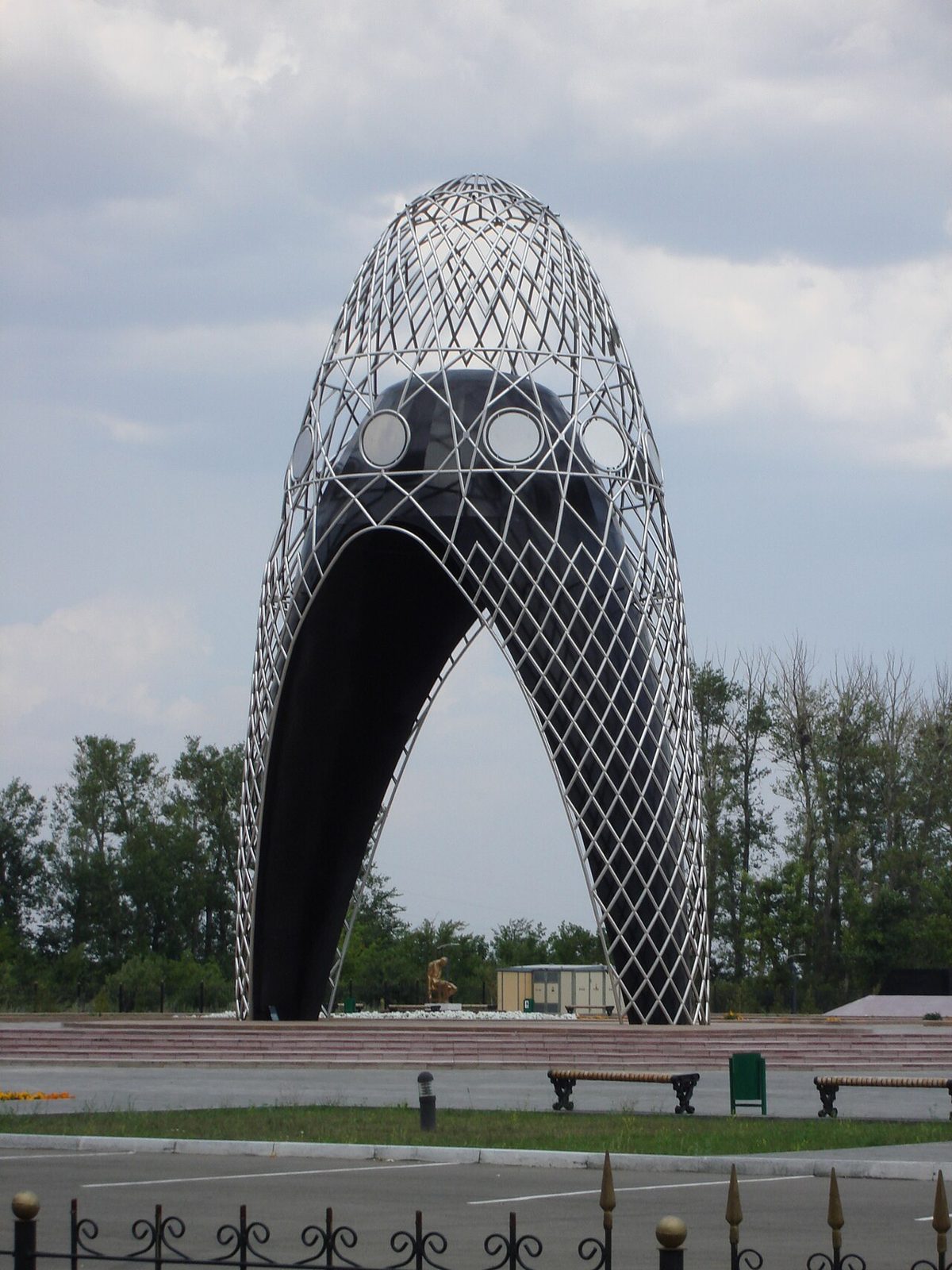
This confusion is worth heading off, because guides and readers conflate them constantly. ALZHIR is not at Karaganda. It is at Akmol village, about 40 kilometres west of Astana — a separate camp, for the wives of men declared “traitors to the Motherland”, operating from 1938 to 1953 and holding more than 18,000 prisoners. Its memorial museum opened on 31 May 2007, and city bus 300 goes there from central Astana.
If you are based in Astana, ALZHIR is your half-day. If you are in Karaganda, Dolinka is. They are separate camps in different regions. See our day trips from Astana guide for the ALZHIR trip.
Things to do in Karaganda city
Do not treat Karaganda purely as a Gulag day trip. There is a real city here, and its Soviet fabric is unusually intact.
Miners’ Glory and the Miners’ Palace of Culture
The Miners’ Glory monument — two miners raising a block of coal above their heads — was erected in 1974 to mark two million tonnes of coal from the Karaganda basin. It stands opposite the Miners’ Palace of Culture at the main entrance to Central Park on Bukhar Zhyrau Avenue.
The statues on the Palace of Culture’s portico were developed from sketches by Yevgeny Vuchetich, the sculptor behind the giant Motherland Calls statue at Volgograd. Begun in 1940 and completed in 1952, the palace is a fine piece of Stalinist architecture.
Central Park, the Ethnopark and the zoo
Central Park was laid out between 1935 and 1941 and covers 150 hectares. There is also an Ethnopark, where a Holodomor monument was opened on 31 May 2022. The city also has a zoo; the regional tourism site, visitkaraganda.kz, has its current details.
Museums
The Ecomuseum, founded in 1995, focuses on environmental issues in central Kazakhstan and displays fragments of spacecraft debris. The Regional Museum of Local History holds over 134,000 exhibits across 14 halls. There is also a Museum of Fine Arts.
Cathedral of Our Lady of Fatima
The most striking building in the city and a direct legacy of the deportations. Construction ran to 2012, and it was consecrated on 9 September 2012 with Cardinal Angelo Sodano. The building is neo-Gothic, and the national tourism portal bills it as the largest Catholic cathedral in Central Asia.
A German-Gothic cathedral on the Kazakh steppe makes no sense until you know that hundreds of thousands of Catholic Poles and Germans were deported here. Then it makes complete sense.
The space connection
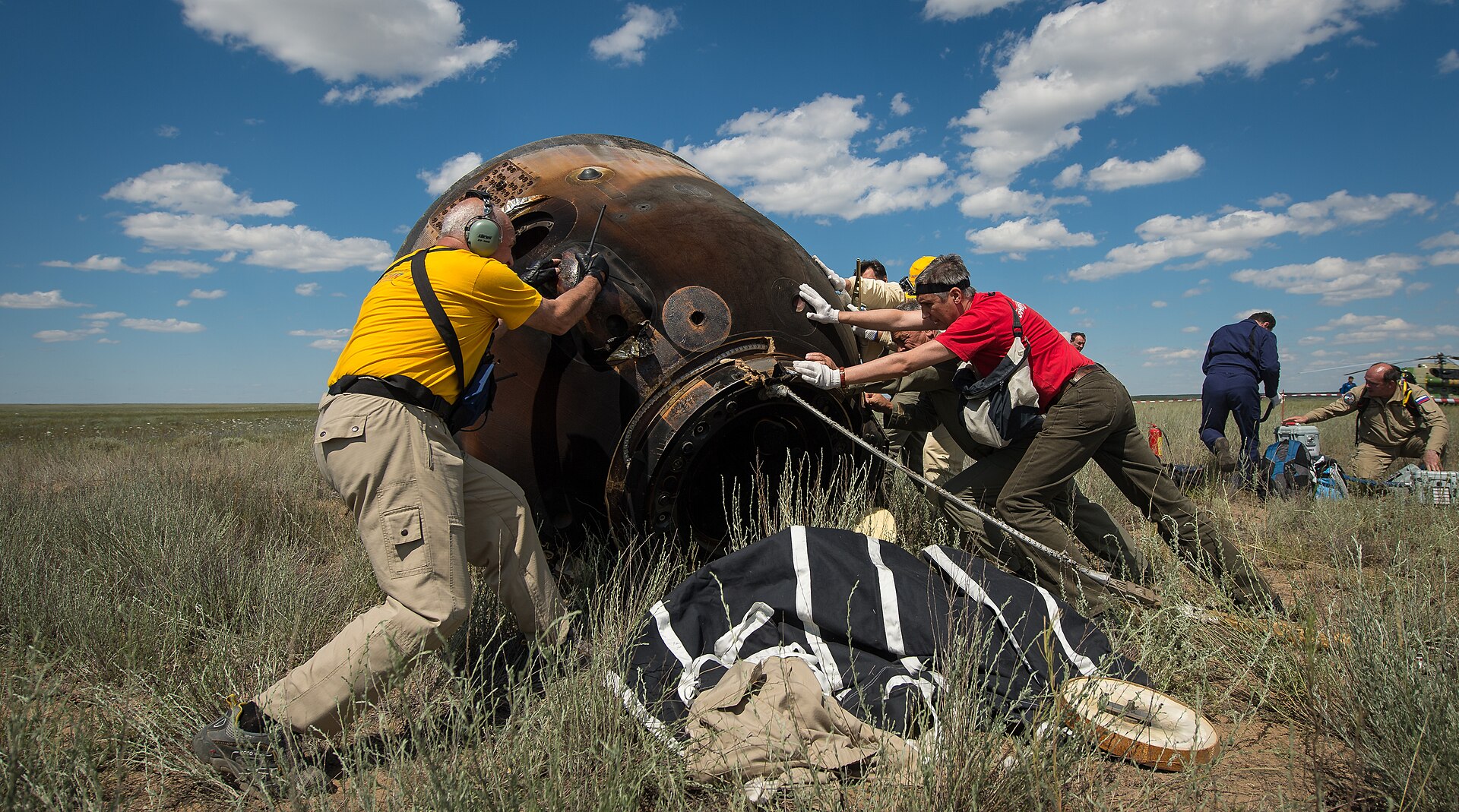
Karaganda is quietly a space city. Soyuz capsules land on the steppe in this region, and returning crews are still helicoptered to Karaganda before flying on — as happened with Soyuz MS-28 in July 2026 after 241 days in orbit. Hotel Cosmonaut opened in 1972 for crews returning from orbital flights and now describes itself as a five-star hotel. There is a Gagarin monument and a Viktor Tsoi monument, plus Soviet mosaics worth hunting for. See our Baikonur guide for the launch end of the story.
Temirtau and the steppe
Temirtau is 35 to 40 kilometres north, and it is where Nursultan Nazarbayev’s career began: he started work at the Karaganda Metallurgical Plant in 1960, worked as a steelworker and blast-furnace hand, graduated from the plant’s technical college in Temirtau and became the plant’s party committee secretary in 1972.
The plant has changed hands. ArcelorMittal completed the sale of ArcelorMittal Temirtau on 8 December 2023, and four days later it was renamed Qarmet. The sale followed a period of serious accidents, including the Kostenko mine fire of 28 October 2023 which killed 46 people.
Karaganda still has eight working mines in the city as of 2023, down from as many as 26 in Soviet times.
Practicalities
From Astana
Buses and trains link the two cities, and both are very cheap. Check the day’s timetables before you travel. The fast Tulpar service between Astana and Almaty stops at Karaganda. See train travel and buses in Kazakhstan.
From Almaty and by air
Almaty is an overnight fifteen hours or more on the older train. Sary-Arka Airport (KGF) has 2026 routes including Almaty and Moscow. See Almaty to Astana.
Where to stay, eating, how long
Hotel Cosmonaut is the atmospheric choice; there is a normal range of business hotels otherwise. For food, the Kaganat chain of stolovaya canteens is the cheap, reliable local answer — point at what you want. See Kazakh food.
Two nights is right: one full day for Dolinka and Spassk, one for the city. Use 2GIS for transport and Yandex Go for taxis.
Season and air quality
January averages minus 13.4 with mean minima of minus 17.7; July averages 20.0. Records are minus 42.9 from 1938 and 40.2 from 2002. May and September are the best months.
Air quality is a genuine issue: Karaganda recorded the highest PM2.5 of Kazakhstan’s measured cities between 2017 and 2022, ranked 23rd worldwide, and appeared among the world’s most polluted cities in the 2024 World Air Quality Report. For a two-night visit this is a nuisance rather than a risk, but it is real, and worst in still winter conditions.
Frequently asked questions
What is Karaganda famous for?
Coal, the Karlag Gulag administration, a Russian idiom meaning “the middle of nowhere”, and being where Soyuz crews are brought after landing.
What was Karlag and how many people passed through it?
One of the largest Soviet camp administrations, operating from 1931 until its reorganisation on 27 July 1959, across about 1.78 million hectares; in 1953 it had 26 branches and 192 camp points. Peak population was around 65,000, and more than a million prisoners passed through it.
Where is the Karlag museum and how do I get there?
Dolinka, about 50 kilometres southwest of Karaganda at Shkolnaya Street 39. Take bus 121 toward Shakhtinsk to the Dolinka stop and walk or catch a local taxi from there, or go by taxi all the way from the city.
How much does the Dolinka museum cost and when is it closed?
1,000 tenge entry, 2,000 with a guided excursion, 3,000 for a private one. Closed Mondays; open Tuesday to Sunday with a 13:00–14:00 lunch break.
Is there an English-speaking guide?
Labelling is partly in English and English-language excursions do happen, but do not assume one will be available on the day. Contact the museum in advance if it matters.
How do I get from Astana to Karaganda?
Bus in about three hours or train in about four, four services daily. Both cheap.
Why do Russians say “Where? In Karaganda!”?
Because in the locative case Karagande rhymes with gde, “where” — and with an obscenity. The city put up a monument to the phrase in 2011.
Is Karaganda worth visiting?
Yes, for two nights, if Soviet history interests you. Dolinka alone justifies the trip; the city adds a well-preserved Stalinist centre and one of the more surprising cathedrals in Asia.
Why were there so many Germans in Karaganda?
Volga Germans were deported en masse to Kazakhstan and Siberia in 1941, and Karaganda was one of the places they were sent. Many of their descendants emigrated to Germany from the 1990s.
Is ALZHIR the same as Karlag?
No. ALZHIR was a separate camp for wives of “traitors to the Motherland” at Akmol, about 40 kilometres from Astana, not Karaganda.
Do Soyuz capsules land near Karaganda?
They land on the steppe in the wider region, and crews are helicoptered to Karaganda before flying onward. This was still happening in July 2026.
How long do I need at Dolinka?
At least four hours including travel from Karaganda. The guided tour is about two hours.
Final thoughts
Most people arrive in Karaganda for one building in a village about fifty kilometres away, and that is a good enough reason. The Dolinka museum documents political repression inside the former Karlag administration building, which prisoners built in 1933–35, and that fact gives it a weight no exhibition design could manufacture.
But give the city its day too. Walk down Bukhar Zhyrau Avenue past the Miners’ Palace and its Vuchetich statues, look at a Gothic cathedral built with donations from abroad, Germany among them, and remember that half the people in this city in 1939 were prisoners. Karaganda is not a stopover between Astana and Almaty. It is the clearest single illustration of how twentieth-century Kazakhstan was actually made.
Our guide to dark tourism in Kazakhstan covers the country’s other difficult sites, the history of Kazakhstan provides the background, and northern and eastern Kazakhstan ties this region to the rest. If you are continuing south, Lake Balkhash is on the road to Almaty.
Photo credits
Karlag administration building at Dolinka: Yakov Fedorov, CC BY-SA 4.0, via Wikimedia Commons. ALZHIR Arch of Sorrow: Tosa1, CC BY-SA 3.0, via Wikimedia Commons.
Soyuz capsule recovery near Zhezkazgan: Expedition 47 Soyuz TMA-19M Landing (NHQ201606180009) by Bill Ingalls, Public domain, via Wikimedia Commons.