Contents
- Eagle hunting at a glance
- What berkutchi actually is
- How old is the tradition?
- How an eagle is trained
- Where the tradition genuinely survives
- What you’ll actually see as a visitor in Kazakhstan
- Is it ethical? An honest look
- The season, and why it matters more than anything else
- Where eagle hunting sits in Kazakh culture
- Photographing it well
- Frequently asked questions
- Final thoughts
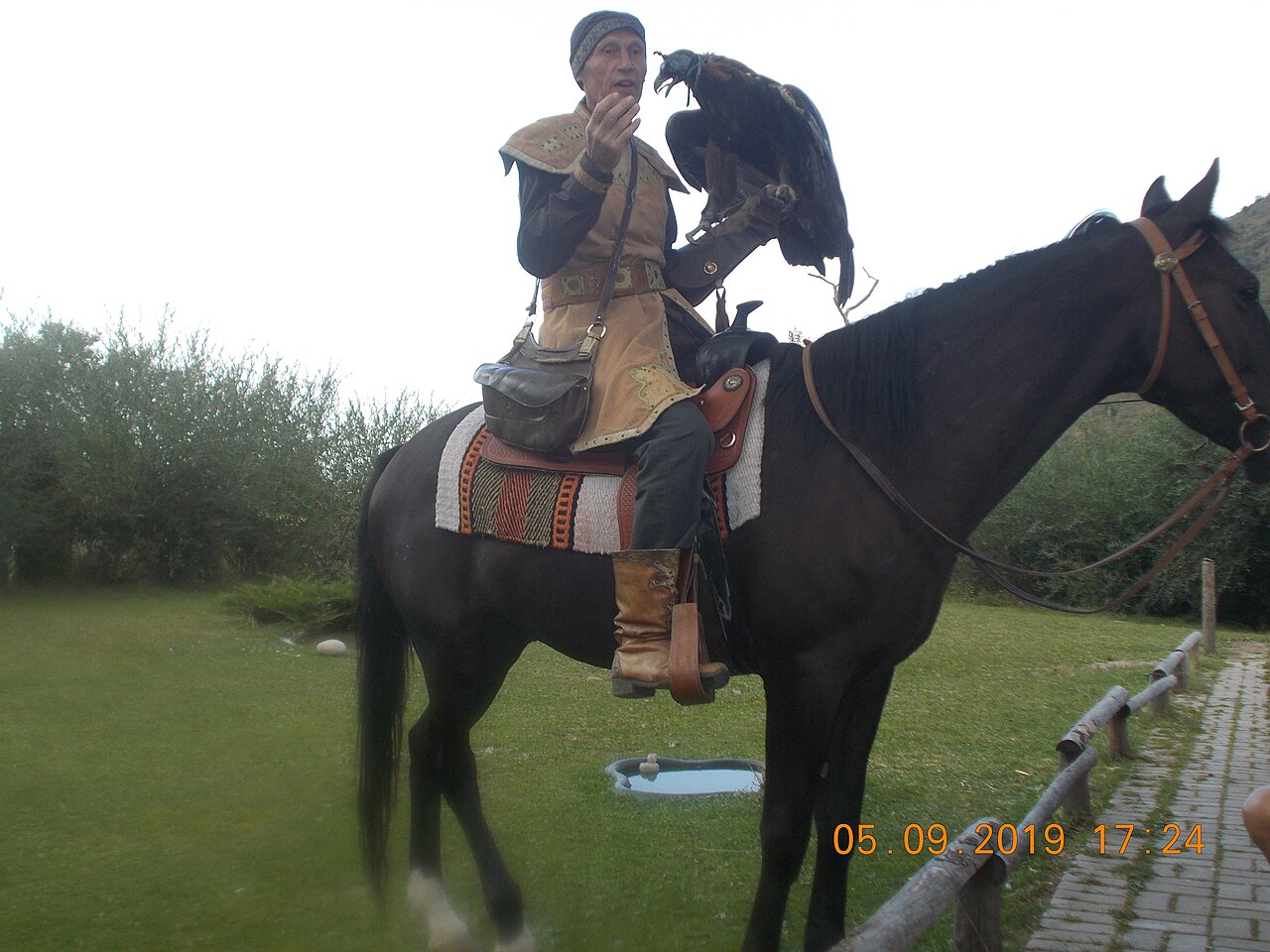
A golden eagle weighs about five kilos and sits on a padded glove on your forearm. That doesn’t sound like much until you’re holding one, at which point the arm starts shaking within about forty seconds and you understand why the hunters ride with a forked wooden prop wedged against the saddle. The bird is not the heavy part. The bird plus gravity plus a horse, for six hours, in January, is the heavy part.
Eagle hunting in Kazakhstan is berkutchi — hunting with trained golden eagles from horseback, practised for centuries across the steppe and still alive in the Kazakh Altai in the east. The real hunting season is winter, roughly October to March, when snow makes prey visible. Outside that, what visitors see near Almaty is a demonstration rather than a hunt, and it’s worth knowing the difference.
This guide is about seeing it honestly. Where the tradition genuinely survives, where it’s staged for cameras, how the birds are actually treated, and what “ethical” means in a practice that is simultaneously a UNESCO-recognised heritage art and a tourist photo opportunity involving a live raptor.
Eagle hunting at a glance
| The Kazakh name | Berkutchi or bürkitshi — from bürkit, golden eagle. Also qusbegi, “bird master” |
| The bird | Golden eagle, Aquila chrysaetos. Hunters fly females, which are roughly a quarter heavier than males |
| Quarry | Fox and hare mainly; corsac fox, marmot, and historically wolf |
| Real season | Winter — roughly October to March, when snow exposes tracks and fur is at its best |
| Where it survives | The Kazakh Altai in East Kazakhstan, and among Kazakh communities in western Mongolia’s Bayan-Ölgii |
| Where visitors see it | Demonstration centres in the Almaty foothills, and winter festivals |
| UNESCO status | Falconry is inscribed on UNESCO’s list of Intangible Cultural Heritage as a multinational element including Kazakhstan |
| Traditional release | Birds are conventionally returned to the wild after some years of hunting, to breed |
| Best time to visit for this | Winter for the genuine article; any season for a demonstration |
What berkutchi actually is
Eagle hunting is falconry with the largest bird anyone has managed to fly at quarry. A trained female golden eagle is released from a horseman’s glove at a fox or hare spotted on open ground, strikes it, and holds it until the hunter arrives. Then — and this is the part people don’t expect — the eagle gives it up in exchange for a piece of meat and goes back on the glove.
The equipment is specific and every piece solves a problem:
- The balak, a heavy leather glove and gauntlet running well up the forearm. Golden eagle talons exert enough force to break bone.
- The tomaga, a hood covering the bird’s eyes. A hooded eagle is calm; an unhooded eagle on a horse in open country is looking for something to kill.
- Jesses and a leash, the short straps on the legs.
- The baldak — a forked wooden support that braces against the saddle and takes the bird’s weight off the arm. This is the piece that gives away how physically hard the job is.
- A perch in or beside the home, where the bird lives at the centre of household life rather than in a shed.
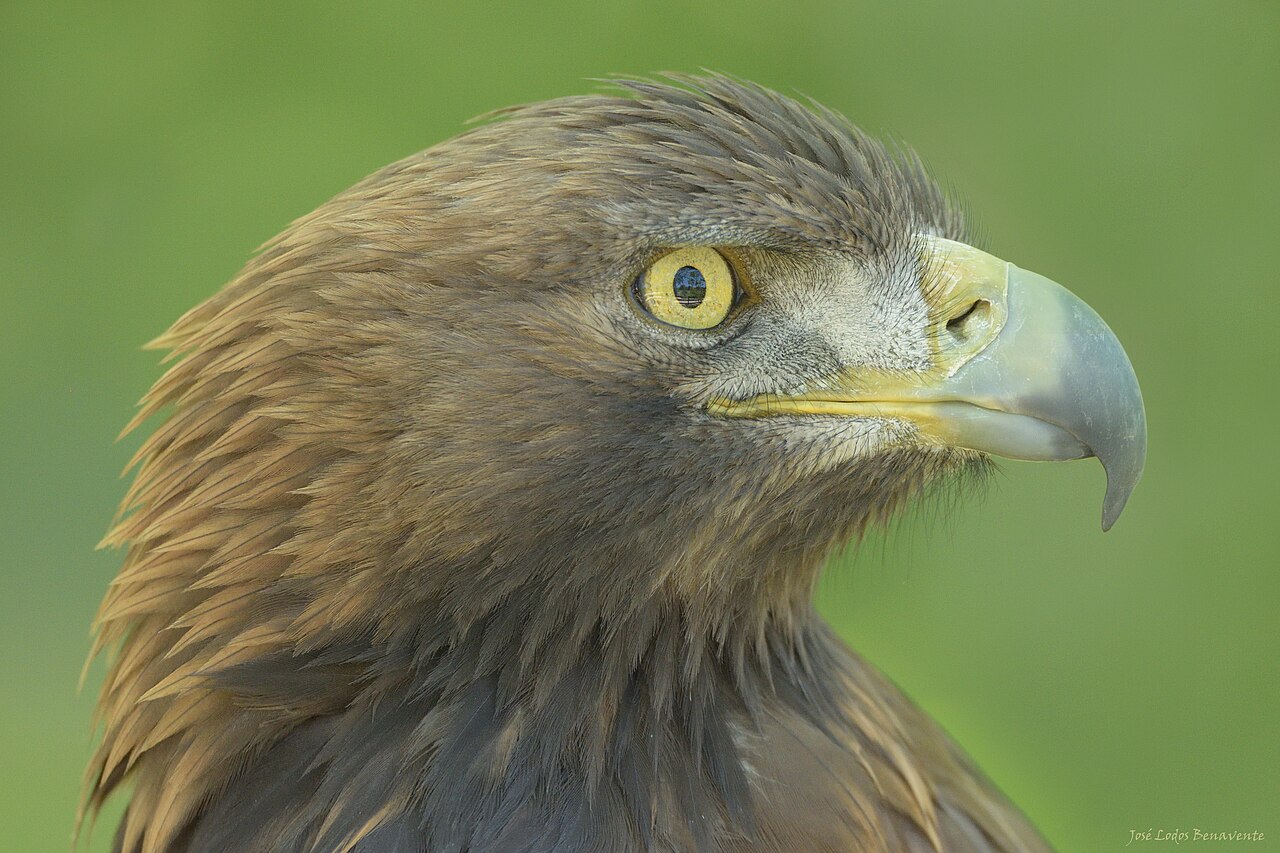
Why females? Because in raptors the female is substantially larger — for golden eagles, around a quarter heavier — which means more reach, more grip and the ability to take bigger quarry. It’s the same logic across falconry worldwide.
How old is the tradition?
Old, and I’d rather give you a range than a headline number. Falconry in Central Asia is generally traced back thousands of years, with rock art and burial evidence across the steppe belt, and eagle hunting specifically is documented among Turkic and Mongol peoples for many centuries. Marco Polo described hunting with large raptors at the Mongol court.
You will see “4,000 years” and “6,000 years” quoted confidently. Those figures come from general falconry claims rather than from anything specific to golden eagles on the Kazakh steppe, and I wouldn’t repeat them as fact. What’s solid: this is a genuinely ancient practice, continuous in some communities into the present day, and part of a hunting culture that also gave Kazakhs the tazy sighthound.
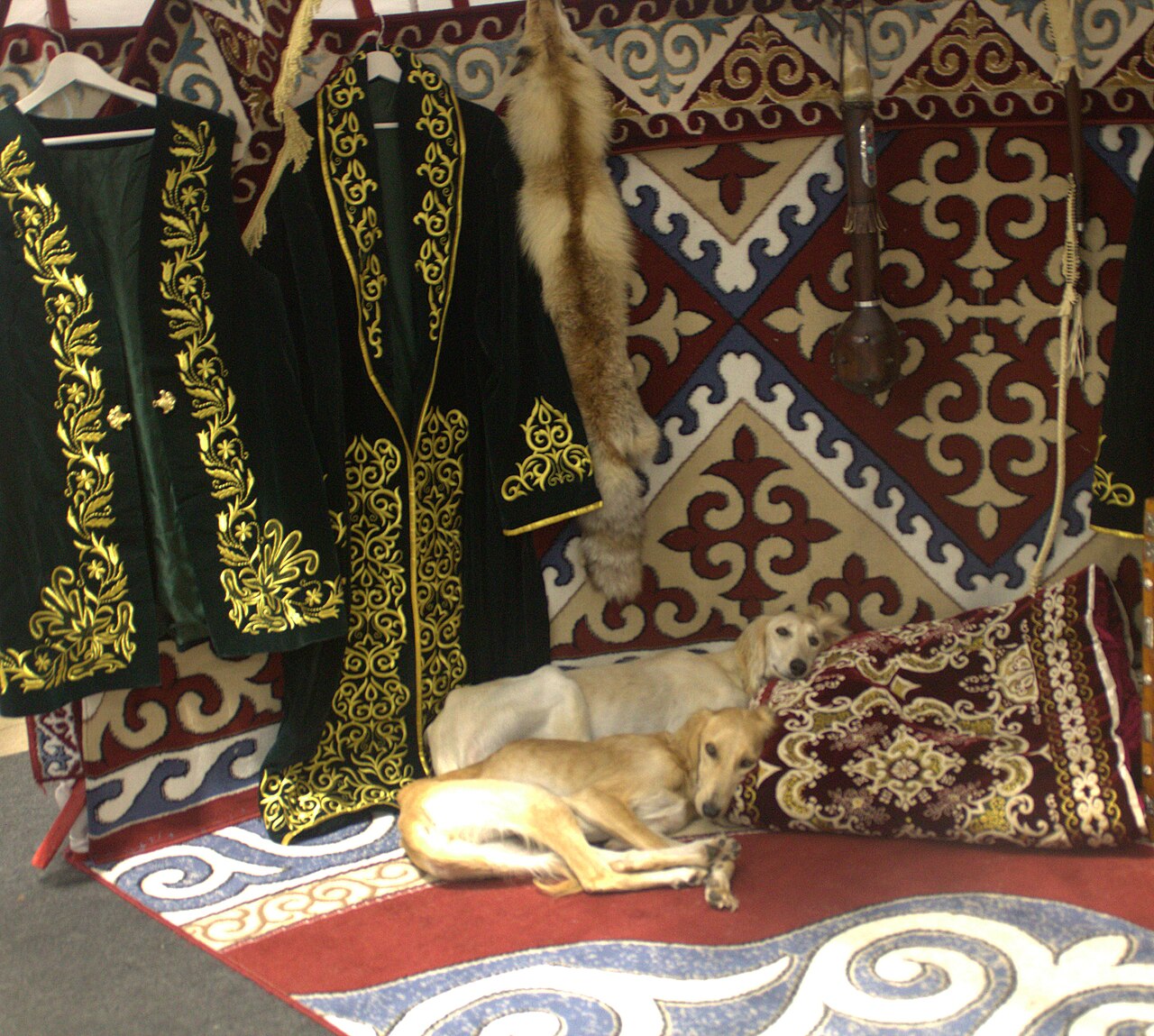
The tazy is worth a paragraph of its own. It’s the Kazakh sighthound — lean, fast, built for open ground — and in the classic setup dog and eagle work together, the dog flushing and coursing, the eagle striking. A household with a good tazy and a good eagle was a household that ate well in winter. The breed has been through a serious decline and is now the subject of a deliberate revival, with a national breed standard and, in Pavlodar, a statue.
How an eagle is trained
The core of the training is not dominance. It’s food and patience.
Birds are traditionally taken as eyasses — young eagles from a nest — or occasionally trapped as juveniles. The first phase is manning: getting the bird accustomed to the hunter’s presence, voice, hands and the noise of a household. Sleep deprivation for both parties features heavily in accounts of this stage; the hunter effectively lives with the bird until it stops treating him as a threat.
Then comes the association of the hunter with food. The eagle is fed only by hand, from the glove, so the glove becomes the single most reliable thing in its world. Weight management is the technical heart of falconry everywhere: a bird too heavy won’t respond, a bird too light is in danger. Getting that balance right is the skill that takes years.
Next, the bird is flown to a dragged lure — often a fox skin pulled behind a horse — first on a line, then free. Finally it’s taken to live quarry. Good hunters describe the relationship in terms of trust and reading each other, and the language they use about their birds is closer to how people talk about a working dog than about equipment.
Traditionally the knowledge passes from father to son, and a hunter’s reputation rests on his bird’s performance. The word qusbegi — bird master — was historically a title of considerable standing.
The release
Here’s the detail that changes how you think about the whole practice: the traditional expectation is that the bird is released back into the wild after a period of years, to breed. Accounts differ on the timing, and I’ve seen everything from around ten years to “when she’s ready,” which suggests it’s a judgement rather than a rule. There are descriptions of a farewell ritual — a last meal, the hood removed for good.
How consistently this happens today, I can’t tell you, and I’d be suspicious of anyone who claims to know across the whole community. But it’s the stated norm, and it’s a meaningful one: the bird is borrowed rather than owned.
Where the tradition genuinely survives
Two places, and it’s worth being precise because a lot of writing blurs them.
The Kazakh Altai, in East Kazakhstan region around Katon-Karagay and the far east of the country, is where berkutchi persists as a working practice in Kazakhstan itself. This is remote, mountainous, hard-winter country — see our guide to northern and eastern Kazakhstan for how to get into it.
Bayan-Ölgii in western Mongolia is home to an ethnically Kazakh community where the tradition is arguably strongest of all, and it’s the source of most of the famous photography — including the images that made The Eagle Huntress and its subject Aisholpan internationally known. That documentary did enormous good for awareness and also, in the view of some in the community, oversimplified the story. If you’ve seen it, treat it as an introduction rather than an ethnography. It’s also worth noting that girls and women hunting with eagles is not unprecedented; the film’s framing as a first has been contested.
The important practical consequence: the biggest eagle festivals are in Mongolia, not Kazakhstan. If your specific goal is a large competitive gathering of eagle hunters, that’s a Bayan-Ölgii trip in autumn, not a Kazakhstan trip.
What you’ll actually see as a visitor in Kazakhstan
Let me set expectations clearly, because this is where disappointment happens.
Demonstration centres near Almaty
Within an easy drive of Almaty there are raptor centres — the best known being the Sunkar falcon centre in the foothills — where you can see golden eagles, saker falcons, eagle-owls and other birds, watch flying demonstrations, and hold a bird on the glove for a photograph. Some include a horseman in traditional dress releasing an eagle to a lure.
This is a demonstration. It’s on a lawn, the quarry is a dragged skin, and it happens in September as readily as January. That doesn’t make it worthless — the birds are impressive at close range, the handlers know their subject, and it’s the only realistic option for most visitors. Just don’t expect a hunt.
Practicalities shift year to year, so confirm before you go: opening days, whether demonstrations are scheduled or on request, and prices. Independent operators also run half-day eagle-hunting experiences from Almaty combined with a yurt visit and a meal. Our day trips from Almaty guide covers the general logistics of getting out of the city, and things to do in Almaty puts it in context with the rest.
Winter festivals and competitions
Kazakhstan holds eagle-hunting competitions, typically in winter, where berkutchi compete on their birds’ obedience, speed to the glove and performance at a lure. These are the real thing culturally — the hunters are hunters — and they’re where you’ll see the equipment, the horses and the community rather than a show. Dates and locations are announced locally and change, so ask a Kazakh operator rather than relying on a list published abroad.
The Altai, if you’re serious
If you want to see actual hunting, you need to go east, in winter, with a local contact, and accept that it involves long cold days on horseback with no guarantee of a kill. It is not a packaged product. It is also, by every account I’ve read, extraordinary.

Is it ethical? An honest look
I don’t think there’s a clean answer here, so let me lay out both sides and tell you what to look for.
The case that it’s defensible
Falconry is inscribed by UNESCO as intangible cultural heritage, in a multinational listing that includes Kazakhstan — a recognition that it’s a living social practice with real cultural value, not a spectacle. The birds are worked, not caged for display; they fly free every time they hunt and could leave. They’re kept at the centre of household life. And the traditional norm is release back to the wild to breed. A well-kept hunting eagle arguably has a better life than a great many captive raptors.
The case for concern
The concern isn’t really the hunting. It’s the photo trade. Where tourism demand is high, there’s pressure to keep birds available for handling all day, every day, in and out of season — hooded, on a glove, passed to strangers for pictures. That’s a different activity from hunting, with different welfare implications: heat stress in summer, constant disturbance, and birds selected for docility rather than working ability.
Golden eagles are also a protected species, and taking birds from the wild is regulated. A legitimate operation can account for where its birds came from.
What to look for, practically
- Are the birds flying? A bird that flies to a lure and comes back to the glove is being worked. A bird that only ever sits hooded for photographs is a prop.
- Is there shade and water, and are birds given breaks? Summer heat is the main welfare risk at demonstration sites.
- How long is a bird on the glove for photos? Minutes, ideally, with rotation between birds.
- Does the handler talk about the individual bird — her name, her age, her temperament, what she’s caught? Real hunters do this unprompted and at length.
- Can they tell you where the bird came from and whether she’ll be released?
- Are you being invited to hold the bird without a proper gauntlet? That’s a red flag for the bird’s handling standards as much as for your arm.
- Follow instructions exactly. Don’t reach for the bird, don’t put your face near it, don’t use flash.
And a plain safety note: a golden eagle can injure you seriously. Wear the glove you’re given, keep your other hand down, and if the handler says don’t move, don’t move.
The season, and why it matters more than anything else
Eagle hunting is a winter activity, and the reasons are entirely practical. Snow makes prey visible and trackable across open ground. Fox and hare fur is at its best. And a working eagle needs cool weather — flying a five-kilo bird in summer heat is hard on the bird.
So the honest calendar:
| October–March | The real season. Hunting in the Altai, competitions and festivals, cold and authentic |
| April–September | Demonstrations only. Enjoyable, photogenic, not a hunt |
If you’re building a trip around this, that pushes you towards a winter visit — which has its own considerable rewards. See Kazakhstan in winter, Kazakhstan in January and February and the winter packing list, because standing still in an Altai field at −20 °C is a genuine test of your clothing.
Where eagle hunting sits in Kazakh culture
It’s not an isolated curiosity. It belongs to a whole complex of steppe practices built on horses and open ground: kokpar and the mounted games, baiga racing, the tazy, and the food culture that came with it — horse meat, kazy sausage, kumis.
The eagle also carries symbolic weight well beyond hunting. A golden eagle appears on the Kazakhstan flag, beneath the sun, wings spread. It’s on the coat of arms of a country whose national identity is deliberately built on the steppe past. When a Kazakh hunter tells you the eagle is part of who Kazakhs are, that’s not tourist patter.

Our Kazakh culture pillar sets the whole picture out, and Kazakh traditions and customs covers the hospitality, dastarkhan and life-cycle ceremonies you’ll meet alongside it. If you get the chance to combine an eagle demonstration with a night in a yurt, take it — the two belong together.
Photographing it well
A few things that help, since most people come away with a lot of blurry eagles:
- Fast shutter. A bird coming off the glove is quick; 1/1000 or faster if the light allows.
- Get low. Shooting a horseman from standing height flattens everything. Crouch.
- Ask before you photograph the hunter. Always, and especially in the Altai. A demonstration handler expects it; a working hunter in his own yard is a person, not a subject.
- No flash. Ever, near the birds.
- Shoot the hands. The glove, the jesses, the hood, the fork of the baldak against the saddle — the equipment tells the story better than another wings-spread shot.
- Winter light is short. In the Altai in January you have a narrow window of decent light. Plan around it.
Frequently asked questions
What is eagle hunting called in Kazakh?
Berkutchi or bürkitshi, from bürkit, the word for golden eagle. A master of the art may also be called qusbegi, literally “bird master,” which was historically a title of real standing.
Where can you see eagle hunting in Kazakhstan?
For demonstrations, raptor centres in the foothills near Almaty — Sunkar being the best known — plus independent half-day experiences from the city. For the genuine practice, the Kazakh Altai in the far east, in winter, with a local contact. The largest competitive eagle festivals are actually in Bayan-Ölgii in western Mongolia, among the Kazakh community there.
When is the eagle hunting season?
Roughly October to March. Snow makes prey visible, fur is at its best and cool weather suits a working bird. Anything you see between April and September is a demonstration rather than a hunt.
Why do eagle hunters use female eagles?
Because female golden eagles are substantially larger than males — around a quarter heavier — giving more reach, more grip and the ability to take bigger quarry. The same pattern holds across falconry worldwide.
What do the eagles hunt?
Mainly fox and hare, along with corsac fox and marmot. Historically wolves too, which is where a lot of the legend comes from — though a wolf is exceptional quarry rather than routine.
How are the eagles trained?
Through food and habituation rather than force. The bird is taken young, then “manned” — accustomed to the hunter’s voice, hands and household — and fed only by hand from the glove, so the glove becomes the most reliable thing in its world. Careful weight management, then flying to a dragged lure on a line, then free, then live quarry. It takes years.
Are the eagles released back into the wild?
That’s the traditional expectation — birds are conventionally freed after some years to breed, sometimes with a farewell ritual. Accounts of the timing vary from about a decade to “when she’s ready,” and how consistently it happens today is genuinely hard to verify.
Is eagle hunting cruel?
The hunting itself has a reasonable defence: the birds fly free, are worked rather than displayed, live at the centre of the household, and are traditionally released to breed. UNESCO recognises falconry as living cultural heritage. The area of real concern is the tourist photo trade, where birds may be kept hooded and available for handling all day in and out of season. Judge the operation, not the tradition.
Can you hold a golden eagle?
At demonstration centres, usually yes, on a heavy gauntlet with a handler managing the bird. Expect your arm to shake within a minute — the bird weighs around five kilos. Follow the handler’s instructions exactly, keep your face away, and don’t use flash.
Is eagle hunting UNESCO listed?
Falconry is inscribed on UNESCO’s Representative List of the Intangible Cultural Heritage of Humanity as a multinational element that includes Kazakhstan. It’s recognised as a living social practice rather than a monument or a show.
What is a tazy?
The Kazakh sighthound, a lean fast breed built for coursing on open ground, traditionally worked alongside the eagle — the dog flushing and pursuing, the bird striking. It went into serious decline in the twentieth century and is now the subject of a national revival effort.
Was Aisholpan really the first eagle huntress?
That framing has been contested. Women and girls hunting with eagles is not unprecedented in Kazakh communities, and specialists have pushed back on the “first” claim in The Eagle Huntress. Watch the film as a compelling introduction rather than a definitive history.
Final thoughts
Eagle hunting is the Kazakh tradition most likely to be sold to you and least likely to be delivered as advertised. The photographs that brought you here — a horseman on a ridge at dawn, an eagle’s wings filling the frame — were mostly taken in western Mongolia in October, by photographers who spent weeks getting them.
What Kazakhstan can reliably offer is a demonstration near Almaty that is genuinely interesting if you go in with the right expectations, and a winter competition that is culturally the real thing if you time it. What it can offer if you’re willing to work for it is a hard, cold, uncertain few days in the Altai with a hunter and his bird, which is the version worth having.
Either way, the thing to pay attention to isn’t the eagle. It’s the hunter’s hands, and the way he talks about her.
Photo credits
Berkutchi with a golden eagle at the Sunkar centre, Almaty — Photo: Rudolph.A.furtado / CC0 via Wikimedia Commons. Golden eagle in profile — Photo: Joselodos / CC0 via Wikimedia Commons. Kazakh tazy sighthounds — Photo: Canarian / CC BY 4.0 via Wikimedia Commons. Berkutchi on horseback with a golden eagle — Photo: Altaihunters / CC BY-SA 3.0 via Wikimedia Commons. Berkutchi holding a golden eagle — Photo: Ceyhun Kavakci / CC BY-SA 2.0 via Wikimedia Commons.