Contents
- Aksu-Zhabagly at a glance
- Why Aksu-Zhabagly matters
- What is a zapovednik? Why this isn’t a national park
- The tulips — Kazakhstan’s great untold story
- Aksu Canyon
- The Kaskabulak petroglyphs
- Wildlife and birding
- Permits, guides and what it costs
- Zhabagly village and where to stay
- Getting to Aksu-Zhabagly
- When to go: a month-by-month guide
- What to bring
- Frequently asked questions
- Final thoughts
Almost every tulip in every garden centre in the world is descended from a handful of wild species, and most of those species come from the mountains of Kazakhstan. There is a reserve in the country’s deep south where three of them still grow on the open hillside, in numbers, in late April — and where they have been protected continuously since 1926, which makes 2026 its hundredth year.
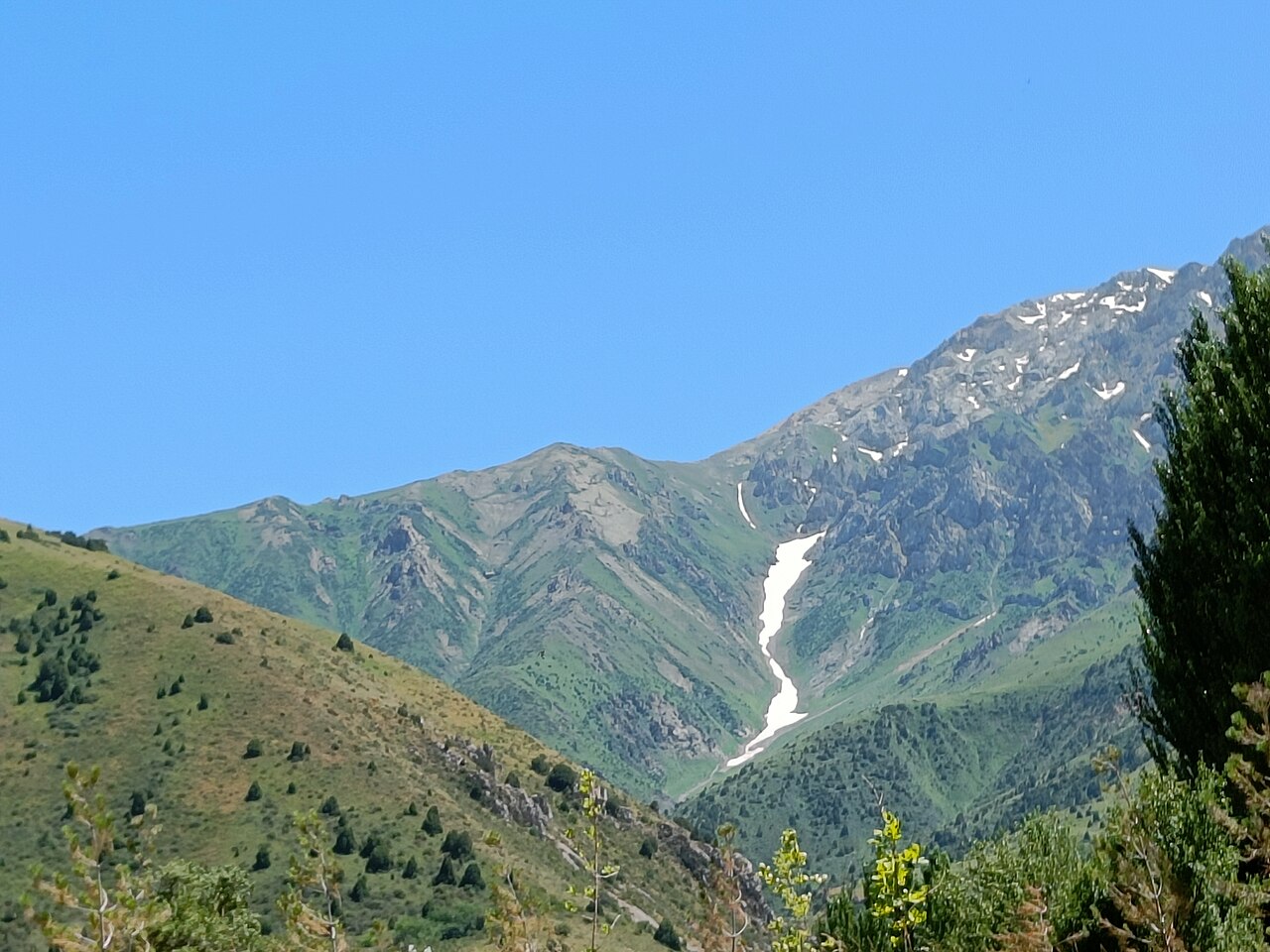
Aksu-Zhabagly is the oldest nature reserve in Kazakhstan and in Central Asia, founded in 1926 in the Western Tien Shan roughly 100 to 120 km east of Shymkent. It covers about 132,000 hectares from 1,200 metres up to Sayram Peak at around 4,240 metres, and it is a strict reserve — you cannot enter without a permit and a ranger or guide.
Aksu-Zhabagly at a glance
| Founded | 1926 — oldest reserve in Central Asia; centenary in 2026 |
|---|---|
| Status | Zapovednik (strict reserve); UNESCO Biosphere Reserve; part of the Western Tien-Shan World Heritage property (2016) |
| Size | About 132,000 ha |
| Altitude | ~1,200 m to about 4,240 m at Sayram Peak |
| Gateway | Zhabagly village; nearest reserve cordon 6–7 km away |
| From Shymkent | ~1.5–2 hours via Tulkibas |
| Tulips | Late April to early May, running into June with altitude |
| Entry | Permit plus ranger or guide, arranged in the village. Cash only |
| Season | April–October; hiking June–September |
Why Aksu-Zhabagly matters
Kazakhstan protected this valley in 1926 — before most of the world had national parks worth the name, and at a moment when the Soviet Union was otherwise busy industrialising everything it could reach. It is the country’s first reserve and the oldest in Central Asia, and a century on it is still doing the job.
It is a UNESCO Biosphere Reserve, and it is one of three Kazakh component sites, alongside the Karatau Reserve and Sayram-Ugam National Park, of the transboundary Western Tien-Shan World Heritage property inscribed in 2016 and shared with Kyrgyzstan and Uzbekistan. Our UNESCO sites guide covers the whole listing.
The name comes from its two rivers: Aksu, “white water,” and Zhabagly, a one-year-old foal.
What is a zapovednik? Why this isn’t a national park
This is the thing to understand before you plan anything, and it’s why half the advice online about “just driving out to Aksu-Zhabagly” is wrong.
A zapovednik is a strict scientific reserve, not a park. Human intervention is limited to catastrophic events like fire. There is no infrastructure for casual visitors, no marked trail network, no visitor centre with a café. The reserve functions as a laboratory for nature left alone, and tourism is permitted as a controlled exception rather than a purpose.
In practice that means: you need a permit and you must be accompanied by a ranger or guide. You cannot walk in. Reserve rangers generally don’t speak English, so an English-speaking guide is a separately priced extra. It sounds like bureaucracy; it’s actually the reason the tulips are still there.
Compare this with Kazakhstan’s national parks, which you can enter by paying at a gate.
The tulips — Kazakhstan’s great untold story
Kazakhstan is where tulips come from
Not the Netherlands. Kazakhstan is a global centre of tulip origin, home to somewhere around 35 to 40 of the world’s roughly 100 to 120 known wild species. Eighteen of them are on the national Red List and twelve are found nowhere else.
Here is the fact to carry: three Kazakh wild species — Tulipa greigii, T. kaufmanniana and T. schrenkii — are the origin of about 75 per cent of all cultivated tulip varieties in existence. Every spring, in every garden in Europe, most of what comes up is descended from plants that grew wild on these hillsides.
Greig’s tulip, the king of tulips
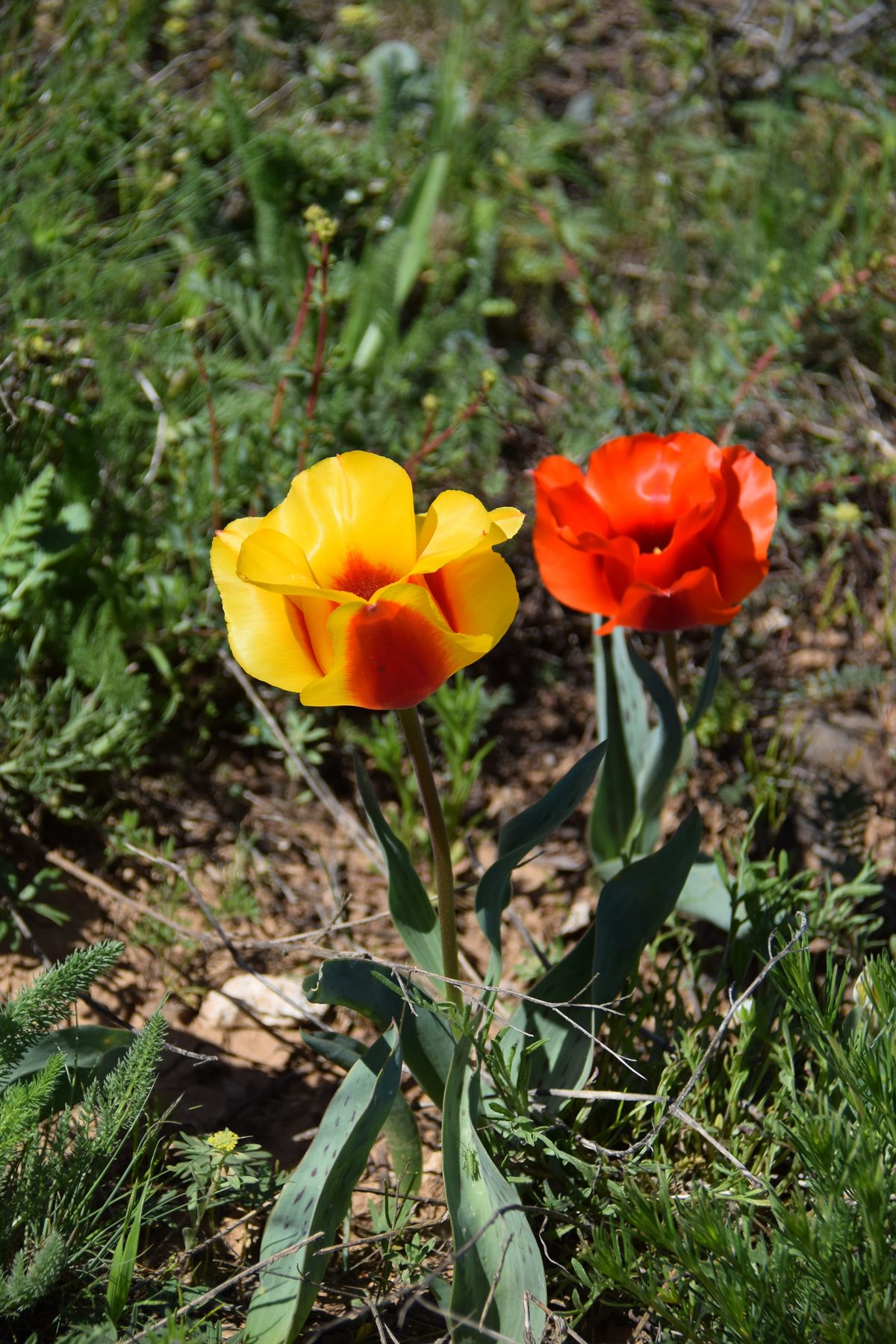
Tulipa greigii is the one you’ll see here, and it earns the nickname. It has the largest flowers of any tulip — petals up to fifteen centimetres — in scarlet, fiery orange or burgundy with a black basal blotch, on stems thirty to forty centimetres tall, with distinctive mottled purple-brown striped leaves that identify it even before it flowers. It was first described in 1868 from Kazakhstan, and more than two hundred modern garden varieties descend from it.
In Aksu-Zhabagly it grows at densities of up to twenty plants per square metre. Some operators claim more than sixty per square metre on Red Hill; treat twenty as the citable figure and sixty as enthusiasm.
Kaufmann’s tulip, the waterlily tulip
Tulipa kaufmanniana is lower-growing, often bicoloured or tricoloured, and opens flat in the sun like a waterlily. In the wild it grows only in the Western Tien Shan and the Karatau mountains of Kazakhstan — nowhere else on earth. About two hundred garden varieties come from it. It’s named for Konstantin von Kaufman, the first Governor-General of Russian Turkestan.
When do the tulips bloom?
The hillsides around Zhabagly turn red in late April and early May. Greig’s tulip can start in late March in the warmest low spots, and the season climbs with altitude into early June.
Calibrate carefully, though. One traveller who arrived in late March found no tulips out at all and the canyon road still snowed shut. If the tulips are the reason for your trip, aim for the third or fourth week of April and build in flexibility. Our Kazakhstan in spring guide covers the wider bloom season, including the poppy fields and the steppe tulips further north.
The ethics of tulip photography
One fact should settle this. A wild tulip seedling takes ten to seventeen years to flower for the first time. The botanist Anna Ivashchenko, who first saw T. greigii in Aksu-Zhabagly in 1964 and has studied Kazakh flora for sixty years, puts it perfectly: if you pick a flower, you orphan the whole meadow.
So: don’t pick them, don’t lie down in them for a photograph, and stay on whatever path your guide is following. Getting the shot low and close with a wide lens works better than wading in anyway.
Aksu Canyon
The reserve’s other headline feature, and the thing most visitors come away talking about. The Aksu river has cut a canyon up to about 500 metres deep — sources quote anywhere from 300 to 500, and one aggregator absurdly says 1,800, so take 500 as the top end. It’s crossable only in the south of the reserve, by a narrow pedestrian footbridge, which is an experience in itself.
It’s roughly a 25 km drive from Zhabagly. The road can still be snowed shut in late March, so it isn’t a reliable early-spring option.
Standing on the rim is the moment the scale of this place lands. It’s also where you understand why the reserve exists: the walls are essentially inaccessible, which is why anything can still live in them.

The Kaskabulak petroglyphs
High on Mount Kaskabulak at 3,200 metres, above the treeline, there are roughly two thousand Bronze Age carvings: wild and domestic animals, hunting scenes and sun discs, pecked into dark rock two to three thousand years ago.
Now the honest part, because operators are inconsistent about this. The standard trip is a 32-kilometre horseback route, run May to September and best June to August, with a maximum of twelve people, staged from a hotel five kilometres outside Zhabagly via a botanists’ lodge at Kishi-Kaindy at 1,800 metres. One operator sells this as a single very long day. The same company’s other page describes it as a three-day trip.
Believe the second. Thirty-two kilometres on horseback climbing to 3,200 metres is a full, hard day at absolute minimum, and if you want to actually look at the carvings rather than glance at them before turning round, plan multiple days. If you haven’t ridden much, say so before you book — this is not a pony trek.
Wildlife and birding
The snow leopard question, answered honestly
Yes, there are snow leopards in Aksu-Zhabagly. No, you will not see one.
They’re confined to remote high terrain, largely nocturnal, and even the reserve’s own researchers work mostly from camera traps and tracks. Every tourism page that leads with “snow leopard habitat” is technically correct and practically misleading. Come for the tulips and the canyon; treat the leopard as a fact about the place rather than an item on a list.
What you can realistically see
The reserve holds around 52 mammal species. In rough descending order of your odds: marmots, including the rare Menzbier’s marmot, which are everywhere and entertaining; Siberian ibex on the crags; Tien Shan argali, the big wild sheep; wolves, which you’ll hear about rather than see; the Tien Shan white-clawed brown bear, best chance in spring; Eurasian lynx; stone marten; and Indian crested porcupine.
Birding
This is the reserve’s quiet international reputation and it’s badly underserved in English-language coverage. Around 267 bird species have been recorded, 130 of them nesting and 30 Red-Listed. (A second source says about 250; either way it’s a lot.)
Headline species: golden eagle — the bird on the Kazakh flag — bearded vulture (lammergeier), Egyptian vulture, steppe eagle, saker falcon, black and white storks, demoiselle crane and eagle owl. The rarities birders come for are paradise flycatcher, Himalayan snowcock, white-winged woodpecker, white-throated robin and yellow-breasted azure tit.
There’s also the Chokpak Pass ringing station nearby, reachable from Zhabagly, with transfers offered only in April–May and September–October — the two migration windows. Worth asking about if you’re here at the right time.
Junipers, wild apples and 1,300 plants
Around 1,312 flowering plant species have been recorded inside the reserve, with 1,400-plus counting the immediate surroundings, and somewhere between 30 and 44 of them Red-Listed. Two are worth knowing about: wild apple, Malus sieversii, the ancestor of every domestic apple in the world and the tree Almaty is named for, and wild grape, Vitis vinifera.
But juniper is what defines the landscape. Tall juniper woodland covers around 9,000 hectares and creeping Turkestan juniper another 11,000 in the subalpine belt. Zeravshan junipers reach ten to fifteen metres, with giants to twenty, and the oldest trunks are three metres in girth. They never form closed forest — the trees stand five to ten metres apart, because the roots spread horizontally two to four times wider than the crown. Once you know that, the spacing of the trees on the hillside stops looking random and starts looking like arithmetic.
Permits, guides and what it costs
The published fees conflict badly, so here is what each source actually says rather than a single number I can’t stand behind.
A Zhabagly guesthouse price list, last updated May 2025, gives: reserve entrance 2,250 tenge for foreigners and 1,250 for Kazakh citizens; a reserve escort for foreigners 2,500 tenge for a group of up to six; an English-speaking guide 45,000 tenge per sightseeing day; horses 1,000 tenge an hour.
A local NGO price list that describes itself as the official reserve tourism-service distributor gives much higher figures: entrance 7,800 tenge per person per day, a ranger 12,000 tenge per group per day, and a conservation-expert guide 39,000 tenge per group per day for one to five people. That list is dated 2021.
The 3.5× gap on the entrance fee is most likely the difference between the bare state tariff and a bundled tour-service price. What’s consistent across both is the shape of the cost: the permit itself is cheap; the mandatory guide and the 4WD transfers are what you actually pay for. Budget accordingly and confirm when you book.
It is cash only
No cards, no phone payments anywhere near the reserve. The nearest ATMs are at Tulkubas railway station and the Halyk Bank in Turarkent, and there is no currency exchange locally. Bring tenge. See our money guide.
How to book
Through a Zhabagly guesthouse or the local conservation NGO in the village — not through an online platform. Post-pandemic, the guesthouses came off the booking sites and now have to be contacted directly, and travellers report needing several days’ notice. Message ahead; don’t turn up expecting to walk in the same morning.
Zhabagly village and where to stay
Zhabagly is the gateway, six or seven kilometres from the nearest reserve cordon and roughly 70 to 100 km from Shymkent depending on which road you measure. It has guesthouses, a café doing home cooking, a small shop and a natural history museum for a few hundred tenge. It does not have restaurants, and it does not have an ATM.
The village has a real homestay tradition and that’s the right way to do this. Two names that are verifiable: the Belousov family’s boarding house on Abaya Street, which also publishes the price list above and can arrange permits and transfers; and Ruslan’s, which has rooms, a yurt and camping seven kilometres above the village right on the reserve boundary, with transfers from Zhabagly.
Two cautions. Ruslan’s village property was reported closed as of 2022, and a guide named in older articles was reported unreachable around the same time. Confirm directly before relying on any name from an old blog post. If a yurt night appeals, our yurt stay guide covers what to expect.
Getting to Aksu-Zhabagly
From Shymkent
The standard route: a marshrutka from Shymkent’s Aina bus station to Tulkibas, about an hour for 400 to 500 tenge, then a shared taxi Tulkibas to Zhabagly, ten minutes for 300 to 500 tenge. There’s sometimes an on-demand direct marshrutka from Aina between nine and eleven in the morning. Door to door, under two hours.
An alternative railhead is Turarkent, also called Vanovka or Turar Ryskulov, about thirty minutes out.
Guesthouse transfers are the easy option: Zhabagly to Tulkubas station around 5,000 tenge by car, Zhabagly to Shymkent around 20,000 by car or 35,000 by minibus. Our Shymkent guide covers the city end.
By train
Underused, and rather good. There is a rail halt at Tulkubas, and trains from Almaty, Astana and Karaganda heading for Shymkent stop there. That means the reserve slots into a Kazakhstan rail itinerary without a detour — you get off on the way past rather than making a special trip. Local Shymkent–Tulkibas train times are inconvenient, so use the long-distance services. See our train travel guide.
By car
Perfectly doable on the A-2 corridor between Shymkent and Taraz. You still can’t drive into the reserve. Our car rental guide covers the practicalities.
When to go: a month-by-month guide
- March. Too early. Snow still on the canyon road, tulips generally not out.
- April. The month. Greig’s tulip from mid-month, peaking in the last week at lower altitudes. Bears are most active in spring. Migration birding at Chokpak Pass.
- May. Tulips continuing and climbing; green everywhere; the best all-round month if you want flowers and walkable trails together.
- June–August. Hiking season. Kaskabulak at its best. Hot in the valleys, pleasant up high.
- September. Autumn colour, stable weather, autumn migration. Excellent and quiet.
- October. Cold mornings, thinning access, end of the visitor season.
- November–March. The reserve doesn’t formally close but most high trails do. Not a practical visit.
Our best time to visit guide puts this in the context of the wider country.
What to bring
- Cash in tenge — enough for permits, guide, transfers, accommodation and meals, with a margin
- Sturdy shoes with grip; trails get rough and muddy, though full boots aren’t essential
- Sun hat and high-factor sunscreen — you’ll be at altitude in open country
- A water bottle or filter; mountain stream water is drinkable at source
- Snacks — the village shop is minimal and there’s nothing at the mountain guesthouses
- Your own toilet paper
- Binoculars, if you have any interest in birds at all
- A macro or close-focusing lens in tulip season
- Warm layers, whatever the month — nights are cold at 1,200 metres and colder above
Frequently asked questions
Where is Aksu-Zhabagly Nature Reserve?
In the Western Tien Shan in southern Kazakhstan, straddling Turkestan and Zhambyl regions, roughly 100 to 120 km east of Shymkent and about 1.5 to 2 hours by road. The gateway is Zhabagly village near Tulkibas.
How old is Aksu-Zhabagly?
It was established in 1926, making it Kazakhstan’s first nature reserve and the oldest in Central Asia. It celebrates its centenary in 2026.
Do you need a permit to enter Aksu-Zhabagly?
Yes. It’s a strict reserve, or zapovednik, so you need both a permit and a ranger or guide. There are no marked trails and you cannot enter on your own. Permits are arranged through the village guesthouses or the local conservation NGO, not online.
How much does it cost to visit Aksu-Zhabagly?
Published figures conflict. One 2025 village price list gives 2,250 tenge entrance for foreigners plus 2,500 for a ranger escort and 45,000 for an English-speaking guide day. An older NGO list gives 7,800 entrance and 12,000 for a ranger. The permit is cheap; the guide and transfers are the real cost. Bring cash.
When do the wild tulips bloom in Kazakhstan?
The hillsides around Zhabagly turn red in late April and early May, with the season running from late March in the warmest low spots into early June at altitude. Aim for the last two weeks of April if the tulips are your reason for going.
Are tulips originally from Kazakhstan?
Largely, yes. Kazakhstan is a global centre of tulip origin with around 35 to 40 wild species, and three of them — Greig’s, Kaufmann’s and Schrenk’s tulips — are the ancestors of roughly 75 per cent of all cultivated varieties.
Can you see snow leopards in Aksu-Zhabagly?
They live here but you will not see one. They keep to remote high terrain and are largely nocturnal; even researchers work from camera traps. Realistic sightings are marmots, ibex, argali and, in spring, Tien Shan brown bear.
How deep is Aksu Canyon?
Up to about 500 metres, though sources quote anywhere from 300 to 500. It’s cut by the Aksu river, crossable only by a narrow footbridge in the south of the reserve, and about a 25 km drive from Zhabagly village.
Where do you stay near Aksu-Zhabagly?
In Zhabagly village, which has a homestay and guesthouse tradition — the Belousov family’s boarding house and Ruslan’s place above the village are the two verifiable options. Book directly by phone or email several days ahead; the guesthouses came off the booking platforms after the pandemic.
Is Aksu-Zhabagly worth visiting?
If you come in late April for the tulips, or you’re a birder, or you want to see a hundred-year-old strict reserve that still works, yes. If you want casual hiking with marked trails and no paperwork, Sayram-Ugam National Park nearby is the easier choice.
Final thoughts
Aksu-Zhabagly asks more of you than most places: a permit, a guide, a village booking made by phone several days ahead, and cash you had to draw two towns back. That friction is the whole reason it’s still worth going. A century of keeping people out is why a hillside here can still turn scarlet in April with a plant that takes seventeen years to flower.
Come in the last week of April if you can. Stand on the rim of the Aksu canyon, look at the junipers spaced out across the slope like a diagram, and think about the fact that most of the tulips in the world started here.
For the wider region see our Silk Road Kazakhstan pillar, and for other protected landscapes our guides to Kazakhstan’s national parks and hiking in Kazakhstan.
Photo credits
Wild Greig’s tulips: V.A. Kovshar (CC BY-SA 4.0) via Wikimedia Commons. Aksu Canyon: Tomiris (CC BY-SA 3.0) via Wikimedia Commons. Talas Alatau slopes: Jack Bartovsky (CC BY-SA 4.0) via Wikimedia Commons.