Contents
- Taraz at a glance
- First, the name: why your map might say Dzhambul
- Two thousand years on the Talas
- The Battle of Talas, 751 — and what it did and didn’t do
- The Aisha Bibi Mausoleum
- What to see in Taraz itself
- Day trip: Akyrtas, the unfinished red-stone palace
- Getting to Taraz
- When to go, and where to stay
- A suggested two-day plan
- Frequently asked questions
- Final thoughts
If you are looking at an old map, or a Soviet-era rail timetable, or your grandmother’s papers, the city in southern Kazakhstan you want may be called Dzhambul. Or Aulie-Ata. Or Mirzoyan. Or Talas. It has been all of those, and since 1997 it has been Taraz again — which is what it was called when Byzantine ambassadors turned up here in 568 AD.
Taraz in Kazakhstan is the capital of Jambyl Region, on the Talas river near the Kyrgyz border, about 500 km west of Almaty. It is one of the country’s oldest cities — officially 2,000 years old — and its best-known monument is the Aisha Bibi mausoleum, an eleventh- or twelfth-century Karakhanid tomb 18 km west, covered in around sixty different types of carved terracotta tile.
Taraz at a glance
| Where | Jambyl Region capital, on the Talas river, southern Kazakhstan; elevation 610 m |
|---|---|
| Population | About 428,000 (April 2023) |
| Age | Official 2,000th anniversary celebrated in 2001 |
| Former names | Talas/Taraz → Aulie-Ata → Mirzoyan (1936) → Dzhambul (1938) → Taraz (1997) |
| Famous for | Aisha Bibi mausoleum; Karakhanid architecture; the Battle of Talas |
| Distances | Almaty ~495 km · Shymkent ~175 km · Bishkek ~4 h |
| Climate | July mean high 33.0°C, record 43.7°C; January mean −3°C |
| Best season | Late April–early June, September–October |
| Days needed | One full day, or two with Akyrtas |

First, the name: why your map might say Dzhambul
This catches people out constantly, so let’s clear it up before anything else.
Five names in a hundred and fifty years
The city was Talas, then Taraz, through antiquity and the medieval period, until the Mongols destroyed it in 1220 and it faded. A Kokand fortress grew on the site in the late eighteenth century and the town became Aulie-Ata — “holy father” — in the mid-nineteenth. In 1936 the Soviets renamed it Mirzoyan after the party official Levon Mirzoyan. In 1938, when Mirzoyan was purged, it became Dzhambul after the beloved akyn (bard) Zhambyl Zhabayev. The spelling shifted to Jambyl or Zhambyl in 1992–93, and in 1997 the ancient name Taraz was restored.
Three overlapping Jambyls
To make it worse: the region is still called Jambyl Region, after the poet. The poet was Zhambyl Zhabayev. The city is Taraz. So “Taraz, Jambyl Region” is correct and looks like a mistake. It isn’t.
Two thousand years on the Talas
36 BCE and the 2,000th anniversary
Taraz celebrated its official two-thousandth anniversary in 2001, a date recognised by UNESCO at its 30th General Conference in 1999. The reckoning runs from the fortress of the Xiongnu chanyu Zhizhi and the Battle of Zhizhi in 36 BCE.
568 CE: Byzantium comes to the steppe
The first firm written record is wonderful. In 568 the Byzantine historian Menander Protector describes the embassy of Zemarchus, travelling with the Sogdian merchant Maniakh, to the court of the Turkic yabgu Istemi at Talas. Persia sent a rival envoy at the same moment, competing for the silk trade. Istemi sided with Byzantium.
Sixty years later the Chinese monk Xuanzang came through in 629 and wrote of “the city of Daluosi, eight or nine li in diameter, settled by Hu merchants from various nations.” Two of the great civilisations of the age describing the same market town, from opposite directions.
The Karakhanid golden age
Under the Kara-Khanid Khanate in the tenth to twelfth centuries Taraz reached its peak: terracotta water pipes, paved streets, sewage collection. The tenth-century Baghdad geographer Ibn Hawqal called it “a place of trade between Muslims and Turks.” Everything architecturally interesting around Taraz — Aisha Bibi, Babaji Khatun, the original Karakhan mausoleum — dates from this period.
1220 and the long silence
The Mongols razed the city in 1220, though coins were still minted here until 1334. Then, essentially, nothing for four centuries. Russia took Aulie-Ata in 1864 under General Chernyaev; the 1897 census recorded 11,722 people, 72 per cent of them Uzbek. The railway reached the town in 1917.
A modern footnote worth knowing: in 2022 Taraz became the first Kazakh city on the World Crafts Council’s World List of Craft Cities.
The Battle of Talas, 751 — and what it did and didn’t do
Every guide to Taraz mentions this. Almost none of them handle it honestly.
What happened
In July 751 an Abbasid army under Ziyad ibn Salih, with Tibetan allies, met a Tang Chinese army under Gao Xianzhi and its Ferghana and Kashmiri allies. On the fifth day the Karluk mercenaries — who made up two-thirds of the Tang force — turned on the Tang, and the Chinese army was destroyed. Al-Dhahabi says the Karluks were Abbasid allies from the start.
Where was it actually fought?
Here’s the part travel writing skips. Wikipedia states plainly that “the exact location of the battle has not been confirmed but is believed to be near Taraz and Talas, on the border between present-day Kazakhstan and Kyrgyzstan.” Scholarship often names Atlakh, roughly 12 km southeast of Taraz, and Kazakh sources place Atlakh in Jambyl Region.
So Taraz has the strongest claim and it is not an undisputed one. It may well have been fought in what is now Kyrgyzstan. Say “near Taraz” and you are on safe ground; say “at Taraz” and you are guessing.
The papermaking story
You will be told that Chinese prisoners taken at Talas carried papermaking west, and that this is why Europe got paper. It’s a wonderful story and the evidence is weak.
The claim comes from the eleventh-century historian al-Tha’alibi, writing three hundred years after the fact. Jonathan Bloom, in Paper Before Print, argues paper was already used and probably made in Samarkand decades before 751; that eighth-century Chinese paper was bast-fibre while Islamic paper was rag-fibre, so the technology doesn’t match; that no Chinese source and no contemporary Arabic account records any transfer; and — the detail that really lands — that Du Huan, an actual prisoner from Talas who wrote up his captivity, describes Chinese POWs weaving silk, not making paper.
And the battle’s importance
Also overstated. Tang withdrawal from Central Asia was driven by the An Lushan rebellion from 755, not by Talas: a caliphal envoy reached the Tang emperor in December 752, and the Karluks submitted to the Tang again in 753. One recent historian calls Talas “a mere border skirmish.” It was significant, but it was not the hinge of history the plaques suggest.
The Aisha Bibi Mausoleum
This is why you came, and it deserves the visit.
The legend
Aisha, daughter of a Sufi holy man, was betrothed to Karakhan Muhammad, the ruler of Taraz, against her father’s wishes. She fled to join him with her nurse. On the way she was bitten by a snake while bathing at the Asa river and died. Karakhan built this tomb over her.
In one version a mullah married them as she lay dying and Karakhan called out three times, “Aisha, you have now become bibi” — a wife. Her father’s name varies across tellings: Zengi-Baba, Khakim-Ata, or simply “a wealthy man.”
What the documents say
The scholar Bayan Tujakbayeva has noted a documented parallel that fits the legend’s shape uncomfortably well: reports of the death in 1034 of the daughter of Bogra Khan, ruler of Talas, who died while travelling to Ghazna to join her fiancé Maudud, heir of Mas’ud. Whether that’s the same woman is unknowable. It does suggest the story is built on something real.
Sixty kinds of terracotta
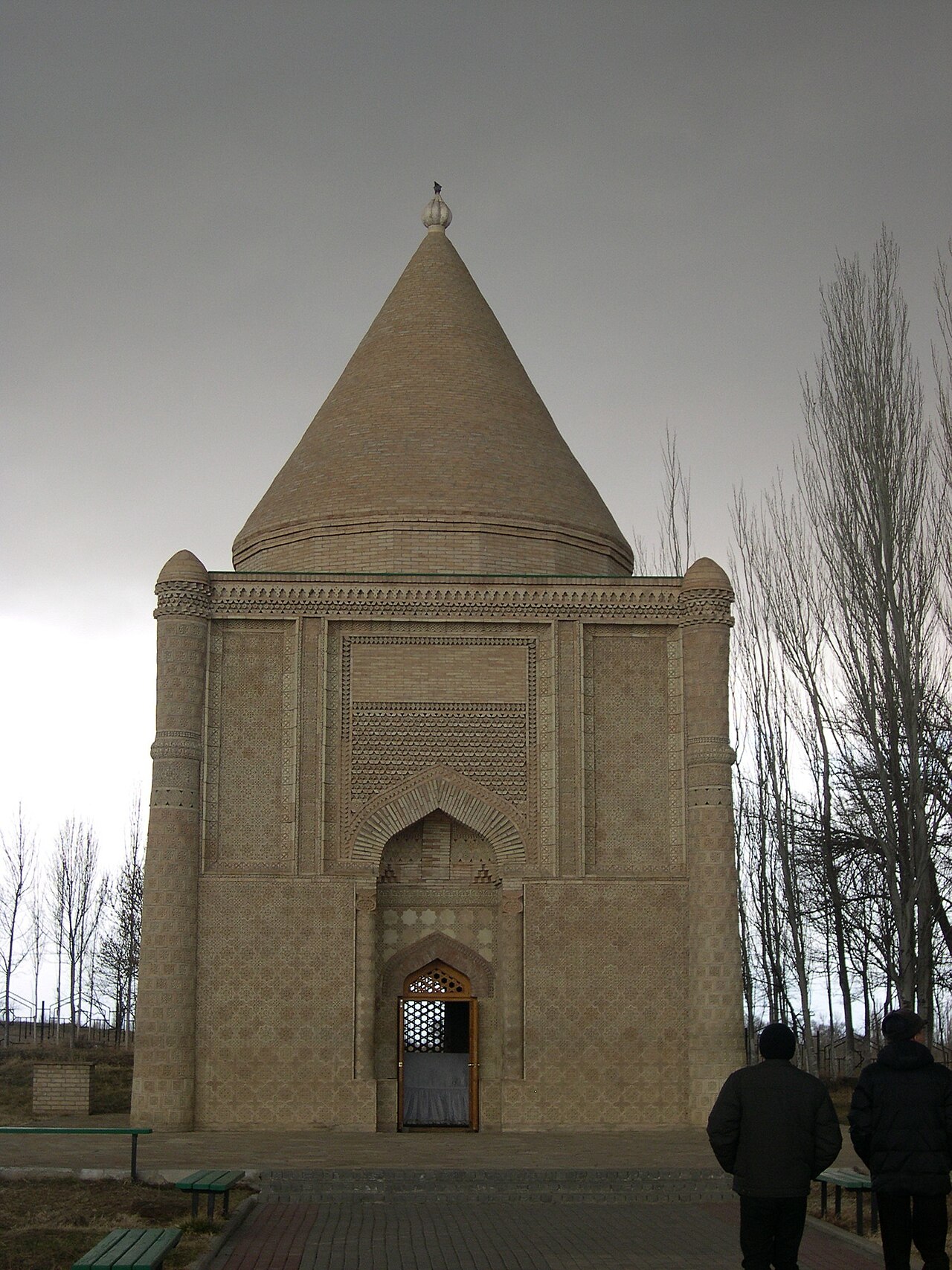
The architectural claim is the one that matters. According to the state museum-reserve, Aisha Bibi is the only monument in Kazakhstan and Central Asia entirely covered in carved terracotta tiles, with more than sixty different types making up the facade. Wikipedia counts sixty distinct floral, geometric and calligraphic patterns; Lonely Planet says more than fifty. Call it around sixty.
What that means in practice is a building that reads as lace from twenty metres and as engineering from two. Four engaged corner columns, each carved differently. Panels of interlocking geometry. A surviving distich reads: “Autumn… Clouds… The Earth is beautiful.”
It is a direct stylistic descendant of the Samanid Mausoleum in Bukhara, and its corner columns echo pre-Islamic Sogdian wooden columns. The decoration works entirely in light and shadow rather than colour — a pre-Mongol trait, before the great glazed blue of the Timurid period. Come in early morning or late afternoon when the low sun rakes across it; at noon the whole thing flattens out.
V.V. Bartold first recorded the ruins in 1893, and Shoqan Walikhanov painted the monument in 1856.
How much of it is original?
Honestly: not much, and you should know that before you go.
Per the museum-reserve, only one original wall from the west facade and small fragments of other parts survived. Restoration ran from 2002 to 2005 under the state body Kazrestoration, and the finished monument was unveiled in spring 2005.
Lonely Planet’s verdict is the fairest I’ve read: though heavily restored, it is “probably the only authentically old building around Taraz.” That’s the right frame. Compared with the Karakhan mausoleum in the city, Aisha Bibi is the real thing.
One correction to something you may read elsewhere: a Soviet-era protective glass shell was built over the monument around 1960. It is not there now — the 2002–05 work superseded it, and recent visitors photograph the building in the open, in a landscaped park. Don’t expect glass.
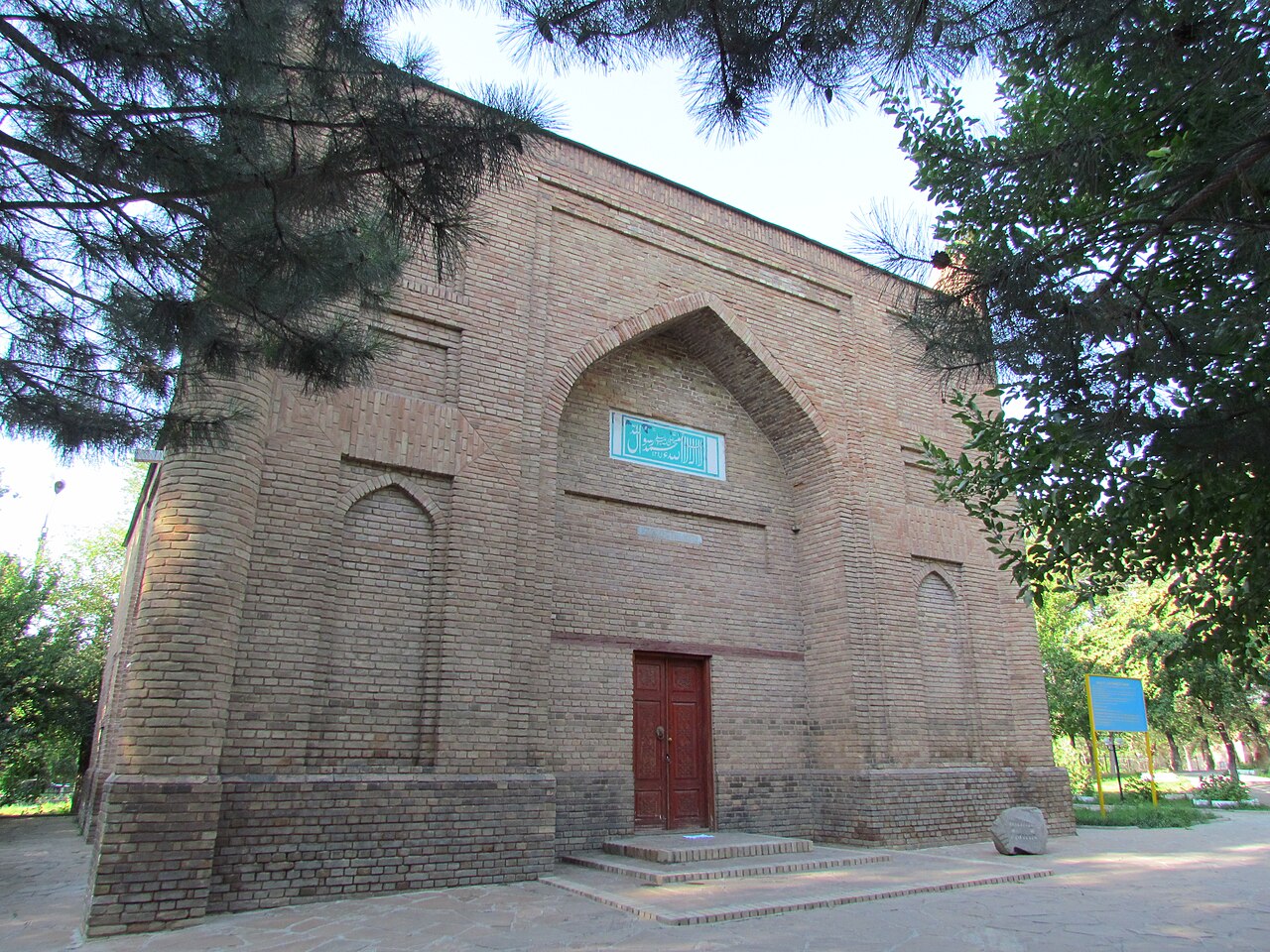
Babaji Khatun, a few dozen paces away
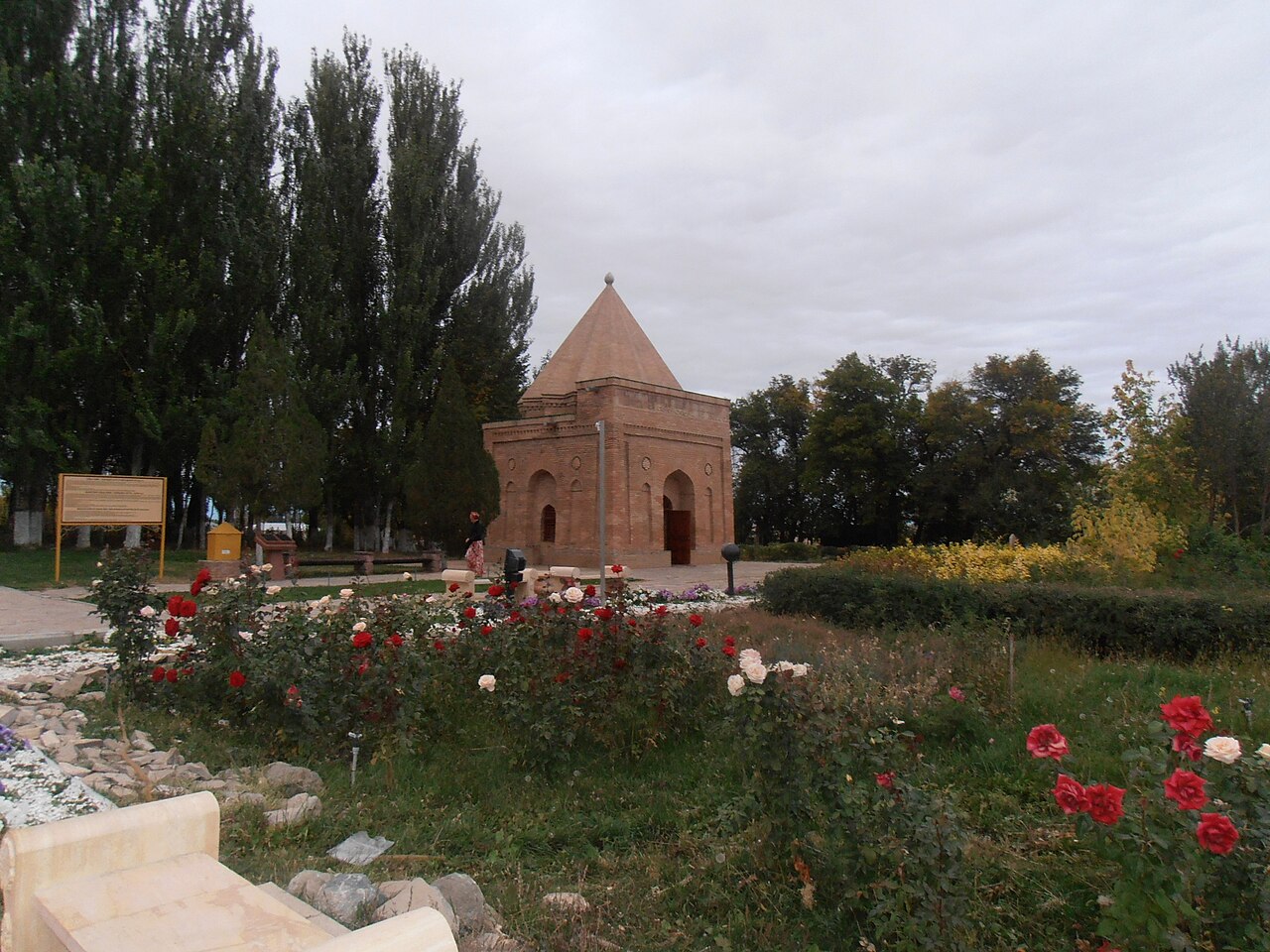
The second mausoleum on the site is eleventh-century and completely different in character: austere fired brick with no wall decoration at all, topped by a cone-shaped dome with sixteen facets on a prism-shaped base — unusual anywhere in Kazakhstan. A broken Arabic inscription reads “This grand tomb is named Babadja-khatun. Its builder was…” and then the name is lost.
Tradition makes her Aisha’s nurse and companion. Lonely Planet notes it was totally rebuilt in 2000–02.
The two together are the point: one covered in every kind of ornament available in the eleventh century, one with none, standing side by side.
Visiting Aisha Bibi
The village of Aisha Bibi is about 18 km west of Taraz — sources say anywhere from 16 to 20 — a 25- to 30-minute drive via Tauke Khan Street onto the A-2, past the airport and Oktyabr village; at the village mosque turn left and go 400 metres.
Without a car: Shymkent-bound minibuses will drop you in the village on the main road, and the mausoleums are 300 to 500 metres south, signposted — a six-minute walk. Getting back is easiest by local taxi. I could find no published marshrutka number, departure point or fixed taxi fare for this run, so negotiate rather than expecting a set price.
On fees and hours, the sources are genuinely inconsistent. The only hard number is 300 tenge per person, reported in 2018; more recent visitors describe a small entrance fee, and some earlier ones found it free. There are no published opening hours, and at least one visitor arriving early found both mausoleums shut while the grounds and exteriors were accessible. There’s a car park, a WC and gift stalls. Women should bring a headscarf; shoes come off inside. Twenty to forty minutes covers both buildings.
One lovely detail: this is a living site. Taraz newlyweds retrace Karakhan’s journey from the Karakhan mausoleum in the city out to Aisha Bibi to have their marriage blessed, and women pray here for children. Go on a Saturday and you will see wedding parties. It’s listed among Kazakhstan’s national “Sacred Places.”
What to see in Taraz itself
Karakhan Mausoleum — and why it looks newer than it is
In central Taraz, at Tole Bi and Baizak Batyr, stands the tomb of Shakh Mahmud Karakhan, the eleventh- or twelfth-century ruler of the Aisha Bibi legend. It was known as Aulie-Ata, “holy father” — and that is the name the nineteenth-century city took for itself.
Be clear about what you’re looking at. The modern mausoleum was built by local residents in 1906 on the site of the previous one, working from a 1902 photograph, and largely without its decoration. Only the dome and interior arched niches use eleventh-century brick-tiles. It was renovated again in 2002 for the city’s 2,000th anniversary. Wikipedia’s Taraz article puts it bluntly: the mullahs “built a new mausoleum with minarets, which had nothing in common with the older one.” A 1961 excavation found up to thirty varieties of terracotta decoration on the original — all gone.
Go anyway. It’s the spiritual centre of the city and where the wedding tradition starts. Just don’t think you’re looking at the eleventh century.
Ancient Taraz archaeological park
The single most interesting thing the city has done in a century. In 2011 Taraz moved its central bazaar — which had stood on that ground for centuries — so that archaeologists could dig beneath it. Bartold had deduced in the 1930s that ancient Taraz lay under the Green Bazaar; Bernshtam and Patsevich had excavated to two to six metres in 1938; nobody had ever been able to go further because there was a working market on top.
They found around 40,000 artefacts from the sixth to twelfth centuries, plus a medieval citadel, a mosque, a madrasah, a fire-worshippers’ altar, a zindan (underground prison), a caravanserai, clay water pipes and paved streets.
It’s open to visitors, with wooden walkways over the trenches and a 34-metre observation tower, at Kh. Bekturgan Street 3. Reported hours are Tuesday to Sunday, 09:00 to 18:30, closed Monday — though that comes from a secondary source, so allow for change. Excavation is ongoing.
The museum-reserve’s posted tariff lists foreign citizens of CIS states at 2,000 tenge and other foreign citizens at 2,500, with Kazakh adults 500, students and pensioners 300, and school-age children 150. A guided tour in English for a group of up to 25 is 6,000 tenge. The tariff is undated, so treat it as indicative.
Tekturmas
A mausoleum on a hill on the right bank of the Talas, believed to hold Sultan Mahmud Khan, commander-in-chief of the Karakhanid army, and dated to the fourteenth century. It was destroyed in the 1930s by militant atheists, excavated in 2001 and rebuilt in 2002 on the exact site using an 1880s photograph.
The hill is also an ancient necropolis with Zoroastrian, Muslim and Nestorian Christian burials — a genuinely striking fact about a single hillside — and the views over the city are the best in Taraz. Note: I could find no documentation of a pedestrian suspension bridge here, only fragments of an ancient stone bridge across the Talas, so don’t plan on walking across.
Mosques and squares
The Aulie-Ata (Yunusbay) Mosque was built in 1913 at B. Adambaev Street 24 and named by residents after the nearby Karakhan mausoleum. Separately, the remains of a tenth-century mosque were found in Taraz in 2006, with Arabic-style columns and a west-facing mihrab, on a site historians believe held a Nestorian Christian temple in the sixth or seventh century.
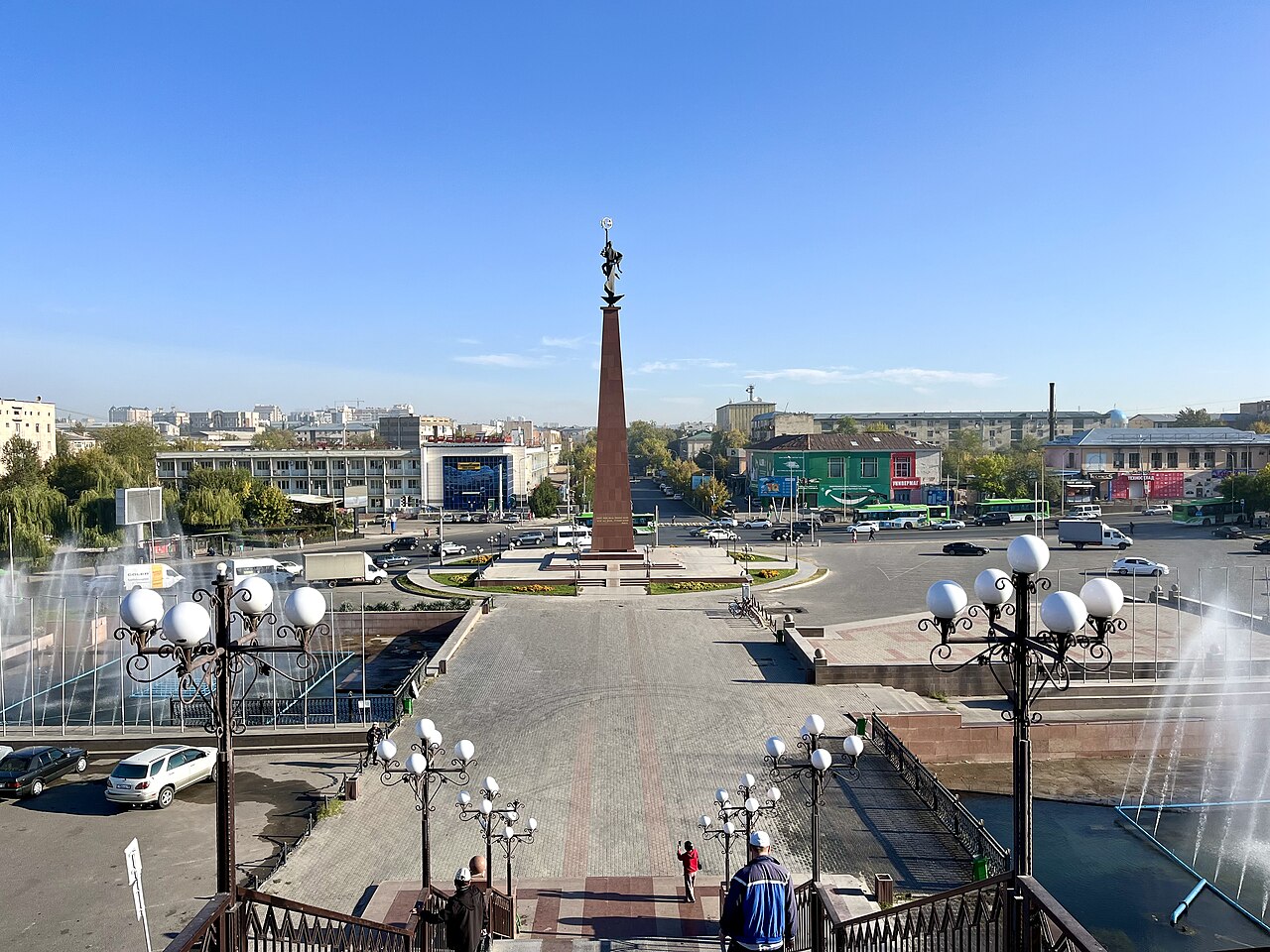
Dostyk Square and the Zhambyl Regional Museum round out a day in the city, and the bazaars are worth an hour.
Day trip: Akyrtas, the unfinished red-stone palace
About 45 km east of Taraz lie the ruins of an eighth-century palace complex built from enormous dark-red sandstone blocks. It covers around 2.5 hectares with some seventy rooms; the blocks weigh about a tonne each and some more than ten. The main building measures roughly 142 by 169 metres with walls three and a half to five metres thick.
Nobody agrees what it was. Buddhist temple, Nestorian monastery, an Umayyad palace begun for Qutayba ibn Muslim who died in 715, or — per a 2023 argument by Northedge — an early Islamic palace built for a Karluk ruler around 780 to 809, its four-iwan plan resembling Al-Ukhaidir in Iraq. Stone was stripped from the site in 1938–39 for railway construction.
It is a strange, silent, unresolved place, and it is UNESCO-inscribed — see below.
Getting there: 30 to 40 minutes east along the A-2, then a short drive off the highway at Akchulak on a decent paved road. A custodian collects a small fee. The visitor centre was standing closed and apparently unfinished as of mid-2024. Interpretation panels include English. One visitor paid around 5,000 tenge for a round-trip cab; it’s six to seven kilometres off the main road with no public transport.
The UNESCO question — get this right
Akyrtas is inscribed on the World Heritage List, in 2014, as part of the Silk Roads: Routes Network of the Chang’an-Tianshan Corridor. Five Jambyl-region sites are inscribed: Akyrtas, Kulan, Kostobe, Ornek and Aktobe/Balasagun.
Aisha Bibi, Babaji Khatun, Karakhan and Tekturmas are not. You will find websites claiming Babaji Khatun is on the World Heritage List and that Aisha Bibi is “listed by UNESCO.” Both claims are false. Our UNESCO sites guide lists what actually is.
Getting to Taraz
From Almaty
Roughly 495 km by road, about five hours fifty by car. The train is the sensible option: 36 weekly services, averaging just over seven hours, from about US$8, three times a day — and the overnight is a good use of a night. Buses leave Almaty’s Sairan station and take eight to nine hours for US$10–15. SCAT flies Almaty to Taraz (DMB) once daily in under three hours, but at US$162–272 it’s poor value against a US$8 train. Our train travel guide explains the classes.
From Shymkent and Turkestan
Shymkent is about 175 km and two and a half to three hours by road, or three and a half hours by train at US$4–6, with four services daily and 73 trains a week — an absurdly good connection. Turkestan is a little further via Shymkent. See our Shymkent guide.
To and from Kyrgyzstan
Two crossings, and the names matter. The Taraz–Talas crossing is called, appropriately enough, Aisha Bibi – Chongkapka: take bus 33 from Taraz to the border or a taxi, and Talas is another 1.5 to 2 hours on the Kyrgyz side.
For Bishkek, the road crossing is Sypatai Batyr (Chaldybar), between Merke in Kazakhstan and Kara-Balta in Kyrgyzstan — the one the Bishkek–Tashkent buses use. Bishkek is roughly four hours from Taraz.
Don’t confuse Talas with Bishkek. They are different places on opposite sides of a mountain range. Our Almaty to Bishkek guide and Kazakhstan–Kyrgyzstan itinerary cover the crossings.
Getting around town
Yandex Go works. City buses cost a nominal fare by card. Taraz also has its own airport, Aulie-Ata, reconstructed in 2013, with domestic flights to Astana, Almaty and Atyrau plus a direct Moscow route.
When to go, and where to stay
Taraz has a cold semi-arid climate. The 1991–2020 normals give a January mean of −3°C and a July mean of 25.5°C, with a July mean daily maximum of 33.0°C and a record high of 43.7°C. Annual precipitation is 357 mm, and August and September are the driest months at under 10 mm each.
So: late April to early June and September to October. July and August are genuinely hot and none of the monuments have meaningful shade — Aisha Bibi sits in an open park and Akyrtas is bare stone on open steppe.
On accommodation I’ll be straight with you: I could not verify a single named hotel in Taraz from any reliable source, which tells you something about how little English-language coverage this city gets. Check Booking or 2GIS before you arrive. Our where to stay guide covers what to expect from Kazakh regional hotels generally.
A suggested two-day plan
Day 1. Morning at the Ancient Taraz archaeological park and the Karakhan mausoleum, both central. Lunch. Afternoon out to Aisha Bibi and Babaji Khatun for the late light — this is the right way round, not the other. Evening up at Tekturmas for the view.
Day 2. Akyrtas in the morning, back for lunch, then the regional museum and the bazaars, or straight on to Shymkent or Bishkek.
One day is enough if you skip Akyrtas. See our Kazakhstan itineraries for how it fits into a longer route.
Frequently asked questions
Where is Taraz, Kazakhstan?
In southern Kazakhstan on the Talas river, close to the Kyrgyz border, about 495 km west of Almaty and 175 km east of Shymkent. It’s the capital of Jambyl Region and has around 428,000 people.
Why was Taraz called Dzhambul?
It was renamed Mirzoyan in 1936 after a party official, then Dzhambul in 1938 after the akyn Zhambyl Zhabayev when Mirzoyan was purged. The ancient name Taraz was restored in 1997. Older maps and timetables still say Dzhambul or Jambyl.
Is Taraz the oldest city in Kazakhstan?
It’s one of them. Taraz celebrated an official 2,000th anniversary in 2001, dating from 36 BCE, and it appears in Byzantine records from 568 CE. Sayram near Shymkent and Turkestan also have very old claims.
Who was Aisha Bibi?
By legend, a young woman betrothed to Karakhan, ruler of Taraz, who died of a snakebite while travelling to join him; he built the mausoleum over her. A documented parallel exists in reports of the 1034 death of Bogra Khan’s daughter travelling to meet her fiancé.
How far is Aisha Bibi from Taraz and how do I get there?
About 18 km west, a 25- to 30-minute drive on the A-2. Shymkent-bound minibuses will drop you in the village; the mausoleums are 300 to 500 metres south and signposted. No fixed taxi fare is published — negotiate.
Is there an entrance fee for the Aisha Bibi mausoleum?
A small one. The only firm figure on record is 300 tenge per person from 2018; more recent visitors report a nominal fee and some earlier ones found it free. No opening hours are published, and early arrivals have found the buildings shut while the grounds were open.
Is Aisha Bibi a UNESCO World Heritage Site?
No, despite what several websites claim. Neither Aisha Bibi nor Babaji Khatun is inscribed. The UNESCO-listed sites in Jambyl Region are Akyrtas, Kulan, Kostobe, Ornek and Aktobe/Balasagun, all inscribed in 2014 as part of the Silk Roads Chang’an-Tianshan Corridor.
Where was the Battle of Talas fought?
The exact site has never been confirmed. It is believed to have been near Taraz and Talas, on what is now the Kazakhstan–Kyrgyzstan border; scholarship often names Atlakh, about 12 km southeast of Taraz. Taraz has the strongest claim but it isn’t settled.
Did papermaking really reach the West after the Battle of Talas?
Probably not. The story comes from a historian writing 300 years later. Paper was likely already made in Samarkand before 751, the fibre types don’t match, and Du Huan — an actual prisoner from the battle who wrote about his captivity — describes Chinese POWs weaving silk, not making paper.
What is Akyrtas and can you visit it?
An eighth-century unfinished palace complex of huge red sandstone blocks, 45 km east of Taraz, UNESCO-inscribed in 2014. Its purpose is still argued — Umayyad palace, Karluk palace, Buddhist temple or Nestorian monastery. It’s a short drive off the A-2 with a custodian collecting a small fee, and no public transport.
Final thoughts
Taraz is a city that keeps losing its own name and its own buildings, and then getting them back in a form that isn’t quite the original. The Karakhan mausoleum is a 1906 rebuild. Tekturmas is a 2002 rebuild. Aisha Bibi is a 2005 restoration of a wall and a half. Under the whole of it, only excavated in the last fifteen years because someone finally moved the market, is the actual medieval city.
Which makes it a strange and rather moving place to visit, if you go with your eyes open. Get out to Aisha Bibi late in the afternoon, when the sun comes in low across those sixty kinds of carved terracotta and the whole facade turns into shadow and relief, and you’ll understand why people kept rebuilding it.
For the rest of the route, see our Silk Road Kazakhstan pillar, our landmarks guide and our off-the-beaten-path guide.
Photo credits
Aisha Bibi mausoleum: Дмитрий Кошелев (CC BY-SA 4.0) via Wikimedia Commons. Babaji Khatun mausoleum: Дмитрий Кошелев (CC BY-SA 4.0) via Wikimedia Commons. Carved terracotta detail: upyernoz (CC BY 2.0) via Wikimedia Commons. Karakhan mausoleum: Yakov Fedorov (CC BY-SA 3.0) via Wikimedia Commons.