Contents
- The one thing to understand first: Almaty runs uphill
- Almaty’s eight districts, and why you can mostly ignore them
- The Golden Square: Almaty’s default answer
- Panfilov Park, the Arbat and Zhibek Zholy
- Around the Green Bazaar and Raiymbek
- Dostyk Avenue and Samal: uphill, greener, pricier
- Al-Farabi and the Esentai corridor
- Kok Tobe foothills, the Medeu road and Gornyi Gigant
- Sayran, Auezov and the west
- Where not to stay on a short trip
- Getting around from each area
- What you will pay, by area
- Safety, noise and winter air by area
- Where to stay in Almaty: quick picks
- Frequently asked questions
- Final thoughts
Almaty is not a flat city, and almost every guide to where to stay in Almaty writes as if it were. The whole place tilts. The mountains are south, and south is up — up towards cooler air, cleaner air, bigger trees and higher prices. North is down: flatter, cheaper, and in January, considerably smoggier. Understand that single fact and you can choose a neighbourhood in about ninety seconds.
The direct answer: for a first trip, stay in the Golden Square, the grid of central streets roughly bounded by Zhibek Zholy, Abay Avenue, Seifullin Avenue and Dostyk Avenue. It puts you inside walking distance of the restaurants, the parks, the bazaar and two metro stations. If you want views and cleaner winter air, go uphill to Dostyk or Samal. If you are counting tenge, go downhill toward the Green Bazaar.
| Area | Best for | Rough nightly rate |
|---|---|---|
| Golden Square | First trips, walkability, restaurants | 55–170 USD |
| Panfilov Park and the Arbat | Short stays, sightseeing on foot | 45–120 USD |
| Green Bazaar and Raiymbek | Budget, transport connections | 20–50 USD |
| Dostyk and Samal | Greener, quieter, uphill | 80–160 USD |
| Esentai and Al-Farabi | Business, luxury, malls | 120–350 USD |
| Kok Tobe foothills and Medeu road | Views and mountain air, with a car | 70–200 USD |
| Sayran and Auezov | Long stays on a budget | 25–55 USD |
The one thing to understand first: Almaty runs uphill
The city sits against the Trans-Ili Alatau and climbs as it goes south. Elevation within the city ranges roughly from 600 metres in the northern districts to 1,300 metres at the southern fringes, with the historic centre somewhere around 700 to 900. The southern suburbs — Gornyi Gigant, the Kamenskoye plateau — reach higher still.
Three consequences follow, and they are the whole basis of choosing where to stay.
South is cooler, cleaner and more expensive
Historically the higher southern areas have been the prestigious ones, and they still are. You are closer to the mountains, the summer heat is a degree or two gentler, and the air is measurably better.
The air-quality numbers are stark
A peer-reviewed study of Almaty’s air found particulate pollution inversely correlated with elevation, with an R-squared of 0.64 — a strong relationship. The share of days exceeding the WHO daily PM2.5 limit, by district: Turksib 87 per cent, Alatau 67, Almaly 61, Auezov 59, Bostandyk 56, and Medeu just 43. For days above 75 micrograms per cubic metre the gap is wider still: Turksib 35 per cent, Almaly 25, Medeu 9.
Peak pollution is in January, when average wind speed drops to around 0.2 metres per second and a thermal inversion caps the basin. The sources are the coal-fired heat plant in the north-west of the city and household coal stoves, trapped by the mountains.
One caveat worth stating: the same study found nitrogen dioxide and carbon monoxide show no correlation with elevation, because they come from traffic, which is everywhere. Going uphill helps with particulates and sulphur, not with car exhaust.
The practical trick
Stand on any Almaty street and look along it. It runs either up towards the mountains or down away from them. That is your compass, and it is more reliable than your phone in a city where half the streets have two names. If your hotel is uphill of Abay Avenue, you are in the good half.

Almaty’s eight districts, and why you can mostly ignore them
Almaty has eight administrative districts: Alatau, Almaly, Auezov, Bostandyk, Medeu, Nauryzbay, Turksib and Zhetysu. Around two million people across 683 square kilometres.
Most guides structure the whole where-to-stay question around these names, which is a mistake. Medeu district alone is nearly 40 per cent of the city’s territory and contains both the historic centre and a ski resort — telling someone to “stay in Medeu district” narrows nothing. Almaly is the genuinely central district and holds the pedestrianised Arbat. Alatau, Zhetysu and Turksib are northern and of no tourist interest.
| District | Where it is | Do you care? |
|---|---|---|
| Medeu | East and south-east, huge — centre to ski resort | Yes, but the name is too broad to be useful |
| Almaly | Central | Yes — this is where most hotels are |
| Bostandyk | South and south-west, uphill | Yes, for the Esentai corridor |
| Auezov | West | Only for budget long stays |
| Nauryzbay | South-west outskirts | No |
| Alatau, Zhetysu, Turksib | North | No |
What locals actually navigate by are informal areas — the Golden Square, the Arbat, Samal, Gornyi Gigant, Esentai. Those are the names in the rest of this guide.
The Golden Square: Almaty’s default answer
Where it actually is — and the honest disagreement
The Golden Square, Zolotoy Kvadrat, is the grid of central streets that most visitors mean when they say “central Almaty”. Nobody agrees exactly where it stops.
The name is not historical. It was coined by realtors, architects and developers in the 1990s to mark the most prestigious central residential district — the Almaty City Museum pointedly does not use the term at all, preferring “the historic centre of Almaty”.
The classic, narrow definition given by local historians runs: Tole Bi Street (north), Abay Avenue (south), Abylai Khan Avenue (west), Dostyk Avenue (east). The modern version, as Almaty residents now use it, extends the boundary north to Zhibek Zholy and west to Seifullin Avenue, keeping Abay and Dostyk as the southern and eastern edges. That is the version I would work with. You will find at least three other definitions in circulation, including one on English Wikipedia, which tells you how soft the concept is.
One practical consequence: realtors and short-let hosts stretch “Golden Square” well beyond any of these lines to justify a price. If a listing calls itself Golden Square, check the actual street on a map before you believe it.
What it is like to stay there
Built out between 1930 and 1970, so the fabric is Stalin-era apartment blocks with neo-Russian ornament and pastel facades, interleaved with Soviet Modernist civic buildings. Wide tree-lined streets, irrigation channels running along the kerbs, and a density of cafés, restaurants and bars that no other part of the city matches.
The most prestigious streets are Tulebaev — known locally as Tulebayka, lined with memorial plaques to writers and ministers, and home to the Viktor Tsoi monument — and Kulyash Baiseitova. Both are lovely to walk.
You are within walking distance of the Abai Opera House, Republic Square, most of the restaurants in our Almaty dining guide, and two metro stations.
Who it suits, and who it does not
It suits first-time visitors, anyone on a three-to-five-day trip, and anyone who wants to walk to dinner. It is less good if you are driving — parking is genuinely limited and if you are renting a car you want a hotel with a guaranteed space, confirmed in advance. And it is not the cheapest part of town; Golden Square resale flats were running around a million tenge per square metre even in 1970s buildings as of mid-2025.
Landmarks to orient by
Hotel Kazakhstan on Dostyk Avenue — the 1977 tower with the golden crown, and the single best landmark in the city — marks the eastern edge, at Abai Square, with the Kok Tobe cable car station beside it. Almaty Hotel at Kabanbai Batyr and Panfilov marks the western-central side, near the Opera House. If you can find both, you can navigate the Golden Square.
Panfilov Park, the Arbat and Zhibek Zholy
Just north of the Golden Square proper, this is the most walkable pocket in Almaty and my recommendation for anyone on a short trip who wants to do the sights on foot.
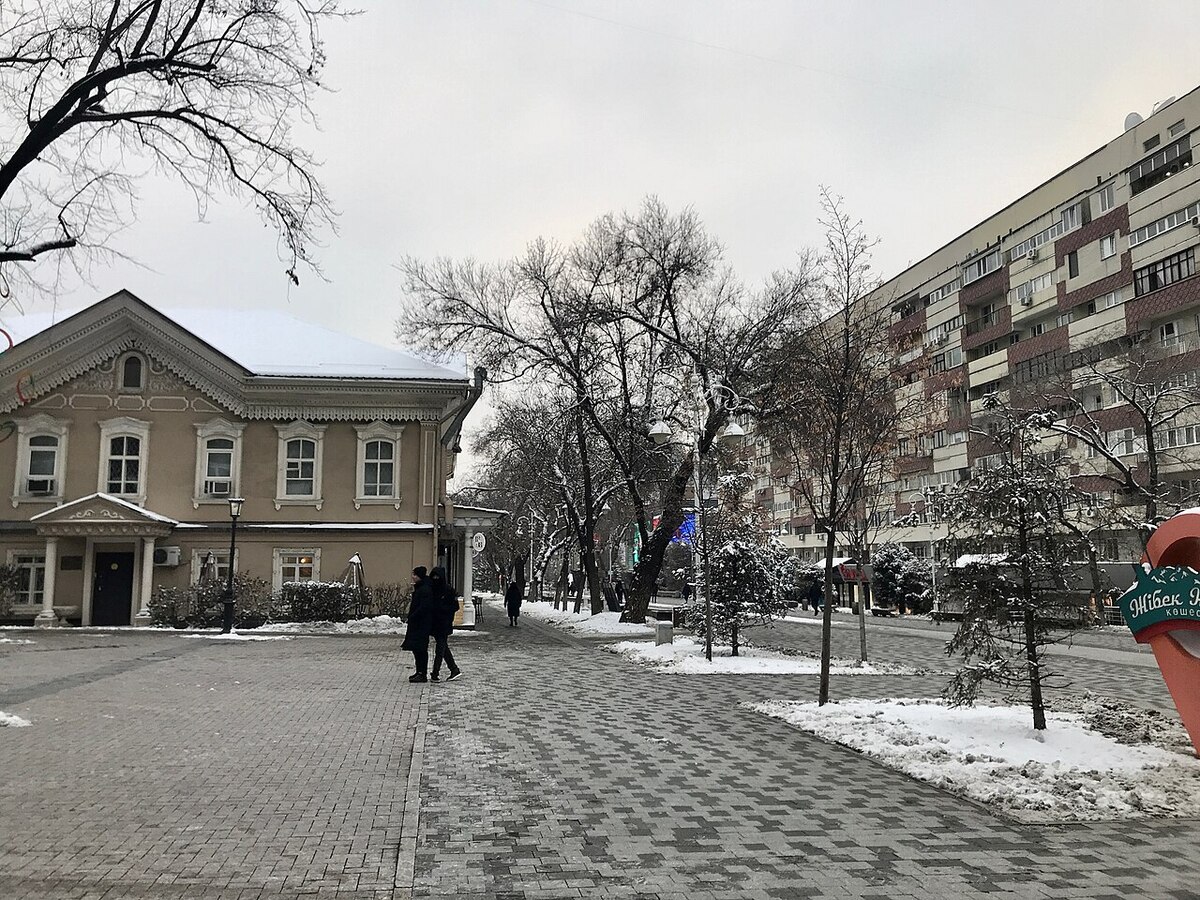
Zhibek Zholy — “Silk Road” — was Almaty’s first stone-paved street, laid in 1883; its pedestrianised section, universally called the Arbat, was created in the 1980s and runs roughly from Abylai Khan Avenue to Furmanov Street. Panfilov Street was pedestrianised in 2017–18 and runs from the Abai Opera House north to the Arbat, passing two metro stations on the way.
From here you can walk to Panfilov Park and the wooden Zenkov Cathedral, along the Arbat past the buskers and portrait artists, and east to the Green Bazaar in about ten minutes. It is busier and slightly scruffier than the Golden Square, and a little cheaper.
Around the Green Bazaar and Raiymbek
Downhill, cheaper, grittier, and better connected than anywhere else in the city. The Green Bazaar dates to the second half of the nineteenth century and sits beside Panfilov Park; Raiymbek Batyr is the metro terminus, and Almaty-2 railway station — the central one, despite what some maps claim — is just below it on Ablai Khan Street.
This is where I would stay on a tight budget or if I were arriving by train and leaving by train. Rooms in the 20-to-50-dollar band are plentiful. It is noisier, the buildings are older, and the winter air is worse than uphill. It is also completely safe and full of life at seven in the morning when the bazaar is loading.
Dostyk Avenue and Samal: uphill, greener, pricier
Head south and east from the Golden Square along Dostyk and the city changes character. Samal is a post-1990s district of larger apartments, malls, gourmet shops and business centres, sitting just uphill of the Golden Square. Upper Dostyk is leafier, quieter and noticeably more expensive.
The trade-off is straightforward: better air, better views, more greenery, more space — and you are far enough from the restaurant density that you will take a taxi to dinner more often than you expect. It works well for a stay of a week or more, for families, and for anyone who cares about winter air quality.
Al-Farabi and the Esentai corridor
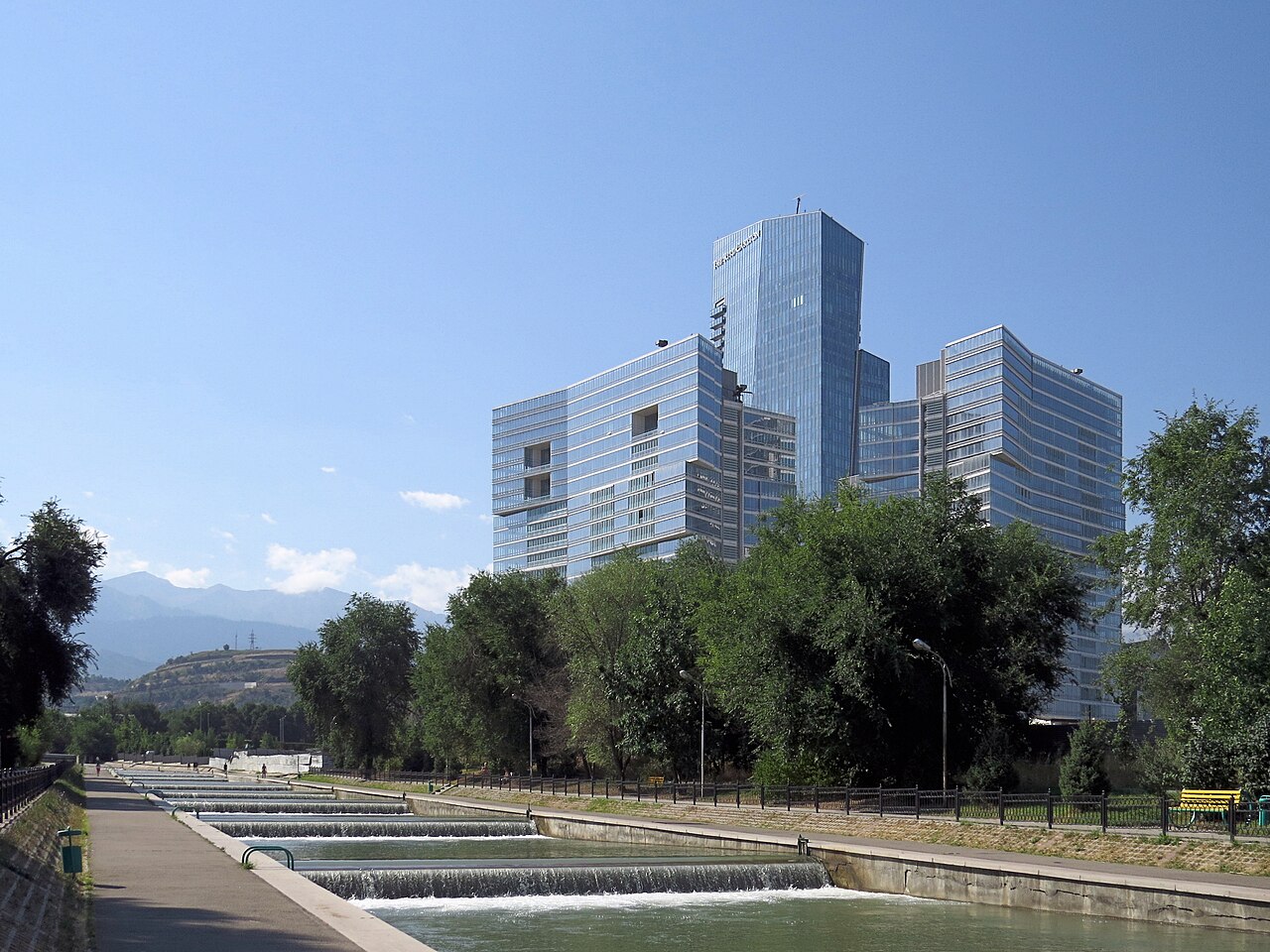
The modern business district, up on Al-Farabi Avenue about three kilometres uphill of the centre. Esentai Tower — 36 floors and 162 metres, completed in 2008 to a Skidmore Owings & Merrill design — sits at 77/7 Al-Farabi, with Esentai Mall next door at 77/8. This is glass-and-steel Almaty, and the city’s flagship luxury hotel is in the tower.
Stay here if you are in Almaty on business, if you want a five-star hotel, or if you want mall-and-mountain-view Almaty rather than tree-lined-Soviet Almaty. It is not walkable to the centre and the metro does not come near it, so budget for taxis. Our accommodation pillar covers the country-wide picture.
Kok Tobe foothills, the Medeu road and Gornyi Gigant
Right at the top of the city, where the streets stop being a grid and start winding. Kok Tobe hill is at 1,100 metres, about 200 metres above the centre, with the 371-metre Almaty TV Tower on top and the cable car running down to the Palace of the Republic on Dostyk.
Gornyi Gigant is a former collective farm swallowed by the city that has kept a village feel — known among Almatians for cheap Uzbek cafés with outdoor tapchans, and home to the Sunkar ski-jumping complex. Almaty’s newly wealthy have been moving up here specifically to get above the smog.
The Medeu road runs on up the gorge to the ice rink and Shymbulak. There are hotels and guesthouses all along it.
Stay up here for views, for air, and for waking up with mountains outside the window. Do not stay up here without a car or a serious taxi budget — you are twenty to forty minutes from the centre depending on traffic, and there is no metro.
Sayran, Auezov and the west
Residential west Almaty: the Sairan reservoir, Family Park, the big MEGA Alma-Ata mall, and a lot of Soviet apartment blocks. The metro reaches it — Sayran, Moskva and Bauyrjan Momyshuly stations — which is the one thing it has going for it.
Cheap, local, and a long way from anything you came to see. Worth considering only for a long stay on a budget, or if you have a specific reason to be out this way.
Where not to stay on a short trip
The far north
Turksib, Alatau and Zhetysu. Nothing to see, worst air in the city, long commute in.
Near Almaty-1 station
A genuine trap. There are two railway stations and Almaty-2 is the central one, on Ablai Khan Street just below Raiymbek Batyr metro. Almaty-1 is a twenty-minute drive north-east and handles mostly suburban services. Booking a hotel “near the station” without checking which station is a mistake people make regularly. A fair taxi from Almaty-2 to the centre is under a thousand tenge; from Almaty-1, about double.
Medeu or Shymbulak, if you only have three days
This one is counter-intuitive. Staying up at the ski resort sounds romantic and is lovely if you are there to ski. On a three-day city trip it means two long taxi rides a day and no evenings out. Visit; do not stay.
Anywhere requiring two taxis a day
The general rule. If you cannot walk to dinner and cannot reach a metro station on foot, count the taxi fares before you book — they add up faster than the room saving.
Getting around from each area
The metro: one line, eleven stations
Almaty’s metro is a single line, 13.4 kilometres and eleven stations, opened in 2011 and extended twice. From east to west: Raiymbek Batyr, Zhibek Zholy, Almaly, Abay, Baikonur, Auezov Theater, Alatau, Sayran, Moskva, Saryarqa, Bauyrjan Momyshuly. It runs largely beneath Abay Avenue then turns north under Furmanov to Raiymbek. End to end is about twenty minutes. The stations themselves are marble-and-mosaic showpieces and worth a look in their own right.
The fare is a flat 120 tenge, roughly a quarter of a dollar. Trains run from about 06:20 to midnight, every eight minutes at peak and up to fifteen off-peak. Mobile data works throughout, and an Onay card covers metro and buses.
What the metro does not serve: Dostyk Avenue, Samal, Al-Farabi and Esentai, Kok Tobe, Medeu, Shymbulak, or the airport. For the mountains you ride to Alatau station and change to a bus or taxi. This is why “close to a metro station” is a much weaker criterion in Almaty than in most cities. A western extension to Kalkaman is under construction with a target of December 2026, though the timeline has slipped before.
Taxis
Yandex Go and inDrive, always in the app, never by hailing. Prices are low — a short cross-town ride is a few dollars. Our Yandex Go guide covers how it works.
The airport
Almaty International (ALA) is about 15 kilometres north-east of the centre, roughly 19 kilometres by road and 25 to 40 minutes depending on traffic. A Yandex Go into town runs somewhere in the 2,500 to 7,500 tenge range depending on time of day and surge — call it five to fifteen dollars.
One firm piece of advice: never accept a ride offered to you inside the terminal. Airport touts routinely quote 15,000 to 25,000 tenge for the same journey. Walk out, open the app, book it. See our Almaty airport guide.
What you will pay, by area
These are approximate 2026 ranges for a double room, and they move with season — November is the cheapest month, August the dearest.
| Area | Budget | Mid-range | Upper |
|---|---|---|---|
| Golden Square | 40–55 | 55–100 | 100–170 |
| Arbat / Panfilov Park | 30–45 | 45–80 | 80–120 |
| Green Bazaar / Raiymbek | 20–30 | 30–50 | — |
| Dostyk / Samal | 55–80 | 80–120 | 120–160 |
| Esentai / Al-Farabi | — | 120–200 | 200–350+ |
| Medeu road / foothills | 50–70 | 70–130 | 130–200 |
| Auezov / Sayran | 25–35 | 35–55 | — |
Two notes. Serviced apartments are excellent value here and usually undercut a comparable hotel room, particularly for stays over three nights. And local platforms and the 2GIS app often list family-run places 20 to 30 per cent below the big booking sites, though usually requiring cash in tenge and a phone call in Russian.
Safety, noise and winter air by area
Almaty is among the safer cities in Central Asia for foreign visitors, and violent crime against tourists is uncommon. Petty theft and pickpocketing occur in markets, on crowded transport and in tourist areas. Risk concentrates in the outer districts and poorly lit streets late at night, and around bars after closing. The Arbat and the central shopping streets are among the safest places in the city, and the metro — permanently staffed — is very safe. Our safety guide has more.
On noise: the Golden Square has active nightlife and Friday and Saturday can be lively on the bar streets. Dostyk and Samal are quiet. Anything on a main arterial road will have traffic noise.
On winter air, refer back to the district numbers above. If you are visiting between November and February and anyone in your party has asthma, book uphill. The difference between Turksib at 87 per cent of days over the WHO limit and Medeu at 43 is not a rounding error.
Where to stay in Almaty: quick picks
- First trip, three to five days: Golden Square, ideally near Tulebaev or Panfilov Street.
- Tight budget: around the Green Bazaar or Raiymbek.
- Families: a serviced apartment in Samal or upper Dostyk.
- Views and clean air: the Kok Tobe foothills or Gornyi Gigant, with a car.
- Business: the Esentai corridor on Al-Farabi.
- Skiing: up the Medeu road, or the Golden Square with a daily taxi.
- Long stay or remote work: Samal, or the streets just uphill of Abay.
Frequently asked questions
What is the best area to stay in Almaty for first-time visitors?
The Golden Square. You are within walking distance of the restaurant and bar scene, the Opera House, Republic Square and two metro stations, and it is a genuinely pleasant part of the city to walk around. Expect roughly 55 to 100 US dollars for a decent mid-range room.
Where is the Golden Square in Almaty?
As Almaty residents now use the term, it is bounded roughly by Zhibek Zholy to the north, Abay Avenue to the south, Seifullin Avenue to the west and Dostyk Avenue to the east. The stricter historical version starts at Tole Bi and Abylai Khan instead. There is no official boundary — the term was invented by property developers in the 1990s.
Is it worth staying near Medeu or Shymbulak instead of the city?
Only if you are there to ski or specifically want a mountain stay. For a short city trip it means long taxi rides in both directions every day and no evenings in town. Go up for the day instead.
Is Almaty safe at night?
Broadly yes, particularly in the central districts. Petty theft happens in crowded places and around bars at closing time; the outer northern districts are less pleasant late. Use Yandex Go rather than walking home across the city, and normal precautions apply.
How far is Almaty airport from the centre?
About 15 kilometres north-east, 25 to 40 minutes by road. A Yandex Go ride runs roughly 2,500 to 7,500 tenge depending on time and demand. Book in the app rather than accepting a ride from someone inside the terminal.
Does the Almaty metro go to the airport?
No. The single line runs east–west across the city and does not reach the airport, Dostyk Avenue, Esentai, Kok Tobe or the mountains. A second line to the airport is planned but unbuilt.
Which train station should I use, Almaty-1 or Almaty-2?
Almaty-2 is the central one, on Ablai Khan Street below Raiymbek Batyr metro, and it handles intercity and international services. Almaty-1 is a twenty-minute drive north-east and is mainly suburban. Check which one your ticket says before booking a hotel nearby.
How bad is the smog in Almaty in winter?
Real, and worse the further downhill you are. Almaty’s annual mean PM2.5 has been measured several times above the WHO guideline, peaking in January when a thermal inversion caps the basin. Medeu district exceeds the daily limit on about 43 per cent of days; Turksib on 87 per cent. Book uphill in winter.
Is Almaty walkable?
The central districts, yes — pleasantly so, with wide tree-lined streets and pedestrianised sections. The city as a whole, no; it is large, it is on a slope, and the metro covers only one axis. Plan on walking within your neighbourhood and taking taxis between them.
How many days do you need in Almaty?
Three days for the city itself, five if you want a mountain day and a bazaar morning without rushing, and seven to ten if you are adding Charyn and the Kolsai lakes. See our Almaty itinerary.
Final thoughts
If you take one thing from this page, take the slope. Almaty’s whole geography — its prices, its air, its greenery, its social geography — organises itself along a north-south gradient, and once you can feel which way a street runs you will never be lost here again.
For most visitors the answer is simple: book somewhere inside the Golden Square, ideally on or near Tulebaev, and walk everywhere. If you are here in January and can afford to go a few streets uphill, do. If you are here for a month, look at Samal. And whatever you do, check whether “near the station” means the station you are actually arriving at.
Next: things to do in Almaty for the sights, getting around Almaty for the transport detail, and where to stay in Kazakhstan for the rest of the country.
Photo credits
Almaty skyline beneath the Tian Shan — Dauren Nabijan, CC0, via Wikimedia Commons. Zhibek Zholy pedestrian street — ShadZ01, CC BY 4.0, via Wikimedia Commons. Esentai Tower and the Esentai river — Alexandru Panoiu, CC BY 2.0, via Wikimedia Commons.