
Contents
- First, a Distance Reality Check
- Trains in Kazakhstan: The Heart of the Whole System
- Getting to Kazakhstan in the First Place
- Domestic Flights: How You Beat the Distances
- Buses, Marshrutkas and Shared Taxis: The Budget Layer
- Yandex Go, InDrive and Taxis: City Movement Solved
- City Public Transport: Cheap, Cheerful, QR-Coded
- Renting a Car in Kazakhstan: Freedom, With Asterisks
- Crossing Borders: Kazakhstan as a Hub
- Which Transport for Which Traveler?
- The Apps That Run Your Trip
- A Worked Example: Ten Days of Transport, Costed
- Five Mistakes I See Travelers Make
- Luggage, Money and the Small Print
- FAQ: Getting Around Kazakhstan
- Final Thoughts: The Distances Are the Destination
- Explore getting around Kazakhstan in more depth
- Related Kazakhstan travel guides
Look at a map of Kazakhstan and try to plan a route, and the scale hits you fast. Almaty and Aktau — two cities in the same country — sit at opposite ends of it, thousands of kilometers apart by road. So let’s get one thing straight before we talk about anything else: getting around Kazakhstan is not a detail you sort out after booking your flights. It IS the trip.
Getting around Kazakhstan comes down to four tools: overnight trains for the classic long hauls, cheap domestic flights (FlyArystan from around $30–50) for the monster distances, Yandex Go for every city ride, and a rented 4×4 or driver for the canyons, lakes and deserts that public transport simply doesn’t reach. Most trips combine at least three of them.
You can cross this country by platzkart bunk, by Talgo sleeper, by budget A320, by marshrutka and by rented Land Cruiser on washboard steppe tracks. This guide covers transport in Kazakhstan — real prices in tenge and dollars, the booking sites that actually accept foreign cards, and the honest trade-offs nobody mentions, written for travelers planning their first or second visit.
First, a Distance Reality Check
Kazakhstan is the ninth-largest country on Earth — roughly five times the size of metropolitan France, home to just over 20.6 million people (20,618,796 on 1 September 2026). The emptiness is the attraction, but it punishes lazy route planning. A “quick side trip” between two dots on the map can mean most of a day on the steppe.
The table below compares the main ways to cover the big routes. Prices are approximate one-way figures as of mid-2026; always check current fares before you book.
| Route | Distance (road) | Flight | Train | Bus / shared taxi |
|---|---|---|---|---|
| Almaty → Astana | ~1,250 km | About 2h, ₸20,000–45,000 ($40–90) | Talgo ₸16,000–35,000; night train from ~₸5,000 | 16–18h, ~₸8,000 (don’t) |
| Almaty → Shymkent | ~700 km | from ₸10,000 (FlyArystan) | Overnight, ₸4,000–12,000 | Most of a day, ₸4,000–7,000 |
| Almaty → Turkistan | ~870 km | ~1h 30m direct (FlyArystan, 4–5 a week) | Overnight, ₸5,000–14,000 | A long day, similar to train money |
| Almaty → Aktau (Mangystau) | Far west | ~3h, ₸30,000–65,000 | 2.5–3 days, multiple trains | genuinely, no |
| Astana → Burabay (Borovoe) | ~255 km | — | 2.5–4h, from ~₸2,000 | 4–5h marshrutka/bus, ~₸2,500 |
The pattern you should steal: fly the monster legs, train the overnight legs, and save road transport for the last 100 kilometers — the day trips, the national parks, the border hops. That’s the formula my favorite Kazakhstan itineraries are built around, and it’s why this guide is organized the way it is.
Trains in Kazakhstan: The Heart of the Whole System
If you only take one piece of advice from this page, make it this: book at least one overnight train. Kazakhstan inherited a sprawling Soviet rail network — over 16,000 km of broad-gauge track operated by Kazakhstan Temir Zholy (KTZh) — and riding it is one of the best things to do in Kazakhstan, full stop. Not transport that happens to be scenic. An actual highlight.
Locals treat long train rides as social events, so expect conversation, shared snacks and the odd card game across the compartment table. You will not get that on FlyArystan.

The two kinds of train
Kazakhstan effectively runs two parallel systems, and they feel like different decades:
- Classic (Soviet-era, much of it refurbished) trains. Slow — your train’s timetable shows just how slow — but cheap, atmospheric and surprisingly well-kept. Many carriages have been modernized in recent years with air-conditioning and vacuum toilets, which matters enormously in July.
- Tulpar-Talgo trains. Modern Spanish-designed trainsets on the trunk routes, Almaty–Astana among them. They cut the Almaty–Astana run by roughly eight hours versus the old service. Comfortable, air-conditioned, with a dining car — and noticeably pricier.
Classes, decoded
On classic trains, you’ll choose between four classes:
- Platzkart — the famous open-plan dormitory carriage: 54 bunks, zero privacy, maximum Kazakhstan. Fine for solo travelers and anyone on a budget; bring earplugs and a sense of humor.
- Kupe — 4-berth compartments. The sensible middle: far more privacy than platzkart, and still cheap by Western standards. A good choice for long overnight runs.
- Lyux (SV) — 2-berth compartments. Worth it for couples on long hauls.
- Obshhiy — seats only. Avoid for anything overnight.
Talgo trains have their own sleeper options: Tourist compartments (usually 4-berth, some with two), Business (2-berth), and Grand (2-berth with a private shower and toilet — a rolling hotel room, near enough). Some Talgo services also carry seated carriages.
Getting to Kazakhstan in the First Place
Quick context before the domestic detail, because your arrival point shapes your whole route. Kazakhstan has two main international gateways, and they sit 1,000 km apart:
- Almaty (ALA) — Kazakhstan’s busiest airport, with direct flights to Istanbul, Dubai, Abu Dhabi, Doha and Frankfurt. If your trip is about mountains, canyons and the south, land here. Most travelers should: Charyn Canyon, the Kolsai and Kaindy lakes and Big Almaty Lake, among Kazakhstan’s headline sights, are all within reach of Almaty.
- Astana (NQZ) — the capital’s modern airport, well connected through Istanbul and the Gulf, and the logical entry for northern itineraries or winter city breaks.
Shymkent and Aktau have direct international flights too, to cities such as Baku and Istanbul, which makes a useful trick possible: fly into Almaty, exit from Aktau (or vice versa) and never backtrack across the width of the country.
Overlanders have options the airlines can’t match: comfortable direct trains from Tashkent, the Bishkek bus, road crossings from everywhere, and the gloriously unpredictable Caspian ferry from Baku. More on those in the borders section below. Either way, check entry rules first. Most Western passports are visa-free for up to 30 days, but from 1 November 2026 visa-free visitors should also apply for a QazETA electronic travel authorization. The specifics are in our Kazakhstan visa guide.
How to buy train tickets (without a Cyrillic keyboard)
Two online options, one of which actually works smoothly for foreigners:
- Tickets.kz — English interface, accepts foreign Visa/Mastercard, issues a PDF e-ticket you just show on your phone. There’s a small service fee. Refunds work.
- bilet.railways.kz — the official KTZh shop. Slightly cheaper, but the English version has a habit of failing at the exact moment you reach payment. Use it if you enjoy suspense.
You can also buy at any station ticket window, where prices are lowest and English is rarest. Write your destination, date and class on paper (or show the Cyrillic on your phone) so nothing gets lost in translation at the window.
Three booking rules that save real pain:
- Summer sells out. June–August trains on popular routes fill one to two weeks ahead, sometimes faster. Book as soon as your dates firm up — especially around the July holidays. (Winter is far looser; more on seasons in our guide to the best time to visit Kazakhstan.)
- Lower bunks beat upper bunks. You sit on them by day; choose your berth number at booking. Odd numbers are lower in platzkart and kupe.
- Check which station. Almaty has two: Almaty-2 is the central one, and Almaty-1 stopped taking passengers on 15 July 2026 while it is rebuilt, so trains currently use Almaty-2. Astana’s gleaming main station is Nurly Zhol. Your ticket says which — read it twice.
The time-zone trap that no longer exists
Here’s a fun way to spot an outdated Kazakhstan guide: it will warn you that train tickets are sold on “Astana time” while western Kazakhstan runs an hour behind. Since March 2024, the whole country runs on a single time zone (UTC+5) — the ticket time is simply the local time, everywhere. One less thing to think about, and several page-one guides still get it wrong.
What riding a Kazakh train is actually like
Every carriage has a samovar of boiling water — bring instant noodles, tea bags and a mug and you’re catered for. Clean bed linen is included in your ticket. The dining car serves decent plov, lagman and cold beer at fair prices, and provodnitsas (carriage attendants) sell snacks and coffee. Power sockets exist but are scarce and temperamental outside Talgo and refurbished cars: a power bank is non-negotiable. Toilets range from “fine” to “character-building”; pack tissues and hand sanitizer and you’ll cope.
One quirk worth knowing: a handful of legacy lines in the far north and west briefly cross Russian territory (the Soviet engineers weren’t thinking about future borders). On those specific routings you’d need a Russian transit visa, so double-check your train’s path when booking northern or far-western routes — and sort your own paperwork with our Kazakhstan visa guide before you worry about Russia’s.
Two oddities for train romantics: Turan Express, a small private operator running a few comfortable services out of Almaty, and the Keruen Express, a seasonal tourist train that loops Almaty–Turkistan–Samarkand–Bukhara–Tashkent–Almaty over six days with guided stops — a lazy, brilliant way to do the Silk Road if your dates line up with its handful of annual departures.

Domestic Flights: How You Beat the Distances
Trains are the heart of the system, but some legs are simply too long for them. When the alternative is the long rail haul to Mangystau’s canyons and the Caspian coast, a flight of a few hours is not a hard decision.
The domestic market is genuinely good now:
- FlyArystan — Air Astana’s low-cost arm and the workhorse of budget travel here, flying A320s to 13–14 domestic cities including Almaty, Astana, Shymkent, Aktau, Atyrau, Oskemen, Kyzylorda and Turkistan. Booked a few weeks out, fares from roughly ₸15,000–25,000 ($30–50). It’s a proper no-frills carrier: pay for bags, pay for seat selection, read the hand-luggage rules or pay at the gate like everyone who didn’t.
- Air Astana — the full-service flag carrier, consistently one of the best airlines in the region. Worth the premium on longer routes for the baggage allowance alone.
- SCAT and Qazaq Air — regional carriers filling the gaps, useful for smaller cities and odd routings.
Between them, the big three operate the overwhelming majority of domestic flights, and the Almaty–Astana corridor runs all day long, in about two hours. Typical domestic fares land between ₸20,000 and ₸65,000 depending on route, season and how late you book.

Flying tips specific to Kazakhstan: book FlyArystan directly at flyarystan.com (the booking flow takes foreign cards happily); weigh your cabin bag at home because they do check; and if you’re connecting onward the same day, leave generous buffers in winter — fog and snow delays at Astana are a January tradition. Almaty’s airport got a shiny new international terminal in 2024, but domestic flights still use the older building next door — allow a few extra minutes if you’re transferring between them.
What train tickets actually cost
Approximate one-way fares I’d budget as of mid-2026 — treat them as ballpark, not gospel:
| Route | Platzkart | Kupe | Talgo (Tourist/Business) | Time |
|---|---|---|---|---|
| Almaty → Astana | from ~₸5,000 | ₸10,000–16,000 | ₸16,000–35,000 | 15–24h |
| Almaty → Shymkent | ₸4,000–6,000 | ₸7,000–12,000 | ₸12,000–20,000 | 10–14h |
| Astana → Karaganda | ~₸2,000 | ~₸4,000 | ~₸6,000+ | 3–4h |
| Almaty → Aktau | ₸12,000–18,000 | ₸20,000–30,000 | — | 2.5–3 days |
Children ride at deep discounts, lower berths sometimes cost slightly more than uppers, and dynamic pricing means the same berth can vary by thousands of tenge between a Tuesday in October and a Friday in July. If the fare you see looks oddly cheap or oddly dear, that’s why.
Platzkart etiquette for first-timers
A few unwritten rules make the open carriage pleasant: change into slippers and comfortable clothes immediately (everyone does — jeans mark you as a rookie), accept offered food at least once, offer something back, keep your shoes out of the aisle, and climb to your upper bunk from the designated footholds rather than your neighbor’s mattress. Solo women travel platzkart constantly and the carriage looks after its own; if you’d simply rather have a lockable door, kupe costs only a few dollars more. Families take note: a four-berth kupe booked entirely for your own crew is the single best family transport hack in the country.
Buses, Marshrutkas and Shared Taxis: The Budget Layer
I’ll be candid: intercity buses are my least favorite way of getting around Kazakhstan, and I say that as someone who has taken a lot of them. The seats are tired, the films are loud, and on a 12-hour run the novelty dies around hour three. But they’re cheap, they go everywhere trains don’t, and on a few corridors they’re honestly the rational choice.
When the bus actually wins
- Short-to-medium hops (under 6 hours). Almaty–Taraz, Astana–Karaganda, Shymkent–Turkistan: buses and marshrutkas run constantly and often beat the slow trains on time.
- Mountain and lake country with no rails. Much of the territory covered in our Almaty day-trips silo — and the wider hiking regions — is bus, marshrutka or private-driver territory.
- Border runs. The Almaty–Bishkek international bus is the classic, around 4–5 hours including the Korday border shuffle for roughly ₸2,500–4,000.
Marshrutkas — the minivans that depart when full — are the folk transport of Central Asia. No timetable, no website, no seatbelts in any meaningful sense. You find them at bus stations and informal lots, you pay the driver around ₸1,500–3,000 for a medium hop, and you experience Kazakhstan at its most local. I have great affection for them in doses of two hours or less.
Shared taxis work the same routes faster: fixed price per seat (typically 1.5–2x the bus fare), departure when the car fills. At every bus station, drivers will find you before you find them. Agree the price and whether it’s per seat or the whole car before your bag enters the boot — that one habit saves real money.
Booking intercity buses online is patchy — local sites exist but mostly want local payment methods. In practice: turn up at the bus station (avtovokzal) a day ahead for long routes, or same-day for shorter ones. Almaty’s main long-distance terminal is Sairan, a gloriously chaotic place that also functions as an accidental museum of Soviet logistics.
Yandex Go, InDrive and Taxis: City Movement Solved
This is the easiest section to write, because one app solves 90% of it. Yandex Go (the regional Uber) offers rides in Kazakhstan: type the destination, see the fare, pay cash or card. Services vary by region, so check what the app offers where you are. Short city rides run ₸500–1,000 ($1–2), cross-town maybe ₸1,500–2,500, and the airport run in Almaty or Astana lands around ₸2,000–4,500 depending on traffic and tariff. Cars arrive in minutes. It is, frankly, one of the great quality-of-life features of traveling here.
- InDrive is the haggler’s alternative — you propose a price, drivers counter. It sometimes beats Yandex on long or surge-priced rides, and it’s strong in smaller cities.
- Street taxis and “gypsy cabs” still exist — locals stick out a hand and negotiate through the window. As a visitor you’ll pay the optimism tax; I only bother where the apps thin out, like small towns and trailheads.
- Private drivers for the day are the unsung heroes of Kazakh travel: for roughly ₸25,000–45,000 ($50–90) split between a group, a driver will run you to Charyn Canyon or the Kolsai Lakes and wait while you hike. Hotels and tour offices arrange them, or negotiate directly via Yandex drivers who freelance. For the full logistics of those routes, see our dedicated guide to day trips from Almaty.
One cultural note: Kazakh urban driving is assertive. Lanes are a suggestion, the horn is punctuation. Sit back and let the professionals handle it — statistically you’re fine, even when it feels like an audition for a stunt team.
City Public Transport: Cheap, Cheerful, QR-Coded

City transport in Kazakhstan costs next to nothing and has quietly gone digital. A bus ride costs ₸120 in Almaty and ₸110 in Astana — pennies — with the catch that cash is being squeezed out: Almaty’s buses take no cash at all, so you pay by transport card, QR code or app, while Astana’s charge ₸220 if you pay in cash.
- Almaty runs an underground metro — one line, 11 stations, immaculate marble-and-chandelier platforms that double as an attraction (Baikonur and Zhibek Zholy stations are legitimately worth a look between sights from our Almaty guide). Astana has rail transit of its own now, a light rail line that opened in May 2026. Buy an Onay card at kiosks (a few hundred tenge, then load credit) or use the Onay app’s QR — though the plastic card wins underground where there’s no signal. The same card covers buses and trolleybuses.
- Astana is bus-only but the network is dense and modern; pay by QR or transport card, and expect to use it constantly because the capital’s distances defeat walking — sights are spread out, as you’ll see in our Astana guide.
- Shymkent, Aktobe, Karaganda and the rest run cheap bus networks where Yandex Go is so inexpensive you’ll mostly skip them.
Download 2GIS before you arrive: it’s the offline map-and-routing app the whole region runs on, with bus numbers, exits and building entrances that Google Maps simply doesn’t know. Between 2GIS for routing, Onay for payment and Yandex for everything else, the cities are trivially easy.
Renting a Car in Kazakhstan: Freedom, With Asterisks

Now for the question I get most: should you self-drive Kazakhstan? My answer is a firm “yes, but” — yes for the nature, but only with your eyes open about the conditions.
The case for renting: the best landscapes in the country — Charyn Canyon’s quieter rims, the Assy Plateau, Altyn-Emel’s singing dune, the Bartogai reservoir backroads — sit beyond the last bus stop. With your own wheels, the steppe opens up: eagle-on-a-fencepost, horizon-to-horizon emptiness, stopping wherever the light is good.
The realities to respect:
- Costs. A compact sedan from local agencies or the airport internationals runs around ₸18,000–28,000/day ($35–55); a proper 4×4 more like ₸45,000–70,000 ($90–140). Petrol is mercifully cheap — roughly ₸230–280 per liter for 95 — so a long trip costs less than you’d fear. Budget detail lives in our Kazakhstan trip-cost guide.
- Roads are a lottery. The main intercity highways are mostly decent (some, like Almaty–Shymkent, genuinely good); secondary roads deteriorate fast, and “road” on a map can mean graded gravel, washboard or wishful thinking. The scenery you came for often lies at the end of the unpaved stretch. For Altyn-Emel, the Assy Plateau and anything in Mangystau, take the 4×4 — not for status, for clearance.
- Police and cameras. Speed cameras (the “Sergek” system) blanket the cities, and highway patrol spot-checks are routine. Carry passport, license and rental papers; stay polite; insist on official paperwork if fined. A dashcam — standard equipment in every local car for good reason — keeps interactions wonderfully professional. Speed limits depend on the vehicle and the class of road (motorways, roads with a dividing strip and other roads each have their own), so follow the posted limits, and never drink before driving.
- You need an International Driving Permit alongside your license (rental desks ask; police occasionally do). Drive on the right; zero-tolerance drink-driving — and they mean zero.
- Distances and fuel planning are real. Outside cities, fill up whenever you see a station; in the west especially, the next one can be a long way off. Carry water, snacks and a charged power bank — assistance can be hours away.
- Winter changes everything. November–March means ice, ground blizzards (буран) and road closures on the steppe. Unless you have genuine winter-driving experience, take the train or fly in the cold months and read our winter travel guides first.
If you want the landscapes without the liability, hiring a car with driver costs surprisingly little more than self-drive once you factor insurance and nerves — most tour agencies in Almaty quote day rates around ₸50,000–70,000 for a 4×4 with a driver who knows where the potholes live. For one-day nature hits from Almaty, that’s usually the smart money.
Crossing Borders: Kazakhstan as a Hub
Kazakhstan borders five countries, and using it as a Central Asia hub is half its charm. The short version of the classic crossings:
- To Kyrgyzstan: Almaty–Bishkek by international bus or shared taxi via the Korday crossing. The single most-traveled border hop in Central Asia.
- To Uzbekistan: comfortable direct trains link Almaty and Shymkent/Turkistan with Tashkent — the overnight Almaty–Tashkent run is one of the region’s great sleeps — plus a short land crossing from Shymkent.
- To China: the Khorgos crossing east of Almaty (the famous Almaty–Urumqi train remains suspended; buses and a freight-heavy rail line do the work).
- To Russia: multiple road and rail crossings in the north — check the sanctions-era practicalities and your own visa needs carefully.
- Across the Caspian: the Aktau–Baku ferry, a legendary exercise in patience with no fixed schedule. An adventure, not a transfer.
Whatever you’re crossing, confirm your re-entry rules first — most nationalities get visa-free re-entry but day-counting rules apply; details in the visa and entry guide.
Which Transport for Which Traveler?
- First-timers with 7–10 days: fly the Almaty–Astana leg one way, take the Talgo back overnight, use Yandex Go and one hired driver day for Charyn/Kolsai. Zero stress, maximum range.
- Budget backpackers: platzkart everything, marshrutkas for the gaps, FlyArystan only when a sale beats two days of rail. You can cross the whole country for the price of a European taxi ride.
- Couples and comfort-seekers: Talgo Business or Grand class, Air Astana for long legs, drivers over self-driving.
- Photographers and nature-obsessives: a 4×4 (with or without driver) is non-negotiable — the shots that made you book the flight live down dirt tracks in Mangystau and the south.
- Winter travelers: trains and planes, full stop — and the city-to-ski-resort logistics are easy regardless.
The Apps That Run Your Trip
Install these five before wheels-down, in order of importance: Yandex Go (city rides), 2GIS (offline maps and bus routing), Tickets.kz (train booking that takes foreign cards), Onay (Almaty transit payment), and InDrive (taxi haggling, smaller cities). A local eSIM makes them all sing — data is cheap and coverage along main corridors is far better than the emptiness suggests. One honest warning: Kazakhstan’s beloved superapp Kaspi powers half the QR codes you’ll see, but it effectively requires local ID — you’ll watch locals breeze through payments you can’t make. Visa/Mastercard and a little cash cover the difference fine.
A Worked Example: Ten Days of Transport, Costed
Abstract advice is cheap, so here’s the actual transport spine of a classic first-timer route — Almaty, the canyon-and-lakes country, then the capital — with realistic mid-2026 money:
| Leg | Mode | Cost (per person) |
|---|---|---|
| Almaty airport → city | Yandex Go | ~₸3,000 |
| 3 days around Almaty | Metro/buses + Yandex | ~₸5,000 total |
| Charyn Canyon + Kolsai day tours | Shared 4×4 with driver (group of 4) | ~₸15,000 each, per day |
| Almaty → Astana | Overnight Talgo, Tourist class | ~₸20,000 |
| 2 days in Astana | Buses + Yandex | ~₸6,000 total |
| Astana → Almaty (or onward) | FlyArystan, booked early | ~₸18,000 |
Call it roughly ₸80,000–90,000 ($160–180) of transport for ten days, including two long-haul legs and two private-driver nature days. Try assembling that itinerary in Switzerland for the price. The full daily-budget picture — sleeps, food, entrance fees — is broken down in our Kazakhstan trip cost guide.
Five Mistakes I See Travelers Make
- Underestimating distances, then overcorrecting into flights-only. You’ll move efficiently and feel nothing. At least one overnight train belongs in every itinerary — it’s where the country talks to you.
- Booking summer trains “tomorrow.” By July, tomorrow’s kupe berths to anywhere good were sold last week. The moment your dates are fixed, book — Tickets.kz takes two minutes and foreign cards.
- Renting a sedan for 4×4 country. The rental agent will happily hand you a low-slung Toyota for the Assy Plateau. The plateau will win. Match the vehicle to the terrain, or hire the driver who already owns the right one.
- Ignoring winter on the roads. Weather can change sharply between Almaty and the steppe farther north, so a dry November morning in the city tells you little about the road ahead. From November to March, the steppe belongs to trains and planes; check conditions obsessively if you must drive, and read up on safety and practicalities first.
- Treating buses as the default because they’re cheapest. Platzkart is usually within pocket change of the bus fare, runs overnight so you save a hotel night, and lets you lie flat. The bus wins under six hours; beyond that, rail every time.
Luggage, Money and the Small Print
A few practical fragments that don’t fit anywhere else but will save you friction on the ground:
- Luggage on trains is gloriously unregulated in practice — under the lower bunks and on the shelf above the door, first come, best stowed. Board early on busy summer services to claim space. On FlyArystan, the opposite applies: the cabin-bag limits are real and enforced with low-cost-carrier zeal.
- Cash vs card: cards work almost everywhere in cities, but keep ₸10,000–20,000 in small notes for marshrutkas, bazaars, platform snack-sellers and the occasional rural fuel station whose terminal is “broken.” ATMs are everywhere in cities, rare on the steppe.
- Left-luggage rooms (камера хранения) at train stations cost a few hundred tenge and unlock day-long city visits between night trains — the backpacker’s hotel-free Kazakhstan circuit runs on them.
- Accessibility: Talgo trains, the Almaty metro and newer airports are reasonably step-free; classic trains and most buses are not. Travelers with limited mobility should weight flights and Talgo heavily and budget for Yandex over city buses.
- And yes, horses. In the mountain villages and around the lakes you can still cover real ground the pre-railway way; multi-day horse treks in the hiking and adventure regions remain one of the most memorable ways of getting around Kazakhstan that no transit app will ever show you.
FAQ: Getting Around Kazakhstan
Is it easy to get around Kazakhstan without a car?
Yes — between cities, easily. Trains and flights connect every major city, Yandex Go handles urban transport, and buses fill the gaps. The exception is nature: canyons, lakes and national parks generally require a hired driver, tour or rental car for the final stretch. City-hopping travelers never need a car; landscape-hunters almost always do.
What’s the best way to travel between Almaty and Astana?
Flying wins on pure logistics: about two hours and from around ₸20,000 ($40) booked ahead, with departures all day. The overnight Talgo wins on experience — board in the evening, sleep in a proper berth, wake in the capital having paid one night less for a hotel. If you have the time, try the train at least one way.
How long does the train from Almaty to Astana take?
The Talgo services are the quick option and older trains take noticeably longer; the official KTZh shop, bilet.railways.kz, shows each train’s current timetable. All the sensible departures are overnight, which converts the duration from a cost into a feature — you sleep through the empty middle of the steppe and arrive rested.
Are trains in Kazakhstan comfortable?
More comfortable than their reputation. Much of the fleet has been refurbished with air-conditioning and clean vacuum toilets, linen is included everywhere, and Talgo Business/Grand class approaches European sleeper standards. Platzkart is basic but perfectly survivable — and the social experience is the entire point. Pack earplugs, slippers and a power bank and you’re set.
How much do trains in Kazakhstan cost?
Cheap by any Western measure. As rough mid-2026 figures: Almaty–Astana from around ₸5,000 ($10) in platzkart on slower trains, ₸10,000–16,000 for kupe, and ₸16,000–35,000 for Talgo berths depending on class. Booking early matters — Talgo fares can run up to 30% cheaper in advance, and summer berths sell out.
Is Yandex Go available in Kazakhstan?
Yes, in every major city, and it’s excellent — fixed upfront fares, card or cash payment, English interface, cars in minutes. Short rides cost ₸500–1,000. InDrive is the popular alternative where you negotiate the price. Between them, you’ll rarely touch a street taxi in urban Kazakhstan.
Should I rent a car in Kazakhstan?
Rent if your trip is about landscapes — Charyn, Kolsai, Altyn-Emel, Mangystau — and you’re comfortable with patchy secondary roads, police checkpoints and serious distances. Skip it for city-to-city trips, where trains and flights are cheaper and easier. The compromise most travelers land on: hire a car with a local driver for nature days at ₸50,000–70,000 per vehicle.
Do I need Russian or Kazakh to use public transport?
No, but a little Cyrillic literacy goes a long way. Apps remove most friction — Yandex Go, 2GIS and Tickets.kz all work in English — and younger urban Kazakhs increasingly speak some English. At station ticket windows and in marshrutkas, pointing, patience and Google Translate carry you through. Learning to sound out station names in Cyrillic pays for itself daily.
Is FlyArystan reliable?
Broadly yes — it’s Air Astana’s low-cost subsidiary, flies a young A320 fleet, and runs the lion’s share of domestic departures. Delays cluster in winter weather, and the ancillary fees (bags, seats, check-in slips) are classic low-cost — read the fare rules before clicking buy. For tight same-day connections, build in buffer or pay for the flexibility of Air Astana mainline.
Final Thoughts: The Distances Are the Destination
Every country has a transport system; Kazakhstan has a transport experience. The night train across the steppe, the absurdly cheap flight over a desert the size of Germany, the Yandex driver giving you an unsolicited tour of Almaty’s best shashlik — moving around this country stopped feeling like logistics to me years ago. Plan with the table above, book the summer trains early, put the right apps on your phone, and the ninth-biggest country on Earth shrinks to something you can hold.
For what to actually do once you’ve mastered moving around, start with our complete guide to things to do in Kazakhstan, then build your route with the itinerary planner. And for deeper dives on every mode — trains, FlyArystan, car rental, Yandex and the border runs — the whole Getting Around section is yours.
Last updated: June 14, 2026 · Written by the Kazakhstan Tourism Guide editorial team. Prices were checked at the time of writing; fares and rules change — always verify current schedules and prices before booking.
Explore getting around Kazakhstan in more depth
These companion guides go deeper on each way of travelling the country:
- Kazakhstan by Train: The Complete Guide
- How to Buy Kazakhstan Train Tickets Online
- Domestic Flights in Kazakhstan: Air Astana, FlyArystan & SCAT
- Renting a Car & Driving in Kazakhstan
- Intercity Buses & Marshrutkas in Kazakhstan
- Taxis & Yandex Go in Kazakhstan
- Almaty to Astana: Train, Flight or Bus? (2026 Guide)
- Almaty to Bishkek: Crossing the Korday Border (2026)
- Kazakhstan to Uzbekistan Overland: Routes & Borders
Related Kazakhstan travel guides
This is one piece of a much bigger Kazakhstan trip-planning series. If it helped, these companion guides are the natural next reads:
- Is Kazakhstan Safe? — an honest, up-to-date safety rundown.
- Kazakh Food & Drink — what to eat, from beshbarmak to baursak.
- Kazakh Culture — nomadic traditions, music and hospitality.
- Hiking in Kazakhstan — the best trails, treks and trekking logistics.
- Kazakhstan in Winter — skiing, frozen lakes and cold-weather travel.
Photo Credits
- Photo: Kabelleger / David Gubler (bahnbilder.ch), CC BY-SA 3.0, via Wikimedia Commons (source)
- Photo: Matti Blume, CC BY-SA 4.0, via Wikimedia Commons (source)
- Photo: Nikolai Bulykin, CC BY-SA 4.0, via Wikimedia Commons (source)
- Photo: Aeroprints.com, CC BY-SA 3.0, via Wikimedia Commons (source)
- Photo: Alex J. Butler, CC BY 2.0, via Wikimedia Commons (source)
- Photo: Dmitry Savelyev, public domain, via Wikimedia Commons (source)
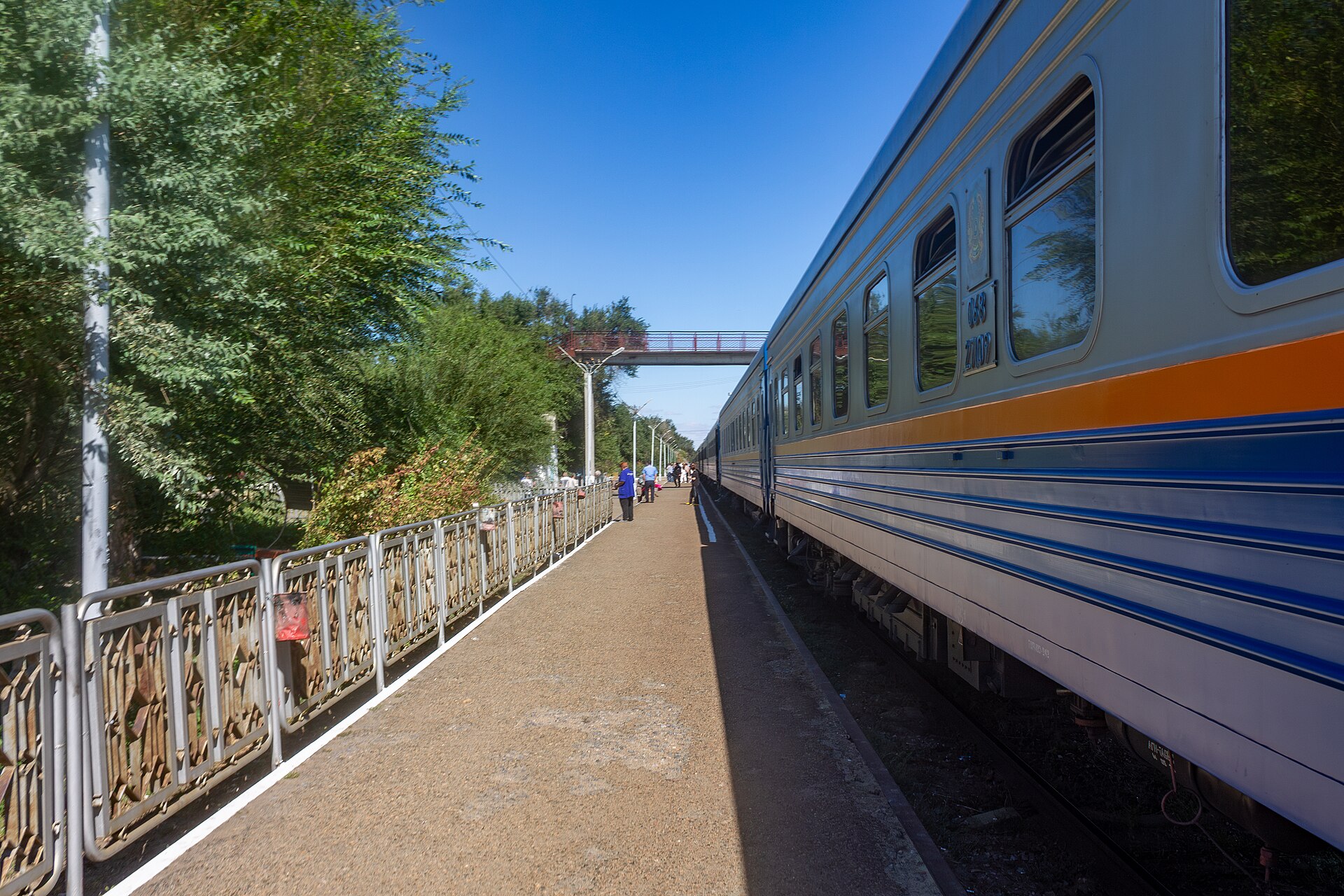
- A KTZ passenger train at Matay: Матай, платформа станции by Nikolai Bulykin, CC BY-SA 4.0, via Wikimedia Commons.
2 comments