Contents
- The short version
- Three different things, and why everyone confuses them
- Border zone versus border strip: the distinction that decides everything
- What changed, and why the internet has not caught up
- Area by area: what you actually need in 2026
- If you genuinely need a strip permit: the process
- At the checkpoint
- Penalties, so you know the stakes
- Park fees you will actually pay in 2026
- A planning checklist
- Frequently asked questions
- Final thoughts
Every few weeks somebody emails us in a mild panic about a Kazakhstan border zone permit. They have read that they need one for the Kolsai Lakes, that it has to be arranged through an agency in Almaty, and their flight is on Thursday. So let us clear this up.
For almost every hike a visitor actually wants to do in Kazakhstan, there is no border zone permit to get. The regulation that created the permit for foreigners was repealed by a decree dated 14 October 2020, which took effect ten calendar days after its first official publication, and foreign nationals now generally enter the border zone on their identity documents. A separate, much narrower permit still exists for the border strip — a ribbon of land a couple of kilometres deep at most — and that one is free.
The confusion is not the readers’ fault. Until the 2020 repeal, foreigners did need a permit for the border zone, and the upper Kolsai lake still needs one today. Below is what the rules actually say in 2026, area by area, along with the fees you will pay, what happens at the checkpoints, and the handful of places where a permit is still a genuine requirement.
The short version
| Question | Answer for 2026 |
|---|---|
| Permit for Kolsai Lakes, Kaindy, Saty? | Not for the lower and middle Kolsai lakes. Upper Kolsai needs a border-zone permit. Bring your passport |
| Permit for Charyn Canyon, Big Almaty Lake, Medeu, Shymbulak, Kok-Zhailau? | No, but carry your passport: Big Almaty Lake is in a border zone and documents are checked |
| Permit for the border zone generally? | Usually not — foreigners enter on identity documents since the old rules were repealed by a decree dated 14 October 2020 |
| Permit for the border strip? | Yes. Free, 10 working days, from the KNB Border Service |
| Who still needs one in practice | Khan Tengri and North Inylchek climbers, some Altai and Markakol routes, parts of the Ustyurt plateau |
| What you must always carry | Your passport. In the border zone this is a legal requirement, not a suggestion |
| Kolsai sanitation and upkeep charge | 0.2 MCI = 865 KZT per person per day (about US$1.90) |
| Fine for no documents in the border zone | 5 MCI = 21,625 KZT (about US$48) |
| Can a border guard charge you cash? | No. Officers are forbidden from collecting money |
MCI is the monthly calculation index, the unit Kazakhstan pegs most official fees to. For 2026 it is 4,325 tenge, up from 3,932 in 2025. The index is reset every year, so any figure in this article that comes as a multiple of MCI will move with it.
Three different things, and why everyone confuses them
Almost all the bad advice online comes from mashing three unrelated permissions into one. Separate them and the whole subject becomes simple.
1. The border zone permit, or “propusk”
This is the document people mean when they say “border permit”. It is issued by the Border Service of the National Security Committee — the KNB — and it governs entry to land near an international frontier. For foreign visitors, the procedure that used to issue these for the border zone no longer exists. More on that below.
2. National park entrance fees
Completely separate, collected by the park, nothing to do with the border. You pay at a booth on the road in, in cash or by Kaspi transfer, and you get a paper ticket. This is what you will actually hand money over for at Kolsai, at Charyn Canyon, at Big Almaty Lake. People come back from a trip saying “we had to pay for a permit” and they mean this. It is a ticket.
3. Reserve permissions and peak permits
Kazakhstan’s strictest protected areas are zapovedniks — scientific reserves, not parks. Aksu-Zhabagly and the Markakol reserve work this way: you cannot simply drive in and wander, you need the reserve’s permission and usually a staff guide, and your guesthouse arranges it. Climbing high peaks adds a further layer, because expedition operators register routes and carry insurance obligations. None of this is a border permit either.
Border zone versus border strip: the distinction that decides everything
Kazakh law draws two lines inland from the frontier, and they are wildly different in size.
The border strip (pogranichnaya polosa)
This is the genuinely restricted band immediately along the frontier. Along the Chinese border it is 2,000 metres deep. Along the Kyrgyz border it is 100 metres. Where the Border Service has built engineering structures and barriers, the strip runs to the line of those instead.
Read those numbers again, because they are the single most useful fact in this article. One hundred metres. The Kyrgyz border strip is narrower than a football pitch is long. You are not going to wander into it by accident on a day hike.
To enter the strip you need your ID and a special permit from the KNB Border Service, and you may only enter at designated points.
The border zone (pogranichnaya zona)
This is the much larger administrative buffer behind the strip. Along the Chinese border it is defined as the whole districts that touch the strip — which is why enormous areas of Almaty Region and East Kazakhstan technically sit inside it. Along the Kyrgyz border it runs 25 kilometres inland.
Inside the zone you must carry identity documents at all times and be able to produce them. That is the requirement. For foreign nationals there is no longer any permit to obtain.
What changed, and why the internet has not caught up
The timeline matters, because it explains why you will find three incompatible answers in your first ten minutes of searching.
2013–2014: the system everyone still describes
Government Decree No. 734 of 23 July 2013 set out “Rules for issuing permits for entry into the border zone to foreigners and stateless persons”. Under it, foreigners applied seven calendar days ahead, decisions took seven business days, and permits ran up to a month. Decree No. 356 of 16 April 2014 mapped the zones and strips district by district. This is the regime that Caravanistan, the guidebooks and a hundred blog posts describe.
August 2015: some restrictions are lifted
Decree No. 600 of 31 July 2015 amended Decree 356 and added a list of territories in the border districts where some border-zone restrictions are lifted or suspended. It was a partial exemption, not a clean break: official Almaty tourism guidance still says the upper Kolsai lake needs a border-zone permit, even though the lower and middle lakes do not.
14 October 2020: the permit itself is abolished
Government Decree No. 663 of 14 October 2020 repealed Decree 734, with effect ten calendar days after its first official publication. Look up 734 on Kazakhstan’s legal database today and it carries the stamp “Invalidated”. For most of the border zone there is now nothing for a foreign national to apply for. The Law on the State Border, as republished by the KNB’s own Almaty Region border department, says it directly: entry of foreigners and stateless persons into the border zone is carried out on identity documents.
Many older guides still describe the old permit. That is the gap this article exists to close.
Area by area: what you actually need in 2026
Kolsai Lakes, Kaindy and Saty
No permit for the lower and middle lakes. Saty is the base: you drive there, you pay park entry, you walk. There is a border post on the road and you should expect a passport check — polite, unhurried, occasionally curious about where you are from.
One real restriction. The upper lake, the third, lies close to the Kyrgyz border and needs a border-zone permit. If you plan to hike that far, have a local operator or your guesthouse sort the permit out before you set off, and expect the guards at the Kolsai post to check your documents. This is standard and it is not a shakedown.
What the park publishes for 2026 is a service tariff: sanitation and upkeep at 0.2 MCI (865 tenge) per person per day, car parking at 0.06 MCI per space per day and bus parking at 0.2 MCI per space per day. Those are service charges rather than an all-in admission price, so confirm the full amount with the park (kolsai-koldery.kz) and carry a little more cash than you expect to need. The park is also designing daily visitor caps with prepaid online entry; no start date has been announced. It took just over 600,000 visitors in 2025, 128,160 of them foreign, and it is feeling the pressure.
Full detail in our guides to the Kolsai Lakes and Lake Kaindy, plus where to stay in Saty.
The Sary-Bulak pass into Kyrgyzstan — read this before you plan it
Above the third Kolsai lake, the Sary-Bulak pass at 3,278 metres drops into Kyrgyzstan. It appears on maps. Trekking blogs describe it. It is not a legal border crossing. There is no post, no stamp, and walking over it means entering Kyrgyzstan illegally and leaving Kazakhstan illegally in the same afternoon. People have done it and people have been caught doing it. If you want the Kolsai-to-Issyk-Kul link, go around via Karkara.
Charyn Canyon and the Almaty gorges
No border-zone permit for Charyn, Big Almaty Lake, Medeu, Shymbulak or Kok-Zhailau, but carry your passport: Big Almaty Lake sits in a border zone and documents are checked at the post.
Big Almaty Lake deserves a footnote because access there changes on its own schedule, unrelated to border rules. The lake sits above a working reservoir and a border guard post, you cannot camp at the shore, and there have been periods when private cars and taxis were turned back at the gate. Check locally the week you go. Ile-Alatau park charges admission at its checkpoints, with tariffs updated from 1 January 2026; the park’s site, ile-alatau.kz, has the current rates.
See hikes near Almaty and the Kok-Zhailau hike for the walking itself.
Khan Tengri and the Central Tien Shan
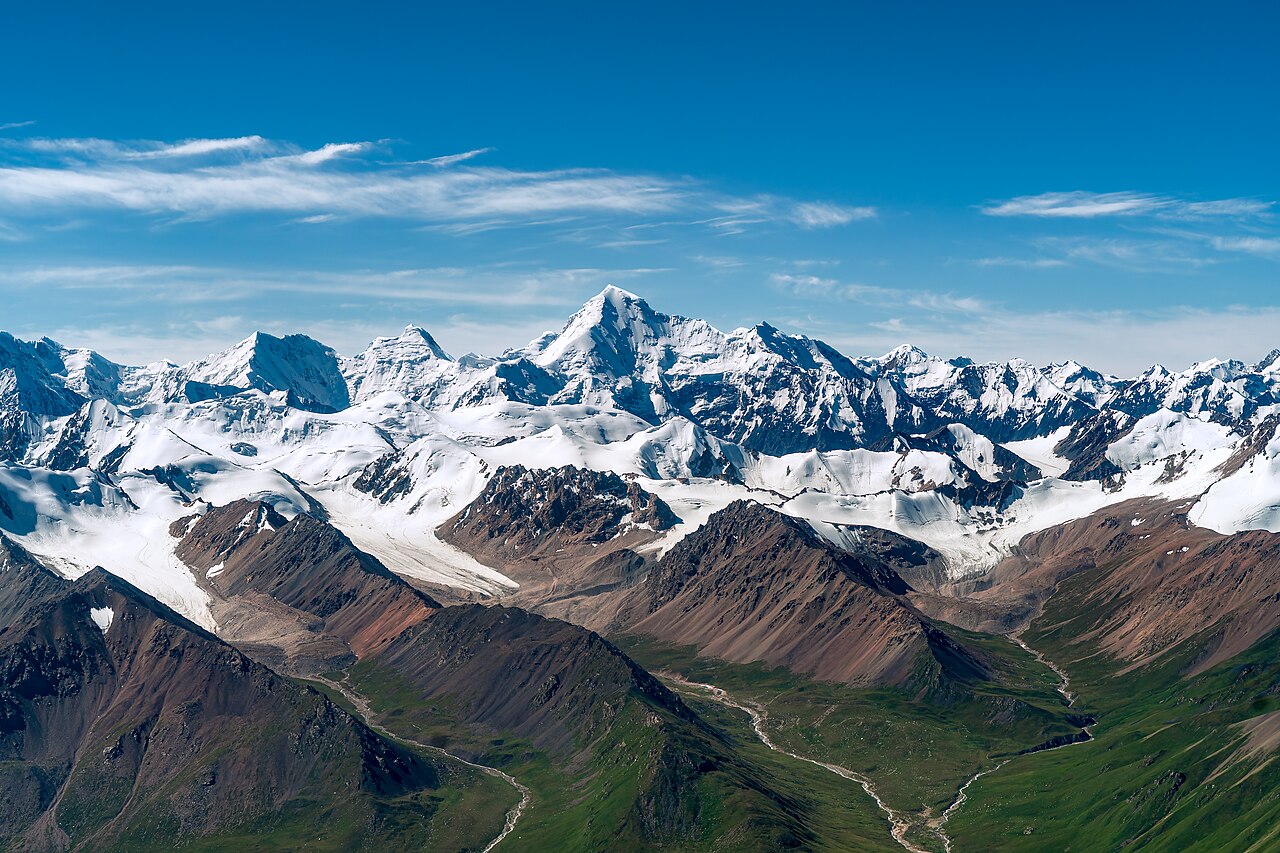
Here a permit is real. Khan Tengri sits at the junction of Kazakhstan, Kyrgyzstan and China, and the northern approach up the Inylchek glacier runs through genuinely sensitive ground. Every expedition operator handles it for you — the Almaty outfits list “border zone permit” as a line item in the package inclusions, which tells you it is still being issued and still being required for that specific approach.
You are not doing this trip independently anyway. A standard 21-day Khan Tengri programme starts around US$3,100, with Karkara base camp at 2,200 metres about 280 kilometres and five hours from Almaty, and the glacier base camp at 4,000 metres. A local guide for one to three climbers runs about US$2,500 on top. Book months ahead and the paperwork is somebody else’s problem — which is the correct arrangement for a 7,000-metre peak.
Our Tien Shan trekking guide covers the routes below the technical peaks.
The Kazakh Altai, Markakol and Rakhmanov Springs
This is the murkiest corner. Anywhere in the border zone you need your identity documents. Deeper in — the Kurchum district, Markakol, the Austrian Road, Berel, Rakhmanov Springs and the Belukha approaches — ask a local operator whether your route needs a permit. Where a route does enter the border strip, the state permit is the one described below: free, ten working days, applied for through the e-licensing portal with an electronic digital signature. Any fee on top of that is an agency’s charge for its time, not the state’s.
Our advice: assume you need permission for the deep Altai, and arrange it through an operator in Oskemen rather than trying to do it yourself. The practical obstacles out there are worse than the paperwork anyway. On the Rakhmanov Springs road, repairs to the 13-kilometre section at km 437–450 were completed and it reopened in October 2026. Park entry at Katon-Karagay is the standard 865 tenge per person per day.
Beware one specific trap: the “ten working days, thirty-five working days, five-kilometre zone, report to the komendatura” instructions that circulate for Belukha are Russian rules for the Russian side of the mountain. They do not apply in Kazakhstan.
More in our guide to the Kazakh Altai.
Mangystau and the Ustyurt plateau
The Ustyurt Reserve is open to visitors and publishes its own tariffs, and Bozzhyra is one of the best reasons to go. But the plateau runs to the Turkmen frontier, and parts of it — along with some stretches of coast — do sit inside the border zone. In practice you will be with a local driver who knows exactly which tracks are fine and which are not, and that is the correct way to see Mangystau regardless. Expect 865 tenge per person per day plus about 3,027 tenge per vehicle, prepaid at the reserve office in Zhanaozen.
Aksu-Zhabagly
Reserve permission plus a guide, arranged by your guesthouse. Not a border matter, despite the Uzbek frontier being close.
If you genuinely need a strip permit: the process
The surviving permit is officially “issuance of a pass for entry and stay in the border strip”. Here is how it works.
- Who issues it: the Border Service of the KNB.
- Cost: free. There is no fee. If somebody quotes you a price, they are charging for their own time as an agent, which is fair enough, but the state charges nothing.
- Processing time: 10 working days.
- How to apply: through elicense.kz or egov.kz, Kazakhstan’s e-government portals.
- The catch: the online application must be signed with a Kazakh electronic digital signature, which requires a Kazakh ID number. A short-term visitor does not have one.
That last point is why, in practice, this is an agency-only permit. Your operator, guesthouse or expedition company applies on your behalf using their own signature. Give them your passport scan and a fortnight and stop worrying about it.
One more thing worth knowing: if you are running any kind of organised event in the border zone — a group trek, a film shoot, a race — the law asks only for free-form written notification to the nearest Border Service unit, stating the nature, place, time and number of people. Not an application. A letter.
At the checkpoint
You will meet border guards in southeastern Kazakhstan whether or not any permit applies. Some notes from experience.
Carry the passport, not a copy
Inside the border zone, carrying identity documents is a legal duty. A photo on your phone is better than nothing but it is not what the law asks for. If your passport is with a hotel for registration, get it back before you drive to Saty.
Drones and photography
Do not fly a drone near a border post, a military installation or the frontier itself. This is where travellers get into real trouble rather than paperwork trouble. Kazakhstan has also seen GPS interference in some border areas, so do not rely on a phone map as your only navigation near a frontier.
Nobody may take your money
The KNB Border Service states explicitly that its officers are forbidden from collecting any money in the border zone or the border strip. The Almaty Region department publishes reporting numbers for exactly this. A guard asking for cash is not enforcing a rule. The checks at Kolsai are routine and correct, but you should know where you stand.
Penalties, so you know the stakes
Kazakhstan’s Code of Administrative Offences sets these out. At the 2026 MCI of 4,325 tenge:
| Offence | Penalty | In tenge / US$ |
|---|---|---|
| In the border zone without ID (Art. 510.1) | 5 MCI | 21,625 / ~$48 |
| Unnotified activity or event in the zone (Art. 510.2) | 5 MCI individuals; 25–75 MCI businesses | up to 324,375 / ~$715 |
| Breach of the border strip regime, foreign national (Art. 514.2) | 20 MCI with confiscation of vehicle and items, or up to 10 days’ arrest, or expulsion | 86,500 / ~$190 |
| Disobeying a border guard (Art. 516) | 10 MCI or 5 days’ arrest; for foreigners, arrest with expulsion | 43,250 / ~$95 |
Dollar figures use about 450 tenge to US$1 (late 2026). The money is not the point — the expulsion and re-entry consequences are. Nobody is doing hard time for wandering, but an administrative expulsion on your record is a genuinely bad souvenir.
Park fees you will actually pay in 2026
Since this is what most people are really asking about, here it is in one place.
| Place | Per person / day | Car |
|---|---|---|
| Kolsai Kolderi | 865 KZT (0.2 MCI sanitation and upkeep charge) | 0.06 MCI parking per space |
| Charyn | Check charyn-park.kz | See the same tariff |
| Katon-Karagay | 865 KZT | 2,595 KZT |
| Ile-Alatau | Charged at the checkpoint | Charged at the checkpoint |
| Ustyurt / Bozzhyra | 865 KZT | ~3,027 KZT |
| Burabay | no pedestrian tariff listed | 1,298; 1,730 at weekends and on public holidays, 1 May–30 September |
Vehicle charges depend on the park and the vehicle. A minibus pays 4,325 tenge at Burabay but 8,650 at Katon-Karagay, where buses pay 17,300 or 25,950 by size, so check the tariff of the park you are heading for. Bring cash in small notes; card machines at park gates are aspirational. Our national parks guide has the wider picture, and trip costs puts these numbers in context — they are trivially small next to your transport.
A planning checklist
- Going to Kolsai, Kaindy, Charyn, Big Almaty Lake, Shymbulak or Kok-Zhailau? Bring your passport and cash for the gate. Only the upper Kolsai lake needs a border-zone permit.
- Climbing Khan Tengri or heading up the Inylchek? Your operator arranges the permit. Book three months out.
- Going deep into the Altai — Markakol, Berel, Rakhmanov, Belukha? Assume permission is needed, use an Oskemen operator, allow two to three weeks.
- Mangystau and Ustyurt? Local driver, prepay at Zhanaozen, do not freelance near the Turkmen line.
- Aksu-Zhabagly? Guesthouse arranges reserve permission and a guide.
- Anywhere within 25 km of the Kyrgyz border or in a China-border district? Passport on your person, always.
- Flying a drone? Not near the frontier. Not near a post. Not at all if you are unsure.
If you are still at the visa stage, start with Kazakhstan visas and entry — that is a real bureaucratic step, unlike this one.
Frequently asked questions
Do I need a border zone permit for Kolsai Lakes in 2026?
Not for the lower and middle lakes. Upper Kolsai, the third lake, is the exception and does need a border-zone permit, so arrange one in advance if you mean to walk that far. Bring your passport and money for park entry.
Is the Kazakhstan border zone permit still required for foreigners?
Not for most of the border zone. Government Decree No. 663 of 14 October 2020 repealed the rules that issued it, and the law now provides for entry on identity documents. A permit still exists for the narrow border strip, and the upper Kolsai lake needs a border-zone permit.
What is a “propusk” and who issues it?
Propusk is simply Russian for pass. The surviving one is issued by the Border Service of the National Security Committee (KNB) for entry to the border strip.
How much does a Kazakhstan border permit cost?
The strip permit is free. The “from 10,000 tenge” figure still quoted online refers to the abolished system, and probably to agency fees within it.
How long does it take to get a permit for Khan Tengri?
The official processing time is 10 working days. Because the online application needs a Kazakh electronic signature, your expedition operator will file it — build in two to three weeks and book the trip much further ahead than that.
Do I need a permit to hike to the third Kolsai lake?
Yes. Of the three lakes, only Upper Kolsai needs a border-zone permit; the lower and middle lakes do not. Carry your passport either way.
Can I hike from Kolsai over the Sary-Bulak pass into Kyrgyzstan?
No. It is not a legal crossing point. Use an official border post.
Do I need a permit for Charyn Canyon or Big Almaty Lake?
No permit, but carry your passport to Big Almaty Lake: it is in a border zone, and documents are checked at the post for everyone, children included. At Charyn the park says an identity document is enough for its admission ticket. You pay ordinary park entry at both.
What is the fine for being in a border zone without documents?
Five MCI, which is 21,625 tenge in 2026 — roughly US$48.
Is Bozzhyra in a border zone with Turkmenistan?
The plateau runs right up to the Turkmen frontier, so carry your passport and keep to the tracks your driver knows. Travel with a local driver, which is how Mangystau works anyway.
Do I need anything for Katon-Karagay or Belukha?
Carry your passport in Katon-Karagay and the West Altai. For Markakol, Berel, Rakhmanov Springs and the Belukha approaches, ask a local operator, assume permission is needed and arrange it in Oskemen.
Can a border guard fine me on the spot in cash?
No. The Border Service states its officers may not collect money in the border zone or strip, and publishes numbers for reporting it.
Final thoughts
This is a strange article to write, because the honest answer to its own headline is “you probably do not need one”. That is a good thing. A decade ago the border permit was a real obstacle to hiking in the most beautiful part of Kazakhstan, and the country has quietly cut it back: Decree 663 of 14 October 2020 repealed the 2013 rules for foreigners’ border-zone passes. The strip permit survives, and so does the one for Upper Kolsai.
What has not been dismantled is the sensitivity of the frontier itself. The 100-metre strip along the Kyrgyz line and the 2,000-metre strip along the Chinese one are still real, still patrolled, and still not places to test your luck with a drone. Carry your passport, pay the 865-tenge upkeep charge and whatever else the park’s tariff adds, be pleasant to the men in the green caps, and go and look at the lakes.
For the wider picture, our complete guide to hiking in Kazakhstan covers the trails, seasons and gear, and camping in Kazakhstan deals with where you can legally pitch a tent — which, refreshingly, is almost everywhere.
Photo credits
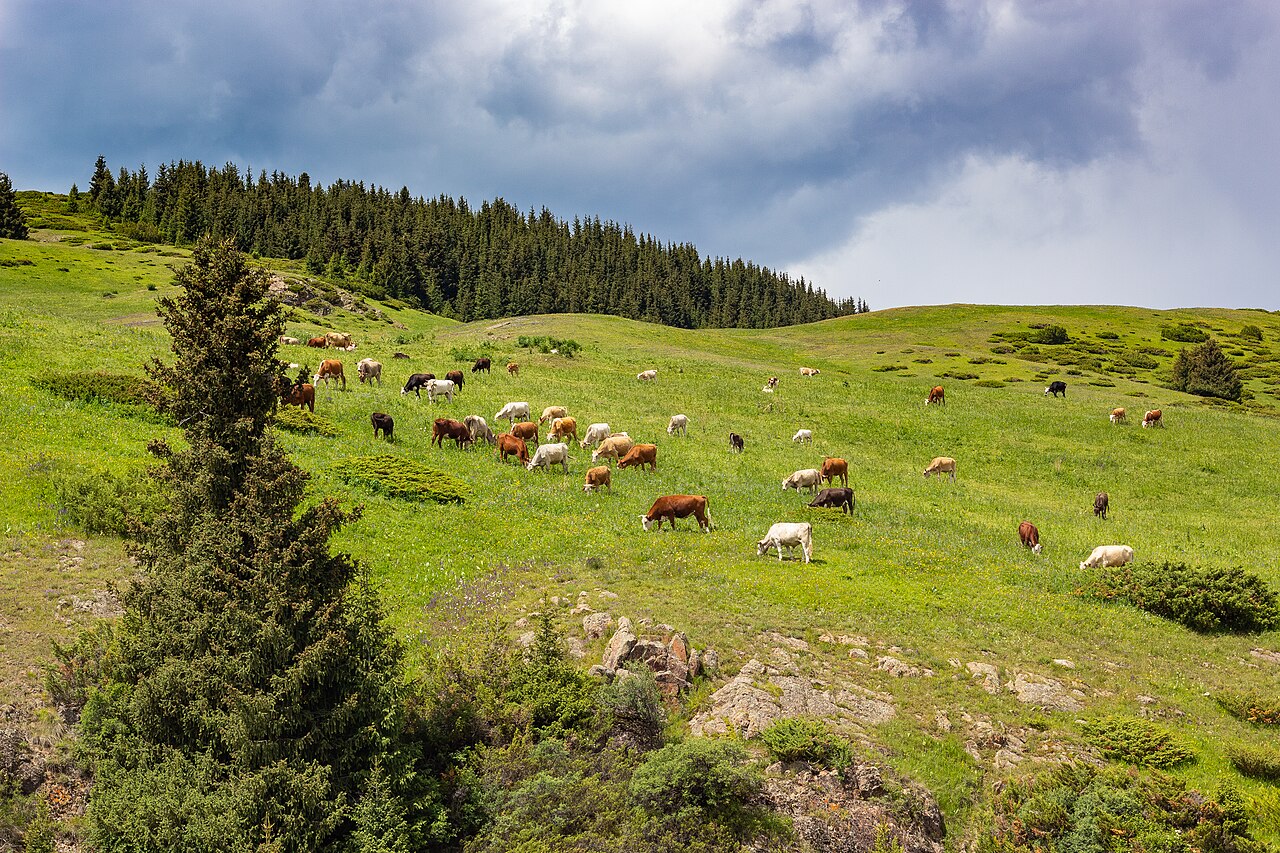
Khan Tengri State National Nature Park: Maryliflower, CC BY-SA 4.0, via Wikimedia Commons.
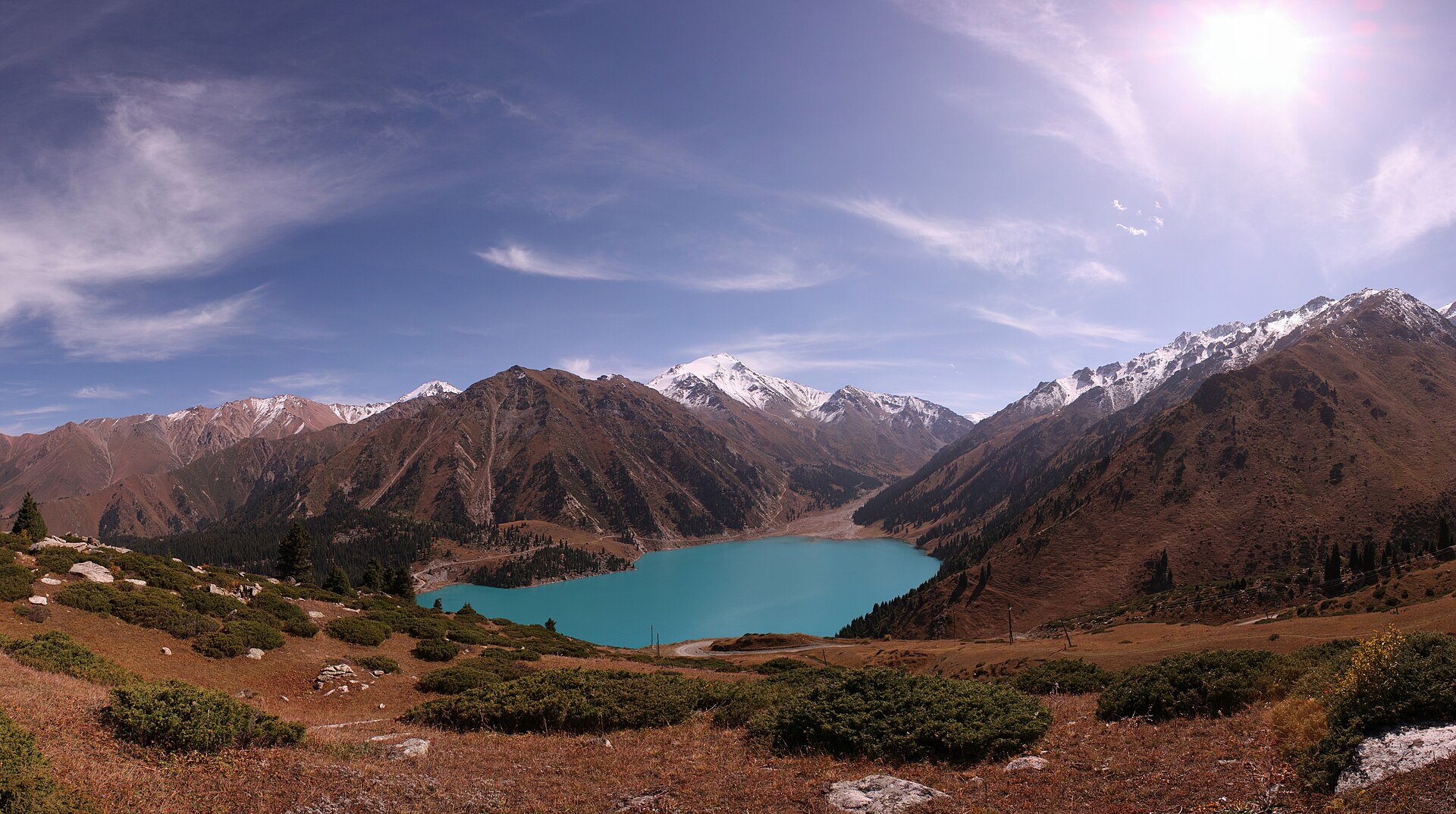
Big Almaty Lake and the Trans-Ili Alatau: Above the lake – panoramio by Ilya Rudakov, CC BY-SA 3.0, via Wikimedia Commons.
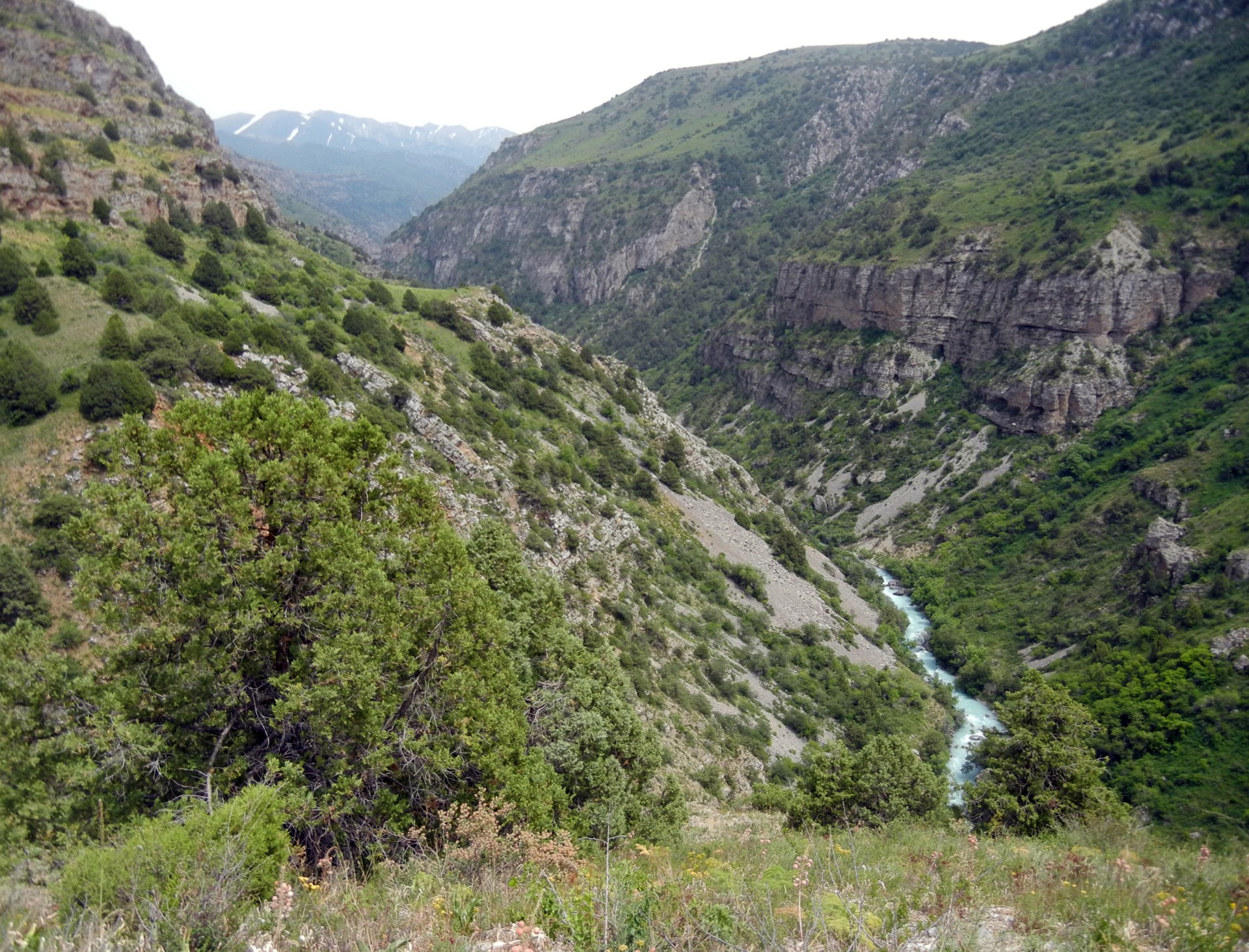
Aksu Canyon in Aksu-Zhabagly Nature Reserve: Aksu river canyon (Aksu-Zhabagly Nature Reserve, Kazakhstan) by Kovshar A.F., CC BY-SA 4.0, via Wikimedia Commons.