Contents
- Korgalzhyn at a glance
- Why Korgalzhyn matters
- The lakes
- The flamingos: what you will actually see
- Beyond the flamingos: the real bird list
- Getting there from Astana
- Permits, the visitor centre and the rules
- When to go
- Where to stay and what to bring
- Honest verdict: is Korgalzhyn for you?
- Frequently asked questions
- Final thoughts
Flamingos are tropical birds. Everybody knows this. So the fact that greater flamingos breed on a salt lake in the northern Kazakh steppe, at about 50 degrees north, in a colony that has numbered up to 14,000 pairs, is one of the real oddities of world ornithology.
Korgalzhyn State Nature Reserve, in Akmola Region and within a day trip of Astana, protects the Tengiz-Korgalzhyn lake system, home to the northernmost breeding colony of greater flamingos on Earth. With Naurzum reserve it forms the UNESCO World Heritage site Saryarka – Steppe and Lakes of Northern Kazakhstan, inscribed in 2008, and it has been a Ramsar wetland since 1976.
It is also a strict nature reserve where the flamingos breed on islands far out in a lake more than thirty kilometres wide, which means the honest answer to “will I see them close up” is no. This guide tells you what you will actually get, what it costs, and why serious birders come anyway.
Korgalzhyn at a glance
| Where | Akmola Region, a day trip from Astana |
| Getting there | By road via Korgalzhyn village, then on into the reserve; guided day tours from Astana run ten hours |
| Founded | Strict nature reserve since 1968 |
| Reserve area | 543,171 ha today, expanded from 258,963 ha in December 2008 |
| UNESCO | Saryarka World Heritage site, 2008. Whole property: 450,344 ha |
| Ramsar | Site No. 107, designated 11 October 1976 |
| Flamingos | Up to 14,000 breeding pairs; northernmost colony on Earth |
| Flamingo season | Mid-April to September; peak May–June and August–September |
| Birds recorded | 344 species (UNESCO); over 60 rare plants and animals in the national Red Data Books |
| Access | Official permission and a qualified guide; confirm current conditions with the reserve |
| Rough day-trip cost | Eco fee 369 KZT pp · inspector ~13,430 KZT per group · car 70,000–80,000 |
Why Korgalzhyn matters
What “northernmost” actually means
Greater flamingos (Phoenicopterus roseus) breed around the Mediterranean, in West Africa, the Middle East and South Asia. Lake Tengiz holds the species’ northernmost breeding colony — on mud islands at about 50 degrees north, on a lake that ices over in winter.
They manage it because Tengiz is exactly the right kind of wrong. It is shallow, saline and biologically productive, generating the brine shrimp and algae that flamingos filter-feed on, and its islands sit far enough from shore that ground predators cannot reach them. The birds arrive in April as the ice goes, breed, and leave before it returns.
The Saryarka World Heritage site
UNESCO inscribed Saryarka – Steppe and Lakes of Northern Kazakhstan in 2008 under natural criteria (ix) and (x). The property covers 450,344 hectares with a buffer zone of 211,147 hectares, and it comprises two separate reserves, Korgalzhyn and Naurzum.
Confusingly, Korgalzhyn reserve today covers 543,171 hectares — it was expanded by decree on 18 December 2008, after inscription, so the reserve is now considerably larger than its World Heritage component. Nearly every source muddles these figures. Korgalzhyn was also recognised as Kazakhstan’s first UNESCO Biosphere Reserve in 2012.
The scale of the bird migration is what earned the listing. UNESCO cites the lakes as supporting up to 15 to 16 million birds on passage, with flocks of up to 2.5 million geese and as many as 350,000 nesting waterfowl. See our guide to Kazakhstan’s UNESCO sites.
The lakes
Tengiz, a shallow salt sea
Lake Tengiz — the name simply means “sea” — covers 1,382 square kilometres at an elevation of 305 metres. Its maximum depth is 6.7 metres, and its water level varies with the seasons. It is endorheic and saline, fed by the Nura and Kulanotpes rivers.
Its eastern shore is deeply indented and holds the Tengizi Islands, and that is where the flamingos nest. Remember the dimensions: a lake around forty kilometres across, breeding islands offshore, and no boat access for visitors. This single geographical fact governs the entire visitor experience and no other guide explains it.
One good piece of trivia while you are looking at it: on 16 October 1976, Soyuz 23 crash-landed through the ice on northern Lake Tengiz. The crew survived a night in a capsule in a freezing salt lake before rescue — the first Soviet crewed splashdown, and an unintended one.
The freshwater lakes
The Korgalzhyn group — Sultankeldy, Esey, Kokay and others — sit at the Nura delta and are fresh or brackish. These are where the accessible birding happens: reed beds, open water, pelicans, grebes, terns and waders. Sultankeldy has the reserve’s Karajar scientific station on it.
The combination of a huge saline lake and a delta of freshwater lakes side by side is precisely why the bird diversity is so high. Different species need different water, and both are available within a few kilometres.
The flamingos: what you will actually see
Arrival and departure
Birds are present from roughly mid-April to September, with one Kazakh source giving late April to October. The practical window is early May to mid-September.
Where they breed, and why you cannot get close
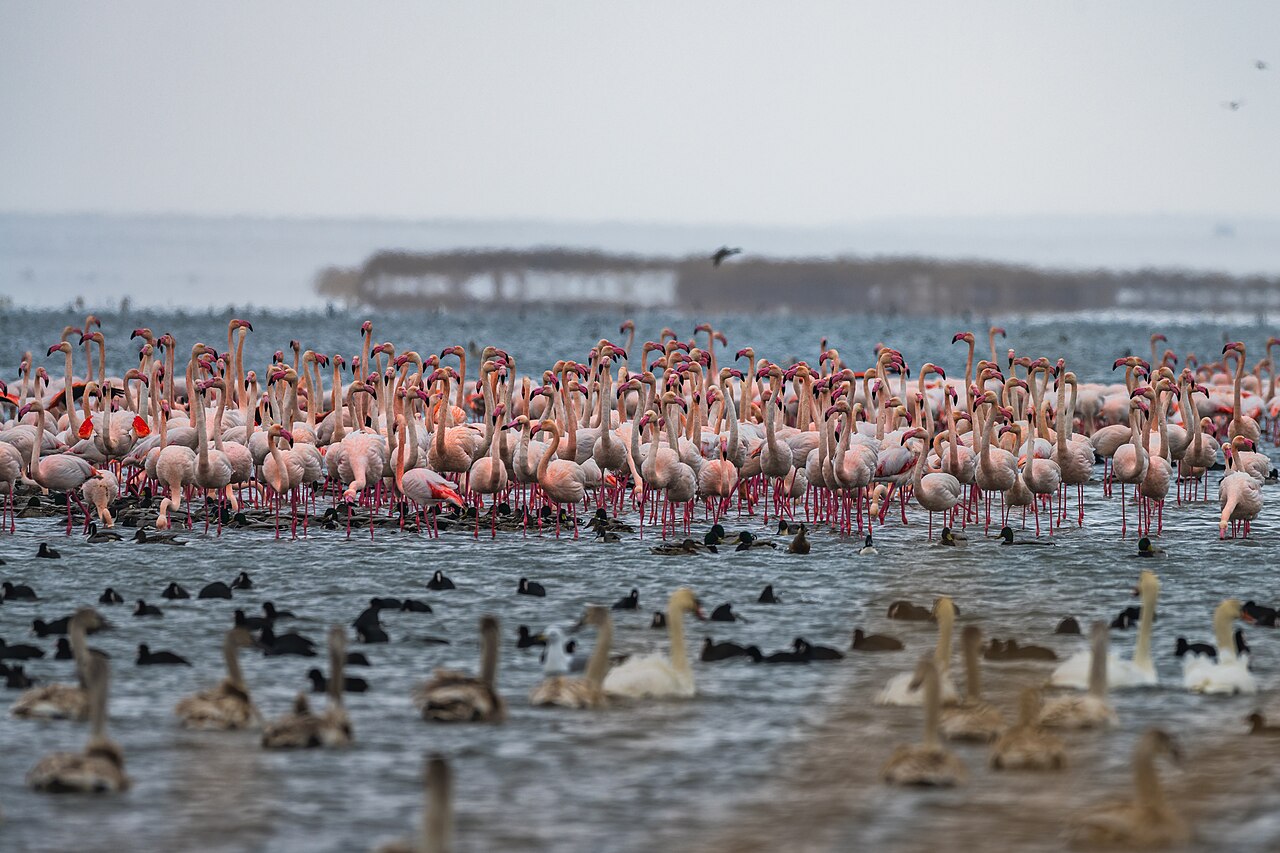
The colony is on mud islands in Lake Tengiz, well offshore. There are no boat trips to it — this is a strict reserve and the colony is protected from disturbance, which is the entire point. So what you get from the accessible shore is distant pink, resolving into recognisable birds only through binoculars, and into individual flamingos only through a telescope.
We are labouring this because visitors arrive expecting a wall of flamingos twenty metres away and leave disappointed. One Kazakh operator puts it with admirable bluntness: there is always a chance the flamingos will not show themselves — yes, it happens — and this is not a zoo.
Bring a scope
If you own a spotting scope, bring it. If you do not, borrow one or book with a birding operator who has one. Ten-power binoculars will show you that there are flamingos; a scope will show you flamingos. On a still morning with the light behind you, a scope-view of several thousand birds on a salt lake in the middle of the Kazakh steppe is worth the entire journey.
Colony size and the decline
The Ramsar listing records up to 14,000 breeding pairs. Counts of total birds have varied considerably: around 45,000 in the period 2006 to 2011, dropping to under 15,000 by 2015.
That is a substantial reported decline, and it is not much discussed. The lake’s water level shifts from season to season.
Beyond the flamingos: the real bird list
For birders, the flamingos are the headline and not the reason to come. The reason to come is on this list.
The headline rarities
- Sociable lapwing (Vanellus gregarius), Critically Endangered. Colonies breed on the steppe around Korgalzhyn, and for many visiting birders this species alone justifies the trip.
- Dalmatian pelican (Pelecanus crispus): the lakes hold an internationally important share of this scarce pelican.
- White-headed duck: in some years the reserve’s lakes hold a significant share of the world population.
Steppe specialities
Black lark and white-winged lark, pallid harrier, steppe eagle, whooper swan, black-necked and red-necked grebe, Pallas’s gull, white-winged tern, Caspian and gull-billed tern, black-winged pratincole, Terek and marsh sandpiper, ruff, great bittern, paddyfield warbler. Plus bobak marmot standing up in the grass and Schrenk’s tulip flowering in early May.
UNESCO lists 344 birds, 42 mammals, 14 fish and more than 500 plants, and counts over 60 rare plant and animal species in the national Red Data Books.
Saiga
Kazakhstan’s saiga antelope recovery is one of the great conservation successes anywhere: the national population passed 4.6 million by June 2026, with the Betpak-dala herd alone at about 1.87 million. Saiga do occur at Korgalzhyn, but sightings here are described as a few rare animals rather than the great herds. Do not come for saiga. If you see one, that is a bonus.
Getting there from Astana
By car
The drive from Astana takes you to Korgalzhyn village, where you register before going on into the reserve. Ask the reserve or your guide about road conditions, and whether your car has the clearance for them, before you set out.
From the village to the reserve
This is the trap nobody warns you about. Reaching Korgalzhyn village is not reaching the reserve. The lakes lie a further drive beyond the village, so arrange transport into the reserve when you register, and confirm the route there. Your day becomes the drive from Astana, a village stop to register, then the road out to the lakes and back.
Which means that unless you have arranged a vehicle capable of that, arriving in Korgalzhyn village by bus achieves very little. Plan the transport before the trip, not on arrival.
By bus
Buses and marshrutkas run between Astana and Korgalzhyn; check the current times and days on saparzhai.kz before you travel. Plan around them carefully. The birds are best early, so a bus that arrives later in the day usually means a night in the village.
With a tour
Realistically the right answer for most visitors, because it solves the vehicle, the inspector, the permission and the scope in one transaction. Welcome.kz runs a ten-hour guided day tour from Astana; ask for a current quote for your group. Specialist birding operators run multi-day trips working the buffer zone. See day trips from Astana and Kazakhstan tours.
Permits, the visitor centre and the rules
Registering in the village
Entry to the reserve requires official permission and an accompanying guide or inspector. You register at the “Ptichiy Ray” — Bird Paradise — visitor centre in Korgalzhyn village, which also has a small museum. Excursion schedules vary by operator: Welcome.kz lists its private Korgalzhyn day tour from May to September, Monday to Sunday at 09:00. Confirm availability with whichever operator you choose.
What it costs
Approximate costs in tenge, from a tour operator’s price list. Fees change, so confirm current rates with the reserve office before you go:
| Item | Cost (KZT) |
|---|---|
| Visitor centre museum, adult | 400 |
| Visitor centre museum, schoolchild | 200 |
| Ecological fee, per person | 369 |
| Inspector’s services, group up to 10 | 13,430 |
| Car hire for the day | 70,000–80,000 |
Note the shape of that: the reserve fees are trivial and the transport is everything. A day tour is 9 to 10 hours. If you can fill a car, the per-person cost collapses.
What zapovednik status means
Korgalzhyn is a zapovednik, a strict scientific reserve, not a national park. The official tourism board presents it as a place for ecological tourism, scientific research and wildlife observation. In practice this means guided access to designated areas, no wandering, no boats to the colony, and a core zone you will not enter. Confirm the current visitor rules with the reserve before you go.
Serious birding operators work primarily in the buffer zone rather than the core, which is where the photography actually happens and which no general guide mentions. If you are booking, ask whether the itinerary is core or buffer — the buffer is often the better answer.
Our guide to Kazakhstan’s national parks explains the difference between park and reserve status, and border zone permits covers the other kind of paperwork — not relevant here, since Korgalzhyn is nowhere near a frontier.

When to go
Late April to May
The best period overall. Spring migration is at full volume, the flamingos arrive, Schrenk’s tulips flower on the steppe, and sociable lapwings are on their breeding grounds. High water means mud, so the roads are at their worst. Bring a vehicle that can cope.
June and July
Breeding season. Fewer species moving but the residents are settled and active. Long days, warm, and the mosquitoes and midges around the freshwater lakes become a serious matter.
August and September
Autumn migration, and in some ways the better birding. Water levels drop, roads improve, insects ease. Early September is our pick if you want comfort with the birds.
The weather, honestly
This is open steppe. There is no shade of any kind. Wind can make a mild day feel cold and will shake a telescope, so bring a windproof layer even in July, closed shoes for marshy ground, sun protection, and more water than you think.
The lakes freeze in winter and the birds are gone. There is no winter visit. See Kazakhstan in spring and best time to visit.
Where to stay and what to bring
Accommodation is basic guesthouses and homestays in Korgalzhyn village, generally with shared bathrooms. There is a simple guesthouse and wooden cabins at the Karajar scientific station on Lake Sultankeldy, which is the atmospheric option if you can get it. Homestay contacts can be arranged through the local NGO Rodnik. One 2008 trip report paid 3,000 tenge including meals, which gives you the order of magnitude even if the number is long superseded; agree the current rate, and whether meals are included, when you book.
A day trip from Astana works. An overnight in the village works better, because it lets you be at the water at dawn instead of at 11:00 — and dawn is when this place is at its best. See where to stay in Kazakhstan.
Bring: binoculars, a spotting scope if at all possible, a windproof and waterproof layer, closed walking shoes, insect repellent, sun hat and sunscreen, water, food for the day, cash in small notes, and a bird guide to the Western Palearctic.
Honest verdict: is Korgalzhyn for you?
Yes, if you are a birder. This is one of the great wetland sites of Eurasia — sociable lapwings, Dalmatian pelicans and white-headed ducks in numbers that matter globally, and the northernmost breeding colony of greater flamingos on the planet. On those terms it is unmissable, and it is a day trip from a capital city with international flights.
Probably not, if you are a general traveller expecting a wildlife spectacle. You will spend most of a day on the road, pay for a vehicle and an inspector, sit in the wind, and look at distant pink smudges through somebody else’s telescope. Some people find that magical. Many find it thin.
The middle path, if you are curious but not a birder: do it as a guided day trip from Astana in May, treat it as a steppe-and-lakes day with tulips and marmots and a chance of flamingos, and set your expectations at “interesting landscape with good birds in it” rather than “flamingo experience”. On that basis it rarely disappoints.
Frequently asked questions
Where can you see flamingos in Kazakhstan?
Lake Tengiz in Korgalzhyn Nature Reserve, southwest of Astana, holds the main breeding colony. Flamingos also occur on some southwestern lakes near the Caspian.
Are these really the northernmost flamingos in the world?
Yes. Lake Tengiz holds the northernmost breeding colony of greater flamingos, at around 50 degrees north on a lake that ices over in winter.
How far is Korgalzhyn from Astana?
Far enough that a visit takes most of a day. You travel to Korgalzhyn village first and then on into the reserve; arrange transport for that last stretch when you register, and confirm the route with the reserve.
Do you need a permit to enter the reserve?
Yes. Korgalzhyn is a strict reserve — you need official permission and an accompanying inspector or guide, arranged at the Ptichiy Ray visitor centre in the village.
How much does it cost?
The reserve fees are small: around 369 tenge eco fee per person, 400 for the museum, and about 13,430 for an inspector for a group of up to ten. Vehicle hire at 70,000 to 80,000 tenge is the real cost. For a guided day tour from Astana, ask Welcome.kz or another operator for a current quote.
Can you get there by public transport?
Buses run from Astana to Korgalzhyn village, but the reserve does not allow independent entry: you need a qualified guide and transport for the road into the reserve. Public transport gets you to the village, not to the birds.
What is the best time of year for flamingos?
May to June and August to September. The birds are present from roughly mid-April to September.
Can you do it as a day trip from Astana?
Yes — day tours run nine to ten hours. An overnight in the village is better because it gets you to the water at dawn.
Will I see the flamingos up close?
No. They breed on islands well offshore in a lake around forty kilometres across, and there is no boat access. Expect distant views and bring a telescope.
Do you need a 4×4?
Check with the reserve or your guide whether your vehicle suits the roads, both on the way to the village and on the road beyond it into the reserve.
Where do you stay in Korgalzhyn village?
Basic guesthouses and homestays with shared bathrooms, arrangeable locally or through the Rodnik NGO. There are also cabins at the Karajar station on Lake Sultankeldy.
Are there saiga antelope?
Occasionally, but sightings are rare here, even though Kazakhstan’s saiga population passed 4.6 million in June 2026.
Final thoughts
Korgalzhyn is a serious conservation site that happens to be within a day trip of an international airport, and that combination is rare enough to be worth a great deal. Critically Endangered sociable lapwings breed on the steppe around one village. Dalmatian pelicans gather on these lakes in numbers that matter to the species. And every April, flamingos fly two thousand kilometres north to raise chicks on mud islands in a salt lake that will be frozen by November.
Go in May with binoculars and low expectations about proximity, and you will have one of the more remarkable days available in Kazakhstan. Go expecting a flamingo photograph and you will be looking at pink dots.
Our guide to lakes in Kazakhstan covers the country’s other water, northern and eastern Kazakhstan covers the wider region, and Burabay is the other great day trip out of Astana — greener, easier and considerably more crowded.
Photo credits
Greater flamingo flock in Kazakhstan: Максат79, CC BY-SA 4.0, via Wikimedia Commons. Sunset over a steppe lake in Korgalzhyn Nature Reserve: Dildakhmet, CC BY-SA 4.0, via Wikimedia Commons.