Contents
- Otrar and Sauran at a glance
- The Otrar incident: how one decision changed world history
- Otrar before the Mongols
- Where Timur died — and why the Yasawi mausoleum is unfinished
- The long ending
- Visiting Otrar today: what you’ll actually see
- Arystan Bab: the mausoleum you’re supposed to visit first
- Sauran: the best-preserved walled city in Kazakhstan
- Are Otrar and Sauran UNESCO sites?
- How to visit: routes, costs and timing
- When to go — and the heat warning
- What to bring
- Is it worth it? An honest verdict
- Frequently asked questions
- Final thoughts
In the winter of 1218 a caravan of about 450 merchants arrived at a walled city on the Syr Darya carrying gold, silver, sable and silk. The governor decided they were spies, had them killed, and kept the goods. One camel driver got away. What followed is arguably the most consequential decision any provincial official has ever made.
Otrar in Kazakhstan is a ruined Silk Road city in Turkestan Region, roughly 55 to 70 km from Turkestan, where the massacre of a Mongol trade caravan in 1218 triggered Genghis Khan’s invasion of Central Asia. Sauran, about 40 to 48 km north of Turkestan, is the best-preserved medieval walled city in Kazakhstan — and it survived the Mongols by doing the opposite.
Otrar and Sauran at a glance
| Otrar | Sauran | |
|---|---|---|
| What it is | Excavated mound of a destroyed Silk Road city | Standing mud-brick walls of an abandoned city |
| What survives | Foundations, a restored gate, an intact bathhouse | Walls 3–6 m high, twin-towered gate, a moat line |
| From Turkestan | ~55–70 km southwest | ~40–48 km northwest |
| Site size | Pentagonal mound, ~2 km², up to 18–20 m high | Oval, roughly 40–50 hectares, 2,360 m of wall |
| Fee | 200 tenge reported (June 2024) | Effectively free and unstaffed |
| Time needed | 1.5–2 hours, plus the Shauldir museum | 1–1.5 hours |
| UNESCO | Both on Kazakhstan’s tentative list (2021) as part of Silk Roads: Fergana-Syrdarya Corridor | |
| Getting there | No public transport. Taxi, hired driver or tour | |

The Otrar incident: how one decision changed world history
The caravan
Genghis Khan had spent years trying to open trade with Khwarazm, the enormous Persianate empire to his west. In late 1218 he sent a commercial mission — around 450 merchants, mostly Muslim, travelling under the protection of his commanders, carrying the sort of goods designed to demonstrate that the Mongols were worth doing business with.
They reached Otrar, then a wealthy city of the Otrar oasis.
The governor
Otrar’s governor was Inalchuq, also titled Ghayir Khan — a Kipchak, a nephew of the queen mother Terken Khatun, and an uncle of Shah Muhammad II himself. He accused the merchants of espionage, had them killed, and appropriated the caravan. The goods were subsequently sold in Bukhara.
Was the espionage charge true? Probably partly. Both empires routinely used merchants to gather intelligence and everyone knew it. Scholars disagree about the Shah’s role: the chronicler al-Nasawi blames Inalchuq’s greed alone, most sources say Muhammad allowed or ordered it, and Ratchnevsky argues Inalchuq must at minimum have had tacit agreement from above.
The envoys
One camel driver escaped and carried the news east. Genghis then did the reasonable thing: he sent three envoys — one Muslim, two Mongols — demanding Inalchuq be handed over for punishment.
Muhammad had the Muslim ambassador beheaded and the two Mongols’ beards shaved off before sending them home.
Under the Mongol yassa, envoys were inviolate. Killing one was not a diplomatic setback; it was a category of offence with only one answer. That was the moment the invasion of Khwarazm became certain.
The siege
The Mongols arrived in December 1219. Modern estimates put their force at 50,000 to 75,000 — the older figures of 150,000 to 200,000 are now rejected — against a garrison of perhaps 5,000 to 15,000. Chagatai and Ögedei led the siege while Genghis waited across the river, hoping to bait the Shah into open battle. He never came.
Most Khwarazmian cities surrendered within days. Otrar held out for over five months, into February 1220. It fell only when a sub-commander named Qaracha opened the gates and defected — whereupon the Mongols killed him and his men anyway, on the grounds that they did not employ traitors.
Inalchuq then barricaded himself in the inner citadel with about a tenth of the garrison and held out for a further month. The chronicles say he ended up on the upper floors with two bodyguards, throwing bricks down at the Mongols, before being taken alive.
Molten silver? Separating legend from record
You will read everywhere that Inalchuq was executed by having molten silver poured into his eyes and ears. Some local versions say molten lead down the throat.
Treat this as legend. It comes from later Persian chronicle tradition, relayed through modern popular histories, and even the sources that repeat it note it may be apocryphal. That he was captured alive and executed is reasonably solid. The manner is a story that grew in the telling — an appropriately poetic end for a man who killed for silver.
What it actually triggered
Otrar’s fall opened the Khwarazmian heartland. Jochi went north up the Syr Darya; Jebe and Subutai swung south into Fergana; Genghis and Tolui crossed the Kyzylkum to fall on Bukhara from a direction nobody expected. Bukhara, Samarkand and Gurganj were isolated and taken in turn. Within a few years the Khwarazmian Empire had ceased to exist, and Mongol armies had reached the Caucasus and the edge of Europe.
There’s an economic dimension usually missed too. Khwarazm controlled every route west of Otrar, so its hostility cut the Mongols off entirely from Near Eastern trade. The massacre wasn’t only an insult; it was a blockade.
Otrar before the Mongols
It’s easy to treat Otrar as a place that existed to be destroyed. It wasn’t.
The city — also called Farab, Parab or Turarband, from a Persian toponym meaning “lands irrigated by diverted river water” — sat near the confluence of the Syr Darya and the Arys. Crucially, the Otrar oasis was not one city but a system: about 200 square kilometres containing ten walled towns and fifty villages, inhabited since the second century BC. UNESCO’s own dossier notes that no other cultural site in Kazakhstan preserves such an irrigation system — channels, dams, sluices, irrigated fields and melon plantations spanning the first to eighteenth centuries.
The tenth-century geographer Makdisi recorded “about 70,000 male souls” in Farab, with a citadel, Friday mosque, markets and shops. Otrar minted its own coins.
It also produced al-Farabi — one of the country’s defining cultural figures — born here around 872, the philosopher known across the Islamic world as the Second Teacher — after Aristotle. Arystan Bab preached here. Two of the Jawhari scholars came from here. There is a persistent local tradition that Otrar held the second-largest library in the world after Alexandria; I could find no academic support for it and its location has never been found, so enjoy it as a tradition rather than a fact.
Where Timur died — and why the Yasawi mausoleum is unfinished
Otrar has a second appearance in world history, and this one connects directly to the building most visitors have just come from.
In February 1405, Timur — Tamerlane — was at Otrar, mustering an army to invade Ming China. He fell ill and died there, on 17 or 18 February. Local tradition places it at the Berdibek Palace, whose foundations are excavated on the site.
Timur had commissioned the Mausoleum of Khoja Ahmed Yasawi in Turkestan, seventy-odd kilometres away, in 1389. When he died, work simply stopped. That is why the main portal is raw brick with two amputated minaret stumps, and why UNESCO’s citation describes the unfinished portions as exceptional evidence of period construction methods.
So: stand on the mound at Otrar, look northeast, and understand that the most famous unfinished façade in Central Asia is unfinished because of something that happened where you’re standing. Nobody tells you this on either site. It is the single best reason to do both in one day.
The long ending
Otrar was rebuilt after the Mongols and was a significant trade centre again by the mid-thirteenth century; Timur built its cathedral mosque. What finally killed it was slower and less dramatic: Dzungar raids and the collapse of the irrigation system. By the end of the eighteenth century only forty families remained, against perhaps 5,000 to 7,000 in the city’s later heyday, and irrigated land had shrunk to about five square kilometres. At the start of the nineteenth century the last of them left.
Visiting Otrar today: what you’ll actually see
Let’s manage expectations properly, because every travel page overselling this place is doing you a disservice.
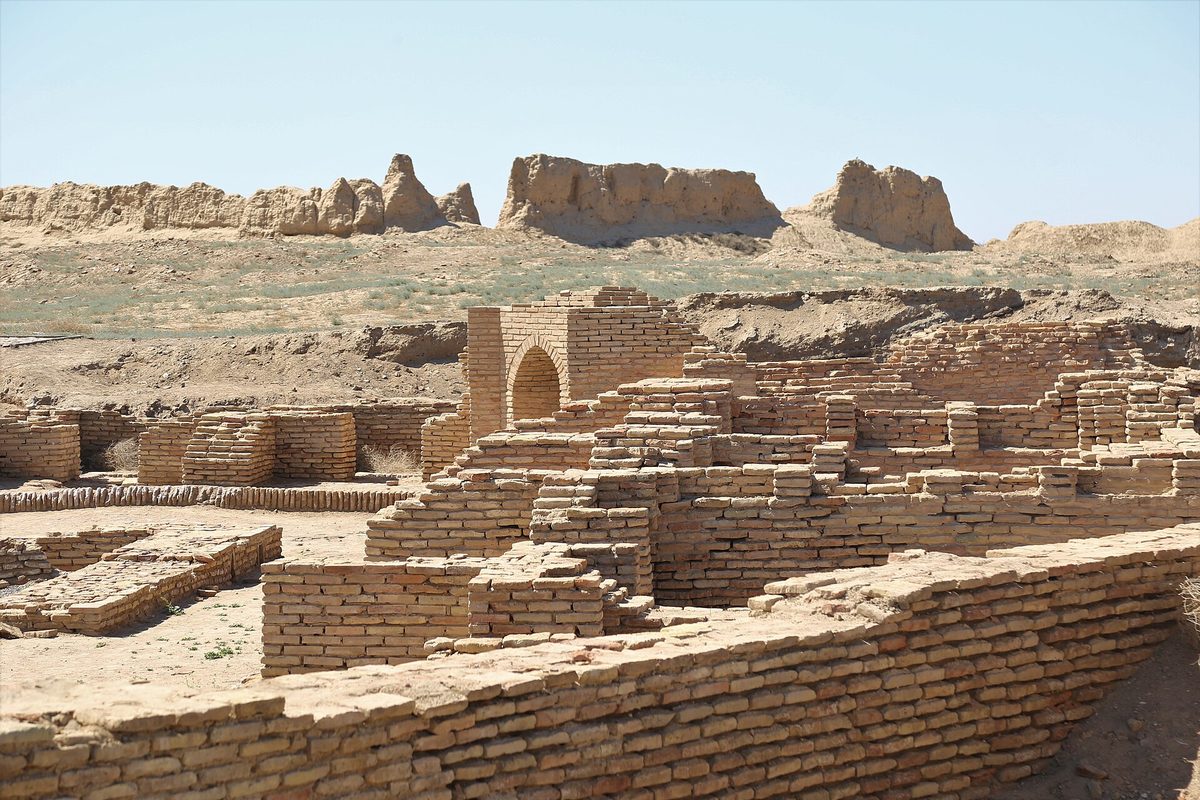
Otrar is a pentagonal mound about 18 to 20 metres high covering roughly two square kilometres. It was built of mud brick. What survives is foundations, wall lines and the outlines of streets — a jigsaw of lanes and house plots — plus a handful of restored or better-preserved structures. As one reviewer put it plainly: most of the city is unrestored sand hills.
What’s genuinely good:
- The bathhouse. Two ninth- to twelfth-century bathhouses with hot-water supply lie outside the wall in the rabat, and one is the best-preserved structure on the site — baked brick, surviving tile, visible floor and plumbing channels. This is the thing to walk to.
- The restored Zharakty gate and sections of wall, which give you the scale.
- The Berdibek Palace foundations — where Timur is said to have died.
- Ceramic shards. You can pick eight-hundred-year-old pottery fragments out of the path. Look, photograph, put them back.
- Solitude. Most visitors have the entire site to themselves.
The reconstruction debate
There are reconstructed elements, including a plastic caravan and camels near the entrance which visiting history enthusiasts have been rude about — one review calls it “Disney World” and argues that preservation, not reconstruction, is what makes a site interesting. Fair enough. But the reconstructions are limited and easily ignored, and the vast majority of the site is untouched.
Go to the museum first
The Otyrar State Archaeological Reserve-Museum in Shauldir village was established in 1979 and manages the site. Multiple visitors give the same advice: see the museum before the ruins, because it turns a field of foundations into a city. Note that there is also a newer museum building near the site itself which at least one 2024 visitor found closed and gated.
Arystan Bab: the mausoleum you’re supposed to visit first
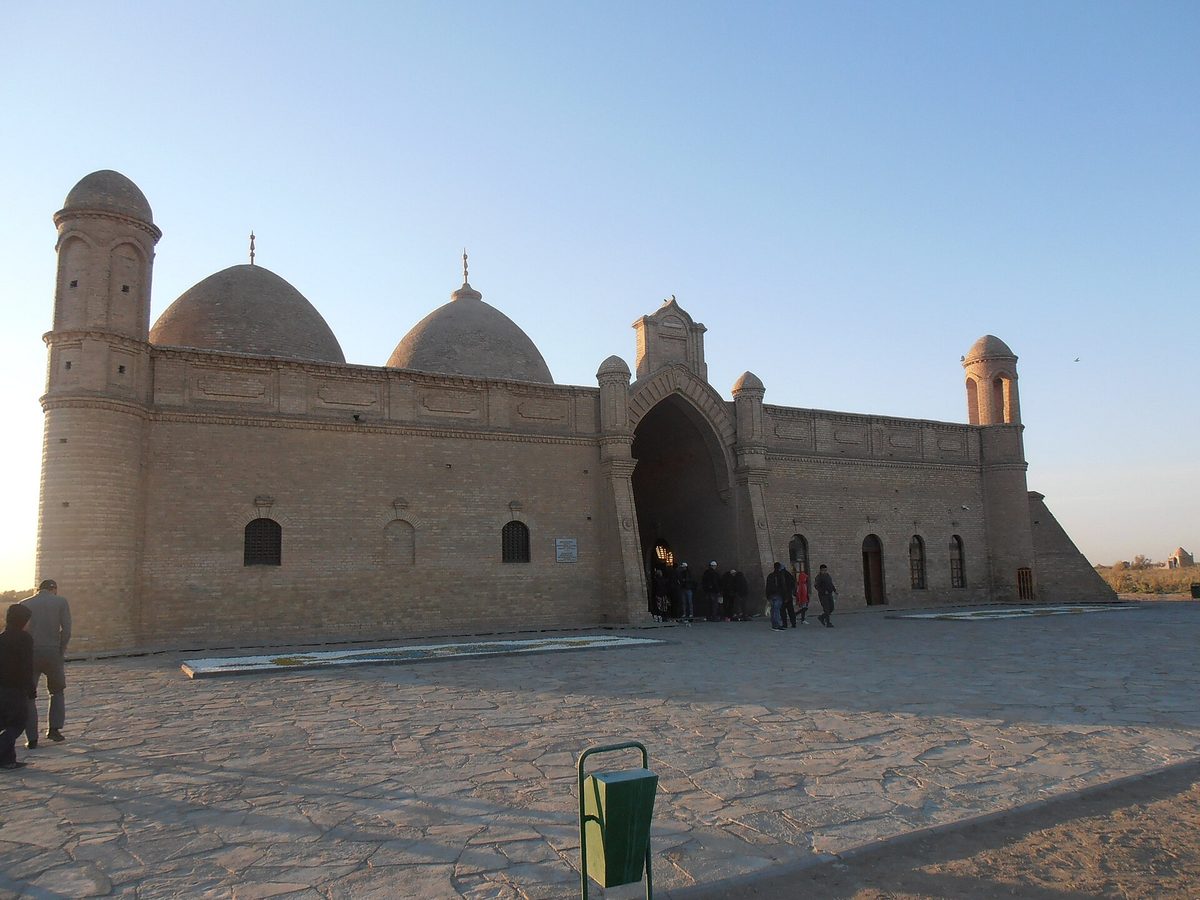
About two kilometres from the Otrar site, near Bayaldyr, stands the mausoleum of Arystan Bab — Khoja Ahmed Yasawi’s teacher. Tradition holds that pilgrims visit Arystan Bab before Yasawi, and the legend explains why: Timur’s construction in Turkestan kept collapsing until a dream instructed him to build Arystan Bab’s tomb first.
The present building dates to 1909, per an inscription on a frieze cartouche, replacing an eighteenth-century two-domed structure destroyed by earthquake. Only the carved wooden aivan columns survive from the fourteenth- or fifteenth-century original. The mosque inside was demolished and rebuilt in 1971 because of high groundwater. It holds the two-chambered tomb of Arystan Bab and three of his students, plus a mosque, a museum and a souvenir shop.
It is an active pilgrimage site, so dress modestly and behave as you would in any working shrine. See our etiquette guide.
Sauran: the best-preserved walled city in Kazakhstan
If Otrar is a history lesson that requires imagination, Sauran is the one that doesn’t.
The walls
The site is an oval of roughly 40 to 50 hectares, about 800 metres northeast to southwest by 500 metres, ringed by 2,360 metres of wall with seven towers still standing three to six metres high, and the line of a moat three metres deep and up to twenty wide. The main gate on the north-east is flanked by two two-storey towers with a twenty-metre defensive entry corridor behind — you walk in the way an attacker would have had to, and it is immediately obvious why nobody enjoyed doing so.
The judgement isn’t a tourism board’s. The archaeologist E. Smagulov of Kazakhstan’s Institute of Archaeology calls Sauran the most spectacular and well-preserved medieval ruins in the country, and Lonely Planet independently rates it the best preserved and most atmospheric of all the ruined Silk Road cities of the Syr Darya valley.
The city that surrendered
Sauran first appears in written sources in the first half of the tenth century, in al-Istakhri and then al-Maqdisi. When the Mongols came it did the arithmetic Otrar refused to do and submitted. It survived, and then it prospered: in the fourteenth century it became capital of the White Horde — the Ak-Orda, a subdivision of the Mongol successor states, not the Golden Horde itself — and the largest city in what is now Kazakhstan. Timur fortified it.
It declined from the sixteenth century as maritime trade replaced the overland routes, and was abandoned by the eighteenth. Two Silk Road cities, forty kilometres apart, opposite decisions, opposite fates — and the one that fought is a mound while the one that surrendered still has its walls.
The kariz
Sauran’s genuinely world-class feature is underground and you cannot see it, which is why nobody writes about it.
Geological and archaeological survey has identified and mapped 235 kariz shaft lines around the medieval city — and Smagulov notes there are in fact far more. If the ring structures visible on the surface all sit above galleries, the total length of the system exceeds 110 kilometres. A kariz, or qanat, is a gently sloping underground tunnel that carries groundwater to the surface by gravity, dug and maintained through vertical shafts. Bartold considered only three Central Asian kariz systems worth naming, and Sauran is one of them.
The sixteenth-century writer Zayn al-Din Vasifi credited the local sayyid Mir-i Arab with building two “life-giving” kariz for the city, plus a garden and a domed underground water-catchment nearby — features Smagulov could partly confirm from aerial photography.
When you’re walking the site, the pockmarks and ring-shaped depressions in the surrounding ground are shaft heads. A hundred kilometres of hand-dug tunnel, in a desert, to make a city possible.
Karatobe and the wider complex
Early Sauran was at Karatobe, about three kilometres away, occupied until the twelfth or thirteenth century; the late city was built on top of the old cemetery. There’s also a site called Mirtobe. The whole thing is administered by the Azret-Sultan reserve museum in Turkestan.
What it’s like to walk
Unfenced, unstaffed and free. The northern gate, central street, madrasah, mosque and khanaqah were restored in 2011; everything else is essentially unexcavated and you can walk wherever you like. Bring water. There is no shade, no café and nobody to ask — it is one of the emptiest major landmarks in the country.
Are Otrar and Sauran UNESCO sites?
Not inscribed — both are on Kazakhstan’s tentative list, submitted on 25 August 2021 as components of “Silk Roads: Fergana-Syrdarya Corridor” (ref. 6568, criteria ii, iii and v). The nine components are Asanas, Kyshkala, Otrar, Sygnak, Yassy-Turkestan, Zhankala, Zhankent, the archaeological complex of Sauran, and the Zhetyasar oasis sites. Otrar is listed as spanning the first to nineteenth centuries and Sauran the first to eighteenth.
The only inscribed World Heritage Site in the immediate area is the Yasawi Mausoleum, listed in 2003. UNESCO’s file flags the modern road running close to Sauran as an integrity concern. Our UNESCO sites guide covers the country’s full list.
How to visit: routes, costs and timing
From Turkestan — the sensible base
Turkestan is 40 to 48 km from Sauran and 55 to 70 km from Otrar, in roughly opposite directions. Base yourself there and you can do Sauran as a half day and Otrar with Arystan Bab as another. Our Turkestan guide covers where to stay.
From Shymkent
Possible but long. The standard operator routing is Shymkent to Shauldir and Otrar at 145 km and two hours, Otrar to Turkestan at 75 km and about an hour and a quarter, and Turkestan back to Shymkent at 170 km and two and a half hours. That’s a ten-hour day. Our Shymkent guide has the city end.
Taxi versus tour
There is no public transport to any of these sites. Your options:
- Round-trip taxi. The only published figure for Turkestan to Sauran is 8,000 tenge, and that dates from 2020 — treat it as a historical floor and expect materially more now. Critical detail: specify “Krepost Sauran,” the fortress. There is also a Sauran village ten kilometres away and drivers will take you there instead.
- Hired driver for the day. Roughly US$80 to 150 out of Shymkent or Turkestan, which is the best value if there are two or more of you.
- Organised private tour. One established operator’s 2026 pricing for a one-day Shymkent-based Arystan Bab, Otrar and Turkestan trip with driver, guide and entry fees is US$230 for one person, US$125 each for two or three, and US$110 each for four. Nine hours.
See our tours guide and taxi guide.
Entrance fees
Otrar was 200 tenge per person as reported in June 2024 — about forty US cents. There are basic toilets at the car park and no gift shop on site. Sauran is effectively free and unstaffed. Bring small notes.
Can you do both in one day?
Yes, from Turkestan, with a car and an early start: Sauran in the morning, Otrar and Arystan Bab in the afternoon, and the Shauldir museum if it’s open. It’s a long day and you’ll be filthy. It’s also one of the most rewarding days in Kazakhstan for anyone who likes history.
When to go — and the heat warning
Late April to May, and September to October — the same windows that suit spring and autumn travel generally. Summer in southern Kazakhstan regularly tops 35 to 40°C and shadeless ruins become an endurance test rather than a pleasure. Both sites have no shade whatsoever.
Specific warnings from people who’ve been: the walk from the Otrar car park is the better part of a kilometre with nothing overhead, wind gusts kick up very fine sand that hangs in the air at the slightest disturbance, and one visitor reports biting midges in early May. Go early in the day. Our seasonal guide covers the wider calendar.
What to bring
- More water than you think — there is none on site at either place
- A hat and high-factor sunscreen
- Closed shoes; the ground is rubble and thorns
- Cash in small tenge notes
- Offline maps — signage is minimal and Sauran is unmarked from the road
- A buff or scarf for the dust
- Snacks; there is no café at either site
Is it worth it? An honest verdict
Go if you like history more than scenery, you’ve read something about the Mongol conquests, you enjoy having a site to yourself, or you’re the sort of person who finds a hand-dug hundred-kilometre irrigation network more impressive than a dome. Sauran in particular will exceed your expectations.
Skip it if you need standing buildings to enjoy a historic site, you’re travelling with restless children, or it’s July. Otrar in particular rewards preparation and punishes casual visits.
If you only have time for one: Sauran, for the walls. If you want the story: Otrar, with the Shauldir museum first.
Frequently asked questions
Why did Genghis Khan destroy Otrar?
Because in 1218 Otrar’s governor Inalchuq seized a Mongol trade caravan of around 450 merchants and had them killed as spies, and Shah Muhammad II then executed one of Genghis Khan’s envoys and humiliated the other two. Killing envoys was an unforgivable offence under Mongol law.
How long did the siege of Otrar last?
Roughly five to six months, from December 1219 into February 1220, with the governor holding the inner citadel for a further month after the city fell. Sources vary between five months and “six months and six days.”
What happened to Inalchuq?
He was captured alive after barricading himself in the citadel. Tradition says he was executed by having molten silver poured into his eyes and ears, though this comes from later Persian chronicles and may well be apocryphal. Some local versions say molten lead.
Where is Otrar and how far is it from Turkestan?
On the edge of Talapty village in Otrar district, Turkestan Region, near Shauldir. Sources differ: roughly 55 to 70 km by road from Turkestan, and about 150 km from Shymkent. There is no public transport.
Was al-Farabi really born in Otrar?
Yes — the philosopher known as the Second Teacher was born in the Otrar oasis around 872. Kazakhstan treats him as a national figure; Almaty’s main university and a central avenue are named after him.
Did Tamerlane die at Otrar?
Yes, in February 1405, while assembling an army to invade Ming China. Local tradition places his death at the Berdibek Palace, whose foundations are on the site. His death is why the Yasawi Mausoleum in Turkestan was never finished.
Is there anything left to see at Otrar?
Mostly foundations, street outlines and low walls on a mound about 18 metres high — this was a mud-brick city. The exceptions are a well-preserved bathhouse with visible flooring and plumbing, a restored gate, and excavated palace foundations. Visit the Shauldir museum first.
Why is Sauran better preserved than Otrar?
Because it submitted to the Mongols instead of fighting them, then prospered as capital of the White Horde before fading gradually as trade moved to the sea. It was abandoned rather than destroyed, which is why 2,360 metres of wall still stand three to six metres high.
How much does it cost to visit Otrar and Sauran?
Otrar was 200 tenge per person as of June 2024. Sauran is free and unstaffed. The real cost is transport: a hired driver for the day runs roughly US$80 to 150, and organised tours from Shymkent start around US$110 per person for a group of four.
Are Otrar and Sauran UNESCO World Heritage Sites?
Not inscribed. Both sit on Kazakhstan’s tentative list, submitted in August 2021 as components of the Silk Roads: Fergana-Syrdarya Corridor nomination. The only inscribed site nearby is the Yasawi Mausoleum in Turkestan, listed in 2003.
Final thoughts
Nobody is going to sell you Otrar and Sauran on the photographs. They are mounds and mud-brick in a hot flat landscape, and if you arrive expecting Persepolis you will be back in the car within twenty minutes.
What they offer instead is the rare feeling of standing exactly where something enormous happened, with nobody else around and nothing between you and it. A provincial governor’s greed at Otrar set in motion a chain that ended with Mongol cavalry on the Danube. Timur died on that mound with his last army half-assembled, and seventy kilometres away there is a building with its face still unfinished because of it. Forty kilometres north, a city that made a different choice still has its walls, and a hundred kilometres of tunnel under the desert that kept it alive.
Bring water. Go early. See the museum first. For the wider route, our Silk Road Kazakhstan pillar ties it all together, and our off-the-beaten-path guide has more places like this.
Photo credits
Otrar from the air: Mikhail Gurulev (CC BY 4.0) via Wikimedia Commons. Arystan Bab Mausoleum: Дмитрий Кошелев (CC BY-SA 4.0) via Wikimedia Commons. Sauran: Yakov Fedorov (CC BY-SA 4.0) via Wikimedia Commons.