Contents
- Staying in Saty at a glance
- Why base yourself in Saty rather than day-tripping
- Where Saty is, and getting there
- Where to stay in Saty
- What a Saty guesthouse is actually like
- Meals: what’s included and what it costs
- What a night in Saty costs in 2026
- Saty to the Kolsai Lakes
- Saty to Lake Kaindy
- Park fees in 2026
- Border zone, passports and the route to Issyk-Kul
- Saty practicalities: money, shops, fuel, signal
- When to go, and when Saty shuts down
- Things to do in and around the village
- A suggested two- to three-day plan
- Frequently asked questions
- Final thoughts
Most people see the Kolsai Lakes and Lake Kaindy as a punishing day trip: leave Almaty at five, drive six hours, get ninety rushed minutes at each place, drive six hours back. It works, technically. It also means you see the lakes in the flat midday light with every other bus tour in Almaty Region, and you spend fourteen hours in a vehicle. Staying in Saty fixes all of that for about the price of a pizza.
Saty village in Kazakhstan is the small settlement in Raiymbek district that serves as the base for the Kolsai Lakes and Lake Kaindy, roughly 280–300 km and five to six hours southeast of Almaty. Guesthouses run about ₸6,000–12,000 per person a night including home-cooked meals, the lakes are 10–15 km away, and there is no ATM in the village.
Staying in Saty at a glance
| What | Detail |
|---|---|
| Where | Raiymbek district, Almaty Region, on the Chilik river |
| From Almaty | ~280–300 km, 5–6 hours; paved all the way to Saty |
| To Kolsai Lake 1 | ~10–15 km, paved, 20–30 min (8 km of it is gate-to-lake) |
| To Lake Kaindy | ~11–15 km, unpaved, 45–60 min, high clearance needed |
| Guesthouse rate | ₸6,000–12,000 pp with meals; lakeside yurts ~₸7,000–10,000 pp |
| Park entry 2026 | 0.2 MCI = ₸865 per person per day; car 0.6 MCI = ₸2,595 |
| Money | Cash only. No ATM in Saty — draw in Almaty or Kegen |
| Season | May–October; September is the best month |
| Passport | Original required at the checkpoint before the village. No photocopies |
Why base yourself in Saty rather than day-tripping
Four reasons, in order of how much they’ll change your trip.
Light. The lower Kolsai lake at seven in the morning, with mist coming off the water and no one else on the shore, is a genuinely different place from the same lake at one in the afternoon with fifty people and a queue for the rowing boats. You can only get the first version by sleeping nearby.
The hike. The walk from the first lake to the second is around eight kilometres and 450 metres of climbing, three to four hours up and two to three back. On a day trip from Almaty you cannot fit it in. Staying over, it’s a comfortable morning.
Kaindy separately. Trying to do Kolsai and Kaindy on the same afternoon is what makes day trips miserable. From Saty you can give each a morning.
Cost. A guesthouse bed with dinner and breakfast costs less than the fuel you burn doing the round trip twice.
Where Saty is, and getting there
The village
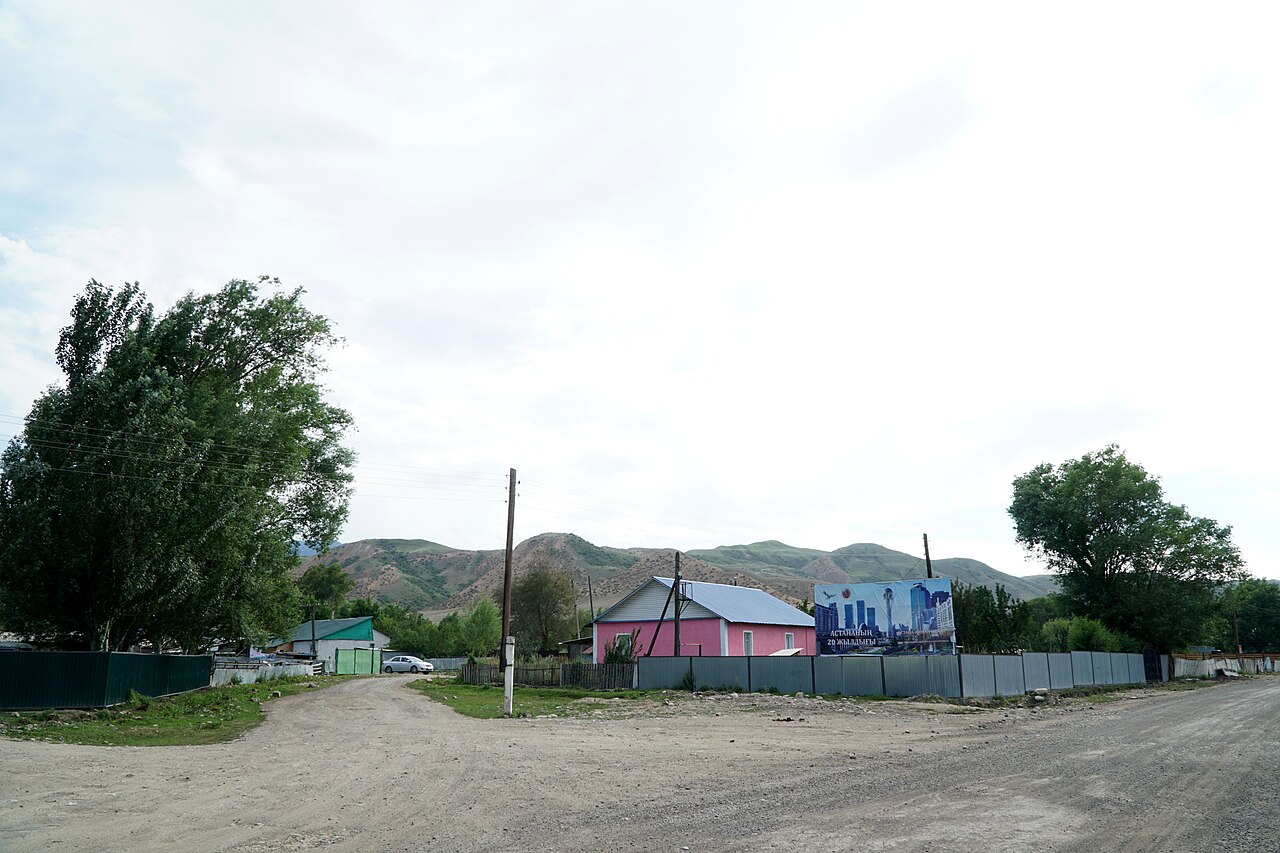
Saty sits on the banks of the Chilik river in Raiymbek district, Almaty Region. It’s a working village of low farmhouses behind painted metal gates, with hay stacked in yards, cattle wandering the lanes and the Kungey Alatau rising behind. It is not picturesque in a manicured way and that’s rather the point.
Driving from Almaty
Take the Kuldja highway east toward Shelek, then the R-16. It’s roughly 300 km and five to six hours, and the road is paved the whole way to Saty — that changed in recent years and older guides still say otherwise. From the Kolsai turnoff on the main road it’s another 68 km to the village.
If you’re approaching from Kegen or the Karkara border, the P-16 is shorter and windier and the A-351 is wider and smoother; both take just under two hours.
By marshrutka and shared taxi
Buses and marshrutkas have historically run from Almaty’s Sayakhat terminal at around six or seven in the morning, taking five to six hours for roughly ₸2,500. One caveat you should know: as of early 2026 travellers were reporting that Sayakhat had closed permanently, and the guides quoting it hadn’t updated. Check before you rely on it. The return marshrutka from Saty leaves around five in the morning, which is brutal but real.
The practical alternative without a car is a shared taxi to Kegen and another from there, or simply hiring a driver for the two or three days. Our getting around Kazakhstan guide covers how shared taxis work.
Coming from Charyn
Charyn Canyon and Saty combine naturally — canyon in the afternoon, night in Saty, lakes the next morning. It’s the single best two-day loop out of Almaty. Our Kolsai, Kaindy and Charyn tour guide lays out the route.
Where to stay in Saty
Nobody publishes a proper list of Saty guesthouses with prices and booking channels, which is odd given it’s the thing everyone actually wants. Here’s what I can verify.
Places you can book online
A growing handful of Saty and Kolsai-area properties now appear on Booking.com, including Guest House Arcabay-Karligash (from around ₸15,000), Kolsay Aisha, Kolsay Kazakh Village, Kolsay Lakes, Kolsay Eco House, TauHouse Saty, A-Frame Kolsai (from about ₸25,000) and Eldos Kolsai. At the upper end there’s Kolsai Grand Hotel from roughly ₸40,000. The selection is thinner than the village actually offers, but it means you can lock something in before you leave home.
Places you book by phone or WhatsApp
This is where most of the beds are. Two that are consistently verifiable:
Mariya Guesthouse, at 91 Ultarakov Street, has its own website and rooms for two, three or four people with shared bathroom and all meals included. The listed rate is ₸12,000 per person on weekdays and ₸13,000 at weekends and holidays. There’s an English-speaking contact number and a separate WhatsApp line. The site’s rates look like they haven’t been touched in a while, so confirm on WhatsApp rather than assuming.
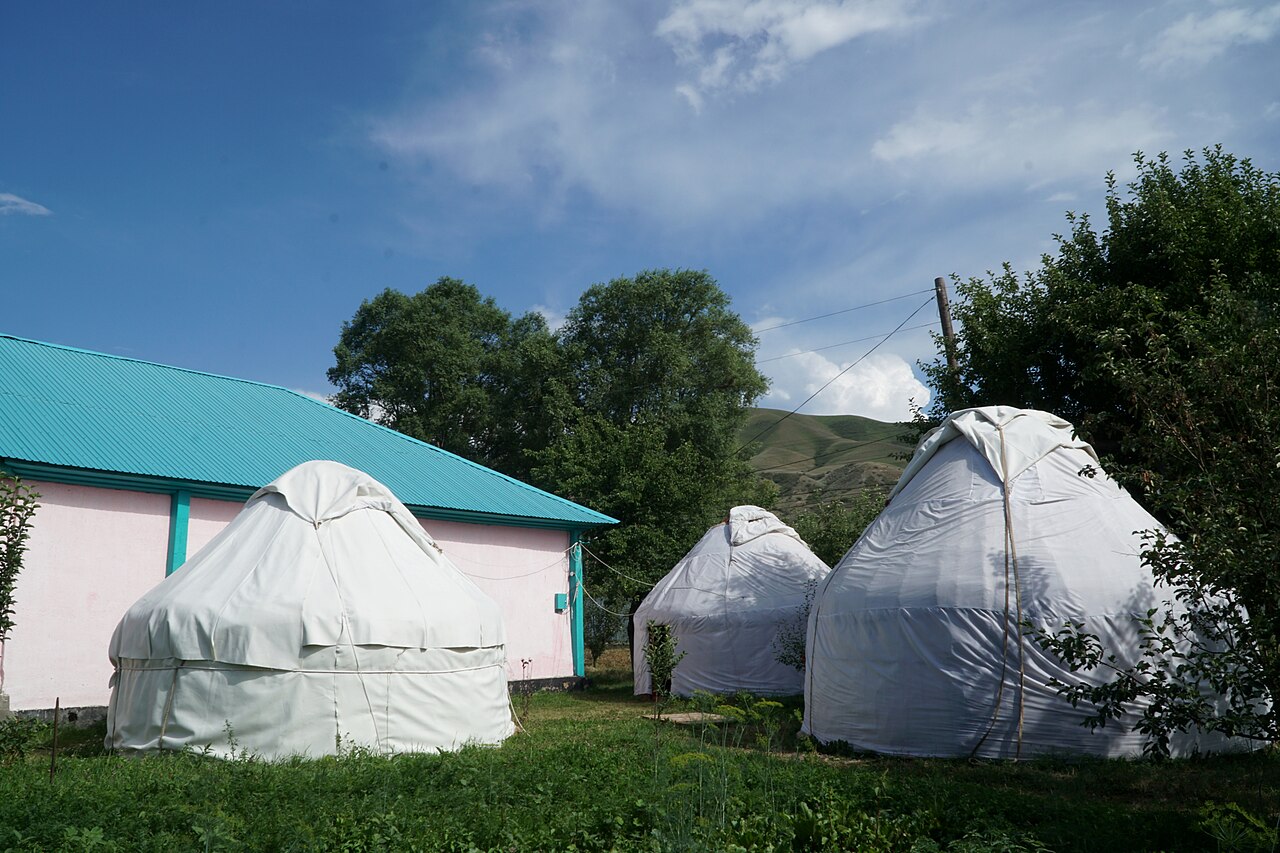
Guest House Zhuldyz (also written Zhyldyz) is family-run — the host’s husband works for the national park, which is handy — with wifi, laundry and three meals a day included. One traveller paid ₸11,000 per person for a private room with shared bathroom, breakfast and dinner, booked by WhatsApp a day ahead. The same family also has yurts with evening bonfires.
Some names that circulate in older guides I could not verify at all, and one — Jibek Joli — is at Kurmenty near the lakes rather than in the village. Don’t plan around a name from a 2019 blog post.
How to actually book
Find the guesthouse on Google Maps or 2GIS, take the phone number, and message it on WhatsApp. Run your message through a translator into Russian; most hosts don’t read English and nobody minds a clumsy translation. A day’s notice is usually plenty.
Turning up without a booking
Works midweek. Drive in, ask at the first place with a sign, and if it’s full someone will point you at a cousin. On summer weekends, when Almaty empties into the mountains, don’t gamble.
Staying at the lakes instead
There are yurts and simple cabins above the first Kolsai lake — roughly ₸7,000 per person without food and ₸10,000 with three meals, with the yurts pitched above the car park going for about half. You wake up on the water, which is lovely, but you’re committed: no shop, no choice of dinner, and the road down to the village in the dark is not fun. Our yurt stay guide covers what a night in one is actually like.
What a Saty guesthouse is actually like
Set your expectations at “village,” not “hotel,” and you’ll have a good time.
Rooms are usually in the family’s own house or a purpose-built annexe in the yard: beds, a rug, a wardrobe, maybe a small heater. Clean, plain, unfussy.
Bathrooms are almost always shared. Some places have a modern indoor bathroom; a good many still have a drop toilet in the yard. Some have a banya — a wood-fired steam bath — instead of a shower, which is not a downgrade once you’ve tried it. Bring your own toilet paper; several guesthouses don’t provide it.
Hot water is usually available but sometimes on a schedule. Ask when you check in rather than at ten at night.
Wifi is common in the village and usually adequate for messages, not for video calls.
Heating in shoulder season is a stove or an electric heater. Nights in Saty are cold from September onward.
Meals: what’s included and what it costs
Most rates quoted per person include either breakfast and dinner or all three meals. Tell your host in advance if you want them, because there’s no restaurant culture here and nobody keeps spare food for people who might turn up hungry.
What arrives is home cooking: beshbarmak, plov, lagman, dimlama, salads, bread, jam, clotted cream, and tea that never stops. If you have dietary requirements, flag them when you book. Vegetarian is workable if you give notice and awkward if you don’t. Our guide to traditional Kazakh dishes tells you what you’re eating.
Where meals aren’t included, budget about ₸1,000 each.
What a night in Saty costs in 2026
Prices vary more than they should, and the spread across published sources is wide enough to be confusing. Current best read:
- Village guesthouse, per person, meals included: ₸6,000–12,000. This is the band to plan around.
- Double room with breakfast and dinner: ₸20,000–30,000 at the smarter places.
- Lakeside yurt: ₸7,000 without food, ₸10,000 with three meals.
- A-frames and boutique cottages: ₸25,000–40,000.
You will still find ₸3,000–4,500 figures quoted online. Those are old. Treat them as a historical curiosity, not a budget.
Everything is cash. See our Kazakhstan trip cost guide for how this fits into a wider budget.
Saty to the Kolsai Lakes
Getting to the lower lake
The road from Saty to Kolsai Lake 1 is paved and takes 20 to 30 minutes. Sources disagree on the distance — anywhere from 5 to 15 km — which is because there are two different measurements floating about: village to gate, and gate to lake. The gate-to-lake stretch is 8 km, and this is the trap. If you take a taxi, say clearly that you want to go to the lake, not to the entrance, or you’ll be dropped at the barrier with an 8 km walk ahead of you. A taxi from the village runs around ₸1,500.
The hike to the middle lake
The trail starts on the right-hand side of the lower lake and climbs about 450 metres over roughly eight kilometres to Kolsai 2 at 2,250 metres. Three to four hours up, two to three down, through Tien Shan spruce with benched rest stops and yellow signboards along the way. It gets muddy after rain. It is the best half-day in the whole area and most day-trippers never see it.
The third lake and the border question
Kolsai 3 sits at 2,700 metres, another four kilometres and 450 metres up on a steeper unmaintained path. Whether you can go is genuinely disputed. Some sources say a border permit is required; others say the guards simply turn everyone back at the second lake. What is consistent is that border guards take your passport at the start of the Kolsai 1 trail and return it when you come back down, because the path leads to the Kyrgyz frontier and stopping illegal crossings is their job.
My advice: don’t plan on the third lake. If you want it, arrange it weeks ahead through a licensed operator or the park office in Saty, and be prepared to be refused.

Saty to Lake Kaindy
The road, and why you need clearance
Kaindy is 11 to 15 km from Saty on an unpaved track — gravel, rock steps, and river crossings that in early September can run 30 to 40 centimetres deep. Rental companies typically prohibit taking their cars on it, and they’re right to. Allow 45 minutes to an hour each way.
The shuttle
Local drivers run UAZ vans and minibuses up the track. Three price models are current, all per vehicle rather than per person: roughly ₸10,000–15,000 (US$20–30) round trip for a car, about ₸20,000 to hire a ten-seat marshrutka, and cheaper if you share. Catch one at the petrol station at the entrance to Saty — it’s closest to the Kaindy road, which turns right near the cemetery — or ask your guesthouse to phone a driver.
The final stretch
At the barrier you park and finish on foot: about 1.5 to 2 km uphill through forest, 45 minutes at a walk. You can ride a horse instead for ₸2,000–3,000 one way, or take a local UAZ the last bit. Our Lake Kaindy guide covers the lake itself.
Worth knowing while you’re standing there: the lake formed in a 1911 earthquake, when a landslide dammed the valley and drowned a spruce forest. The water sits around 6°C even in summer, which is why the trunks are still standing more than a century later.
Park fees in 2026
Kolsai-Kaindy National Park charges by the MCI, Kazakhstan’s monthly calculation index, which was ₸4,325 from 1 January 2026. That gives:
- Pedestrians: 0.2 MCI = ₸865 per person per day
- Car: 0.6 MCI = ₸2,595
- Minibus up to 16 seats: 2 MCI = ₸8,650
- Bus up to 32 seats: 3 MCI = ₸12,975
- Bus over 32 seats: 5 MCI = ₸21,625
Two things worth flagging. First, there is no published foreigner-versus-resident differential for Kolsai, despite several guides implying one — the pedestrian rate is a single figure. Second, it is per person per day, and Kolsai and Kaindy are increasingly charged separately, though some visitors still report a combined ticket. Bring cash and keep the receipt. Non-payment is an administrative offence with a fine starting at 5 MCI.
Border zone, passports and the route to Issyk-Kul
You will read that you can trek from the Kolsai lakes over the Sary-Bulak pass at 3,278 metres and down to Issyk-Kul in Kyrgyzstan. People do it. It is not a legal crossing.
Kazakhstan’s official land checkpoints with Kyrgyzstan are Korday/Ak-Zhol, Karasu/Ak-Tilek, Kegen/Karkara, Sypatay Batyr/Chaldybar and Aisha-Bibi/Chon-Kapka. The only one in Almaty Region is Kegen–Karkara, which is seasonal — roughly April to October — and daytime only. There is nothing at Kolsai. Walking over the pass means crossing illegally, with the consequences that implies for your visa record and your onward travel.
If you want to combine Kazakhstan and Kyrgyzstan, do it properly through Kegen–Karkara or Korday. Our Kazakhstan and Kyrgyzstan itinerary covers the sensible routes.
And carry your original passport everywhere in this area. The checkpoint before Saty will not accept a photocopy and will send you back.
Saty practicalities: money, shops, fuel, signal
Money. There is no ATM in Saty and card acceptance is unreliable. Draw enough tenge in Almaty or Kegen to cover accommodation, meals, park fees, shuttles and a margin. Four independent sources agree on this and every one of them is right.
Shops. Several small supermarkets stock water, bread, beer, sausage and basics, roughly nine in the morning to seven at night, plus one larger store. There’s a small shop at Kolsai 1 that is often shut.
Restaurants. Barely a category. Two get named locally — a Kazakh place called Kolsay Shanyraq and, improbably, an Indian one. Eat at your guesthouse.
Fuel. There’s a petrol station at the entrance to Saty. It and Kegen are your last options; fill up before you turn off the main road.
Mobile signal. Reception is mainly in the village. There is none inside the park or at the lakes. Download offline maps — 2GIS works well in Kazakhstan — before you go.
When to go, and when Saty shuts down
The season is May to October.
May is muddy, the rivers are high with snowmelt, and there are ticks. June to August is warm at 15–25°C and busy, especially at weekends — Kolsai can see 750 to 1,000 domestic visitors on a summer weekend day. September is the consensus best month: golden forest, stable weather, thin crowds. October is cold in the mornings and very quiet. November to April means snow and ice, with trails closed or dangerous.
Many small homestays and all the lake yurts shut for winter; the handful of year-round properties are the ones on Booking. I could find no source giving specific dates when the road itself is snowed in, only that roads and trails close after heavy snowfall — so if you’re considering a winter visit, go with an operator who checks conditions. Our frozen lakes guide covers what the area looks like under ice, which is spectacular but logistically hard.
Things to do in and around the village
- Horse riding. Villagers rent horses, and there’s riding along the Kolsai 1 shore and up toward the higher lakes with a guide. Multi-day rides into the Kungey Alatau are sold commercially.
- A banya. If your guesthouse has one, use it after the Kolsai 2 hike. It’s the best ₸2,000 you’ll spend.
- Boats. Rowing boats on Kolsai 1, rented by the half hour.
- Honey. Locals sell it from their yards, and it’s very good.
- The Chilik river and the Bestobe reservoir for an aimless afternoon.
A suggested two- to three-day plan
Day 1. Leave Almaty early, stop at Charyn Canyon for the Valley of Castles, drive on to Saty, arrive late afternoon. Dinner at the guesthouse.
Day 2. Early start to Kolsai 1 for the morning light, then the hike to Kolsai 2 and back. Back in the village by late afternoon; banya, dinner, early night.
Day 3. UAZ up to Kaindy first thing, an hour or two at the sunken forest, then the drive back to Almaty — or on to Kegen and Kyrgyzstan.
Add a fourth day and you can ride horses, sleep in, and do the lakes twice. See our Kazakhstan itineraries for how this slots into a longer trip.
Frequently asked questions
Where is Saty village and how far is it from Almaty?
Saty is in Raiymbek district, Almaty Region, on the Chilik river, about 280–300 km southeast of Almaty. The drive takes five to six hours via the Kuldja highway and Shelek, and the road is paved all the way to the village.
How much does a guesthouse in Saty cost, and are meals included?
Around ₸6,000–12,000 per person per night, usually with breakfast and dinner or all three meals. Smarter double rooms with two meals run ₸20,000–30,000. Everything is cash, in tenge.
Do Saty guesthouses have private bathrooms and hot showers?
Mostly not. Shared bathrooms are the norm, some places still have a drop toilet in the yard, and some offer a wood-fired banya instead of a shower. Hot water is usually available but sometimes on a schedule. Bring your own toilet paper.
Is there an ATM in Saty?
No, and card acceptance is unreliable. Withdraw all the tenge you’ll need in Almaty or Kegen before you drive in — accommodation, meals, park fees and the Kaindy shuttle are all cash.
How much is the Kolsai-Kaindy park entrance fee in 2026?
0.2 MCI per person per day, which is ₸865 at the 2026 MCI of ₸4,325, plus ₸2,595 for a car. There is no separate foreigner rate published. Kolsai and Kaindy are increasingly charged separately, so budget for both.
Do I need a 4×4 to reach Lake Kaindy?
You need high clearance. The 11–15 km track from Saty is gravel with rocky sections and river crossings, and rental companies generally prohibit it. Most visitors hire a local UAZ or minibus for ₸10,000–20,000 per vehicle round trip.
Can you hike from Kolsai to Kyrgyzstan and Issyk-Kul?
Not legally. The Sary-Bulak pass at 3,278 metres is not an official crossing — the nearest legal one is Kegen–Karkara, which is seasonal and daytime only. Border guards hold your passport at the Kolsai 1 trailhead specifically to prevent illegal crossings.
Is there mobile signal in Saty and at the lakes?
There’s reception in the village but none inside the national park or at the lakes. Download offline maps before you leave Almaty.
When is the best month to visit Saty and the Kolsai Lakes?
September. Golden spruce and birch, stable weather, fewer people and comfortable daytime temperatures. June to August is warm but crowded at weekends, and November to April means snow with trails closed or dangerous.
Can I just turn up in Saty without a booking?
Midweek in season, usually yes — drive in and ask. On summer weekends, when domestic tourists arrive in force, book ahead. The most reliable method is WhatsApp in Russian to a number from Google Maps or 2GIS.
Final thoughts
Saty is not a destination in itself. It’s an ordinary Kazakh village that happens to sit between two of the most photographed pieces of water in the country, and the whole argument for staying there is that it buys you mornings. The 6 a.m. version of Kolsai and the 1 p.m. version are different places, and the difference costs about ten thousand tenge and one night on a firm bed.
Bring cash, bring your actual passport, bring toilet paper, and tell your host you want dinner. For everything else in the area, see our guides to the Kolsai Lakes, Lake Kaindy and Charyn Canyon — and our complete where-to-stay guide for the rest of the country.
Photo credits
Saty village street and yurts at a Saty guesthouse: Adam Harangozó (CC BY-SA 4.0) via Wikimedia Commons. Lower Kolsai Lake: Lfvelynis (CC BY-SA 4.0) via Wikimedia Commons.