Contents
- Oskemen at a glance
- Oskemen or Ust-Kamenogorsk? Sorting out the name
- The city in five minutes
- A short history: fortress, silver road, closed city
- Getting to Oskemen
- Things to do in the city
- Day trips
- Using Oskemen as your Altai staging post
- Where to stay and eat
- When to visit, and the air-quality question
- Honest verdict: two nights, not five
- Frequently asked questions
- Final thoughts
Nobody comes to Oskemen for Oskemen. They come because it is the gateway to the Kazakh Altai, reached by air or on the daily train from Almaty, and they expect a grim metallurgical city to be endured for one night. Which is roughly half right — and the other half is more interesting than the guidebooks suggest.
Oskemen, still widely called Ust-Kamenogorsk, is a city of about 378,000 at the confluence of the Irtysh and Ulba rivers in East Kazakhstan Region, founded in 1720 as a Russian fort and built into a zinc and titanium centre in the Soviet period. It is the gateway to Katon-Karagay National Park and the Altai, and it is worth two nights rather than one.
This guide covers the name confusion, the pollution question answered with actual numbers rather than hand-waving, what to see in a day and a half, the day trips that are genuinely worth taking, and how to use the city as a staging post for the mountains.
Oskemen at a glance
| Names | Öskemen (Kazakh), Ust-Kamenogorsk (Russian). Both official, both used |
| Population | 378,161 at the start of 2025 — Kazakhs 51.5%, Russians 43.5% |
| Founded | 1720, as the fort Ust-Kamennaya, on Peter the Great’s order |
| Where | East Kazakhstan Region, at the Irtysh–Ulba confluence |
| Airport | UKK, about 11 km from the centre |
| Flights | Direct from Almaty and Astana |
| January average | −15.3 °C, dipping to a mean minimum of −20.4 °C |
| July average | 20.5 °C, with mean maxima near 28 °C |
| To Semey | 220 km by road; four hours on the scheduled bus |
| To Katon-Karagay | About 350 km to the village |
| How long to stay | Two nights |
Oskemen or Ust-Kamenogorsk? Sorting out the name
Both names are official and both appear on the city seal. Öskemen is the Kazakh form; Ust-Kamenogorsk — literally “mouth of the stone mountain” — is the Russian one, from the fort built where the Ulba meets the Irtysh.
In practice the two names live side by side: the airport code is UKK, timetables and Russian speakers say Ust-Kamenogorsk or just “Ust”, official Kazakh-language material says Öskemen, and English maps use both. Nobody will misunderstand you either way.
The same Kazakh-first pattern applies across the region: the Irtysh is the Ertis, Semipalatinsk became Semey. And a further wrinkle for anyone using an older guidebook — Abai Region was created on 8 June 2022 out of East Kazakhstan Region, taking Semey as its capital. Oskemen remains capital of a considerably smaller East Kazakhstan. Guides written before 2022 describe a region that no longer exists in that shape.
The city in five minutes
Where it sits
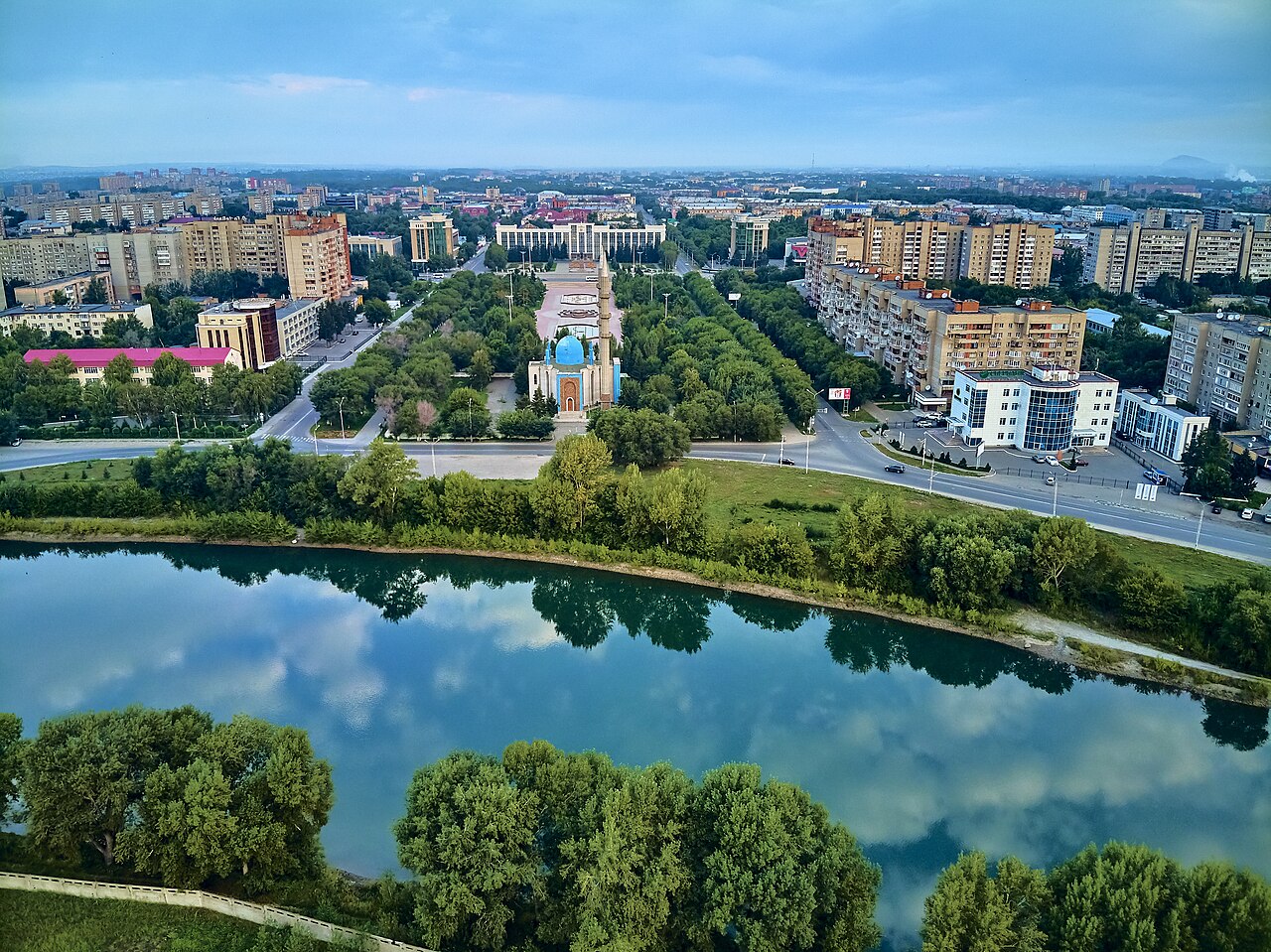
Oskemen occupies the junction of two rivers and two mountain systems. The Irtysh — one of the great Siberian rivers, running eventually to the Arctic — meets the Ulba here. Behind the city rise the Kalba hills to the southwest and the Altai proper to the east. The result is a city with real topography and real water in it, which after a few days on the Kazakh steppe is a pleasant shock.
Who lives here
Here is where we have to correct every competing guide. They all describe Oskemen as an ethnically Russian city. It is not, or at least no longer. As of the start of 2025, Kazakhs number 194,793, or 51.5 per cent, and Russians 164,537, or 43.5 per cent, with Germans, Tatars and Ukrainians each around one per cent. Guides quoting a population of 320,000 to 350,000 are also out of date.
What is true is that Oskemen feels and sounds Russian-speaking. Russian is the working language of the street, the architecture is Soviet, and the food leans Slavic. But it is a Kazakh-majority city with a Russian-speaking culture, which is a more interesting thing than the usual shorthand. Our guide to language in Kazakhstan covers how this works in practice.
The industrial reality
Oskemen is a metals town. The zinc plant opened in 1947, the titanium-magnesium plant in 1965, and in 1997 three non-ferrous combines merged to form Kazzinc. The Ulba Metallurgical Plant handles beryllium, tantalum and nuclear fuel materials. This is the economic base and it is visible from anywhere in the city.
A short history: fortress, silver road, closed city
The fort was established in 1720 at the river confluence by an expedition under Major Ivan Mikhailovich Likharev, sent on Peter the Great’s order and looking, among other things, for the gold of Yarkend. It became a customs and trade point on the route into the Altai and the Chinese frontier.
City status came in 1804, and in 1869 the town became the centre of a newly formed district. The Soviet period transformed it: the Altai’s mineral wealth turned a river town into a metallurgical centre, with the deportations and labour mobilisations that implies — Volga Germans, Chechens, Koreans and others arrived in this region in the 1930s and 1940s. The nuclear-materials work at Ulba added a layer of secrecy that persisted for decades.
For the broader arc, see our history of Kazakhstan.
Getting to Oskemen
Flying
The easy answer. Ust-Kamenogorsk Airport (UKK) sits about 11 kilometres from the centre, and its terminal, opened in 2017, is built to handle 200 passengers an hour.
Almaty and Astana both have direct flights, with Air Astana and FlyArystan among the airlines. Days and departure times shift with the season, so check the current timetable on the airlines’ own sites before you plan around a flight. There are also seasonal and weekly links to Semey, Zaisan, Karaganda, Moscow and Novosibirsk. See domestic flights in Kazakhstan.
The train, and whether it is worth it
Train 351/352 runs daily between Almaty-2 and Oskemen. Check the journey time for your date on bilet.railways.kz when you book.
Fares change, so check current prices on the railway app. Our guides to train travel and buying tickets explain the booking process.
Is the long ride worth it? If you like Soviet long-distance trains, yes — this is a good one, running through the Kazakh steppe into hill country. If you are trying to get to the Altai efficiently, fly.
Buses and driving
Oskemen’s bus station gives its Almaty route as 1,134 kilometres, with a scheduled journey time of 17 hours; confirm the timing for your direction and departure. Not recommended unless you enjoy that sort of thing. Driving it yourself is a genuine road trip — see Kazakhstan road trip.
Getting into the city
Taxis via Yandex Go or InDrive, both of which operate here and both of which are cheap. The city also has a four-line tram network plus buses and marshrutkas, with an electronic “Oskemen Card” that costs less than paying cash. See taxis and Yandex Go.
Things to do in the city
The Ethnovillage and the Left Bank Complex
The standout, and genuinely good. On the south bank of the Irtysh, beside the large new mosque, the Left Bank Complex holds an open-air ethnographic museum — the Ethnovillage — with full-size dwellings representing the peoples who ended up in East Kazakhstan: a Kazakh yurt, a Russian izba, and Korean, German, Armenian and Ukrainian houses. There is a “City of Masters” artisan area, plus Soviet military hardware and a collection of Lenin statues that had to go somewhere.
What makes it work is the honesty of the premise. This is a museum about a region assembled from deportations and migrations, and it lays that out house by house. If you have read our guide to Kazakh culture, this is the place to see the multi-ethnic reality alongside the Kazakh core.
The regional museum
The East Kazakhstan Regional Museum of Local History, founded in 1915, is one of Kazakhstan’s oldest museums and holds more than 147,000 historical and cultural objects. It is at 40 Kasym Kaysenov Street, with tickets around 500 tenge; confirm the opening hours and closing day with the museum before you go.
Parks, the embankment and Strelka
Zhastar Park is the main city green space; Zhambyl Park the other. The Irtysh embankment is the best walk in Oskemen on a summer evening, and Strelka carries the city’s Victory memorial complex, dedicated to the Second World War. Sit there for a moment; it is the most affecting spot in the city.
The Baiterek monument
A 28.5-metre, 22-tonne monument, pedestal included, opened on 27 May 2010. Not to be confused with the far more famous Baiterek Tower in Astana — the name comes from the same tree-of-life myth.
Hockey, theatre and the cathedral
Oskemen is a hockey city, and this is not a small detail: the Boris Alexandrov Sports Palace is home to Torpedo, once a founding member of the Russian VHL and now playing in Kazakhstan’s Pro Hokei Ligasy, and the city produced Evgeni Nabokov, Nik Antropov and Alexander Perezhogin among other NHL players. Catching a game in winter is the most local thing you can do here.
There is also a drama theatre, a puppet theatre, the Trinity cathedral, and a pedestrianised stretch around Ushanov Street for an evening walk.
Day trips
Sibin Lakes
The best half-day out: a cluster of lakes set among rock outcrops in the hills, close enough to the city for a morning or an afternoon trip.
Practical note: a summer bus runs to Lake Shalkar at weekends only, out early morning and back in the evening. Stock up on food in the city, or buy basics in Algabas village three kilometres from Lake Sadyrkol. Our lakes in Kazakhstan guide puts them in context.
Ablaikit, and how it differs from Ablaketka
Ablaikit is a Buddhist monastery-fortress built in 1654 in the Kalba Mountains by the Dzungar taishi Ablai, about 60 kilometres from the city in Ulan district. It is a ruin, and it matters far beyond its size: manuscripts from Ablaikit reached Western Europe in the early eighteenth century and fed the early study of Tibetan texts.
Two corrections. First, one state-media article credits Ablaikit to “Abylai Khan” — wrong. Ablai the Dzungar leader is a different person entirely from Abylai Khan, the Kazakh ruler commemorated at Burabay. Second, and more usefully: Ablaikit is not Ablaketka. Ablaketka is a locality at Oskemen itself, beside the Irtysh hydro dam, notable for a navigation lock described as the highest in the world with a drop of over forty metres. The two are easy to confuse, but Ablaikit is a seventeenth-century ruin 60 kilometres south of the city, while Ablaketka is on its doorstep.
Bukhtarma Reservoir and Ridder
The Bukhtarma Reservoir lies east of the city — a huge body of water created by damming the Irtysh.
Ridder, a mining town, is the access point for the West Altai reserve. Altai Alps, Oskemen’s own ski resort, has five lifts and 12 groomed slopes and rents out equipment — real skiing within reach of a regional airport. See ski resorts in Kazakhstan.
Other towns within reach include Serebryansk, Shemonaikha, Shar and Altai, formerly Zyryanovsk.
Using Oskemen as your Altai staging post
This is the section no competing guide bothers with, and it is why most readers are here.
Distances into the mountains
| Destination | Distance | Time |
|---|---|---|
| Katon-Karagay village | ~350 km | Plan on a full travel day |
| Uryl (via Katon-Karagay) | ~417 km | Asphalt all the way |
| Rakhmanov Springs | ~450 km | Check road conditions with your operator |
| Semey | 220 km | 4 hours by scheduled bus |
| Almaty | ~1,130 km | Fly |
The Osinovsky Pass road is closed overnight in early spring and late autumn because of ice — worth knowing if you are planning a dawn departure in October.
Cars, drivers and operators
You want a driver with a 4×4, not a rental car, for anything past Katon-Karagay village. Katonkaragay Tour is a named operator based in Oskemen. The regional tourist information centre, visiteast.kz, publishes operator and hotel directories and free downloadable guides including a city map and a “By Car across East Kazakhstan” booklet — the most useful official resource for this region.
Regional tours were quoted at 100,000 to 900,000 tenge per person in 2023, which is a wide enough range to be nearly useless but does tell you the order of magnitude. Our Kazakh Altai guide has current tour pricing, and border zone permits covers the paperwork you may need collected here in person.
Supplies, cash and SIMs
Buy everything in Oskemen. Once you head into the mountains, supermarkets, ATMs, camping gas and bank branches get much harder to find. Get a local SIM here too — coverage in the Altai valleys is patchy and you want the best network you can get. Carry more cash than you think you need; the mountain villages are cash-only.
Where to stay and eat
For an international brand, choose Dedeman Oskemen Tavros or Best Western Plus Oskemen; other options include Shiny River Hotel, City Hotel and Mereke Hotel.
Reckon on 5,000 to 10,000 tenge for dinner with drinks in 2026. The food here leans Russian and Siberian — pelmeni, solyanka, river fish, forest mushrooms — alongside Kazakh staples. Altai honey is the regional product to buy, sold everywhere and genuinely good. See Kazakh food and souvenirs.
When to visit, and the air-quality question
The seasons
Using 1991–2020 normals: January has a daily mean of minus 15.3 with mean minima of minus 20.4, and the record low is minus 47.2. July averages 20.5 with mean maxima of 27.8, and the all-time record high, set in August, is 42.8. So: properly cold winters, warm summers, short shoulder seasons.
Come in late August or September if the Altai is your objective — the mountain roads are still open and the city is pleasant. Come in winter if you want hockey and skiing and do not mind minus twenty.
The pollution question, with numbers
Competing guides either omit this or moralise about it. Here is the actual position.
Heavy industry, metals above all, is behind the city’s serious air pollution, and an older estimate counted around 170 polluting components in its air.
That is a serious problem — for the people who live here across decades. For a visitor spending two nights, it is not a reason to change your plans. On a still winter day with an inversion you will smell and taste it, and that is genuinely unpleasant. In summer, with the wind moving, you may not notice at all. If you have significant respiratory disease, factor it in the way you would for any heavy-industry city. Otherwise, go.
Honest verdict: two nights, not five
Oskemen is not a destination city and it does not pretend to be. What it is, is a real place — a river town with hockey, an unusually good ethnographic museum, a Soviet industrial spine and a Kazakh-majority population speaking Russian, sitting at the doorway to the best mountains in the country.
Two nights is the right allocation: one for the city, one for a day trip to the Sibin Lakes or Ablaikit, and then out to the Altai. Five nights would be too many. One night, which is what most people give it, means you fly in, sleep, and leave without ever walking to Strelka — which would be a shame.
Frequently asked questions
Is Oskemen the same city as Ust-Kamenogorsk?
Yes. Öskemen is the Kazakh name, Ust-Kamenogorsk the Russian. Both are official and both are used; the airport code is UKK.
Is the air pollution dangerous for a visitor?
It is a chronic problem for residents rather than an acute risk for a two-night stay. The pollution comes largely from the metals industry. Noticeable on still winter days, often imperceptible in summer.
How do you get from Almaty to Ust-Kamenogorsk?
Fly; it is by far the quickest option. Oskemen’s bus station times its Almaty service at 17 hours, and a train runs daily from Almaty-2.
How far is Ust-Kamenogorsk from Katon-Karagay National Park?
Katon-Karagay village is about 350 kilometres away by road, a full travel day. Ask at the Oskemen bus station about services.
What is there to do in Oskemen for a day?
The Ethnovillage and Left Bank Complex in the morning, the regional history museum after lunch, then the Irtysh embankment and Strelka in the evening. Add a hockey game in winter.
Is Oskemen worth visiting, or just a transit stop?
Both. It rewards a day and a half genuinely, but it is not a destination in itself. Two nights.
What language do people speak?
Russian is the everyday language of the street, though Kazakhs are now a slim majority of the population at 51.5 per cent. English is limited.
How cold does it get in winter?
January averages minus 15.3 with mean daily minima around minus 20.4. The record is minus 47.2.
Can you get to the Sibin Lakes without a car?
There is a summer bus to Lake Shalkar at weekends only, leaving early and returning in the evening. Otherwise you need a taxi or a driver.
Where do you hire a car or driver for the Altai?
Through an Oskemen operator — Katonkaragay Tour is one — or via the operator directory on the regional tourist information site. You want a driver with a 4×4, not a self-drive rental.
Is Ablaketka the same as Ablaikit?
No, they are different places. Ablaketka is a suburb of Oskemen with a very high river lock. Ablaikit is a ruined 1654 Dzungar Buddhist monastery-fortress 60 kilometres away.
Which region is Oskemen in?
East Kazakhstan Region, of which it is the capital — but the region is smaller than it was, since Abai Region was split off in June 2022 with Semey as its capital.
Final thoughts
Most travellers treat Oskemen as an airport with a hotel attached. Give it thirty-six hours instead and you get an open-air museum whose homesteads set the peoples of eastern Kazakhstan side by side, one of the oldest museums in the country, the Sibin Lakes for a half-day out, and the war memorial on Strelka.
Then go to the mountains, which is what you came for. Our guide to the Kazakh Altai covers what is waiting up the valley, Semey is about four hours west by bus if you are continuing overland, and northern and eastern Kazakhstan ties the whole region together.
Photo credits
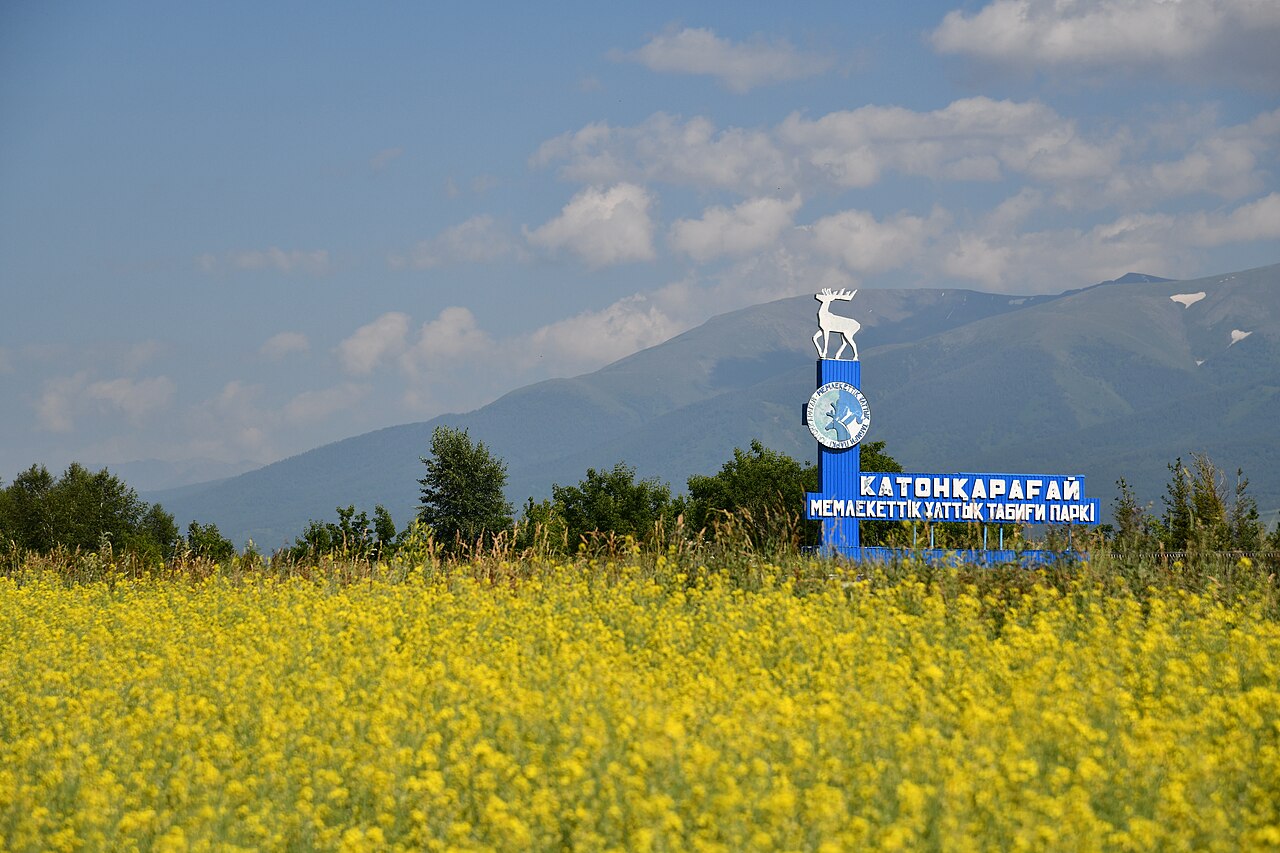
Oskemen from the air: Andriej Szypiłow, CC BY-SA 3.0, via Wikimedia Commons. Katon-Karagay National Park entrance stela: Seitov Sultanbai, CC BY 4.0, via Wikimedia Commons.