Contents
- Almaty nightlife at a glance
- The shape of Almaty nightlife
- When to go out (and when not to)
- The neighbourhoods after dark
- Craft-beer bars in Almaty
- Cocktail bars and the speakeasy scene
- Live music and jazz
- Nightclubs and techno
- Rooftop bars and city views
- What a night out costs
- Face control and dress code
- Local drinks to try
- Safety at night and getting home
- Frequently asked questions
- Final thoughts
My first proper night out in Almaty started with a beer tower in a brewpub off Panfilov Street and ended, somehow, in a room with no sign on the door, a bartender who refused to give me a menu, and a cocktail built around fermented mare’s milk. Somewhere in between there was jazz, a rooftop, and a taxi home that cost less than the tip I’d left. I remember thinking: nobody warned me this city could do this.
Almaty nightlife is the most underrated night scene in Central Asia — a genuine spread of craft-beer pubs, hidden cocktail bars, jazz rooms, techno basements and summer rooftops, mostly packed into the central “Golden Square” rather than one strip. It levelled up sharply after 2022, it’s cheap by Western standards, and it runs Thursday to Saturday until the small hours.
Almaty is Kazakhstan’s largest city and its former capital — the political capital is Astana, up north — but it’s very much the country’s cultural and after-dark heart. If you’re still sketching out your days, this slots neatly alongside the wider list of things to do in Almaty, and most good nights here begin with dinner, so keep our guide to the best restaurants in Almaty open in another tab.

Almaty nightlife at a glance
| Thing to know | The short version |
|---|---|
| Best nights | Thursday–Saturday; weekdays are genuinely quiet |
| Bars fill up | Around 8–10pm; clubs after midnight, peak 11pm–1am |
| Closing / last call | Alcohol service to ~2am weekdays, ~3am weekends; clubs to 5–6am |
| Where | The central “Golden Square” — Gogol, Dostyk, Panfilov St, Zhibek Zholy (the Arbat) |
| Local beer | Around 800–1,600 KZT (US$1.70–3.40) |
| Cocktail | Around 4,000–6,000 KZT (US$8.50–12.50) |
| Club entry | Around 2,500–5,000 KZT |
| Full night out | Roughly 20,000 KZT (US$40–50) with dinner, drinks and taxis |
| Getting home | Yandex Go or inDrive app; a short ride is around 600 KZT |
| Dress code | Smart-casual; upscale venues run face and dress control |
| Drinking age | 21 — carry your passport |
Approximate exchange rate throughout: around 475 KZT to US$1. Prices in Kazakhstan move, and bars open and close fast, so treat every number here as a ballpark, not a promise.
The shape of Almaty nightlife
Here’s the thing most guidebooks miss: Almaty has quietly become the best night city in Central Asia, and hardly anyone outside the region knows it. Tashkent is more conservative, Bishkek is smaller, and the Kazakh capital Astana is newer and colder in every sense. Almaty has the mountains, the money, the students and the melting-pot history — and it all shows up after dark.
The first thing to understand is that there’s no single nightlife strip. The scene spreads across the central grid locals call the “Golden Square” — very roughly the rectangle bounded by Gogol, Dostyk, Furmanov (Nazarbayev) and the streets around Panfilov and Zhibek Zholy, with Panfilov Park in the middle of it. Walk fifteen minutes in any direction from the pedestrian Arbat and you’ll pass brewpubs, cocktail bars, hookah lounges and club doors. It’s dense, it’s central, and you can bar-hop on foot.
The second thing: this scene levelled up around 2022. Without getting into the politics, a large influx of people arrived in the city that year, and among them were bartenders, DJs, promoters and a wave of new demand. Bars sharpened up fast. The cocktail scene in particular went from decent to genuinely good in a couple of seasons. Whatever your view of why it happened, the after-effect on the drinks is real.
And the third: weekends carry the whole thing. I’ll come back to this, but if you’re in town Monday to Wednesday, adjust your expectations. Almaty is a Thursday-to-Saturday city.
When to go out (and when not to)
Let me save you a disappointing evening. On a Tuesday, most of Almaty’s bars are half-empty and the clubs simply aren’t worth the taxi. The city works hard; it goes out at the weekend. Thursday, Friday and Saturday are the nights, with Friday and Saturday the peak. Thursday is the warm-up and often the most fun if you like a room with space to move.
The rhythm of an Almaty night runs late by British or American standards. Bars start filling up around 8 to 10pm, usually after people have had a long, proper dinner. Clubs don’t get going until after midnight, and the real peak lands somewhere between 11pm and 1am. If you roll into a club at 11pm you may feel like you’ve arrived early to your own party.
Closing times are worth knowing because Kazakhstan has rules on alcohol service. As a rough guide, alcohol service stops around 2am on weekdays and around 3am at weekends, while dedicated nightclubs run on to 5 or 6am. That gap matters: a bar may keep its doors open but stop pouring, so if you want to keep drinking into the dawn, you migrate to a club.
Season changes everything too. In summer — roughly May to September — the city moves outdoors: rooftop bars open, terraces spill onto the pavements, and the Arbat fills with buskers and street food into the night. In winter, when Almaty gets properly cold and snowy, all of that retreats indoors to the basements, the beer halls and the speakeasies. Both are good; they’re just different cities. If you’re timing a trip around the weather, our Almaty itinerary flags what each season does best.
The neighbourhoods after dark
Almaty’s night divides into a handful of areas, each with its own flavour. You can cover several in one evening because they sit close together. Here’s how I read the map.
Zhibek Zholy / the Arbat
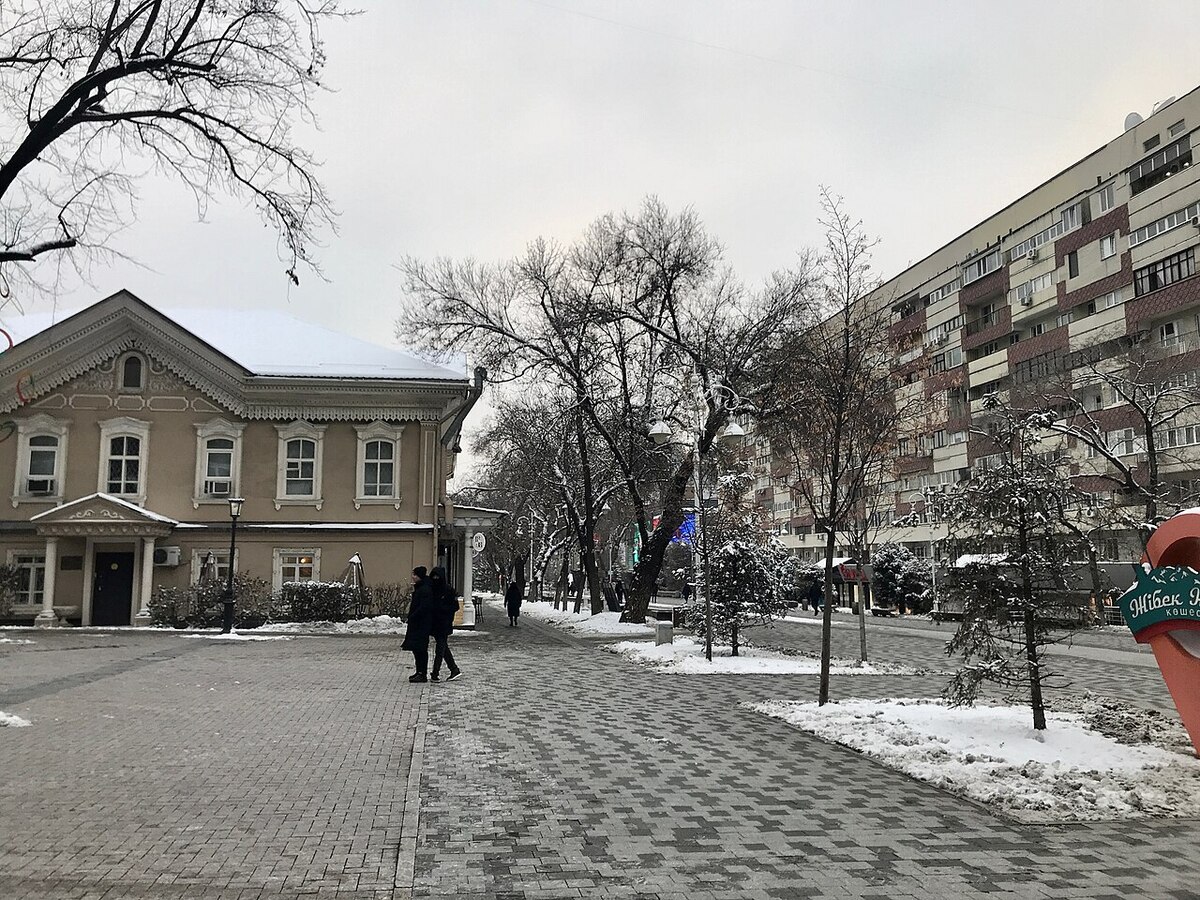
The pedestrianised stretch of Zhibek Zholy, known locally as the Arbat, is the city’s people-watching spine and a good early-evening anchor. It’s not where the serious drinking happens, but it’s alive: buskers, ice-cream sellers, portrait artists, and street food — shashlik skewers and manti — going until about 10pm in summer. Start here with a beer on a terrace, watch the crowd, then move on when the buskers pack up.
Panfilov Street
Running off the Arbat, the pedestrian section of Panfilov Street is one of the densest little clusters of bars and restaurants in the city — brewpubs, wine bars, casual eating, all within a few steps. On a Friday it hums. This is my default when I want to bar-hop without booking anything: park yourself here and let the night find you.
Dostyk Avenue
Dostyk is the broad, leafy avenue climbing gently toward the mountains, and it skews smarter and more upscale. Expect polished cocktail bars, hotel bars, restaurant-lounges and a slightly dressier crowd. If you want a grown-up drink rather than a beer-tower session, drift up Dostyk.
Gogol Street and the old town
Gogol Street and the older central blocks hide some of the best after-dark rooms in Almaty — including the city’s dedicated jazz club and a number of the speakeasy-style cocktail bars. It’s less obvious than Panfilov, more of a “you have to know it’s there” area, which is exactly its charm.
Tole Bi and the pubs
If you’re watching your tenge, Tole Bi and the streets around it run cheaper and more student — honest pubs, beer halls, no-nonsense prices. Less polish, more value. This is where a night out costs a fraction of what Dostyk charges, and it’s often more fun for it.
Esentai and the upscale south
Further south, around the Esentai area, you get the glossiest end of the scene: mall bars, high-end lounges, hotel rooftops and the venues most likely to run strict face control. Dress up if you’re heading here. It’s polished and a bit corporate, but the views and the cocktails can be excellent.
Craft-beer bars in Almaty
One of the genuine surprises of Almaty is how good the craft-beer scene has become. There are proper microbreweries in the city, brewing their own, plus a healthy run of “beer tower” pubs where you order a tall cylinder with a tap at the bottom and pour your own for the table. It’s sociable, it’s cheap, and it’s a great way to start a night with a group.
Local and locally brewed beer runs around 800 to 1,600 KZT a glass — call it US$1.70 to US$3.40 — which makes a long session very affordable. The brewpubs tend to cluster around Panfilov Street and the central grid, and they usually do solid food too, so you can fold dinner and the first few rounds into one stop. For the record, Kazakhstan makes some decent mainstream lagers as well; you’ll see local brands on every tap wall.
If you only do one beer thing here, make it a brewery tap where they’re making it on site. The quality has come a long way, and it’s a world apart from the industrial lager that dominated a decade ago. These are among the most reliable bars in Almaty for a laid-back weeknight when the clubs are dead.
Cocktail bars and the speakeasy scene
This is where Almaty genuinely punches above its weight, and it’s the part of the night I get most excited about. The city has a real cocktail culture now — hidden-door bars, dimly lit rooms, serious bartenders — and a lot of it sharpened up in the last few years as new talent arrived after 2022.
The signature move here is the speakeasy: an unmarked or barely marked door, sometimes behind a shop front or down a stairwell, opening into a small, low-lit room. Several of the best run no menu at all — you tell the bartender what spirits and flavours you like, and they build you something on the spot. “Bartender’s choice” is the whole point. Lean into it; it’s the most fun way to drink in this city.
The other thing worth trying is a cocktail built on local ingredients — most memorably kumys, fermented mare’s milk, which a few bars fold into surprisingly good drinks, plus steppe herbs, local honey and sea buckthorn. It sounds gimmicky and mostly isn’t. For a sense of how good this scene got, one Almaty bar landed on the World’s 50 Best Bars “Discovery” list back in 2019, well before the recent surge.
Cocktails here run around 4,000 to 6,000 KZT (US$8.50–12.50), which is a fraction of what an equivalent drink costs in London or New York for often equal craft. Bars come and go quickly in this part of the scene, so I’ll not bet on specific names — ask a local, ask your hotel, or ask the bartender at wherever you land which door to try next. That’s how the network works here.
Live music and jazz
Almaty has a warmer, more grown-up side to its nights too, and it’s easy to miss if you only chase clubs. There’s a genuine live-music circuit — cover bands, singer-songwriters, rock and blues nights in the pubs — and, more notably, a dedicated jazz club on Gogol Street that’s been a fixture of the scene for years. A night of live jazz with a good cocktail is one of the more civilised pleasures the city offers.

Beyond the bars, Almaty has a serious cultural spine: an opera and ballet theatre, concert halls, and a philharmonic, all of which run evening programmes that make a lovely change of pace from the drinking circuit. It’s a very Almaty combination — high culture and low basements a few blocks apart. If you like your evenings with a bit of range, our wider things to do in Kazakhstan guide points to more of the cultural side.
Live-music venues often charge a small cover or a minimum spend rather than a hard door price, and the crowd tends to be a touch older and more relaxed than the club scene. It’s a great option for a night when you want atmosphere without face control and 5am closing.
Nightclubs and techno
If you want to dance until dawn, Almaty delivers on two levels. There’s a mainstream club scene — big rooms, commercial house and pop, bottle service, dressed-up crowds — mostly in the upscale districts and the malls, and there’s a scrappier, more interesting underground techno scene that surfaces in warehouses, basements and one-off events.
The mainstream clubs are where you’ll meet the strictest face control and the biggest markups; expect entry of around 2,500 to 5,000 KZT, sometimes with a spend minimum, and dress the part. They run late, to 5 or 6am, and the peak crowd lands well after midnight.
The techno side is more word-of-mouth. Events move around, promoters use Instagram and Telegram, and the best nights aren’t advertised on any tourist website. If that’s your thing, follow local party pages before you arrive or ask around in the cocktail bars — the crossover crowd knows where the good parties are. It’s a small, passionate scene, and when it’s on, it’s genuinely good.
One practical note: clubs are the venues most likely to enforce a dress code and turn away large all-male groups, so read the next two sections before you queue anywhere serious.
Rooftop bars and city views
In summer, get up high. Almaty’s setting is the whole trick here: the city runs right up to the wall of the Tian Shan mountains, so a rooftop bar on a clear evening gives you a skyline backed by snow-capped peaks that’s honestly hard to beat anywhere in the region. Watching the sun go down behind the mountains with a drink in hand is one of my favourite Almaty things, full stop.

The catch is that rooftops are strictly summer only — roughly late spring through early autumn. Once the cold sets in they close, and the scene moves indoors. Many of the best sit atop hotels and in the upscale southern districts, so they can run pricier and stricter on dress, but the view usually earns it.
If it’s specifically the view you’re chasing rather than the bar, the cable car up to Kok Tobe gives you the whole valley lit up at night, with food and drink at the top. It’s more family-outing than nightlife, but as a sundowner before you head down to the bars, it’s a brilliant curtain-raiser. Pair a Kok Tobe sunset with a night in the Golden Square and you’ve got the full sweep of the city, high and low.
What a night out costs
Almaty is a bargain for anyone earning in dollars, euros or pounds — you can have a big night for what a couple of cocktails cost back home. Here’s roughly how the money breaks down.
| Item | Rough price (KZT) | Rough USD |
|---|---|---|
| Local beer | 800–1,600 | $1.70–3.40 |
| A shot / spirit measure | 1,000–2,000 | $2–4 |
| Cocktail | 4,000–6,000 | $8.50–12.50 |
| Club entry | 2,500–5,000 | $5–10.50 |
| Short Yandex / inDrive ride | ~600+ | ~$1.30+ |
| Full night out (dinner + drinks + taxis) | ~20,000 | $40–50 |
A few notes on the numbers. Beer and spirits are the cheap way to drink; cocktails are where the bill climbs, though they’re still well under Western prices. Tipping runs around 10 to 15%, and cash is appreciated for it even where you pay the tab by card — Almaty is otherwise impressively cashless. And that “full night out” figure assumes you’re eating a proper dinner first and taking taxis; strip those out and you can do a beer-focused evening for a good deal less.
For how bar spending fits into a wider trip budget alongside hotels and transport, our guide to where to stay in Kazakhstan helps you balance the books — staying central saves a fortune in late-night taxis.
Face control and dress code
Read this before you queue anywhere upscale, because it catches a lot of visitors off guard. Almaty’s smarter venues — the glossy clubs, the hotel rooftops, some cocktail bars — run “face and dress control” at the door. A doorperson looks you over and decides whether you’re getting in. It’s a Soviet-inherited habit that persists across the region, and it’s more subjective than a Western door policy.
The practical rules: dress smart-casual. Avoid shorts, flip-flops, sportswear and scruffy trainers at anything upscale. Men in particular should make an effort — a collared shirt and decent shoes go a long way. Big groups of men rolling up together are frequently turned away or made to wait, so if you’re a lads’ crew, split up or bring some mixed company. Arriving as a couple or a mixed group makes everything smoother.
I’ll be straight with you about one uncomfortable thing: there are honest, repeated reports of discrimination at some doors against darker-skinned visitors, particularly Black and South Asian travellers. It’s not universal and it’s not every venue, but it happens, and I’d be doing you no favours by pretending otherwise. If a door gives you grief, it’s not worth the fight — there are dozens of places nearby, and the beer-hall and pub end of the scene barely does face control at all.
On age: the drinking age is 21, and staff will check ID if you look under about 25. Carry your passport (or a good copy) — more on the passport-and-scams angle below.
Local drinks to try
Half the fun of drinking in a new country is drinking what the locals drink, and Kazakhstan has a genuinely distinctive list. Work through some of this rather than defaulting to the same gin and tonic you’d order at home.
- Kazakh wine — a real and improving thing. The Almaty region has vineyards, and Arba Wine is the name most people cite. A bottle of decent local wine is a lovely, slightly unexpected flex, and a good cocktail bar or restaurant will usually have some.
- Local beer — from the craft taps to the mainstream lagers, Kazakhstan’s beer is cheap, cold and better than it used to be. The brewpub scene is the star here.
- Kumys cocktails — fermented mare’s milk, tangy and faintly alcoholic on its own, now folded into cocktails at a few of the more inventive bars. It’s the most Kazakh drink you can order, and more delicious in a good cocktail than you’d expect.
- Vodka and the toasting culture — vodka is woven into social life here, and if you find yourself at a table with locals you may be pulled into a round of toasts (tamada-led speeches, clinking, the works). Pace yourself, eat as you go, and never turn down the first toast if you can help it — it means a lot.
If you want the food context behind all this — the shashlik and manti on the Arbat, the beshbarmak that soaks up the vodka — our Kazakhstan food guide is the companion read. Late-night street food on Zhibek Zholy runs until about 10pm in summer and is the perfect drinking ballast.
Safety at night and getting home
Almaty is, broadly, a safe city for a night out — the central areas are well-lit and busy at the weekend, and violent crime against tourists is rare. But a few specific habits will keep your evening clean, and they’re worth internalising before you go.
First, transport. Use the apps: Yandex Go or inDrive are the way everyone gets around, they’re cheap (a short hop is around 600 KZT), and they’re far safer than the alternative. They work best with a local SIM so you have data — grab one on arrival. Do not hail an unmarked street car at night; “gypsy cabs” still exist here, and getting into a random stranger’s car after dark is exactly the risk you don’t need to take. Our guide to getting around Kazakhstan covers the apps and the SIM situation in full.
Second, the usual bar sense: keep an eye on your drink, don’t leave it unattended, and be a little wary of over-friendly strangers steering you to a specific bar. Third, and specific to the region: be aware of a “fake police fine” scam, where someone posing as an official demands to see your passport and then invents an on-the-spot fine while holding it. Real police won’t do this. Keep a copy of your passport for daily carry, be very reluctant to hand the original to anyone on the street, and if in doubt, insist on going to an actual police station.
The emergency numbers are 102 for police and 112 as the general line. None of this should put you off — I’ve had dozens of easy, happy nights here — but a little awareness goes a long way. For the bigger picture on personal safety around the country, our honest is Kazakhstan safe guide lays it all out.
Frequently asked questions
What is the legal drinking age in Almaty?
The legal drinking age in Almaty, and across Kazakhstan, is 21. Bars and clubs will check ID if you look under about 25, so carry your passport or a good copy. Alcohol is also not sold in shops overnight — retail sales are restricted late at night — though bars keep pouring until their licensed cut-off in the early hours.
Is Almaty safe for nightlife?
Broadly, yes. Central Almaty is well-lit and busy at weekends, and serious crime against tourists is rare. The main risks are avoidable: use Yandex Go or inDrive rather than unmarked street cars, watch your drink, and be wary of a “fake police fine” scam where someone demands your passport. Keep a copy for daily carry and you’ll be fine.
What are the best nightlife areas in Almaty?
The action centres on the “Golden Square” grid: Panfilov Street and the Zhibek Zholy Arbat for bar-hopping, Gogol Street for cocktail bars and jazz, and Dostyk Avenue for smarter lounges. Tole Bi runs cheaper and more student, while the Esentai area in the south holds the glossiest upscale clubs and rooftops. Most are walkable from each other.
What time do bars and clubs close in Almaty?
As a rough guide, bars stop serving alcohol around 2am on weekdays and around 3am at weekends, though they may keep their doors open a little longer. Dedicated nightclubs run much later, typically to 5 or 6am. The crowd peaks between 11pm and 1am, so arriving at a club before midnight often means an empty room.
What is the dress code for Almaty nightlife?
Smart-casual is the safe bet. Upscale clubs and rooftops run “face and dress control,” so avoid shorts, flip-flops, sportswear and scruffy trainers — a collared shirt and decent shoes get men in far more easily. Large all-male groups are often turned away, so split up or arrive as a mixed group. Pubs and brewpubs are much more relaxed about dress.
How much does a night out cost in Almaty?
A full night out — dinner, drinks and taxis — runs roughly 20,000 KZT, about US$40–50, which is cheap by Western standards. Local beer is around 800–1,600 KZT, cocktails 4,000–6,000 KZT, and club entry 2,500–5,000 KZT. A short taxi is around 600 KZT. Stick to beer and pubs and you can spend far less.
How do I get around Almaty late at night?
Use the ride-hailing apps — Yandex Go or inDrive — which are cheap, reliable and safer than hailing on the street. They work best with a local SIM so you have mobile data, so pick one up on arrival. A short central ride is around 600 KZT. Avoid getting into unmarked street cars at night, however convenient they seem.
What is face control in Almaty clubs?
Face control is a door policy, common across the former Soviet world, where a doorperson decides whether to admit you based on your appearance and dress. Upscale Almaty clubs use it, so dress smart-casual and avoid arriving in a large all-male group. Be aware there are honest reports of discrimination at some doors; if you’re refused, plenty of nearby venues have no such policy.
Final thoughts
Almaty surprised me, and I suspect it’ll surprise you. This isn’t a city with one famous club and a thin scene around it — it’s a proper night town, with craft beer and hidden cocktail rooms and jazz and techno all thriving a few blocks apart, wrapped in that ridiculous mountain backdrop and priced so gently you’ll wonder what the catch is. There isn’t one, really, beyond remembering that it all happens at the weekend.
So go out Thursday to Saturday, dress a little sharper than you think you need to, start with a beer tower on Panfilov and let a bartender’s-choice cocktail steer the rest. Take the app taxis, carry a copy of your passport, and pace yourself through the toasts. When you surface the next day, our Almaty itinerary has the daylight hours covered — because the best Almaty trips balance the late nights with the mountains that were watching over them the whole time.
Photo credits
Images via Wikimedia Commons: Almaty skyline by Dauren Nabijan (CC0); Zhibek Zholy, the Arbat by ShadZ01 / CC BY 4.0; Abai Opera House by Sofi Kan / CC BY-SA 3.0; Hotel Kazakhstan by Nikolay Yushnikov (CC0). Reused under their respective CC0/CC BY/CC BY-SA licences.