Contents
Between 1949 and 1989 the Soviet Union carried out 456 nuclear tests on a stretch of Kazakh steppe west of Semey. One hundred and sixteen of them were in the open air. People lived in the villages downwind the entire time, and were not told.
Semey — called Semipalatinsk until 2007 — is a city of about 313,000 on the Irtysh in northeastern Kazakhstan, and since June 2022 the capital of the new Abai Region. It is the base for visiting the Semipalatinsk Test Site, “the Polygon”, an 18,000-square-kilometre former proving ground. It is also the city where Dostoevsky served five years of exile, and the heartland of the poet Abai Kunanbayev.
Most guides to this subject are out of date in ways that matter. Some still send readers to ground zero at Opytnoe Pole as if a visit were routine. Below is what to expect about access in 2026, what the radiation figures actually are, and why Semey is worth a day and a half even if you never get near the test site.
Semey at a glance
| Names | Semey (Kazakh, official since 2007). Semipalatinsk was the Russian name |
| Region | Abai Region — created 8 June 2022, Semey is the capital |
| Population | 312,764 as of 1 November 2024 |
| Founded | 1718, as a fort on the Irtysh |
| Test site area | 18,000 km², selected by Beria in 1947 |
| Tests conducted | 456 total: 116 atmospheric, 340 underground |
| First test | RDS-1, 29 August 1949, ~22 kilotons |
| Closed | 29 August 1991, by decree of President Nazarbayev |
| Polygon access 2026 | Through an operator; ask about current access and the permit lead time — see below |
| Airport | PLX. Direct FlyArystan flights from Astana and Almaty (Almaty daily) |
| How long to stay | Two days for the city; four to five with the Polygon |
Semey in 2026: what the name means
Semipalatinsk was renamed Semey in 2007 by unanimous vote of the city council. The chair’s stated reason was blunt and revealing: the old name deterred investors. “Semipalatinsk” had become a global shorthand for nuclear testing, and the city wanted its own name back.
The original name means, roughly, “seven-chambered city”, after ruined Buddhist temples about eighteen kilometres away. The fort was founded in 1718 on the Irtysh and moved eighteen kilometres upstream in 1778.
The administrative change is more recent and catches out every older guide: Abai Region was created on 8 June 2022, split from East Kazakhstan Region, with Semey as its capital. If a guidebook tells you Semey is in East Kazakhstan Region, it predates that. Note also the numbers problem — the population figure of 312,764 is the dated official one from November 2024, while various sources loosely claim “over 350,000”. Use the sourced figure.
The Polygon: what happened here
Beria picks an “uninhabited” steppe
In 1947 Lavrentiy Beria selected an 18,000-square-kilometre area west of Semipalatinsk for the Soviet nuclear programme and described it as uninhabited. It was not. Villages, farms and grazing land lay across and around it, and the people in them stayed.
RDS-1, 29 August 1949
The first Soviet nuclear test, codenamed RDS-1 and nicknamed “First Lightning”, was a tower shot of about 22 kilotons at Opytnoe Pole — the experimental field. The Americans called it Joe One. Buildings, bridges, vehicles and animals had been placed at measured distances to record the effects.
From air to underground
The first air-dropped Soviet hydrogen bomb, RDS-37, followed in November 1955. All 116 atmospheric tests took place before 1963. Underground testing used the Balapan borehole field and the tunnel complex inside Degelen Mountain. The last test was on 19 October 1989.
Chagan and the Atomic Lake
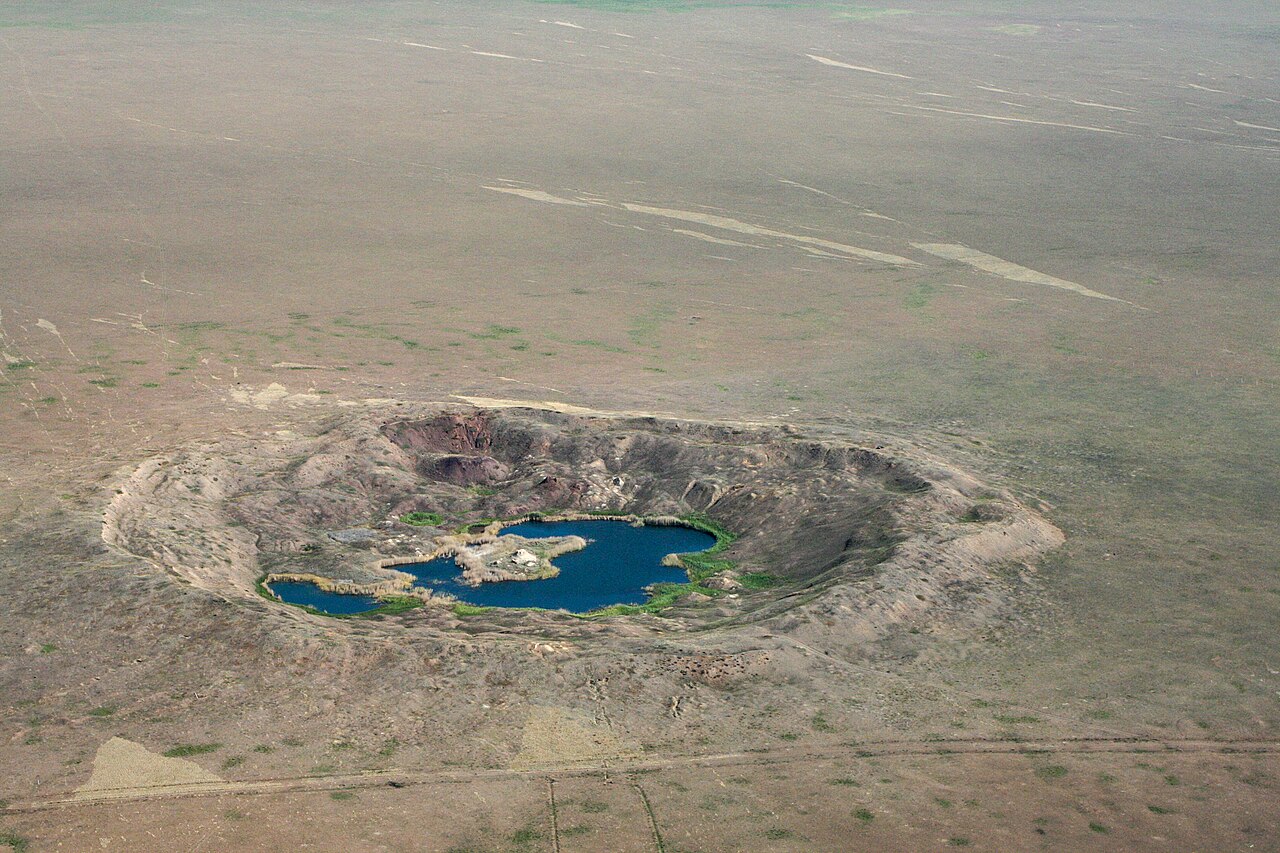
On 15 January 1965 a 140-kiloton device was fired 178 metres down in the dry bed of the Chagan river, as part of a programme to use nuclear explosives for civil engineering. It left a crater roughly 400 metres across and 100 metres deep with a lip 20 to 38 metres high, which filled with water. It is now Lake Chagan, or Atom-Kol.
Tritium concentrations in the lake exceed permissible levels by hundreds of times. Fish live in it. The main hazard to a visitor is contaminated dust from the shoreline rather than the water itself, which is a distinction worth understanding before someone offers you a swim.
Nevada-Semipalatinsk and the 1991 closure
In 1989 the Kazakh poet Olzhas Suleimenov founded the Nevada-Semipalatinsk anti-nuclear movement, which organised protests, peace marches and international conferences. Nazarbayev signed the closure decree on 29 August 1991 — the anniversary of the first test.
That date now carries international weight. UN General Assembly resolution 64/35, adopted on 2 December 2009 at Kazakhstan’s initiative, declared 29 August the International Day against Nuclear Tests, first observed in 2010. In September 2006 the Central Asian Nuclear-Weapon-Free Zone treaty was signed at Semipalatinsk itself.
Plutonium Mountain
The least-known and most remarkable part of the story. Between 1996 and 2012, a secret trilateral operation involving Kazakhstan, Russia and the United States spent around US$150 million sealing weapons-usable plutonium left in the Degelen tunnels and boreholes, using specially formulated concrete. The work was completed with a ceremony in October 2012.
Can you visit the test site in 2026? The honest answer
Partly, and less than you will read elsewhere. This is the section where most published guidance is wrong.
What is open and what is now closed
Do not assume you can reach the western part of the Polygon, including Opytnoe Pole and its concrete measuring towers. Access there can change, so get current written confirmation from the National Nuclear Center before you plan around it. Ask in the same message about the eastern sites — Lake Chagan and the Atomic Lake, smaller structures, boreholes and a command bunker — and the town of Kurchatov.
This matters because the measuring towers at ground zero are the iconic image of the Polygon, and guides written in 2020 still route readers to them. If an itinerary promises you Opytnoe Pole, ask hard questions before paying.
The permit
Your agency applies to three bodies: the National Security Committee, the Institute of Radiation Safety and Ecology, and the Kurchatov city administration. Passes take time to arrange, so ask your operator for the lead time and book well ahead — and realistically much further out, since the operators run fixed departures.
Assume you need a permit for Kurchatov town itself as well as for the test site, and ask your operator to confirm which passes your group needs.
Operators and prices
Young Pioneer Tours runs a five-day “Kazakhstan Polygon” trip at US$1,495, with departures listed for 19–23 April, 19–23 June and 19–23 October 2027; confirm availability before you book. Against the Compass runs a ten-day Off Beat Kazakhstan expedition including the region, next scheduled for June 2027. Welcome.kz sells a six-day “Legacy of the USSR” itinerary, price on request.
You cannot do this independently. The permit process alone rules it out.
Radiation: how much risk there is
Here is where proportion matters, because the internet offers both scaremongering and dismissal.
The IAEA’s assessment is that most of the Polygon poses no significant health hazard, while specific localised pockets genuinely do: vented boreholes, surface-shot craters, tunnel portals.
So: a guided day in the eastern sector with a guide carrying a dosimeter, not eating or smoking on site, and not kicking up dust, is a low-dose activity. Wandering unaccompanied across a former surface-shot crater is not. The equal and opposite error to panic is the tour-brochure line that it is “less than a flight” — true on average, misleading in the pockets.
Operators provide protective suits and dosimeters. Wear what they give you and follow the guide’s instructions about where not to walk.
Kurchatov: the town that built the bomb
Kurchatov, 130 kilometres from Semey by rail, was the closed city that ran the programme, known by its postal code Semipalatinsk-21. An official city profile published in 2023 gives its population as 10,500.
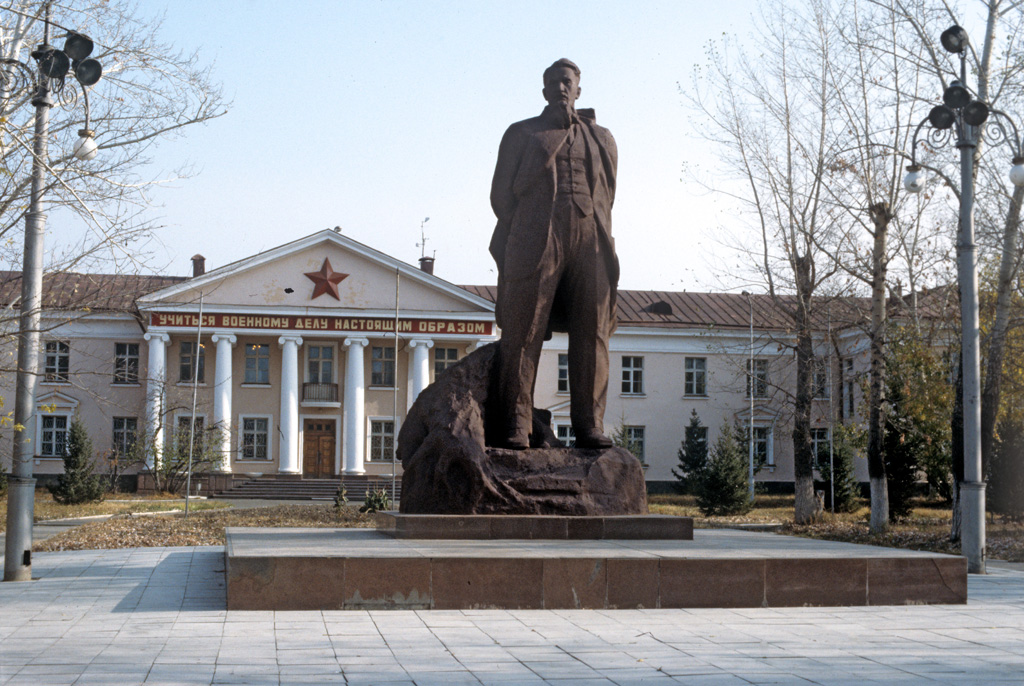
Its facilities are still operated by the Kazakhstan Institute of Atomic Energy under the National Nuclear Center, which continues to run two research reactors. There is a statue of Igor Kurchatov, and the buildings once used by Kurchatov and Beria still stand.
The test-site museum
The Museum of the Semipalatinsk Test Site, established in 1972, is inside the Institute of Radiation Safety and Ecology, which offers tours in three languages. Contact the institute to arrange a visit and ask how to find the entrance.
Visits are by arrangement, so contact the institute ahead of time or ask your operator to include the museum in your itinerary.
The distances
By rail, Kurchatov is 130 kilometres from Semey. One operator, Young Pioneer Tours, quotes Semey to the underground test site as about 200 kilometres and two hours. These are long steppe days.
Semey the city: two days of museums and river
Even if the Polygon permit falls through, Semey justifies the trip. This is one of the more culturally significant cities in Kazakhstan and it is almost entirely overlooked.
Stronger than Death
The Monument to the Victims of Nuclear Testing, unveiled in 2001 on Polkovnichy Island east of the centre. A 25-metre reinforced-concrete stele faced in polished black Semipalatinsk gabbro, with a mushroom-cloud shape cut out of it, and at its base a sculpture of a mother shielding a child. The architect was Shot-Aman Valikhanov.
It is the most powerful piece of public art in the country and it takes ten minutes to see. Go at dusk.
The Dostoevsky Literary Memorial Museum
Fyodor Dostoevsky was arrested in 1849 over the Petrashevsky Circle, had a death sentence commuted at the last moment, served four years of hard labour at Omsk, and was then sent to compulsory military service in Semipalatinsk from 1854 to 1859 — as a private soldier. He lived in the surviving wooden house from 1857 to 1859.
It opened as a museum on 7 May 1971, for his 150th anniversary, and it remains the only Dostoevsky museum outside Russia. It is at 118 Dostoevsky Street. The museum has announced a temporary closure for repairs, so check on dostoevsky.kz that it has reopened before you go; its regular exhibition hours are Tuesday to Sunday, 09:30 to 17:30, closed on Mondays and on the last Friday of each month.
Outside stands a bronze of Dostoevsky with Chokan Valikhanov by the sculptor D. G. Elbakidze. Valikhanov — Kazakh aristocrat, geographer, ethnographer, Russian army officer — became Dostoevsky’s friend here, and the double statue of the exiled Russian novelist and the Kazakh scholar is a genuinely moving thing to stand in front of.
Abai, Auezov and Zhidebay
Semey is the heart of Abai country. Abai Kunanbayev, the poet, composer and philosopher who effectively founded modern Kazakh written literature, came from here, and the region he came from is now named after him.
The Literary and Memorial Museum of Abai in Semey opened in 1940, on the 95th anniversary of his birth. The Zhidebay memorial complex, well south of the city, holds his burial alongside that of his nephew and fellow poet Shakarim. If you have any interest in Kazakh literature it is a pilgrimage; if not, it is a very long drive.
Mukhtar Auezov, who wrote the great novel about Abai, also came from this region. Our guide to Kazakh culture puts these figures in context.
The other museums
The Nevzorov Family Museum of Fine Arts, established in 1985, is a surprisingly good collection for a regional city; check its current hours before you go. The regional history museum at 90 Abai Street, founded in 1883, is one of Kazakhstan’s oldest, with a section on the nuclear testing; it opens Tuesday to Sunday, 09:00 to 17:00, and closes on Mondays.
One museum to ask about before you go: the Semey Medical University anatomical and pathology museum, established in 1975. Whether visitors can get in is up to the university, so contact it before you plan around a visit.
The suspension bridge
Construction began in April 1998, and the bridge opened to traffic in November 2000, with work continuing until November 2001. The main span is 750 metres; the bridge is 1,086 metres long and 35 metres wide. IHI of Japan was the main contractor and Katahira & Engineers the main consultant.
It is a genuinely elegant structure and the best thing to photograph in Semey after the Stronger than Death monument.
Two things nobody mentions
Semey sits beside the Semei Ormany relict pine forest, a band of Siberian pine surviving on sand far south of its natural range — the same geological oddity as Burabay, on a bigger scale. A fire in 2023 reached around 60,000 hectares of it.
And Semey is where Kazakh football began, which is the kind of fact that makes a taxi driver’s day if you know it.

The human legacy
This has to be stated carefully, because it is neither a footnote nor a horror story.
Kazakh experts estimate that around 1.5 million people were exposed to fallout from the Polygon. The consensus of post-closure health studies points to direct health impacts on roughly 200,000 local residents. The forty-year Semipalatinsk cohort study shows statistically significant excess solid tumours — oesophagus, stomach, lung, breast and liver.
On heritable effects, the evidence is real but contested. Studies found that people exposed between 1949 and 1956 showed around 80 per cent more minisatellite DNA mutations than controls, and their children around 50 per cent more.
Compensation exists and is minimal. One village sitting inside three test craters is officially classed as “minimal risk”, and residents receive a one-off payment of roughly fifty US dollars.
If you visit, this is the context. The Polygon is not an abandoned curiosity like a Soviet radar station; it is a place with living downwind communities. Our guide to dark tourism in Kazakhstan discusses how to approach sites like this.
Practicalities
Getting there
Semey’s airport is PLX, with direct FlyArystan flights from Astana and Almaty. The airline describes the Almaty route as daily; search your dates for current frequencies and flight times. Trains run from Astana too, so check the timetable with KTZ, the national railway. Semey sits on the Turksib line with connections to Almaty, Barnaul and Novosibirsk.
By road: Oskemen, to the southeast, is a 220-kilometre bus route, with a scheduled journey of four hours; Pavlodar is around 320 kilometres and five to six hours downstream; Astana is roughly 760 kilometres west; Almaty about 1,000 kilometres south. See train travel and domestic flights.
Season
Using 1991–2020 normals: January has a daily mean of minus 15.1 with mean minima of minus 20.2. The record low is minus 48.6, set in November 1910; the record high 42.5, in August 2002. July is the wettest month at about 50 millimetres.
The practical Polygon season is May to October. Come in September for the best combination of weather and light.
Where to stay and how long
Semey has a reasonable range of mid-range hotels, nothing luxurious. Two days covers the city properly: one for the Dostoevsky and Abai museums plus Stronger than Death, one for the fine arts and regional museums and the bridge. Add two to three days if you have a Polygon permit, and a further long day if you want Zhidebay.
Frequently asked questions
Can tourists visit the Semipalatinsk test site in 2026?
Partly. The eastern sector — the Atomic Lake, boreholes, a command bunker — plus Kurchatov town is bookable through an operator with a permit. Access to the western sector, including Opytnoe Pole and its measuring towers, is not something to count on, so get written confirmation from the National Nuclear Center before you book.
Do you need a permit for Kurchatov, and how long does it take?
Assume yes. Your agency applies to the National Security Committee, the Institute of Radiation Safety and Ecology and the Kurchatov administration. Ask your operator how long passes take and book well ahead.
Is it safe? How much radiation is there really?
According to the IAEA, most of the site poses no significant hazard, but localised pockets do. A guided visit with a dosimeter is low-dose; unaccompanied wandering is not sensible.
Is Semey the same place as Semipalatinsk?
Yes. Renamed Semey in 2007 by the city council, partly because the old name had become synonymous with nuclear testing.
Which region is Semey in?
Abai Region, created on 8 June 2022 with Semey as its capital. It was formerly part of East Kazakhstan Region.
How do you get to Semey?
Fly to PLX on FlyArystan’s direct routes from Almaty or Astana, or take the train from Astana.
Can you swim in or fish the Atomic Lake?
Fish live in it, but tritium levels exceed permissible limits by hundreds of times and the shoreline dust is the main hazard. Do not swim, do not fish, and follow your guide on where to stand.
Is the Kurchatov test-site museum open?
Official listings give Monday to Friday hours by guided tour, and the institute offers tours in three languages. Contact it in advance or ask your operator to arrange a visit.
Why was Dostoevsky in Semey, and can you see his house?
He served compulsory military service here from 1854 to 1859 after his commuted death sentence and Omsk imprisonment. His wooden house at 118 Dostoevsky Street is the only Dostoevsky museum outside Russia. It is temporarily closed for repairs; when it reopens, expect Tuesday to Sunday hours, and check dostoevsky.kz first.
Can you visit the anatomy museum?
Whether visitors can get in is up to Semey Medical University, so contact it before you plan around a visit.
How far is Abai’s mausoleum?
The Zhidebay complex lies south of Semey, a long drive each way, so give it a day of its own. Abai and Shakarim are buried there together.
How many days do you need?
Two for the city. Four to five if you have a Polygon permit. Add a day for Zhidebay.
Final thoughts
Semey is the most substantial city in Kazakhstan that almost no foreign visitor sees, and the reason to come is not really the Polygon — which is hard to access, increasingly restricted, and best understood from a distance anyway.
The reason to come is that this one medium-sized river city holds the only Dostoevsky museum outside Russia, the burial place of the man who invented modern Kazakh literature, and a 25-metre black stele commemorating four decades of nuclear tests on the people who lived here. Three separate histories, none of them small, in one city and its hinterland.
If the permit comes through, go and stand at the edge of the Atomic Lake and think about 1965. If it does not, Semey is still worth the flight.
Our guides to dark tourism in Kazakhstan, northern and eastern Kazakhstan and the history of Kazakhstan put this region in its wider setting, and the Baikonur Cosmodrome is the other great Soviet-legacy site in the country.
Photo credits
Nuclear test crater on the former test site: The Official CTBTO Photostream, CC BY 2.0, via Wikimedia Commons. Kurchatov statue: Alexander Liskin / RIA Novosti archive, CC BY-SA 3.0, via Wikimedia Commons. Semey suspension bridge: Иван Быков, CC BY 3.0, via Wikimedia Commons.