Contents
- Aktau at a glance
- The reason Aktau exists: uranium, and a nuclear reactor that made drinking water
- The streets with no names — and how to actually get around
- Things to do in Aktau
- Can you swim in the Caspian at Aktau?
- The Caspian is falling, and you can see it
- Getting to Aktau
- Climate: hot, dry and startlingly windy
- Where to stay
- Eating in Aktau
- Aktau is a base. Here’s what it’s a base for
- Money and practicalities
- Frequently asked questions
- Final thoughts
Aktau is the only city I’ve visited where I couldn’t tell a taxi driver my address, because there wasn’t one. Not a missing street sign — no streets have names at all. You say three numbers, he nods, you arrive. It’s the first sign that this place was built for reasons that had nothing to do with you turning up as a tourist.
Aktau is the Caspian Sea city that serves as capital of Mangystau region and the gateway to western Kazakhstan’s desert landscapes. Founded in 1958 as a closed uranium-mining town, it now holds just over 300,000 people, has no street names, and is where you fly into for Bozzhyra and the underground mosques. The city itself is worth half a day to two days.
That’s the honest framing, and I’d rather give it to you up front than pad out a sights list. Aktau is a Soviet nuclear company town that became an oil-services hub and is now, slightly reluctantly, a tourist gateway. It has a genuinely strange history, a rooftop lighthouse, a shoreline of bare limestone, and the best-connected airport in western Kazakhstan. What it does not have is a old town, a bazaar quarter or anything you’d call charming. Come for what it is.

Aktau at a glance
| Population | Just over 300,000 — 303,752 as of December 2025, about 40% of Mangystau region |
| Founded | Settled 1958 as Melovoye; town status 1963; called Shevchenko 1964–1991 |
| Elevation | Around −8 m. Most of the city sits below sea level |
| Airport | Aktau International (SCO), about 25 km north-west of the centre |
| Train station | Mangystau, roughly 20 km outside the city — not “Aktau station,” which is 2,000 km away |
| Ferry port | Kuryk, about 90 km south. Nothing sails from Aktau port itself |
| Addresses | Three numbers: microdistrict, building, flat. No street names |
| Best month | September — sea still around 20 °C, desert 20–25 °C, few crowds |
| Sea temperature | Averaged 18.9 °C in July 2026; warmest month is August at about 22.4 °C |
| How long | Half a day to two days for the city; 3–5 more for Mangystau |
The reason Aktau exists: uranium, and a nuclear reactor that made drinking water
This is the best story in the city, and almost no travel guide tells it.
In 1958 Soviet prospectors found uranium on a bare, waterless stretch of the Mangyshlak peninsula and set up camp. They named the place Melovoye, after the bay. Once the deposits were confirmed the settlement was closed to outsiders and given the security designation Guryev-20. In 1963 the closed status was lifted, town status was granted and it was named Aktau — Kazakh for “white hills,” after the pale ridges nearby. A year later, in 1964, it was renamed Shevchenko for the Ukrainian poet Taras Shevchenko, who had been exiled to Novopetrovskoye — now Fort-Shevchenko, about 100 km north-west — from 1850 to 1857. The name Aktau came back in 1991. The airport code, SCO, is a leftover from Shevchenko and has never been changed.
Here is the problem the Soviets had: there is no fresh water here. Before the infrastructure existed, drinking water was trucked in from Fort-Shevchenko on a 300 km round trip across roadless desert. So they solved it the way the Ministry of Medium Machine Building solved things under Efim Slavsky — with a reactor.
The BN-350 was a sodium-cooled fast breeder reactor, built from 1964, generating power from 1973 and shut down permanently on 22 April 1999. It did four jobs at once: it made electricity, it made district heat, it bred weapons-grade plutonium, and it ran the only land-based nuclear-heated desalination plant in the world, producing up to 120,000 cubic metres of fresh water a day. An entire city of a hundred-thousand-plus people drank water boiled by a plutonium factory. Decommissioning follows the SAFSTOR route — sealed and monitored — and is expected to run to the middle of this century at a cost of around US$330 million.
The uranium, incidentally, turned out to be poorer than expected, so from the 1970s the combine pivoted to scandium instead.
What supplies water now? A mix: the thermal power plants and desalination operated by MAEK-Kazatomprom, plus the membrane-technology “Kaspiy” plant, whose capacity was doubled from 20,000 to 40,000 cubic metres a day, and a new Kendirli plant rated at 50,000 cubic metres a day that opened in July 2025 near Zhanaozen. Kazakhstan is also planning a new nuclear plant near the old site, because current capacity is not considered adequate for the city’s water and power needs and blackouts have been a recurring problem. Do not repeat the old line that every drop of Aktau’s water still comes from one reactor — it hasn’t for a quarter of a century.
The streets with no names — and how to actually get around
Aktau’s addresses are three numbers: microdistrict, building, flat. So 14-42-30 means district 14, building 42, apartment 30. For a taxi you only need the first two.
The system is a fossil of the closed-city layout. Districts and apartment clusters were numbered on the plan, which made street names redundant, and nobody has ever bothered to change it. Google Maps labels the airport road “Unnamed Road,” which tells you how well foreign mapping copes.
Two things make this workable in practice. First, use 2GIS or Yandex Maps — both handle the microdistrict system correctly, and 2GIS lets you download the city offline. Asking for a street name will get you a blank look. Second, brace for the fact that building numbers are not sequential: they follow construction order or run clockwise around a block, so building 43 may not be anywhere near building 42.
City buses cost 70 tenge (a figure from April 2025 — check on the day). Taxis flag at roughly 200–400 tenge in town, often quoted at 300 for a foreigner. Ride-hailing works; see our guide to taxis and Yandex Go in Kazakhstan, and pick up a local SIM at the airport if you want data — getting a Kazakhstan SIM card covers the options.
Things to do in Aktau
There are perhaps six things genuinely worth your time. Here they are, honestly ranked.
The rooftop lighthouse
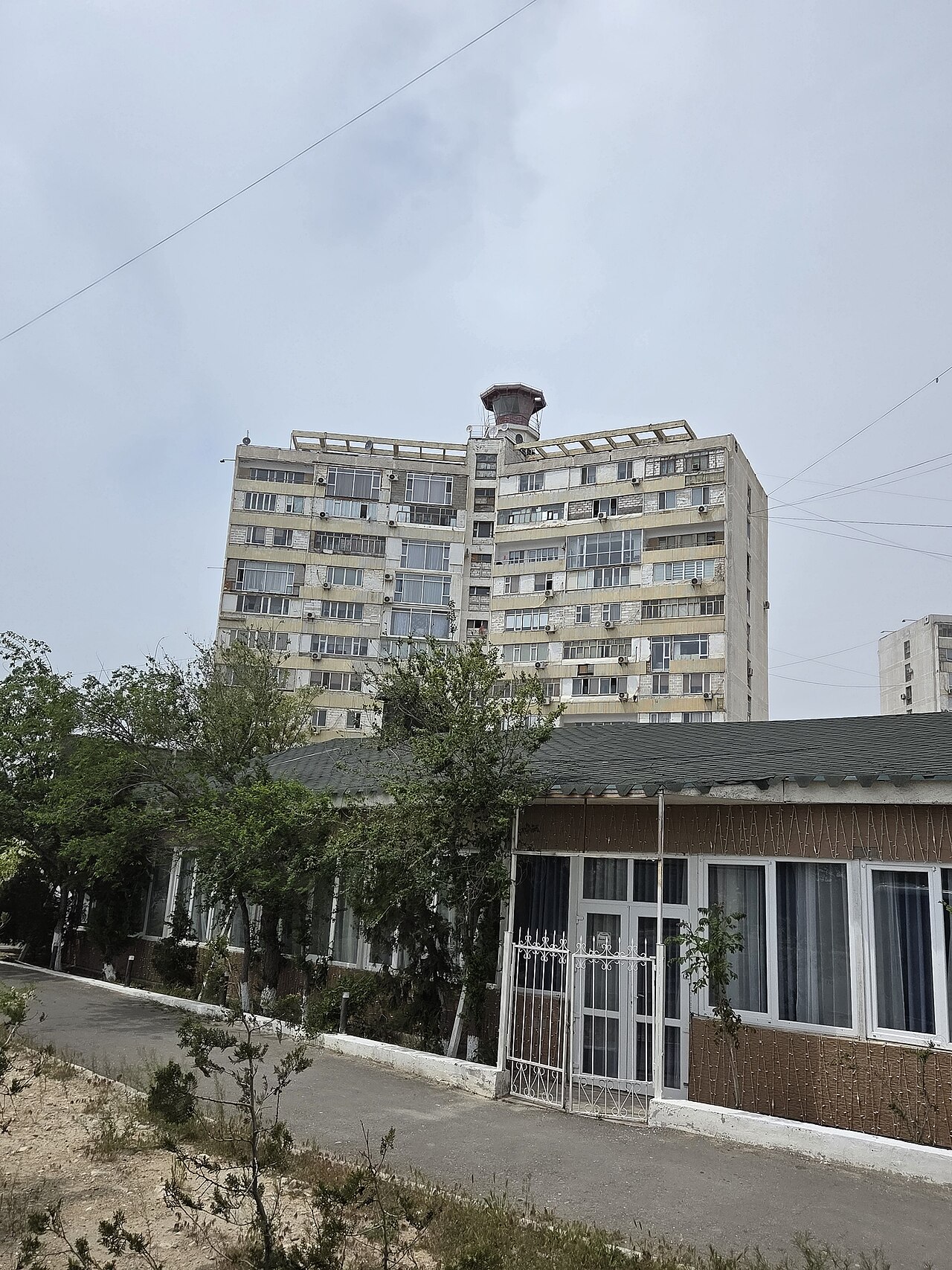
Aktau’s single most distinctive sight is a working lighthouse mounted on the roof of an eleven-storey apartment block at 4th Microdistrict, Building 9. It was built in 1974, stands 73 m above sea level, and its beam reaches roughly 38 km out into the Caspian. It was relit in 2021 for Kazakhstan’s thirtieth independence anniversary and confirmed as a city landmark in 2023. You cannot go up, but you can stand at the bottom and enjoy the fact that somebody looked at a residential tower block and thought: that’ll do.
The Rock Trail and the embankment
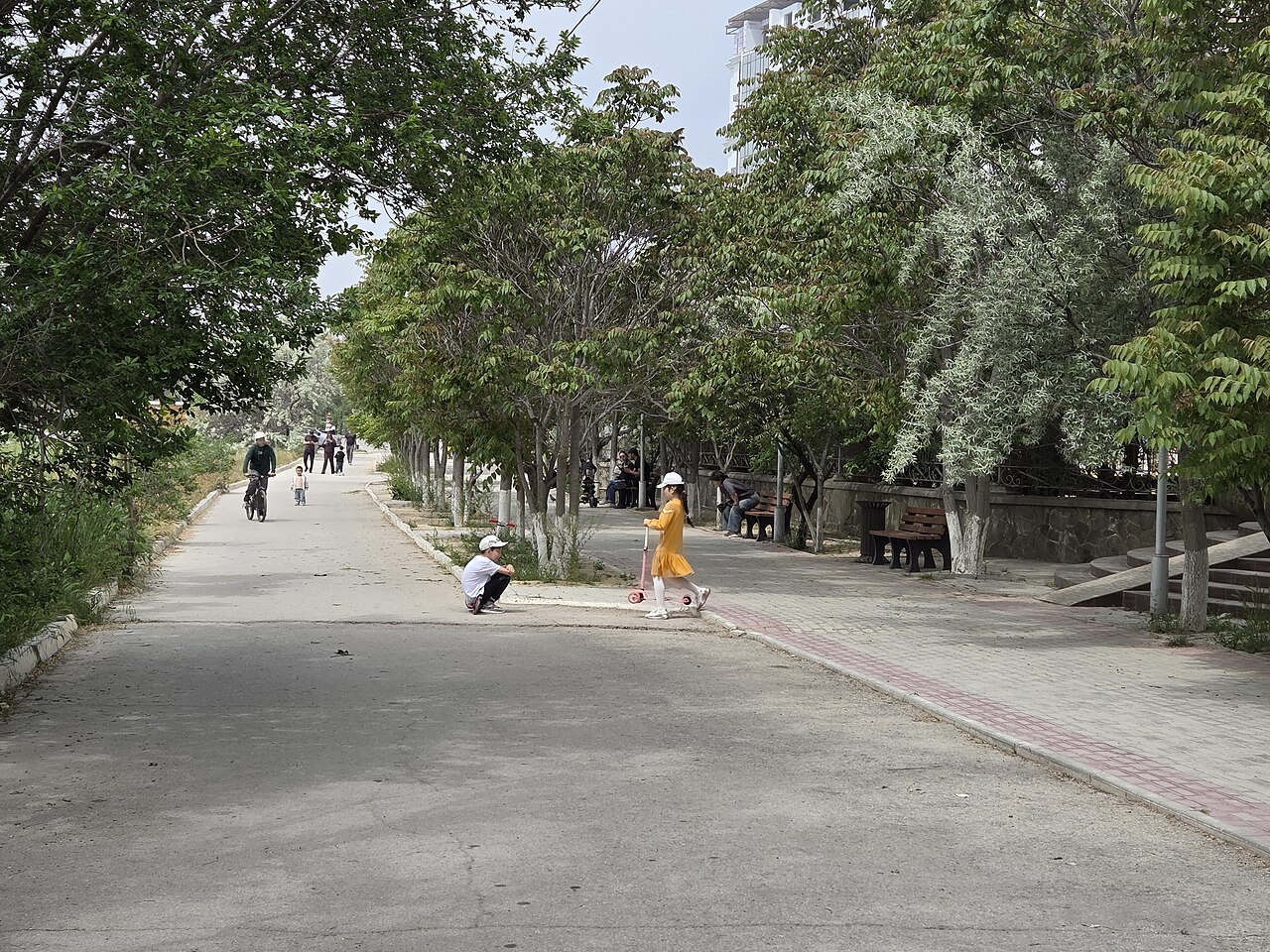
The Skalnaya Tropa, or Rock Trail, opened in 2019 and runs roughly 1.5 km along the coastal limestone, with sculptures, a small cave, rock paintings and viewpoints out over the water. The wider seafront promenade runs about 3 km. Walk it in the evening, when the whole city comes out and the light goes gold on the rock. This, more than anything else, is what Aktau does well.
Mangystau Regional Museum of History and Local Lore
Better than it needs to be. It holds over 58,000 items across around 115 exhibits, with dioramas on the region’s geology and palaeontology, material on the 1870 Adayev Uprising, the Ustyurt hunting traps, and Alan Medoev’s Stone Age finds. Adult admission is under a dollar. If you’re heading into the desert afterwards, an hour here makes everything you’re about to see legible.
The Eternal Flame and the MiG-21
The Eternal Flame is a yurt-shaped Second World War memorial designed by Evgeny Fedorov and unveiled on 9 May 1985, its five pylons standing for the five years of the war. Walk down Victory Boulevard towards the sea and you’ll pass the Peacekeeping Soldiers Memorial and a MiG-21 mounted on a plinth.
The monuments
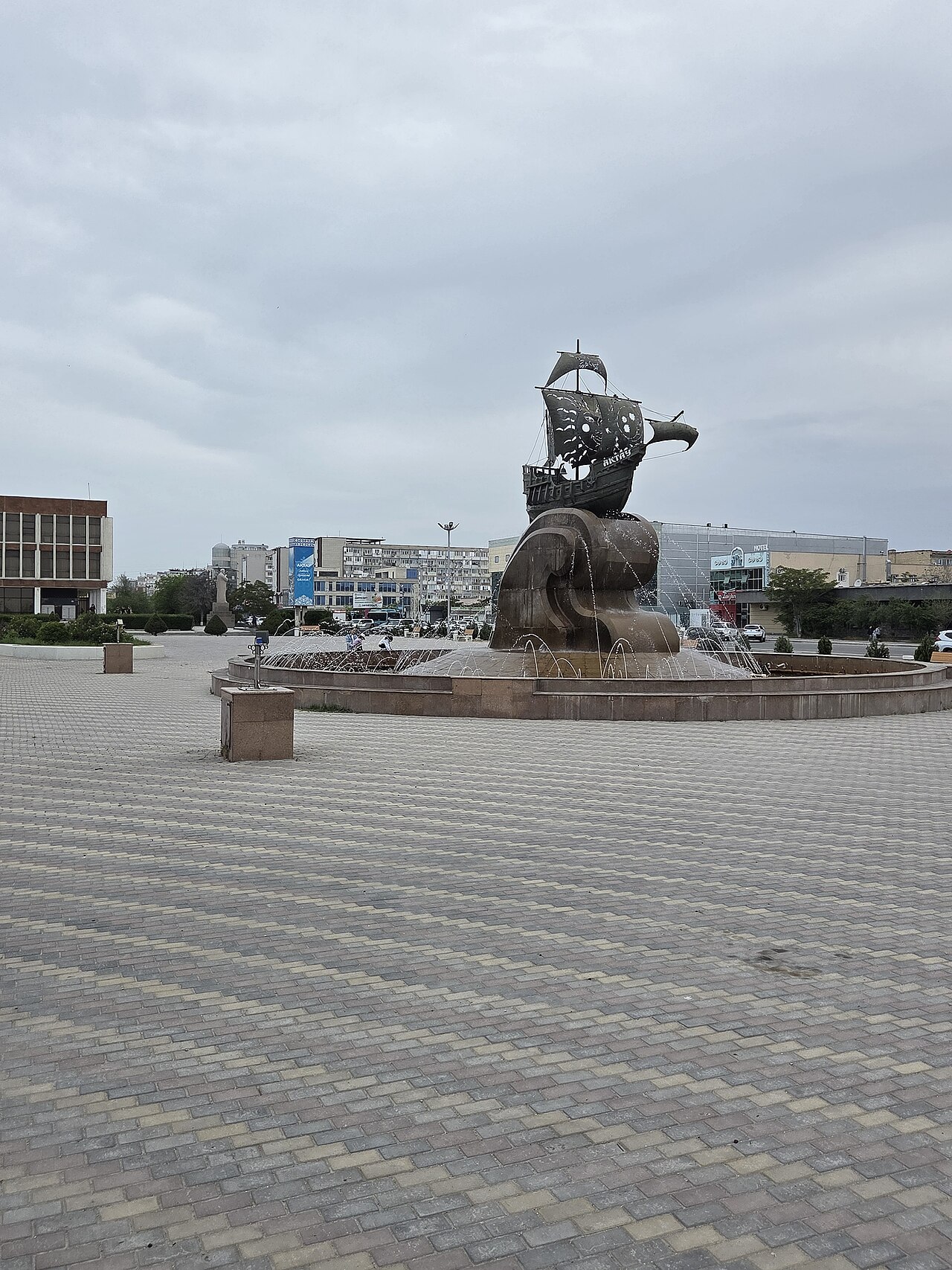
The bronze “Aktau” ship — a five-sailed sculpture in a fountain, sometimes described as a Santa María replica — sits in the 4th microdistrict and is the city’s most photographed object after the lighthouse. Elsewhere: a Taras Shevchenko monument unveiled in 1982, with steps running down to the sea; a monument to Zhalau Mynbayev; an equestrian Kurmangazy Sagyrbayuly; and a Triumphal Arch built in 2021 between microdistricts 19 and 20.
Two things to skip, and one name to get right
The Mangyshlak Experimental Botanical Garden is mostly of scientific interest, though since 2021 it has been trying to grow three species of frost-resistant palm, which is a very Aktau kind of experiment. And the city’s main mosque is the Beket-Ata Central Mosque, with a 50 m minaret and capacity for over 2,000 — not the “Aktau Grand Mosque,” which doesn’t exist. Kazakhstan’s Grand Mosque is in Astana.
Can you swim in the Caspian at Aktau?
Yes, but manage your expectations, and ignore the “warm Caspian” cliché.
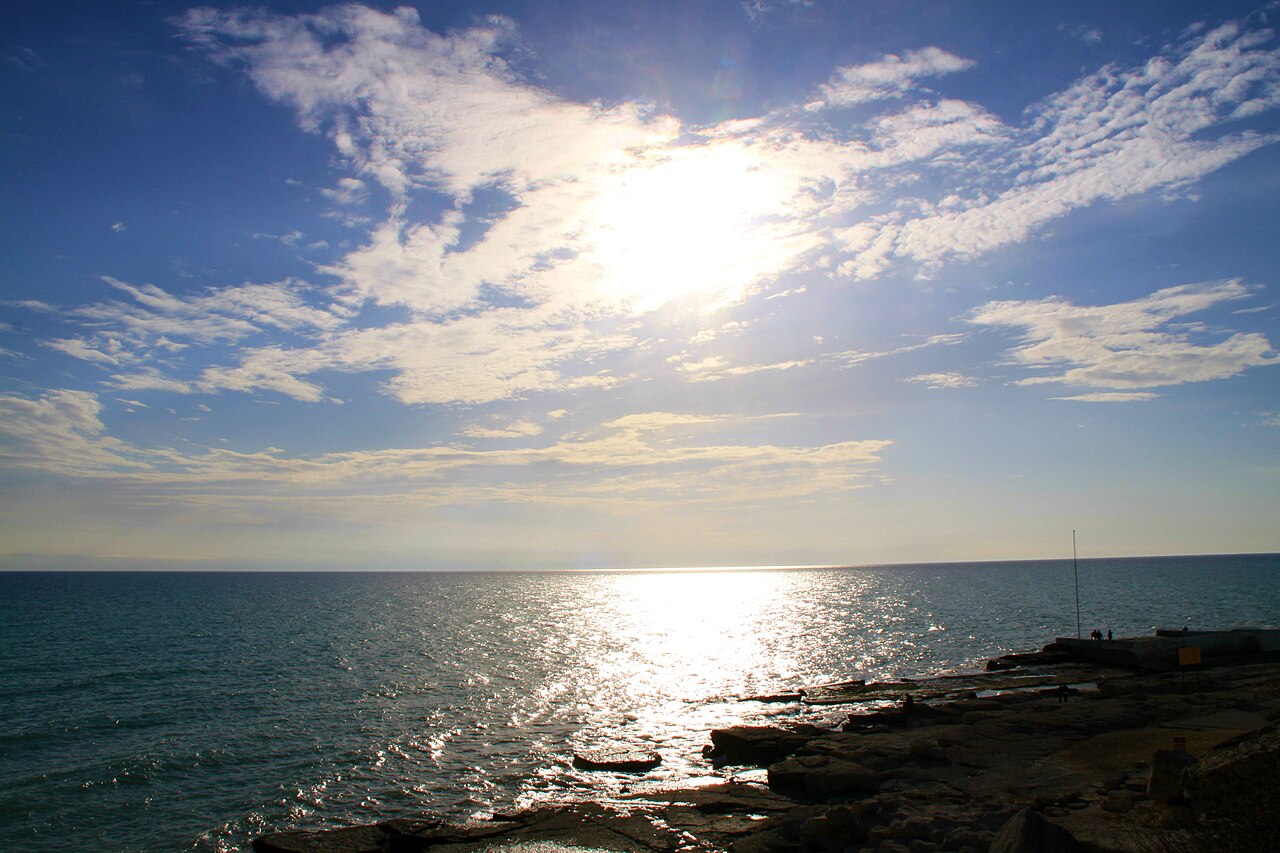
Inside the city the shore is largely bare limestone shelf — flat rock you can walk out on and jump off, not sand. The good sand is at the paid beach clubs: Dostar, Manila and Nur Plaza are the main central ones, with loungers, lifeguards and watersports (alcohol is banned at Manila). The season runs roughly from late June to September.
Now the numbers, because nobody publishes them and they matter. Aktau’s sea temperature averaged 18.9 °C across July 2026, ranging from 15.9 to 21.3. August 2025 averaged 20.8 °C, September 2025 19.6 °C. The warmest month on a multi-year average is August at about 22.4 °C. And it swings hard day to day: on 23 July 2026 the water read 16.5 °C; six days later it was 21.1 °C. That’s wind-driven upwelling pulling cold water to the surface. Bring the expectation of a bracing British sea, not a Mediterranean one.
On water quality, I’d rather give you the rule than a verdict: avoid swimming near the port and the industrial stretches, and use the monitored, lifeguarded beaches. I could find no authoritative bathing-water dataset for Aktau either way.
The Caspian is falling, and you can see it
This is the story of the decade on this coast, and it’s missing from every travel guide I checked.
Caspian sea levels dropped by more than two metres between 2006 and 2024. In the first half of 2025 the average in Kazakhstan’s sector fell to minus 29.3 metres, with the worst decline in the eastern Caspian — which is to say, here. Over the past five years levels in the northern and middle Caspian have fallen by close to a metre, and one March 2026 assessment described the sea as being at its lowest level in four hundred years.
What that means on the ground in Aktau:
- The port is too shallow. Average depth is now around 4.5 m against the 6.5–7 m needed for full operations. Dredging began in 2025 and is meant to restore capacity by the end of 2026.
- Ships carry less. Tankers are limited to roughly 3,100 tonnes, feeders to about 300 tonnes, grain carriers to around 1,200.
- Dredging is now a line item — roughly 400 million tenge a year — and re-berthing a grain vessel costs about a million tenge.
- Beaches are shrinking, forcing developers to redesign waterfront projects.
- The city’s water and power are exposed. Reduced inflow into the thermal plants’ intake channels threatens both.
It’s also the reason the ferry terminal is at Kuryk rather than Aktau: Kuryk sits in a natural bay with better weather for roll-on roll-off operations, and its channel has been dredged to seven or eight metres.
Getting to Aktau
By air
Aktau International (SCO, or UATE) opened in 1983 as Shevchenko-Central and has one terminal and one runway, about 25 km north-west of the city. It’s a focus city for SCAT.
Current routes, as best I can establish them: Air Astana to Almaty and Astana. SCAT to Almaty, Astana, Kokshetau, Karaganda, Shymkent, Turkistan, plus Tbilisi, Urgench and Yerevan. FlyArystan to Almaty, Aktobe, Astana, Atyrau, Oral and Shymkent, plus Baku, Doha, Dubai, Istanbul, Kutaisi, Ürümqi and seasonal Batumi. Azerbaijan Airlines to Baku, Pegasus to Istanbul Sabiha Gökçen, Aeroflot to Moscow Sheremetyevo, Red Wings to Yekaterinburg and Centrum Air to Nukus. Worth noting: Dubai is flown by FlyArystan, not flydubai. Schedules change, so confirm before booking — see flights to Kazakhstan and domestic flights in Kazakhstan.
Airport to city by ride-hailing ran about 5,200 tenge in July 2026; touts in the hall ask 8,000 to 10,000. Bus No. 6 serves the airport at 70 tenge by local transport card or 100 in cash, but it’s unreliable and the last one goes around 21:00.
By train
Here’s the trap. Trains use Mangystau station, formerly Mangyshlak, roughly 20 km outside Aktau. There is also a place called Aktau Station — in Karaganda region, about 2,000 km away. Book the wrong one and your day is ruined.
The journeys are long. Mangystau to Almaty-2 takes roughly 55 hours, with fares from about ₸29,975. Aktau to Astana runs around 48 hours, from about ₸13,117. Bus No. 105 links the station to town every ten minutes or so until 20:00, at 95 tenge by card or 160 cash, in a modern air-conditioned vehicle. If a two-day train sounds appealing rather than appalling, our Kazakhstan train travel guide explains the classes and what to bring.
By ferry
You cannot take a ferry to Aktau. The Caspian crossing from Azerbaijan runs from Alat, about 70 km south of Baku, to Kuryk, about 90 km south of Aktau. Crossings are under 24 hours of sailing with no published timetable, foot passengers pay roughly US$80 including meals and a berth, and the ticket office is in Aktau city at microdistrict 5, building 29. It is a genuinely cult overland route and it is also a lottery — see getting around Kazakhstan for how it compares with the trains and flights.
Climate: hot, dry and startlingly windy
Aktau’s official 1991–2020 normals give mean daily highs of 2.0 °C in January, 16.9 °C in April, 31.9 °C in July, 30.9 °C in August and 17.8 °C in October. Mean lows run from −3.6 °C in January to 21.9 °C in July. The record high is 44.1 °C (August), the record low −24.0 °C. Annual rainfall is a mere 168.7 mm spread over roughly 32 wet days a year, driest in August and September.
The underrated factor is wind. The windiest months are December at around 7.0 m/s, January at 6.8 and November at 6.7 — which in a city with no trees to speak of and a sea on one side is properly unpleasant. The sunniest months are August with about 28 clear days, then July with 27 and June with 26.
Practical upshot: September is the best month. The sea is still around 20 °C, the desert has dropped to a workable 20–25 °C, and you’re not competing with anyone. See Kazakhstan in summer if you’re locked into July or August.
Where to stay
Named, and checked. Rates move, so treat these as “from” figures.
| Rixos Water World Aktau | Five-star, billed as Kazakhstan’s only all-inclusive. Around 500 rooms, with a waterpark and amusement park included, about 20 km out of town on Warm Beach in District 34. Roughly 60,000–150,000+ KZT |
| Renaissance by Sulo | The former Renaissance Aktau — Marriott’s management contract ended on 30 April 2024, so it now trades under the Sulo name. 116 rooms, 150 m from the sea, indoor and outdoor pools. From about US$52 |
| Caspian Riviera Grand Palace | Five-star on the coast at the start of the Rock Trail, 1.4 km from the centre, with an aquarium and private embankment |
| Mid-range | Grand Hotel Victory, Grand Nur Plaza, Holiday Inn Aktau, Chagala Aktau, Zhagalau Resort, Rahat Hotel — roughly 15,000–40,000 KZT |
| Budget | Kaspi Hostel and similar; dorm beds from around 5,000 KZT. A one-bedroom flat in a residential microdistrict runs 15,000–20,000 KZT |
Our national guide to where to stay in Kazakhstan sets the price bands in context, and hostels in Kazakhstan covers the budget end.
Eating in Aktau
You’ll find the national repertoire — beshbarmak, manty, samsa, baursak, plov — plus Caspian fish, principally pike-perch. Mangystau is Aday-Kazakh country, so camel meat and shubat, fermented camel’s milk, are regional specialities worth trying at least once. There’s a large multicoloured sturgeon sculpture on the seafront square, a nod to a fishery that no longer really exists.
Which brings me to something worth knowing: commercial sturgeon fishing in the Caspian is banned, and the five littoral states extended the moratorium through 2026. Catch is permitted only for science and restocking. So if you see wild Caspian sturgeon or caviar advertised, it is farmed, imported, or illegal. Don’t order it as a local delicacy.
Venues that check out across more than one source: Restobar TOFU in microdistrict 7a for Japanese and Korean with sunset views; Pinta Bar & Grill; Bukowski Grill Bar in the 2nd microdistrict; Kaimak Café in the Ardager mall; plus the beach grills below the seafront hotels. Expect roughly 1,600–3,250 tenge for a local meal and 4,300–6,500 for a mid-range restaurant. Our Kazakh food guide and the piece on horse meat in Kazakhstan will prepare you for the menu.
Aktau is a base. Here’s what it’s a base for
The real reason to fly here is everything within a few hours’ drive. Approximate distances from Aktau:
| Karagiye depression | ~50 km — at −132 m, the lowest point in Kazakhstan and Central Asia |
| Sherkala and Torysh | ~170 km each — the yurt-shaped mountain and the valley of stone spheres |
| Shopan-Ata | ~250 km |
| Beket-Ata | ~280 km |
| Bozzhyra | ~270–300 km, four to five hours each way |
Almost all of it needs a 4×4, and none of it is reachable by public transport. Private guided tours run roughly 70,000–150,000 tenge per person per day; group tours cost considerably less. Bozzhyra, Torysh and Beket-Ata realistically need two to three days between them.
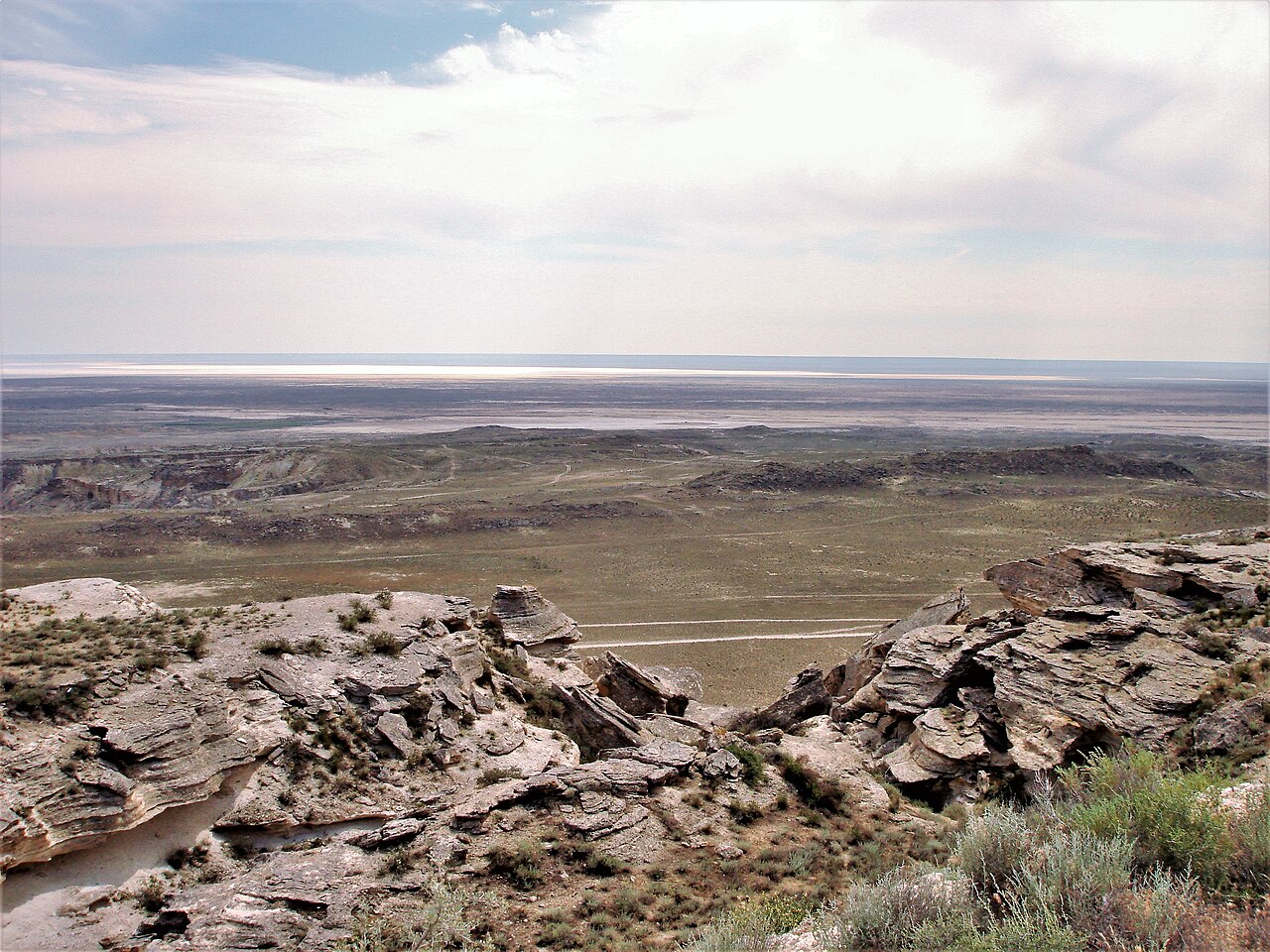
Start with our Mangystau and western Kazakhstan pillar for the full regional picture, then the deep dive on Bozzhyra if that chalk canyon is what brought you here. Aktau also earns its place in our round-up of the best cities in Kazakhstan and features in Kazakhstan off the beaten path.
Money and practicalities
The tenge sat at roughly 477 to the US dollar and 542 to the euro in Aktau in late July 2026. There are ATMs and card acceptance in the city, and essentially nothing beyond the city limits — no ATMs at all once you leave. Draw cash before any desert trip and carry more than you think you need, because some tour operators decline cards or add a surcharge.
Aktau feels safe and easy to walk. Its main practical hazards are heat, sun and wind rather than crime — see is Kazakhstan safe for the national picture, and Kazakhstan currency and money for cards, cash and exchange.
Frequently asked questions
Is Aktau worth visiting?
As a destination in itself, marginally — half a day to two days covers it. As a base for Mangystau, absolutely. The desert landscapes within a few hours’ drive are among the most extraordinary in Central Asia, and Aktau is the only realistic way in.
Why does Aktau have no street names?
It was built as a closed nuclear city, laid out as numbered microdistricts with numbered apartment blocks, which made street names unnecessary. Nobody ever changed it. Addresses are three numbers — microdistrict, building, flat, as in 14-42-30 — and you only need the first two for a taxi. Use 2GIS or Yandex Maps; foreign mapping apps struggle.
How many days do you need in Aktau?
One or two days for the city, plus three to five for the desert. Five to seven days total is the shape most people settle on.
Can you swim in the Caspian Sea at Aktau?
Yes, from late June to September. The in-city shore is mostly bare limestone rather than sand; for sand, use the paid beach clubs like Dostar, Manila or Nur Plaza. Avoid the port and industrial stretches. The water is cooler than most people expect — around 19 °C in July, about 22 °C in August.
What was Aktau called before?
Melovoye when it was founded in 1958, then Guryev-20 as a closed city, then Aktau in 1963, then Shevchenko from 1964 to 1991, when the name Aktau was restored. The airport code SCO is a leftover from Shevchenko.
How do you get from Almaty to Aktau?
Fly — Air Astana, SCAT and FlyArystan all serve the route in about three hours. The train takes roughly 55 hours from Almaty-2 to Mangystau station, from about ₸29,975, which is an experience rather than a transport choice.
Does the Baku ferry still go to Aktau?
No. Since 2018 the Caspian crossing has used Alat, around 70 km south of Baku, and Kuryk, about 90 km south of Aktau. Aktau port handles cargo — grain, oil and containers — and no passenger service calls there.
Which airlines fly to Aktau?
Air Astana, SCAT, FlyArystan, Azerbaijan Airlines, Pegasus, Aeroflot, Red Wings and Centrum Air, with domestic connections to Almaty and Astana and international links to Baku, Istanbul, Dubai, Doha, Tbilisi, Yerevan and Ürümqi among others. Routes change seasonally, so check before booking.
Is Aktau expensive?
No. A local meal runs roughly 1,600–3,250 tenge, a mid-range restaurant 4,300–6,500, a city bus 70 tenge, a mid-range hotel room 15,000–40,000 a night. The desert tours are what cost money — budget 70,000–150,000 tenge per person per day for a private guided trip.
What is the best time of year to visit Aktau?
September. The sea is still swimmable at around 20 °C, the desert has cooled to 20–25 °C, and the crowds have gone. April and May are the other good window. July and August are brutally hot inland; November to February brings the wind.
Final thoughts
Aktau isn’t a beautiful city and it doesn’t pretend to be. It’s a rational grid of Soviet blocks on a limestone shelf above a shrinking sea, with a lighthouse on a roof and no street names, built in the middle of a desert because there was uranium under it. Once you accept that, it’s genuinely interesting — and the museum and an evening on the Rock Trail will tell you more about western Kazakhstan than a week of reading.
But be clear about why you’re coming. Aktau is the door. What’s behind it — the chalk canyons, the stone spheres, the mosques carved into cliffs, the salt flats that turn into mirrors in spring — is one of the last genuinely strange landscapes left that you can reach on a scheduled flight. Give the city a day, then get in a 4×4 and go.
Photo credits
Rocky Caspian shoreline at Aktau — Photo: Rassim / CC BY-SA 4.0 via Wikimedia Commons. Melovoy rooftop lighthouse — Photo: IvarT / CC0 via Wikimedia Commons. The “Aktau” ship sculpture and fountain — Photo: IvarT / CC0 via Wikimedia Commons. Shaded seafront walkway — Photo: IvarT / CC0 via Wikimedia Commons. Afternoon light on the Caspian shoreline — Photo: Rassim / CC BY-SA 4.0 via Wikimedia Commons. Karagiye depression — Photo: Thermokarst / CC BY-SA 3.0 via Wikimedia Commons.


