Contents
- The short answer for travellers
- Kazakh and Russian: what the official status actually is
- Who speaks what: the numbers
- Language in Kazakhstan by region: a practical map
- Do they speak English in Kazakhstan?
- Reading Cyrillic in about an hour
- The Latin alphabet switch: what you will actually see
- Kazakh phrases worth learning — with the Russian equivalent
- Other languages you will hear
- What to do when nobody speaks your language
- Frequently asked questions
- Final thoughts
The first time I tried to buy a train ticket in Kazakhstan, I opened with my carefully rehearsed Kazakh. The woman behind the glass answered in Russian, watched my face go blank, sighed, and typed the price into a calculator. That exchange is the whole language situation in miniature: two languages running in parallel, English somewhere in the distance, and numbers doing a lot of quiet diplomatic work.
The direct answer: the main language in Kazakhstan is Kazakh, a Turkic language which is the state language and is spoken proficiently by around 80 per cent of the population. Russian is used officially alongside it in state institutions and remains the dominant everyday language of Almaty, Astana and the north. English is limited outside hotels, tourist businesses and the under-25s.
| Language | Status | Who speaks it | Where you will need it |
|---|---|---|---|
| Kazakh (Қазақ тілі) | State language | ~80% proficient; ~49% daily | South and west, rural areas, government signage |
| Russian | Used officially alongside Kazakh | ~84% proficient | Almaty, Astana, the north, taxis, markets, trains |
| English | Foreign language | ~35% claim some; real proficiency low | Hotels, tour operators, some cafés, young people |
| Uzbek, Uyghur, Tatar, German | Minority languages | 0.5–2.5% each | Specific communities in the south and north |
The short answer for travellers
If you are here for a fortnight and want to know what to actually do:
- In Almaty and Astana, you will get by in English in hotels, in the better restaurants, at tour desks and with anyone under about 25. Outside that bubble, no.
- Learn ten words of Russian, not Kazakh, if you only have time for one. Russian is what taxi drivers, market traders, train conductors and hotel receptionists in the north will use with you.
- Learn five words of Kazakh anyway. Saying rakhmet instead of spasibo costs you nothing and changes the temperature of an interaction, particularly in the south.
- Learn to read Cyrillic. Seriously. It takes an hour, and it converts an unreadable country into a mostly readable one. This is the single highest-value hour of trip preparation you can do.
- Download offline translation packs for both Russian and Kazakh before you fly.
Kazakh and Russian: what the official status actually is
Kazakh is the state language of Kazakhstan. Russian is not — but it holds a specific, protected status: it is used officially in state institutions and local government bodies alongside Kazakh. That has been the constitutional position since 1995, and it explains why so much official life happens in two languages at once, from parliamentary debate to the signage in a village post office.
Kazakhstan reportedly adopted a new constitution by nationwide referendum in March 2026, in force from July, in which the language provision was renumbered and its wording lightly revised — the phrase describing Russian’s use shifting from “on equal grounds with” to “alongside” Kazakh. Commentators read it as a subtle symbolic demotion; officials described it as an editorial fix to align the Kazakh and Russian texts. Either way, the practical position for a visitor is unchanged: both languages are in official use, and you will see both everywhere.
What has genuinely changed over the last decade is not the law but the demographics of who speaks what.
Who speaks what: the numbers
The 2021 census is the best data we have, and it is more interesting than the headline suggests.
- Kazakh: 80.1 per cent of the population reported speaking it proficiently.
- Russian: 83.7 per cent. Still, narrowly, the more widely understood language.
- English: 35.1 per cent claimed to speak it. Hold that thought.
The number that actually tells you something is this: only 49.3 per cent of the population uses Kazakh daily, and 63.45 per cent of ethnic Kazakhs do. There is a large gap between “can speak” and “speaks”, and that gap is where all the interesting social change is happening.
The direction of travel is clear. Kazakh-medium schooling has risen from roughly 38 per cent of pupils in 1992 to about 67 per cent in 2022. A Kazakh twenty-year-old today has been educated in Kazakh in a way their parents largely were not. Astana is now reportedly more Kazakh-speaking at home than Almaty. Over the next twenty years the balance will keep shifting.
Ethnic Russians make up roughly 15 per cent of the population, concentrated in the northern regions. Minority language proficiency from the same census: Uzbek 2.5 per cent, Uyghur 0.9, Turkish 0.6, German 0.6, Tatar 0.5, Azerbaijani 0.5, Korean 0.3, Kyrgyz 0.2, Ukrainian 0.1.
Language in Kazakhstan by region: a practical map
Kazakhstan is the size of Western Europe and the language balance shifts as you cross it. This is the map I keep in my head.
| Where | What you will hear | English? |
|---|---|---|
| Almaty | Russian dominant, Kazakh rising fast | Best in the country, in the right places |
| Astana | Both, with Kazakh strong at home | Good in hotels and the Left Bank |
| Shymkent and the south | Kazakh dominant, Uzbek in places | Little |
| Turkestan | Kazakh | At the main sites only |
| North (Petropavl, Kostanay, Pavlodar) | Russian dominant | Little |
| West (Aktau, Atyrau) | Kazakh, with oil-industry English pockets | Patchy |
| Rural anywhere | Kazakh in the south and west, Russian in the north | None, realistically |
If you are heading out to Mangystau or up into northern and eastern Kazakhstan, plan on a translation app and a lot of goodwill.
Do they speak English in Kazakhstan?
Here is where I am going to disagree with most of what you will read.
What the rankings actually say
The EF English Proficiency Index for 2025 places Kazakhstan 107th out of 123 countries, with a score of 417 against a global average of 488 — EF’s lowest band, and down ten points on the previous year. Several travel pages still cite a 2023 figure putting Kazakhstan around 57th and “moderate”. That is not the current picture.
So why does the census say 35 per cent?
Because the census asks people whether they can speak English and takes their word for it. “I did English at school and can read a menu” and “I can hold a conversation” both come out as yes. Both numbers are real; they measure different things. The honest synthesis: a third of the country has some English, and a much smaller slice can actually converse in it.
Where English genuinely works
The city-level data is the most useful thing in the whole EF report and nobody quotes it. Astana scores 460 and Almaty 457 — meaningfully above the national average. Then it drops off a cliff: Aktau 397, Shymkent 377, Taraz 376, Petropavl 376, Kyzylorda 369, Karaganda 337.
Translated into travel terms: mid-range and upper hotels, tour operators, the better restaurants in Almaty’s dining scene, museum ticket desks at the big national institutions, and almost any Kazakh in their early twenties. The Almaty metro is unusually helpful here — station names and announcements are in Kazakh, Russian and English, which is rare for post-Soviet transit.
Where it does not
Taxi drivers. Bus stations. Train conductors. Marshrutka drivers. Regional pharmacies. Anyone over 40 outside the tourism industry. Village guesthouses. Border officials, sometimes. The staff at the Kolsai lakes ticket booth.
None of this is a problem, and I want to be clear about that. Kazakhstan is a very easy country to travel in with no local language at all. It is just easier if you stop expecting English and start using the workarounds below.

Reading Cyrillic in about an hour
This is the part of the article I would most like you to actually do. Kazakh and Russian are both written in Cyrillic. Learn the alphabet and street signs, metro maps, shop fascias, menus and bus destinations all become legible. You do not need to understand the words — recognising that a shop says APTEKA and therefore sells medicine is enough.
The six letters that will trick you
Most Cyrillic letters either look like their Latin equivalent or look like nothing you know. The dangerous ones are the letters that look familiar and are not.
| Letter | Sounds like | Not |
|---|---|---|
| Р р | R | P |
| С с | S | C |
| Н н | N | H |
| В в | V | B |
| У у | U / oo | Y |
| Х х | Kh, as in Bach | X |
After that it is mostly mechanical: П = P, Г = G, Д = D, И = I (a backwards N), З = Z (looks like a 3), Ч = Ch (looks like a 4), Ж = Zh, Ш = Sh, Ы = a hard, swallowed “y”.
The nine extra Kazakh letters
Kazakh Cyrillic has 42 letters: the 33 Russian ones plus nine extras. Spotting these is how you tell at a glance whether a sign is in Kazakh or Russian.
| Letter | Latin (2021 alphabet) | Sound |
|---|---|---|
| Ә ә | Ä ä | “a” as in cat |
| Ғ ғ | Ğ ğ | throaty g, close to a French r |
| Қ қ | Q q | a deep k from the back of the throat |
| Ң ң | Ñ ñ | “ng” as in sing |
| Ө ө | Ö ö | “u” as in burn |
| Ұ ұ | Ū ū | “u” as in put |
| Ү ү | Ü ü | French “tu”, German “über” |
| Һ һ | H h | “h” as in hotel |
| І і | I ı | short “i” as in bit |
Twenty words to recognise on sight
Kazakh first, Russian second where they differ: Ашық / Открыто (open) · Жабық / Закрыто (closed) · Кіру / Вход (entrance) · Шығу / Выход (exit) · Дәріхана / Аптека (pharmacy) · Дәретхана / Туалет (toilet) · Ерлер / Мужской (men) · Әйелдер / Женский (women) · Вокзал (station) · Метро · Базар · Тарту (pull) · Итеру (push) · Банк · Кафе · Мейрамхана / Ресторан (restaurant) · Дүкен / Магазин (shop) · Қонақ үй / Гостиница (hotel) · Автобус · Такси.
The Latin alphabet switch: what you will actually see
You may have read that Kazakhstan is changing from Cyrillic to Latin script. It is — slowly, and with several false starts.
A presidential decree in October 2017 ordered the transition by 2025. In early 2021 that deadline was pushed to 2031, with a phased rollout from 2023. There have been four versions of the Latin alphabet since 2017 — apostrophes, then acute accents, then umlauts and breves, then the current 31-letter version adopted in April 2021. President Tokayev has repeatedly said the change must not be rushed.
What that means on the ground in 2026: Kazakhstan is still overwhelmingly Cyrillic. Books, newspapers, menus, most street signs and all Russian text are in Cyrillic. Latin-script Kazakh turns up on newer government nameplates, some shop and pharmacy fascias, first-grade textbooks and the Qazlatyn.kz portal. Note also that Russian is not part of the transition and will stay in Cyrillic permanently.
So: learn Cyrillic. The Latin alphabet is a bonus, not a substitute, and the 2031 target has already slipped once.
Kazakh phrases worth learning — with the Russian equivalent
Every phrase list you will find is either Kazakh-only or Russian-only, which is unhelpful given that you will need both. Here is the pairing. Stresses are marked in capitals.
Greetings and politeness
| English | Kazakh | Say it | Russian |
|---|---|---|---|
| Hello (formal) | Сәлеметсіз бе? | sa-lem-et-SIZ be | Здравствуйте (zdrast-VUY-tye) |
| Hi (informal) | Сәлем | sa-LEM | Привет (pri-VYET) |
| Good morning | Қайырлы таң | kai-yr-LY TANG | Доброе утро |
| Good evening | Қайырлы кеш | kai-yr-LY KESH | Добрый вечер |
| Goodbye | Сау болыңыз | sow bo-lyng-YZ | До свидания (da svi-DA-ni-ya) |
| Thank you | Рақмет | rakh-MET | Спасибо (spa-SI-ba) |
| Thank you very much | Көп рақмет | KUP rakh-MET | Большое спасибо |
| Please | Өтінемін | UH-ti-ne-min | Пожалуйста (pa-ZHAL-sta) |
| Yes / No | Иә / Жоқ | ee-YA / ZHOK | Да / Нет |
| Excuse me, sorry | Кешіріңіз | ke-shi-RING-iz | Извините (iz-vi-NI-tye) |
| Welcome | Қош келдіңіз | KOSH kel-DING-iz | Добро пожаловать |
Getting around and getting stuck
| English | Kazakh | Say it | Russian |
|---|---|---|---|
| I don’t understand | Мен түсінбеймін | men tü-sin-BAY-min | Я не понимаю (ya nye pa-ni-MA-yu) |
| Do you speak English? | Сіз ағылшынша сөйлейсіз бе? | siz a-gyl-shyn-SHA suy-lay-SIZ be | Вы говорите по-английски? |
| Where is the toilet? | Дәретхана қайда? | dah-ret-kha-NA kai-DA | Где туалет? (gdye tu-a-LYET) |
| How much does this cost? | Бұл қанша тұрады? | BOOL kan-SHA tu-ra-DY | Сколько стоит? (SKOL-ka STO-it) |
| Expensive | Қымбат | kym-BAT | Дорого |
| I’m lost | Мен адасып кеттім | men a-da-SYP ket-TIM | Я заблудился |
| Help! | Көмектесіңіз! | kuh-mek-te-SING-iz | Помогите! (pa-ma-GI-tye) |
| I need a doctor | Маған дәрігер керек | ma-GAN dah-ri-GER ke-REK | Мне нужен врач |
At the table
| English | Kazakh | Say it | Russian |
|---|---|---|---|
| Delicious! | Дәмді! | dam-DI | Вкусно! |
| Bon appétit | Ас дәмді болсын | as dam-DI bol-SYN | Приятного аппетита |
| The bill, please | — | use the Russian | Счёт, пожалуйста (shchot, pa-ZHAL-sta) |
| Safe travels | Жолыңыз болсын | zho-lyng-YZ bol-SYN | Счастливого пути |
| My name is… | Менің атым… | me-NING a-TYM | Меня зовут… |
| Good / fine | Жақсы | zhak-SY | Хорошо |
Two notes on things you may see written elsewhere. There is no standard Kazakh greeting “kesh zhaqsy” — the correct forms for good evening are Қайырлы кеш and Кеш жарық (literally “bright evening”). And you will see рақмет and рахмет both used for thank you; the first, with қ, is the standard orthography and matches the official Latin raqmet.
Other languages you will hear
Kazakh belongs to the Kipchak branch of the Turkic family. Its closest relatives are Karakalpak, Nogai, Kyrgyz, Bashkir and Volga Tatar. Kazakh and Kyrgyz are close enough for genuine mutual intelligibility — Kazakhs and Kyrgyz can broadly follow each other, which is worth knowing if you are doing a combined Kazakhstan and Kyrgyzstan trip.
Kazakh and Turkish, despite what a lot of blogs claim, are not mutually intelligible. Turkish sits in the Oghuz branch; there are shared roots and a shared grammatical architecture, but a Kazakh speaker cannot simply understand Turkish without study. Uzbek sits somewhere in between.
Kazakh and Russian are entirely unrelated — Turkic versus Slavic. Kazakh has no grammatical gender, puts the verb at the end, stacks suffixes rather than using prepositions, and runs on vowel harmony. The only real overlap is the large body of Russian loanwords for modern and technical vocabulary.
Kazakh has roughly 13 million speakers worldwide: about 10 million in Kazakhstan, a million in China’s Xinjiang, over half a million in Russia and a substantial community in western Mongolia. Kazakhs in China write the language in an Arabic-based script — a third alphabet for the same language.
Elsewhere in the mix you will find Uzbek around Shymkent and Turkestan, Uyghur in and around Almaty, Tatar in the north, German as a legacy of the Volga German deportations (most emigrated after 1991) and Korean from the 1937 deportations. Kazakhstan counts more than 130 ethnic groups, and in Almaty on a good day you will hear four or five languages in a single market hall.

What to do when nobody speaks your language
This happens constantly and it is fine. The tactics that work:
- Yandex Go. The app has an English interface and you set your destination on a map, so the driver never needs to understand a word you say. This single app removes most of the language friction in Kazakh cities. inDrive works the same way. See our guide to taxis and Yandex Go.
- Offline translate packs. Download Russian and Kazakh in Google Translate or Yandex Translate before you fly. The camera-translate function on a menu or a train timetable is close to magic.
- Photograph the sign. If you need to get back somewhere, take a picture of the building, the street nameplate and the metro station. Showing a photo beats describing a place in a language you do not have.
- Write it down. Have your accommodation write its address in Cyrillic on a card. Hand the card to a driver.
- Numbers on a phone screen. The universal solution to price negotiation. Type it, show it, done.
- Ask a teenager. If you need help in a station or a mall, look for someone in their late teens or early twenties. School English is much better than it was a generation ago, and young Kazakhs are almost universally willing to help.
- Watch for place-name mismatches. Many cities and streets have both a Kazak and a Russian form (Oral / Uralsk, Oskemen / Ust-Kamenogorsk, Semey / Semipalatinsk). Your map app and the departure board may disagree. Know both forms for anywhere you are travelling to.
Frequently asked questions
What language do they speak in Kazakhstan?
Kazakh and Russian, in that constitutional order but not always in that practical order. Kazakh is the state language and is spoken proficiently by about 80 per cent of the population. Russian is used officially alongside it and is understood by about 84 per cent, and it dominates daily life in Almaty, Astana and the northern regions.
Do they speak English in Kazakhstan?
Some. Kazakhstan ranks 107th of 123 countries in the 2025 EF English Proficiency Index. In practice you will find English in hotels, tour companies, better restaurants and among young people in Almaty and Astana, and very little elsewhere. It is not a barrier to travelling here, but do not plan around it.
Is Russian or Kazakh more widely spoken?
By raw proficiency, Russian is still marginally ahead (83.7 versus 80.1 per cent in the 2021 census). By trend, Kazakh is gaining quickly, particularly among the under-30s and in the south and west. Geography decides which you hear more: Kazakh in Shymkent and Turkestan, Russian in Petropavl and much of Almaty.
Is Russian an official language in Kazakhstan?
Russian is not the state language, but it has official status for use in state institutions and local government alongside Kazakh. In everyday terms both languages appear on official documents, signage and government websites.
What alphabet does Kazakhstan use?
Cyrillic, in practice. Kazakh Cyrillic has 42 letters — the 33 Russian ones plus nine extras (ә, ғ, қ, ң, ө, ұ, ү, һ, і). A transition to a Latin alphabet is under way with a current target of 2031, but as of 2026 the great majority of what you will see is still Cyrillic.
Is Kazakh similar to Russian?
No. They are from completely different language families — Kazakh is Turkic, Russian is Slavic. Different grammar, different word order, no shared core vocabulary. Kazakh does contain a lot of Russian loanwords for modern concepts, which is the only significant overlap.
Is Kazakh similar to Turkish?
Related but not mutually intelligible. Both are Turkic, but from different branches. A Kazakh speaker will recognise many roots in Turkish and follow the grammatical logic, and will still not be able to hold a conversation without study. Kazakh and Kyrgyz, on the other hand, are close enough to understand each other.
Is Kazakh hard to learn?
For an English speaker, moderately. The grammar is agglutinative and regular — suffixes stack in predictable order, there is no gender and no articles — which makes it more logical than Russian in some respects. The sound system, vowel harmony and word order take adjustment. Learning to greet, thank and count is easy and pays off immediately.
What language should I learn before visiting?
If you are visiting for a fortnight, learn the Cyrillic alphabet and ten words of Russian. If you are spending months here, or your trip is weighted to the south and west, put your effort into Kazakh — it is the future of the country and it earns you enormous goodwill.
Can I get by in Kazakhstan with only English?
Yes. Thousands of people do every year. Ride-hailing apps, translation apps, offline maps and the general helpfulness of Kazakhs make it entirely workable. You will have a better trip if you can read Cyrillic and say thank you properly.
Final thoughts
Language in Kazakhstan is not a problem to be solved so much as a texture to notice. You will hear a family switch mid-sentence from Kazakh to Russian and back. You will see a shop sign in Latin-script Kazakh next to one in Cyrillic next to one in Russian. You will meet a twenty-two-year-old in Almaty whose English is better than her grandmother’s Kazakh, and a driver in Turkestan who speaks neither Russian nor English and gets you where you are going anyway.
Do the hour on Cyrillic. Learn rakhmet and spasibo and use whichever seems to fit. Keep Yandex Go and an offline translation pack on your phone. That combination will carry you from Almaty to the Caspian without a single genuinely stuck moment.
If you are still planning, our guides to safety and practicalities, getting around the country, Kazakh culture and SIM cards and staying connected are the natural next reads. For food vocabulary specifically, the Kazakh food guide will give you the dish names you need on a menu.
Photo credits
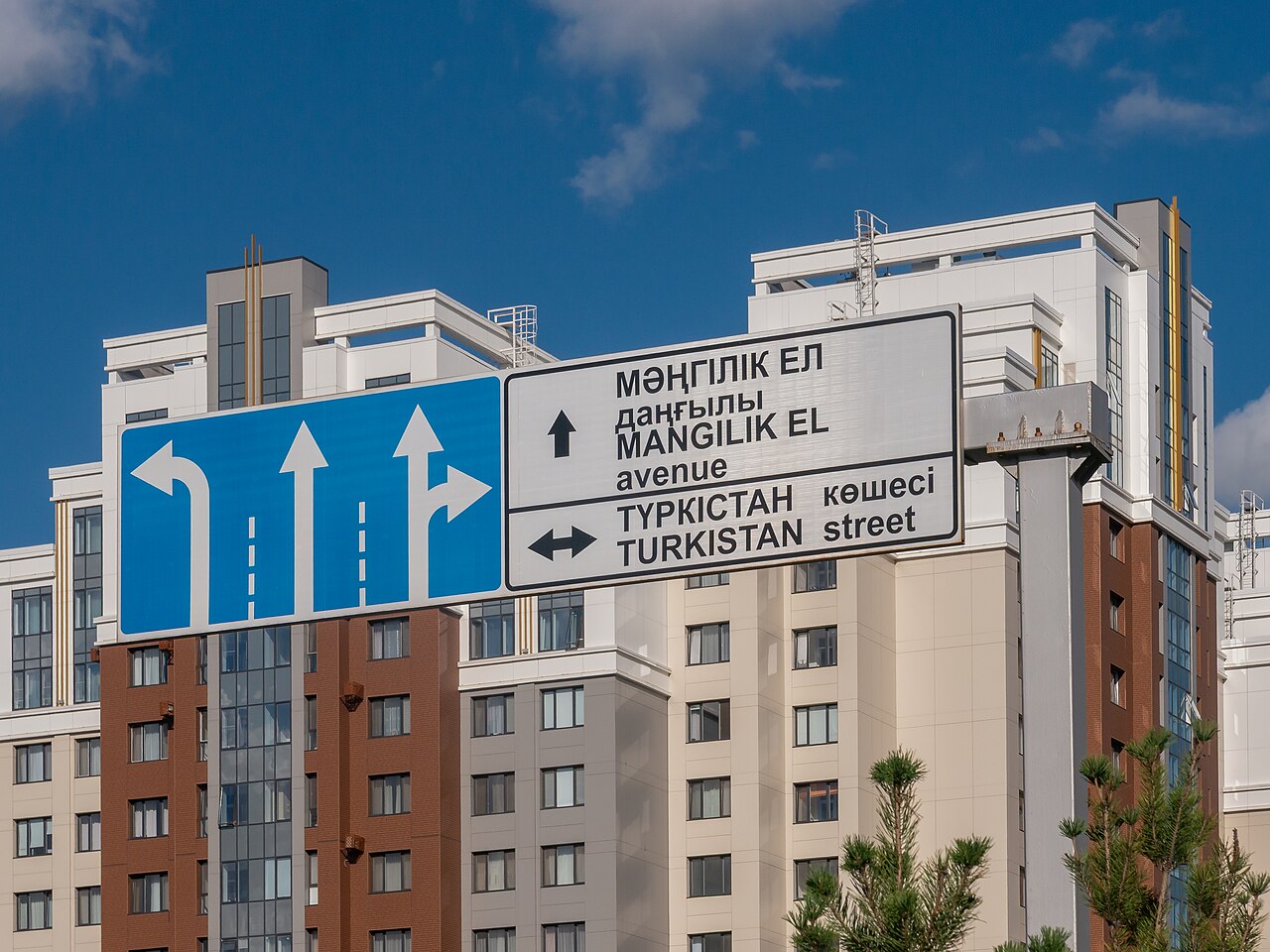
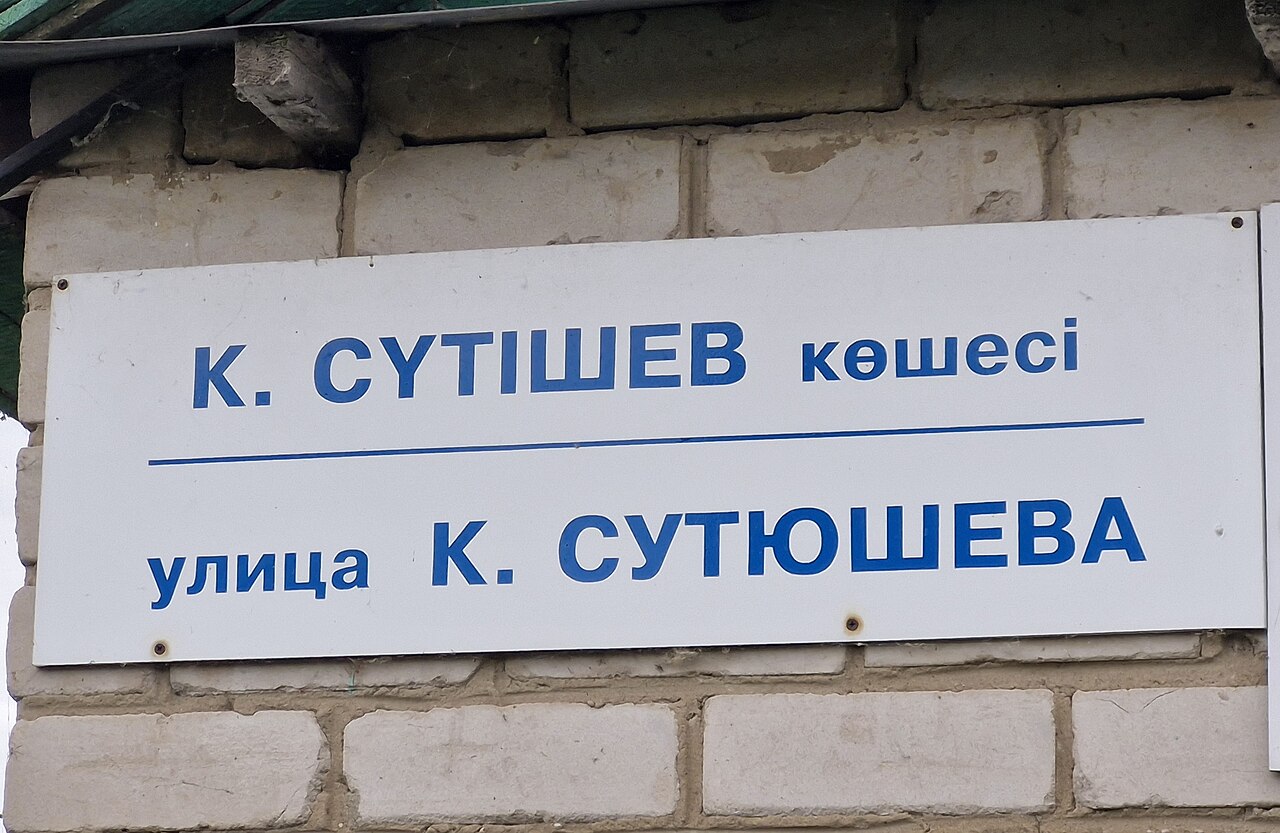
Trilingual road sign, Astana — Matti Blume, CC BY-SA 4.0, via Wikimedia Commons. Almaty metro platform — Alex J. Butler, CC BY 2.0, via Wikimedia Commons. Kazakh and Russian street nameplate — Muzaffar Turgunov, CC0, via Wikimedia Commons. Green Bazaar, Almaty — Carl Malamud, CC0, via Wikimedia Commons.