
Contents
- The short answer: best time to visit Almaty by trip type
- Almaty weather month by month
- Almaty season by season
- Best time for skiing and snow
- Best time for hiking and the mountains
- Best time for day trips from Almaty
- The shoulder seasons: the smart traveller’s sweet spot
- Worst times and months to avoid
- Festivals and events worth timing a trip around
- Hotel prices and crowds by season
- What to pack by season
- Frequently asked questions
- How many days do you need in Almaty?
- Final thoughts
Almaty changes more with the seasons than most cities do. Winter brings deep snow, spring brings rain, July brings real heat, and in autumn the café terraces are still open under the mountains. Each season has its case, and I have opinions about all of it.
So here’s the short version. The best time to visit Almaty is September, when the days are warm (around 24°C), the air is dry and clear, and summer’s crowds have thinned. Late April to June is a close second for spring bloom and green hills, and December to March is the window if you’re here to ski. Everything else is a trade-off, and below I’ll walk you through exactly what each month feels like on the ground.
Almaty is a mountain city, and that changes everything about timing. You can sit in a T-shirt on a café terrace downtown and, the same day, ride the lifts above Shymbulak to about 3,200 metres. The seasons don’t just change the weather; they change which half of the city — the streets or the peaks — is actually worth your time. This guide is the companion to my wider piece on the best time to visit Kazakhstan; here I’m zooming right in on Almaty and its mountains.
The short answer: best time to visit Almaty by trip type
Almaty rewards different visitors in different months. If I had to hand you a single cheat-sheet, it would be this one.
| You’re here mainly for… | Best months | Why |
|---|---|---|
| The city, cafés, culture | May–Jun, Sep | Warm, dry, terraces open, comfortable for walking |
| Hiking & the high mountains | Jul–Sep | High trails and lakes at their most accessible; old snow can linger above 3,000 m |
| Skiing & snow | Late Nov–Mar (best Jan–Mar) | Reliable snow at Shymbulak; cheap lift passes |
| Charyn Canyon & day trips | Apr–Jun, Sep–Oct | Comfortable temperatures; midsummer canyon heat avoided |
| Spring bloom (poppies, tulips) | Late Apr–May | Wild flowers on the steppe and foothills |
| Autumn gold & photography | Mid-Sep–early Oct | Golden larch, clear light, thin crowds |
| Lowest prices | Nov–Feb (skip New Year week) | Cheapest rooms, but cold and hazy in the city |
If you take nothing else from this article: September is the sweet spot, winter is only for skiers, and April can be gorgeous or grey depending on the week. Now the detail.
Almaty weather month by month
These are the long-term averages (based on 1991–2020 normals). Almaty’s climate is continental, so day-to-day swings are big — a warm April afternoon can turn to sleet by evening — but the pattern is dependable. Note the two things that catch people out: April, not July, is the wettest month, and September is the driest.
| Month | Avg high | Avg low | What it feels like |
|---|---|---|---|
| January | 0°C | −8°C | Cold, often hazy in the city; great snow up the hill |
| February | 3°C | −6°C | Coldest nights, best mid-winter skiing |
| March | 10°C | 0°C | Thawing, muddy, unpredictable; Nauryz late in the month |
| April | 18°C | 7°C | Green and blooming but the wettest month (~110 mm) |
| May | 23°C | 11°C | Warm, poppies out, still some rain; lovely overall |
| June | 28°C | 16°C | Early summer, long days, mountains fully open |
| July | 30°C | 19°C | Hottest month; the city empties into the hills |
| August | 30°C | 17°C | Hot and dry; peak lake and trail season |
| September | 24°C | 12°C | The best month: warm, dry, clear |
| October | 17°C | 5°C | Crisp autumn; first city snow possible late month |
| November | 8°C | −1°C | Grey and cooling; ski season starts up top |
| December | 2°C | −6°C | Cold, festive, New Year lights; snow on the slopes |
Almaty season by season
Spring (March–May): green, blooming and a bit of a gamble
Spring is when Almaty comes back to life, and it’s genuinely beautiful — but it’s the season I’d most warn you to keep expectations flexible. March is thaw season: brown snow, mud, and skies that can’t decide. Things turn quickly in April, when the orchards blossom (this is the “father of apples”, after all) and the foothills green up. The catch is that April is statistically the wettest month, so pack a shell and don’t over-plan mountain days.
May is the payoff. The wild poppies come out on the steppe and lower slopes, usually mid-month, and on a good day it’s one of the prettiest sights near the city. Wild tulips — Kazakhstan is the ancestral home of the tulip — bloom from late April. Days are warm and pleasant. Two cautions: the higher mountain trails can still hold snow, and avalanche risk with it, and tick season begins, so use repellent if you’re walking through long grass.

Summer (June–August): hot city, glorious mountains
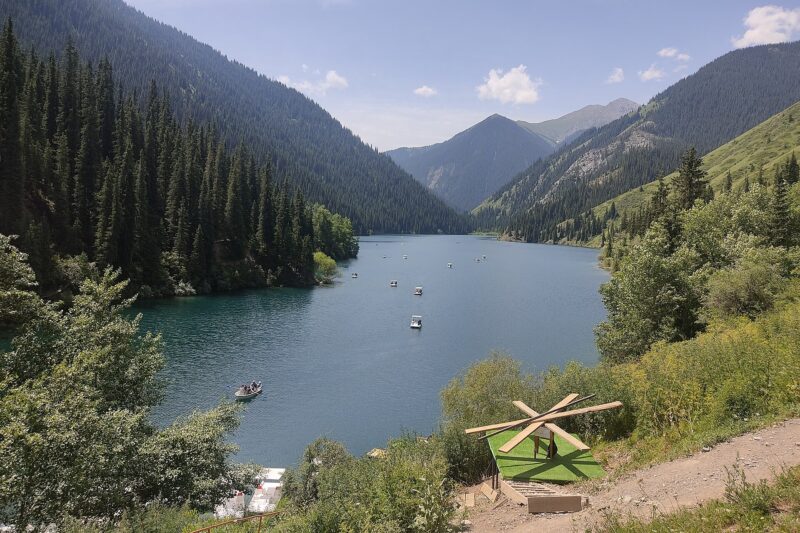
Summer splits Almaty in two. Down in the city it gets hot — July and August highs average around 30°C — and the streets can feel heavy and dusty by mid-afternoon. But this is exactly when the mountains are at their best. Most trails are open (check the highest routes for old snow), Big Almaty Lake is a turquoise mirror, and the Kolsai Lakes are ice-free and swimmable-adjacent (they’re cold, but you’ll want to try).
The rhythm locals follow is simple: do the city early, escape uphill by lunch. Popular guesthouses near the lakes are worth booking ahead. If you’re chasing cool air and alpine scenery, though, July and August are unbeatable — just don’t expect to enjoy a midday walk around downtown.

Autumn (September–November): the best of Almaty
If you make me pick, I’ll always pick September. The heat breaks, the humidity and dust settle, and the light turns crisp and clear. Daytime highs average about 24.5°C. As the month goes on, autumn reaches the mountains, the Charyn foliage follows in late September and October, and photographers get clear, crisp light. Crowds thin as the domestic season ends. It is, quite simply, the month the city looks its best.
October keeps a lot of that magic but cools fast — expect crisp mornings, and the first city snow can arrive by late month. November is the grey shoulder: cooling, often overcast, and the point where the good weather has clearly gone but the ski season hasn’t quite arrived. If you can only travel in autumn, aim for the four weeks from about 10 September to 10 October.

Winter (December–February): skiers only, and the smog question
Winter Almaty is a tale of two altitudes. Up at Shymbulak and Medeu the snow is excellent and the mountains are stunning; down in the city it can be a harder sell. Almaty sits in a bowl against the mountains, and in December and January cold-air inversions trap car exhaust and coal smoke over the streets. On bad days the air quality is genuinely poor — well above WHO limits — and the city looks hazy and grey. The good news is that the mountains sit above the inversion layer, so the fix is literally to go up: the air at Shymbulak on a smoggy city day is clean and bright.
So my honest take: come in winter if you’re here to ski or to combine Almaty with a wider Kazakhstan in winter trip. If you’re here mainly for the city, its cafés and its day trips, winter is the weakest season. The exception is the festive season around New Year, when the centre is strung with lights and there’s a real holiday buzz — though if you plan to stay over New Year, check hotel availability and rates for your dates before you commit.

Each season gets its own countrywide guide: Kazakhstan in spring, summer and autumn, with the full breakdown in Kazakhstan weather by month.
Best time for skiing and snow
Almaty is one of the most underrated ski cities anywhere, mostly because people don’t realise a proper resort sits twenty-five minutes from downtown. The season at Shymbulak typically runs from late November into April, with the most reliable snow from January through March. The resort spans roughly 2,260 to 3,200 metres, and a day lift pass runs around 25–40 US dollars with rentals from about 15–25 — a fraction of what you’d pay in the Alps.
Below Shymbulak sits Medeu, the world’s highest outdoor speed-skating rink at 1,691 metres. The rink is closed for reconstruction, with completion planned for the fourth quarter of 2027, so there is no public skating there for now; Medeu is still where the gondola starts. Even if you don’t ski, a winter day riding the gondola up from Medeu to Shymbulak, standing in clean high-altitude sun above the city haze, is one of Almaty’s great experiences. For non-skiers, February gives you the deepest snow scenery; for skiers, any time from January to mid-March is prime.
Best time for hiking and the mountains
The high country around Almaty is the reason many people come, and it runs on a tight snow calendar. Lower foothill trails — Kok Zhailau, the Butakovka valley, the paths behind Medeu — are walkable from roughly May through October. Higher up, the passes and lakes are another matter: the alpine zone between 3,000 and 3,600 metres can keep old snow even in summer, so July and August are no guarantee, and you should check conditions for your specific route before setting out.
If your trip is built around hiking in Kazakhstan, aim for July to mid-September. June can still hold snow on the highest routes and September nights get cold quickly at altitude, but both are workable with the right gear. Whatever the month, mountain weather here changes fast, so carry layers even on a warm city morning.
Best time for day trips from Almaty
Almaty is a launchpad, and each of the big day trips from Almaty has its own best window. This is the part most guides skip, so here’s the site-by-site version.
Charyn Canyon is best in April–June and September–October. The Valley of Castles bakes in midsummer and the gorge floor has little shade, so if you must go in July or August, start at dawn and carry plenty of water and sun protection. Spring and autumn give you comfortable walking and, in October, golden riverine foliage. Big Almaty Lake sits at about 2,500 m, so it’s chilly even in the shoulder months. Summer and early autumn are the easy time to go; you can visit in winter too, but the road is harder, so check road restrictions and mountain conditions before you travel. The Kolsai and Kaindy Lakes shine from June to September, when the water is ice-free and that unreal turquoise; the rough road to Kaindy is also easier without snow.

The shoulder seasons: the smart traveller’s sweet spot
If you want my actual recommendation rather than the safe one, it’s this: target the shoulder weeks. Late April to early June, and the four weeks of September, give you the best balance of open sites, comfortable temperatures, real bloom or autumn colour, and prices below the July–August peak. You trade a little certainty — spring can throw a wet week, and the very highest trails may not be clear until later — for a city and mountains that feel alive but not crowded.
September edges it because the weather is more dependable than spring. But a good week in mid-May, with poppies on the hills and the whole city out on the terraces, is hard to beat. Both are better all-round bets than the extremes of midsummer heat or midwinter haze.
Worst times and months to avoid
No month is a write-off, but a few are worth going in with eyes open. Late December to January in the city is the smog risk — beautiful up the mountain, hazy and cold below. March is the mud-and-slush shoulder, when winter’s charm has gone but spring hasn’t arrived. November is the other flat spot: grey, cooling, and before the ski season is properly underway. And midsummer midday in the city (not the mountains) can be genuinely unpleasant if you’re trying to sightsee downtown at 2pm in a heatwave. None of these should cancel a trip — just plan around them (go up the hill; carry a shell; time your day trips).
Festivals and events worth timing a trip around
A few dates can shape when you come. Nauryz, the spring-equinox new year and one of Kazakhstan’s major holidays, falls on 21–23 March: the city fills with yurts, outdoor concerts, horse games and stalls of nauryz-kozhe and baursak, and it’s a colourful cultural moment despite the iffy weather. The Almaty Apple Festival, a nod to the city’s apple heritage, comes round again each year (the 2024 edition was held in the Park of the First President on City Day), and the Almaty Marathon is an autumn fixture, run on 27 September in 2026. Both organisers announce the next dates on their own sites and social channels. Summer sees ethnic-music festivals like Spirit of Tengri, and from December the centre lights up for the New Year season. If you love a good market and a party, Nauryz is worth tolerating March’s mud for.
Hotel prices and crowds by season
Almaty is affordable year-round by international standards, but there’s a clear seasonal curve. July and August are the summer holiday months, when mid-range city rooms that might be 40 US dollars in winter push toward 80–130. If you plan to be here over New Year, check availability and rates for your exact dates before you book. The low season is November to February (New Year aside), when budget beds can drop to 15–25 dollars. The value champion is September — you get the best weather of the year at shoulder-season prices, because the domestic peak has just ended. For a fuller breakdown of what a trip runs, see my guide to what a Kazakhstan trip costs.
What to pack by season
Because Almaty is a mountain city, the golden rule in every season is layers — you will feel two climates in one day. In summer, pack light clothes for the city plus a fleece and rain shell for the mountains, sun protection, and proper shoes for the lakes. In spring and autumn, bring a warm mid-layer and a waterproof; April especially is wet, and autumn mornings bite. In winter, you’ll want a real coat, hat, gloves and grippy boots for icy pavements, plus sunglasses for the brilliant snow-glare up at Shymbulak. Whatever the month, throw in something warm for the peaks: a fleece takes up little room, and the top of the gondola is always colder than the streets below.
Frequently asked questions
What is the best month to visit Almaty?
September. You get warm, dry days with highs averaging about 24.5°C, autumn in the mountains, and thinner crowds now that the July–August domestic peak has ended. If September doesn’t suit, mid-May is the strongest alternative for spring bloom and green foothills.
Is Almaty worth visiting in winter?
For skiers, absolutely — Shymbulak has reliable snow from January to March, twenty-five minutes from downtown, at a fraction of Alpine prices. For city-focused travellers it’s the weakest season, because winter inversions can trap smog over the streets in December and January. The trick is to spend your time up in the mountains, which sit above the haze.
What is the weather like in Almaty in summer?
Hot and dry in the city — daytime highs in July and August run around 30°C — but far more comfortable in the mountains, where most trails and lakes are within reach (the highest routes can still hold old snow). Locals sightsee early and head uphill by midday. It’s the main season for the lakes and hiking.
Does Almaty have an air-pollution problem?
Yes, seasonally. In winter the city sits under cold-air inversions that trap traffic and heating emissions, and on bad December–January days the air quality is well above healthy limits. It clears in the warmer months and with wind, and the mountains above the city stay clean year-round — which is one more reason to base your winter days at Shymbulak and Medeu.
When is ski season at Shymbulak?
Roughly late November through April, with the most reliable snow from January to March. The resort runs from about 2,260 to 3,200 metres, day passes are around 25–40 US dollars, and it’s an easy trip from the city via Medeu and the gondola.
When do the mountain trails and lakes open?
Lower foothill trails are walkable May–October. Above 3,000 metres old snow can last through summer, so check the conditions on your chosen route before you go. Big Almaty Lake and the Kolsai Lakes are best June–September; Charyn Canyon is most comfortable in April–June and September–October.
What is the cheapest time to visit Almaty?
November to February, avoiding the New Year holiday week, is cheapest — budget rooms can drop to 15–25 US dollars. But cheapest isn’t best here: those months bring cold and, in the city, winter haze. For the best value overall, September gives you the finest weather of the year at shoulder-season prices.
How many days do you need in Almaty?
For the city itself, two full days is enough to cover the essentials — Panfilov Park and the wooden Ascension Cathedral, the Green Bazaar, Republic Square and a sunset ride up Kok Tobe — with a third day for the Medeu and Shymbulak mountains. But Almaty is really a base, so I’d budget three to four days minimum to fit in at least one big day trip like Charyn Canyon or Big Almaty Lake, and five if you want the lakes at Kolsai too. The season affects this maths: in summer you’ll want extra mountain days, while in winter a slushy city can be comfortably seen in a day or two before you head up to ski. Getting between the sights is easy enough — my guide to getting around Almaty covers the metro, buses and Yandex taxis.
Final thoughts
Almaty is one of those cities where timing genuinely changes the trip. Come in September and you’ll wonder why more people don’t know about it — clear skies, gold mountains, warm terraces, easy day trips. Come in January purely for the city and you might leave underwhelmed; come in January for the skiing and you’ll be thrilled. My advice is to match the month to what you actually want: September or May for the all-rounder, high summer for the lakes and trails, deep winter for the snow. Get that right and Almaty is hard not to love. When you’ve settled on your dates, my guides to things to do in Almaty and putting together an Almaty itinerary will help you build the days out.
Photo credits
Images via Wikimedia Commons: Almaty skyline by Dauren Nabijan (CC0); May poppy fields by Nikita Mikhailovsky (CC BY-SA 4.0); Big Almaty Lake by Nessi Gileva red_fox (CC0); autumn in the Tien Shan by Exxocette (CC BY-SA 4.0); Shymbulak skiers by Matti Blume (CC BY-SA); Charyn Canyon by Bgag (CC0). Reused under their respective CC0 / CC BY / CC BY-SA licences.

1 comment