Contents
- Burabay at a glance
- Burabay, Borovoe or Shchuchinsk? Sorting out the names
- The park itself
- Getting there from Astana
- Entrance fees in 2026 — what has changed
- The sights
- Swimming, boats and everything else
- Where to stay
- When to go
- What Burabay is not
- One day and two days at Burabay
- Frequently asked questions
- Final thoughts
Astana is a city on a treeless plain where the January average is around minus sixteen. North of the capital there are pine forests, granite outcrops and fourteen lakes clear enough to see your feet in. You can understand why the entire capital decamps there every July.
Burabay is a national park in Akmola Region, north of Astana, built around a cluster of freshwater lakes set among pine woods and weathered granite hills. It is one of Kazakhstan’s most popular domestic holiday areas, it is beautiful, and it is also crowded, commercialised and a little confusing to navigate — starting with what to call it, because the park, the resort village and the nearby town all answer to different names.
This guide sorts out the naming, gives you the 2026 entrance tariff, explains why the train is usually the worst way to get there, and tells you which lake to go to for what.
Burabay at a glance
| Where | Burabay District, Akmola Region, northern Kazakhstan |
| From Astana | North of the capital by road; journey time depends on your route and conditions |
| Park area | 129,935 hectares since 2010 (83,511 ha at designation in 2000) |
| Lakes | Many, including Borovoe, Bolshoye Chebachye, Shchuchye and Katarkol |
| Highest point | Mount Kokshetau, 947 m |
| 2026 entry, weekday | Car 1,298 KZT · minibus 4,325 · bus 8,650–12,975 |
| 2026 entry, weekend | Car 1,730 KZT · minibus 6,488 · bus 10,813–15,138 (weekends and holidays, 1 May–30 September) |
| Best months | Late August to early October; February for snow |
| Worst months | July, if you dislike crowds. Mosquitoes are bad from June |
| How long to stay | A long day trip works; two nights is better |
Burabay, Borovoe or Shchuchinsk? Sorting out the names
This trips up nearly every first-time visitor, so we will do it first.
- Burabay is the Kazakh name and now the official one — for the national park, for the main lake’s district, and for the resort village.
- Borovoe (Боровое) is the Russian name, from bor, a pine forest. Most Russian-speaking Kazakhstanis still say Borovoe. The main lake is still labelled Lake Borovoe on many maps, and is also known by the Kazakh name Auliekol, “sacred lake”.
- The village was called Borovoe until 2005, when it was officially renamed Burabay. It sits between Lake Borovoe and Lake Bolshoye Chebachye.
- Shchuchinsk is a separate, larger town to the south, on Lake Shchuchye. The railway station that serves the resort, Kurort-Borovoe, is about 25 kilometres from Burabay village.
The practical upshot: if a hotel says it is “in Borovoe” it means the resort village. If a train ticket says Kurort-Borovoe, that station is about 25 kilometres from the resort village, so you will need onward transport. Hold that thought.
The park itself
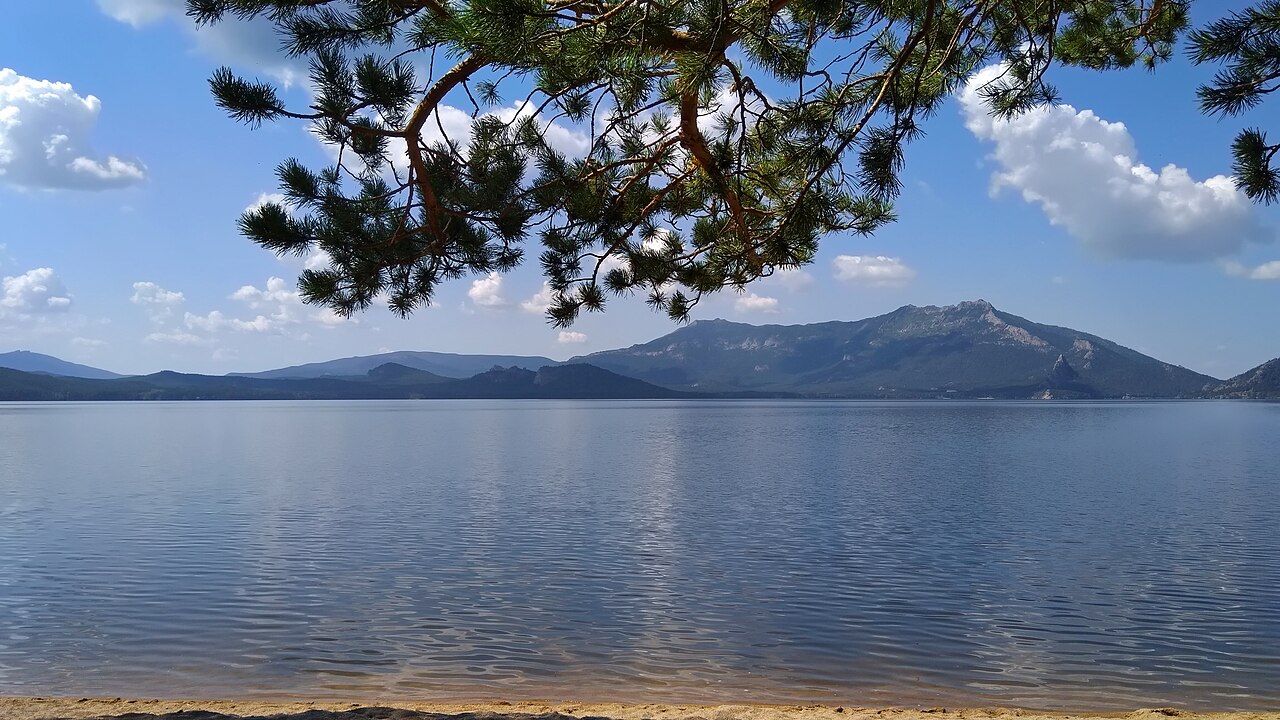
Burabay sits in the Kokshetau Hills, an outcrop of ancient granite pushing up through the flat northern steppe. That geology is the whole point: the rock has weathered into domes, tors and balancing boulders, and the depressions between them hold water. Pine took root on the sandy soils, and the result is a patch of Siberian-looking forest several hundred kilometres from anything similar.
Protection here goes back a long way. A state forest was declared in 1898, the area was nationalised as a spa town of national importance in 1920, and a nature reserve was organised on 1 June 1935. It became a national park by decree in August 2000 at 83,511 hectares, of which 47,600 were forested, and was expanded to 129,935 hectares in 2010. Unusually, it is administered directly under the jurisdiction of the President.
The forest is about 65 per cent pine, 31 per cent birch, 3 per cent aspen. The park records 757 plant species and 305 animal species — around 36 per cent of Kazakhstan’s total fauna diversity in a tiny fraction of its area. Climate is sharply continental: January averages minus 16, July plus 19, with 25 to 35 centimetres of snow cover from mid-November to April.
The lakes, one by one
| Lake | Character | Go there for |
|---|---|---|
| Borovoe (Auliekol) | Freshwater, very clear | The famous views — Zhumbaktas, Okzhetpes, Blue Bay. Boat trips |
| Bolshoye Chebachye | Immediately north of Borovoe, separated by a narrow strip; 26.7 m at its deepest, average 11.1 m (2020 bathymetric survey) | Quiet water, fishing. Worst mosquitoes |
| Shchuchye | 22.3 m at its deepest (2020 survey) | The Rixos and the upmarket hotels. Swimming |
| Maloye Chebachye | Shallower, quieter | Getting away from people |
| Katarkol | Small, wooded shores | Guesthouses, calm |
One myth to put down: you will read that Bolshoye Chebachye holds “over 300 species of fish”. It does not. That figure is a garbled version of the park’s 305 animal species. The lake is fed only by precipitation and a few underground streams and has been slowly shrinking.
Getting there from Astana
Marshrutka and shared taxi — the sensible default
Minibuses and shared taxis leave from Saparzhai-Astana bus station, opposite the old train station. Reckon on around 1,700 tenge for a marshrutka seat and about 2,000 for a shared taxi. You may be transferred to a second vehicle at Shchuchinsk, which is normal and mildly irritating. There are road tolls on the route, so carry cash.
Driving
The best option if you can manage it, because the park is spread out and there is no useful public transport inside it. The drive north is on a decent highway, and how long it takes depends on your route and the traffic. Tolls apply. See renting a car in Kazakhstan.
The train, and why it is the awkward choice
The train looks like the obvious choice, but it has a catch. The nearest station is Kurort-Borovoe, about 25 kilometres from the resort village. The journey from Astana costs around 2,000 tenge, and then you need a taxi for another 2,000 or so. So the train is no cheaper than the marshrutka, and it leaves you well short of the lakes.
There is a daily elektrichka from Astana with evening returns, which does make a day trip feasible if you would rather sit on a train than in a minibus. Otherwise, use the road. Our train travel guide covers the network properly.
Organised day tours
Plenty run from Astana and they solve the internal-transport problem, which is the real difficulty. If you have one day and no car, this is the efficient answer. Our day trips from Astana guide compares Burabay against the alternatives — and it is comfortably the best of them.
From elsewhere
Kokshetau has its own airport, which can take international flights. Petropavl is further north. From Almaty you are looking at a flight to Astana or a very long train — see Almaty to Astana.
Entrance fees in 2026 — what has changed
Older guides quote 198, 200 or 250 tenge per person. Those figures no longer apply, and the tariff structure has changed: Burabay now charges per vehicle, and the rate differs between weekdays and weekends.
| Vehicle | Weekday | Weekend / holiday |
|---|---|---|
| Car | 0.3 MCI = 1,298 KZT | 0.4 MCI = 1,730 KZT (1 May–30 September) |
| Minibus (≤16 seats) or truck | 1 MCI = 4,325 KZT | 1.5 MCI = 6,488 KZT (1 May–30 September) |
| Bus, up to 32 seats | 2 MCI = 8,650 KZT | 2.5 MCI = 10,813 KZT (1 May–30 September) |
| Bus, over 32 seats | 3 MCI = 12,975 KZT | 3.5 MCI = 15,138 KZT (1 May–30 September) |
MCI is the monthly calculation index, 4,325 tenge for 2026. The tariffs were approved by Order No. 04/276 of the Presidential Affairs Manager on 14 November 2024. Because they are set in MCI, the tenge amounts can change whenever the index does.
The tariff is charged per vehicle. If you are arriving on foot or by bike, ask at the park entrance whether a charge applies to you, and pay what is due: entering without paying can bring a fine.
The sights
Zhumbaktas and Blue Bay
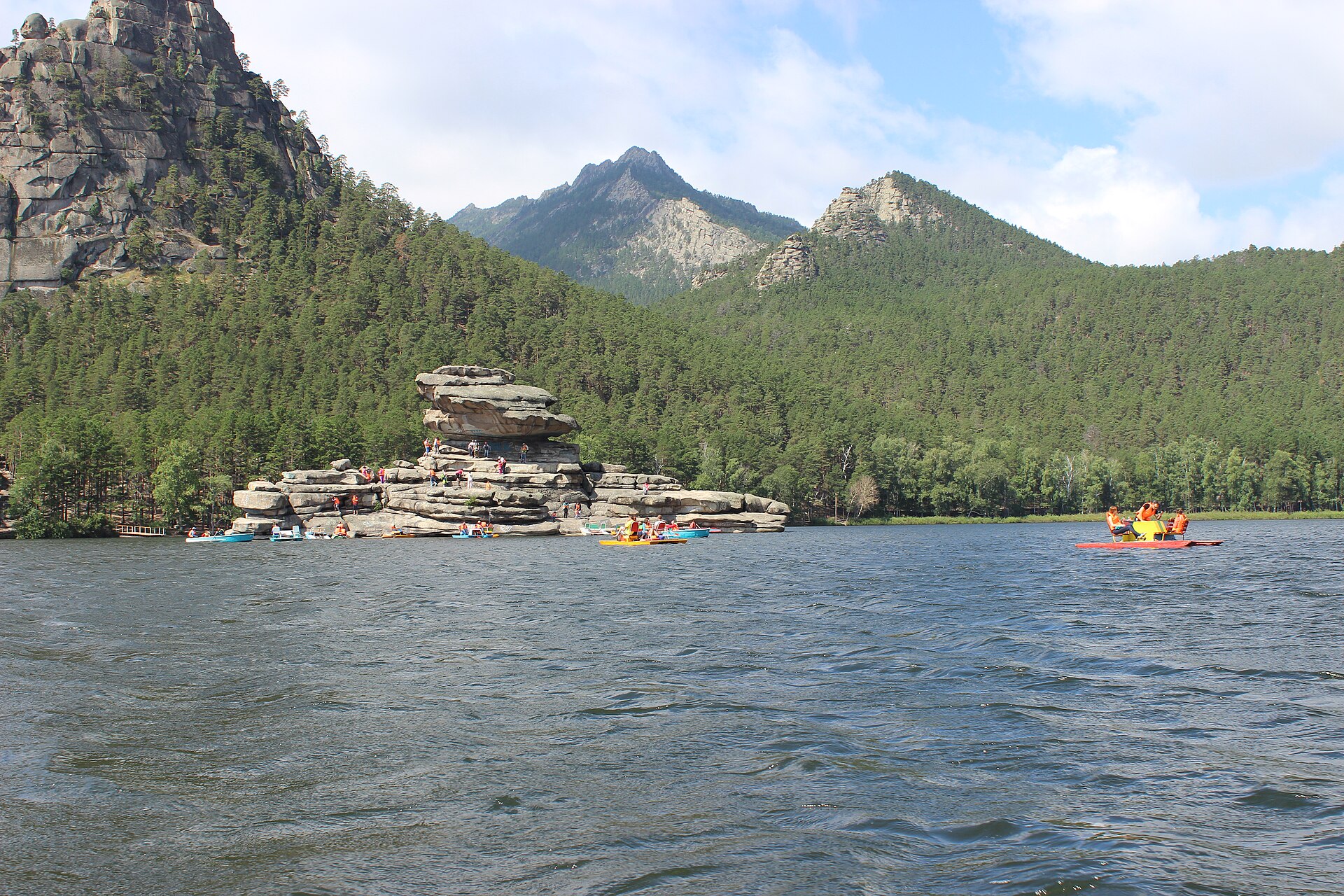
Zhumbaktas — “riddle stone”, often called the Sphinx — is a granite islet standing out of Lake Borovoe in Goluboy Zaliv, Blue Bay. It is the image on every Burabay postcard and it earns it, particularly in the hour after sunrise when the water goes flat. The legend attached to it involves a girl who threw herself from the rock rather than marry, which is a legend attached to a great many rocks in Central Asia. Boats will run you out to it.
Okzhetpes
The rock rising from the northern shore. You can walk to its base easily. Actually summiting it needs equipment and a guide, and people do get into difficulty on it, so admire it from the shore unless you are properly set up.
Bolektau and the new eco-trail
The best short walk in the park. Bolektau is a panoramic viewpoint: from the top you look out over Lake Borovoe, with Zhumbaktas and Okzhetpes in the frame.
In September 2025 Kazakhstan’s first gamified eco-trail opened on Bolektau — QR codes along the route, a Telegram bot, and audio guides in Kazakh, Russian and English. It was funded by Home Credit Bank in partnership with the park and the Akmola tourism department. Whether you want a Telegram bot on a twenty-minute hill walk is a matter of taste, but the English audio is genuinely useful and no other guide mentions it exists.
Abylai Khan’s Glade and the throne
A clearing that tradition associates with Abylai Khan. A stele was erected in 1991 for the 280th anniversary of his birth. There is a throne-shaped stone; visitors circle it seven times to have a wish granted.
It is a place of real significance in Kazakh history and it is also, in warm months, a gauntlet of craft sellers and berkutchi — eagle handlers charging for photographs with a golden eagle on your arm. If that appeals, our guide to eagle hunting in Kazakhstan explains the tradition it comes from and where to see it done properly rather than as a photo op.
Kenesary Cave, the Dancing Birches and Zheke Batyr
A set of smaller curiosities scattered around the lakes: a cave associated with Kenesary Kasymov, a grove of contorted birches, the Three Sisters rocks, and Mount Zheke Batyr, “the lone warrior”.
Museums and the maral farm
The Burabay Museum of Local History and Nature is in the village, alongside a small zoo of around thirty species. There is also a Multimedia Interactive Complex with seven zones; the official tourism listing gives tickets at 3,000 tenge, or 2,000 tenge for children.
The Aqmaral deer farm runs tours and deer viewing, with a wellness side to the business. It opens to visitors in winter too; ask the farm for the current ticket price and viewing times before you go. You cannot bring your own food in; they sell apples at the entrance.

Swimming, boats and everything else
The swimming season is short and worth catching. Lake Borovoe is only about seven metres deep so it warms reasonably in July and August; Shchuchye is deeper and colder. We have not found a reliable published water temperature, so we will not invent one — expect “briefly pleasant in high summer” rather than Mediterranean.
Beyond swimming: boat trips on Borovoe (budget roughly 1,000 tenge for half an hour; prices vary by operator and season), kayaks, bike hire, horse riding, quad bikes. In winter the village runs a skating rink and dog sledding, there is a Ferris wheel, and quad bikes go out on the frozen lake.
There is also a casino, CashVille. Mentioning it is not an endorsement; it is context for what Burabay has become.
Where to stay
Burabay village
Where you want to be if you care about walking to the lake. Kenesary Kasymuly Street is the spine. Options run from Hotel Almaz around 9,000 tenge, through the Zhumbaktas guesthouse, Insar Hotel, Sultan Plaza and Hotel Nurlytau. Prices rise sharply in summer and differ between weekdays and weekends.
Lake Shchuchye and the Rixos
Rixos Borovoe is the five-star option, on Lake Shchuchye, with several restaurants. Wyndham Garden Borovoe is the other international name. Burabay Land Hotel, on the southeast shore of Shchuchye, doubles as the residence of Father Frost, which is a genuine winter draw for families.
Sanatoriums
Burabay has been a spa destination since 1920 and the Soviet sanatoriums are still going — Okzhetpes and Zeleny Bor from around 15,000 tenge. These are an experience in themselves: mineral baths, timetabled meals, treatment plans nobody explains to you. Worth it once.
Shchuchinsk
Some way south of the resort village and its lakeshore. Fine if you have a car, a poor idea if you do not. See where to stay in Kazakhstan for the wider picture.
One practical warning: ATMs inside the park are sparse. Bring cash from Astana.
When to go
Summer
July and early August are peak. Visitor numbers climb from May and hold until late September, and in high summer the tourists appear to outnumber the residents. The national park received 550,000 visitors in the first half of 2022 alone. If you want the postcard without the queue, come on a weekday — and note that park entry is cheaper then too.
Autumn
Our pick. Late August to early October: the birches turn, the water is still swimmable at the start of it, the mosquitoes ease and the crowds thin. See Kazakhstan in autumn.
Winter
Burabay works properly in winter, which is unusual for a Kazakh lake destination. Snow on granite and pine, frozen lakes, skating, dog sledding, the Ferris wheel, quad bikes on the ice, and Father Frost for children. It is cold — January averages minus 16 — but it is a real season here, not a shut-down one. See Kazakhstan in winter and frozen lakes in winter.
Spring and the mosquito problem
Spring is muddy and the lakes are cold. And then there are the mosquitoes, which deserve their own warning: they are a genuine problem here, worst around Chebachye, and readers have reported them being bad as late as early October. Bring repellent, not a token amount of it.
What Burabay is not
Almost everything written about Burabay in English is promotional, so here is the other side.
It is not wilderness. It is a resort — and specifically, it is the resort where a capital city of 1.7 million people goes on holiday. In July the shoreline near the village has souvenir stalls, inflatable slides, amplified music and litter. Abylai Khan’s Glade, a site of real historical weight, has people selling fridge magnets in it.
It is not the Kazakh Alps. Mount Kokshetau, the highest point, is 947 metres. These are hills — beautiful, strange, granite hills, but hills. If you have come from the mountains above Almaty you will find Burabay gentle.
And it is not undiscovered. It has been a spa town since 1920 and a national park since 2000, and it is one of the country’s favourite holiday spots.
None of which makes it not worth going. It makes it worth going in September, on a weekday, with a car — at which point it is one of the more pleasant places in northern Kazakhstan.
One day and two days at Burabay
One day from Astana
Leave Astana early. Climb Bolektau for the view over the lake. Down to Blue Bay for Zhumbaktas and a boat out to it. Lunch in the village. Abylai Khan’s Glade and the Multimedia Complex in the afternoon. Leave by 17:00.
Two nights
Day one as above but unhurried, with a swim. Day two: the maral farm in the morning, then drive round to Lake Shchuchye or Maloye Chebachye for a quiet afternoon, then Okzhetpes at golden hour. Day three: the museum, then home.
Frequently asked questions
Is Burabay the same place as Borovoe?
Yes. Burabay is the Kazakh name, Borovoe the Russian one. The village was officially renamed Burabay in 2005. Shchuchinsk, however, is a different town further south.
How far is Burabay from Astana?
Burabay lies north of Astana, and the drive time depends on your route and the conditions on the day.
Can you do Burabay as a day trip from Astana?
Yes, comfortably — with an early start, or on an organised tour. Two nights is better if you want to see more than Lake Borovoe.
How much is the entrance fee to Burabay National Park?
In 2026 it is charged per vehicle: 1,298 tenge for a car, rising to 1,730 at weekends and on holidays between 1 May and 30 September. Minibuses and coaches pay considerably more. Walkers and cyclists should ask at the entrance whether they need to pay.
Is there a train from Astana to Burabay?
There are trains, but the station — Kurort-Borovoe — lies about 25 kilometres from Burabay village. You will need a taxi from there. The marshrutka is usually quicker and no more expensive.
Can you swim in Lake Borovoe?
Yes, in July and August. It is shallow, around seven metres, so it warms up; Shchuchye is deeper and colder. The season is short.
What is Zhumbaktas and can you get to it?
A granite islet in Blue Bay on Lake Borovoe, the park’s signature view. Boats run out to it from the shore.
How long does it take to climb Bolektau?
Not long: it is a short walk up to a panoramic viewpoint over the lake, Zhumbaktas and Okzhetpes. There is now a signed eco-trail with English audio guides via QR codes.
Where should I stay — Burabay village, Shchuchinsk or Lake Shchuchye?
Burabay village if you want to walk to the lake. Lake Shchuchye for the Rixos and the upmarket hotels. Shchuchinsk only if you have a car.
Is Burabay worth visiting in winter?
Yes, unusually so. Skating, dog sledding, frozen lakes, snow on the granite, and a Ferris wheel with heated cabins.
Are the mosquitoes bad?
Yes. Worst around Bolshoye Chebachye, and they can persist into early October. Bring serious repellent.
What is Abylai Khan’s Throne and why do people walk around it seven times?
A stone in Abylai Khan’s Glade known as his throne. Circling it seven times is said to grant a wish.
Final thoughts
Burabay is the closest thing northern Kazakhstan has to a proper landscape destination, and the reason to go is simpler than any of the sights: it is a pine forest with clear lakes in it, four hundred kilometres from the nearest comparable terrain, and it feels genuinely improbable when you arrive.
Go in September. Take a car so you can reach the quieter lakes. Climb Bolektau early, before the coaches. Then find a shore on Maloye Chebachye where nobody is selling anything, and understand why Astana comes here.
For more of this part of the country, our guide to northern and eastern Kazakhstan covers the wider region, lakes in Kazakhstan puts Burabay’s water in national context, and Kazakhstan’s national parks compares it with the rest of the protected-area system.
Photo credits
Lake Burabay at first light: Евгений Емельянов, CC BY-SA 4.0, via Wikimedia Commons. Zhumbaktas rock: Alter-Ego9312, CC BY-SA 4.0, via Wikimedia Commons.
Zhumbaktas on Lake Burabay: Borovoe by Bescientist, CC BY-SA 4.0, via Wikimedia Commons.