Contents
- The mausoleum at a glance
- Who was Khoja Ahmed Yasawi?
- Why Timur built it, and why it isn’t finished
- The architecture, explained
- The Tai Kazan
- Who is buried here
- Restoration, and the argument about it
- Visiting: what you need to know
- What else is in the Azret Sultan complex
- Frequently asked questions
- Final thoughts
Walk up to the front of this building and the first thing you notice is that it isn’t finished. Bare brick where the tilework should be. Two stumps flanking the entrance where minarets were begun and abandoned. Then you walk round the back and the rear wall is covered in turquoise geometry of a quality that would stop you anywhere in the world. Same building, two states, six hundred years apart in appearance and about sixteen years apart in reality.
The Mausoleum of Khoja Ahmed Yasawi in Turkestan, southern Kazakhstan, was commissioned by Timur between 1389 and 1405 over the grave of a twelfth-century Sufi master. Work stopped when Timur died and the main portal was never faced. It became Kazakhstan’s first UNESCO World Heritage Site in 2003, and its 18-metre dome is the largest brick dome in Central Asia.
The mausoleum at a glance
| Where | Turkestan, Turkestan Region, southern Kazakhstan |
|---|---|
| Built | 1389–1405, on Timur’s order; never completed |
| Honours | Khoja Ahmed Yasawi, Sufi master, c. 1093–1166 |
| UNESCO | Inscribed 2003, criteria (i)(iii)(iv), ref. 1103 — Kazakhstan’s first |
| Size | Roughly 46 × 63 m, 38.7 m high, 35 rooms |
| Main dome | About 18.2 m across — the largest brick dome in Central Asia |
| Ticket | Nominal (around 500 tenge as last reported); grounds free |
| Hours | Daily, roughly 09:00–18:00 |
| Time needed | 1–2 hours for the mausoleum; 3–5 for the whole reserve |

Who was Khoja Ahmed Yasawi?
From Sayram to Yasi
He was born around 1093 in Ispidjab — modern Sayram, a village just east of Shymkent that is still there and still visitable — and spent most of his life in Yasi, the town that became Turkestan. He died there in 1166. Some Kazakh sources give 1103 for his birth and Britannica commits only to “the eleventh century,” so “born in the late eleventh century” is the safe formulation.
He studied in Bukhara under the Sufi master Yusuf Hamadani and went on to found the Yasawiyya, the first Sufi order to spread widely through the Turkic-speaking world. Our Kazakh culture guide covers how that inheritance sits alongside older steppe belief. He is credited with the Islamisation of the Turkic peoples and known as the Father of the Turks.
The Divan-i Hikmet, and why writing in Turkic mattered
He is traditionally the author of the Divan-i Hikmet, the Book of Wisdom — the first major work of Sufi literature in Turkic rather than Arabic or Persian.
It’s worth pausing on that, because it’s the whole reason this building exists. Before Yasawi, serious religious thought in Central Asia was written in languages most Turkic-speakers didn’t read. Yasawi wrote in the language of the steppe, in verse forms people already knew, and Islam stopped being a foreign import and became something you could think in. That’s a bigger achievement than any building.
Two honest caveats. The original manuscript is lost; the surviving copies date from the fifteenth and sixteenth centuries and are scattered between Istanbul, Kokand, Tashkent, Moscow, Almaty and Turkestan. And modern scholars increasingly doubt that Yasawi personally wrote all of what carries his name.
The underground cell
Legend holds that at 63 — the age at which the Prophet Muhammad died — Yasawi withdrew into an underground cell, declaring he would not walk in the sun longer than the Prophet had. The cell is described as about 1.5 by 1.5 metres and 165 centimetres high, two metres below chambers that are themselves four metres underground.
The Hilvet mosque a short walk from the mausoleum is where visitors are shown this. Be clear-eyed: the surviving structure dates to the sixteenth century and was substantially reconstructed in 1941. Accounts of how long he actually lived vary between 73 and 85. Treat it as tradition, which is not the same as treating it as untrue — it is a real and old tradition, just not an archaeological fact.
Why Timur built it, and why it isn’t finished
The small tomb that came first
For two centuries after Yasawi’s death a modest twelfth-century mausoleum stood over his grave. It was a pilgrimage site, but a small one. Timur demolished it and started again on a completely different scale.
Piety and politics
Both motives were real. Timur was building monumental religious architecture across his empire as a matter of policy. But the timing matters: he ordered this after defeating Tokhtamysh of the Golden Horde, and a spectacular shrine to the saint who converted the steppe was an extremely efficient way to bind the region’s Turkic nomads to his rule. Monumental piety and statecraft were not separate activities.
He is reported to have taken part in the design personally. Persian craftsmen were brought in from conquered cities — mosaic-workers from Shiraz, stonemasons and stucco-workers from Isfahan — under a master builder from Shiraz. The façade inscription is signed by a calligrapher of Shiraz and dated 800 AH, which is 1397–98.
1405, and the death at Otrar
In February 1405 Timur was at Otrar, seventy-odd kilometres from here, assembling an army to invade Ming China. He fell ill and died. Work on the mausoleum stopped and was never resumed by anyone.
That is one of the cleanest cause-and-effect chains in world architecture, and it is why the front of this building looks the way it does. Our guide to Turkestan covers the city that grew around it.
How to read an unfinished building
Stand at the south portal. What you see is massive exposed brick masonry — the structural core, without its facing. Either side, two truncated minaret stumps, begun and stopped. Then go round to the north-west and look at the rear façade: glazed turquoise brick set into unglazed brick in geometric patterns and sacred names, running the full height of the wall.
UNESCO explicitly cites this contrast in its inscription, saying the unfinished portions provide “exceptional evidence of the construction methods of the period.” In other words, the incompleteness is part of why it’s protected. Most great buildings show you the result. This one shows you the method.
The other theory
Here is something you will not find in any English-language travel guide. It is not actually certain that work stopped because Timur died. The Kazakh archaeologist E. Smagulov has noted that it remains unclear whether construction was terminated by Timur’s death in 1405 or by the start of the enormous Bibi-Khanym mosque project in Samarkand in 1399, which would have pulled craftsmen and money away. Estimates of the start date also range across 1389, 1391 and 1395.
The death-at-Otrar story is the standard account and probably right. It’s just worth knowing it is an account rather than a certainty.
The architecture, explained
The plan: a khanaqa in 35 rooms
This is not simply a tomb. It’s a khanaqa — a Sufi complex — with 35 rooms across two floors: eight main chambers, twenty-seven smaller rooms and about a dozen passages, including a mosque, the tomb chamber, a sacred well, a refectory, meeting rooms, a library and a large assembly hall. It is rectangular, about 46 by 63 metres, and 38.7 metres high, oriented southeast to northwest.
A note on the numbers: Kazakh and tour sources widely quote 65.5 by 46.5 metres and 37.5 metres high, probably measuring to the portal buttresses. UNESCO’s figures are the ones to trust, but don’t be surprised when a guide tells you something different.
The Kazandyk and the great dome
The central hall, the Kazandyk, is a square about 18.2 metres on each side, roofed by a conical-spherical dome 18.2 metres in diameter — the largest surviving brick dome in Central Asia. Walls run around two metres thick, reaching three metres around the central hall.
Standing under it is the moment the building lands. There is no steel, no concrete in the original: just fired brick, arranged so that eighteen metres of it holds itself up over your head.
The gurkhana
The tomb chamber sits on the central axis at the north-west end, the sarcophagus dead centre, under a ribbed double dome — inner and outer shells — clad in glazed tile. Three domes cover the building in total: the assembly hall, the tomb chamber, and the mosque.
Reading the tilework
Three techniques, and once you can name them you’ll see them everywhere in Central Asia:
Banna’i — glazed bricks set among unglazed ones so the pattern is built into the structure rather than applied to it. Geometric lattices and repeated sacred names. This is what covers the rear façade.
Haftrangi — literally “seven colours,” multiple glazes fired on a single tile, allowing curved and floral designs.
Faience mosaic — individually cut glazed pieces assembled like a jigsaw, the most labour-intensive and the finest.
Inside, look up into the dome intradoses for muqarnas, the honeycomb-like stalactite vaulting worked in alabaster, and read the Kufic and Suls Qur’anic inscription bands running round the walls. Fragments of the original wall painting survive in the mosque.
Two original fourteenth-century doors also survive: one called Kakpa, “gate,” into the assembly hall, and one called Kapsyrma, “latch,” into the burial chamber.
The blueprint for Samarkand
UNESCO makes a claim here that’s easy to miss and hard to overstate: the vaults, domes and decoration developed at Turkestan became prototypes for the great Timurid architecture of Samarkand. And because it was never subjected to the pressures that damaged other buildings, it survives better than the comparably sized Bibi Khanum in Samarkand.
Follow the line forward and it runs, through Timurid and then Mughal architecture, all the way to Agra. This building is upstream of the Taj Mahal.

The Tai Kazan
Seven metals, two tonnes
In the middle of the Kazandyk sits a bronze cauldron that is, by some distance, the most interesting object in the building. The Tai Kazan is 1.62 metres tall with a rim 2.42 metres across, weighs around two tonnes and holds roughly 3,000 litres. It was cast from an alloy of seven metals: iron, zinc, lead, tin, red copper, silver and gold.
Its inscription gives an exact date — 20 Shawwal 801 AH, which is 25 June 1399 — making it the only precisely dated object in the entire complex. It was cast by a master bronze-worker of Tabriz, taken captive during Timur’s western Iranian campaign and set to work at Karnak, about twelve kilometres from here. Three inscription bands run round it, including a Kufic band repeating “Power belongs to Allah” twenty-two times and a dedication naming Timur.
Note that many travel sources date it to 1397. That is the date of the bronze lamps, cast by a different craftsman from Isfahan. The cauldron is 1399.
What it was for
Not cooking, despite the name. It held sweetened water distributed to pilgrims after Friday prayers, alongside a communal meal. Its form is deliberately that of a nomadic steppe cauldron — a sacred object in Turkic culture for centuries before Islam arrived. A Persian craftsman, working for a Turco-Mongol conqueror, casting an Islamic inscription onto a pre-Islamic nomadic form, in a building designed to bind nomads to a settled empire. The whole argument of this place is in one bronze pot.
Leningrad, 1935
In 1935 the Tai Kazan was removed to the State Hermitage in Leningrad for the Third International Congress on Iranian Art and Archaeology, on loan, supposedly for three months. It stayed 54 years. Permission to return it was granted on 25 July 1989 and it was reinstalled in the Kazandyk on 18 September that year. Two bronze candlesticks removed in 1934 are still in the Hermitage.
Who is buried here
Being buried at Yasawi’s feet conferred legitimacy, and the Kazakh khans knew it. Those interred in or beside the mausoleum include Ablai Khan (d. 1781), whose tombstone stands at the grand palace entrance, Esim Khan, Abulkhair Khan, Zholbarys Khan, Ondan Sultan, Rabia Sultan Begim, and the great orator Kaz dauysty Kazybek Bi. The small palace holds 43 gravestones, the oldest dated 1431 and the most recent 1917.
Rabia Sultan Begim’s own mausoleum stands next door. She was Ulugh Beg’s daughter — making her Timur’s great-granddaughter — and married Abulkhair Khan. Her tomb was largely destroyed by the Russian army, its bricks reused in official buildings, and what stands today is a reconstruction from around 1980.
You will sometimes see Bogenbai Batyr listed among the burials. I could not verify that in any reliable source, so treat it with caution.
One more story worth carrying: in the early sixteenth century Ubaydullah Khan stopped here to pray before going into battle against Babur — the future founder of the Mughal Empire — vowing to rule by sharia if he won.
Restoration, and the argument about it
The mausoleum has had a hard nineteenth and twentieth century.
In 1864 Tsarist forces under General Chernyayev bombarded the town, damaging the external walls, and the shrine subsequently served for years as a military depot. Russian surveys began in 1884, restoration work has been near-continuous since 1907, and regular maintenance dates from 1938. Soviet scholars studied the building intensively between 1951 and 1989, and that research is the basis of modern understanding of Timurid vaulting.
The most recent major campaign ran from the early 1990s to 2000, funded by the government of Turkey and carried out by Kazakh and Turkish specialists. It introduced waterproofing, replaced the clay foundation with reinforced concrete, consolidated the walls and re-laid new dome tiles based on historic patterns.
Is it over-restored? You’ll read that it is. In fairness, UNESCO’s own authenticity assessment is positive, describing an exceptionally high degree of authenticity, and the substantive criticism I could find amounts to visitors observing that parts feel polished for tourism. Judge it yourself when you’re there — and note that the bare, unrestored front portal is the strongest possible evidence that the restorers left the important thing alone.
The ongoing threat is less glamorous: rising damp and salt migration from a high water table, plus construction pressure just outside the buffer zone. UNESCO has filed state-of-conservation reports repeatedly, most recently in 2025.
Visiting: what you need to know
Tickets and hours
Open daily, roughly 09:00 to 18:00. The last first-hand report puts the mausoleum ticket at 500 tenge, about a dollar, bought from a separate hut at the back corner of the building rather than at the entrance. The grounds are free to walk. Other sources quote a combined Azret Sultan complex ticket at 1,000 to 2,000 tenge depending on nationality. Either way, this is not a budget item.
One thing to check before you travel: parts of the interior were under renovation as recently as 2025, when visitors could buy a ticket but see relatively little inside. Look at the reserve’s official site before you commit to a long detour.
Getting to Turkestan
From Shymkent: a marshrutka from Samal bus station, about 1.5 to 2.5 hours for roughly 1,500 tenge, or the train in two and a half to four hours. From Almaty: a direct overnight train of roughly 17 to 19 hours, or a 90-minute flight into Hazret Sultan airport, 16 km from town — see our domestic flights guide. Yandex Go works locally and the bus station is 4 km from the sights, so don’t plan on walking in from it. Our getting around Kazakhstan guide has the detail.
Best time to visit
April to June and September to October. Summer hits 35 to 40°C and the courtyard has almost no shade. Come early in the morning, both for the light on the dome and to avoid the coach groups, and avoid weekends if you can. Our seasonal guide covers the wider picture.
Dress code and photography
Modest dress: no shorts, shoulders covered. Women should carry a scarf for interior spaces; headscarves are generally available at the entrance. Remove shoes where asked. Photography is normally permitted, but be discreet around people praying and ask before photographing anyone. Rules can tighten during restoration work. See our Kazakhstan etiquette guide.
This is an active shrine
The single most important thing to understand before you walk in. Pilgrims come here from across the Turkic world and pray at the threshold of the tomb chamber; the inner sanctum is not open to visitors. On a Friday you will be sharing the space with people for whom this is the most significant journey of their lives.
That means: keep your voice down, don’t walk between someone and the tomb, don’t photograph faces without asking, and don’t treat prayer as a photo opportunity. None of this is onerous. It is simply the difference between visiting a shrine and visiting a monument.
Guides and how long to allow
An hour to two hours does the mausoleum itself. Three to five covers the whole Azret Sultan reserve, which makes it a comfortable day trip from Shymkent, two hours south. Guided tours are available in several languages and worth taking if you want the tilework explained — much of what’s interesting here is invisible without someone to point at it.
What else is in the Azret Sultan complex
- Hilvet semi-underground mosque, about 150 metres away, with a nineteenth-century Juma mosque built above it. Same nominal ticket, and it also covers the ancient baths.
- Rabia Sultan Begim’s mausoleum — free to enter.
- Esim Khan’s mausoleum.
- A medieval bathhouse.
- The reconstructed northern citadel wall, rebuilt in the 1970s, and the archaeological remains of medieval Yasi.
- The Azret Sultan Museum, whose collection was established in 1978 and now holds more than 24,000 items, including a four-metre ivory flagpole made on Timur’s orders and letters from Ablai Khan to the Orenburg governor-general and the Chinese emperor Qianlong.
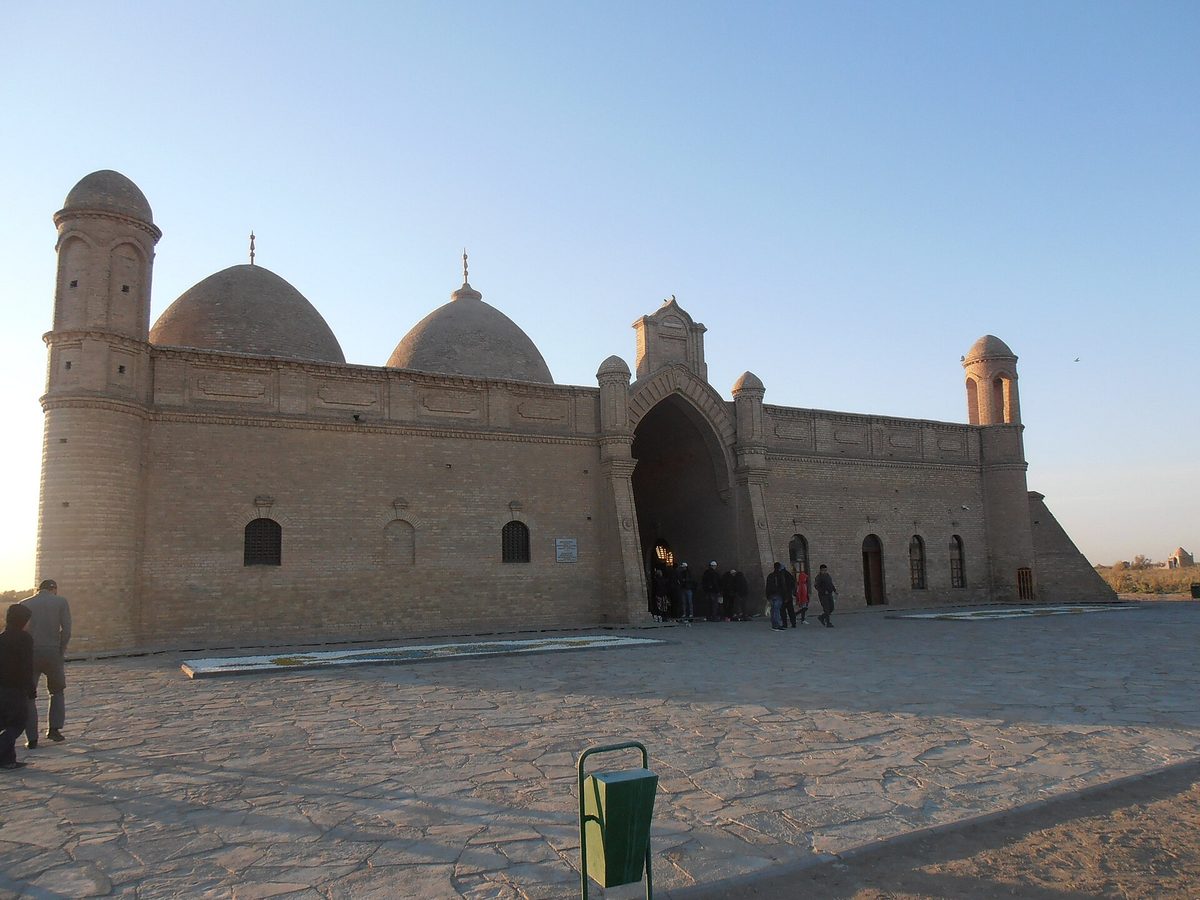
Outside the historic zone, the modern Karavansaray complex and its flying theatre are a ten-minute walk. And 60 km away, near Otrar, is Arystan Bab — Yasawi’s spiritual mentor, whose tomb pilgrims traditionally visit before coming here. The legend says Timur’s construction kept collapsing until a dream told him to build Arystan Bab’s shrine first.
Frequently asked questions
Who was Khoja Ahmed Yasawi and why is he important?
A Sufi mystic born around 1093 in Sayram who died in Yasi in 1166. He founded the Yasawiyya order and wrote the Divan-i Hikmet in Turkic rather than Arabic or Persian, which made Islam accessible across the steppe. He is credited with the Islamisation of the Turkic peoples.
Why was the Mausoleum of Khoja Ahmed Yasawi never finished?
Timur ordered it in 1389 and died at Otrar in February 1405 while preparing to invade China. Work stopped and never resumed, leaving the main portal as bare brick with two truncated minaret stumps. One scholar has suggested work may in fact have halted in 1399 when Bibi-Khanym began in Samarkand.
Who built the Yasawi mausoleum and when?
Timur (Tamerlane), between 1389 and 1405, replacing a smaller twelfth-century tomb. He is reported to have taken part in the design, and Persian craftsmen from Shiraz and Isfahan carried out the work under a master builder from Shiraz.
Where is the Mausoleum of Khoja Ahmed Yasawi?
In the city of Turkestan in southern Kazakhstan, about 165 km north of Shymkent and 1,600 km from Astana. It sits inside the Azret Sultan State Historical and Cultural Reserve.
How much does it cost to visit and what are the opening hours?
Open daily around 09:00 to 18:00. The mausoleum ticket was last reported at 500 tenge, roughly a dollar, with the grounds free. Some sources quote a combined complex ticket of 1,000 to 2,000 tenge. Check the official reserve site for the current tariff.
What is the Tai Kazan cauldron?
A two-tonne bronze cauldron in the main hall, cast on 25 June 1399 from an alloy of seven metals, 2.42 metres across the rim and holding about 3,000 litres. It held sweetened water for pilgrims after Friday prayers. It spent 54 years in the Hermitage in Leningrad and returned in 1989.
Can you go inside the mausoleum?
Yes, into the main hall and most of the complex. The inner sanctum of the tomb chamber is not open — pilgrims pray at its threshold. This is an active shrine, so behave as you would in any working place of worship.
What do you wear to visit the Yasawi mausoleum?
Modest dress: covered shoulders and no shorts for everyone. Women should carry a headscarf for the prayer areas, though scarves are usually available at the entrance. Remove shoes where asked.
Why is Turkestan called the second Mecca of Central Asia?
Because of the tradition that three pilgrimages here count for something approaching a hajj. Treat this as folk tradition rather than religious law — the careful sources always say “it is said” or “it was believed.” What’s certain is that this is one of the Turkic world’s most visited pilgrimage sites.
How do you get to Turkestan from Shymkent or Almaty?
From Shymkent, a marshrutka from Samal bus station takes 1.5 to 2.5 hours for about 1,500 tenge; the train takes two and a half to four. From Almaty, either the direct overnight train at 17 to 19 hours or a flight of roughly 90 minutes into Hazret Sultan airport.
Final thoughts
Most great buildings hide their construction. The dome you see is the dome you’re meant to see; the scaffolding came down centuries ago and the seams were smoothed away. This one didn’t get that treatment, because the man paying for it died in a camp seventy kilometres up the road with the army still assembling around him.
What’s left is a building that shows you both faces at once: the finished Timurid masterpiece round the back, and the raw brick engineering out front. Give it two hours. Stand under the Kazandyk dome, look at the Tai Kazan, then walk out to the south portal and look up at those two minaret stumps and think about February 1405.
For the city that grew around it, see our guide to Turkestan. For the wider route, our Silk Road Kazakhstan pillar and our list of Kazakhstan’s UNESCO sites both cover where it fits, and our landmarks guide puts it alongside the country’s other great structures.
Photo credits
Unfinished portal and mausoleum exterior: Petar Milošević (CC BY-SA 4.0) via Wikimedia Commons. Arystan Bab Mausoleum: Дмитрий Кошелев (CC BY-SA 4.0) via Wikimedia Commons.