Contents
- Why Kazakhstan’s frozen lakes belong on your winter list
- Where are the Kolsai Lakes and Lake Kaindy?
- What happens to these lakes in winter
- Lake Kaindy in winter — the frozen sunken forest
- Kolsai Lakes in winter — what’s realistically reachable
- How to get there in winter (from Almaty)
- Winter weather and what to expect
- Safety on the ice
- Where to stay and winter practicalities
- Park fees, permits and passport checks
- What to pack for a winter visit
- Other frozen-nature add-ons near Almaty
- Frequently asked questions
- Final thoughts
Everyone comes to the Kolsai Lakes in July, when the water is that impossible mirror-green and the meadows are full of wildflowers. I want to talk you into the opposite trip. Come in winter, when the road turns white, the spruce forest is loaded with snow, and the lakes have frozen so hard and so clear that you can walk out over water thirty metres deep. This is the side of southeast Kazakhstan almost no tourist sees, and it is quietly one of the most beautiful things the country does.
The Kolsai Lakes in winter are frozen, snow-ringed and far quieter than in summer, roughly December through March. Only the Lower Kolsai lake is realistically reachable, and the real winter prize sits eleven kilometres away: Lake Kaindy, where a drowned spruce forest freezes into clear ice above the sunken trunks. Go with a driver who knows the road, bring your passport, and treat the ice with respect.

Why Kazakhstan’s frozen lakes belong on your winter list
When people plan a Kazakhstan winter trip, they think about skiing. Fair enough — Shymbulak’s slopes and the high-altitude oval at Medeu are genuinely good, and they are forty minutes from central Almaty. But if you only do the resorts you miss the part of a Kazakh winter that stays with you: the silence of a frozen mountain lake with nobody else there.
These lakes sit in the northern Tian Shan, in a national park that in summer sees a steady stream of day-trippers and trekkers. In winter that traffic all but stops. The guesthouses in Saty village mostly close, the upper trails vanish under snow, and the whole valley goes still. What you get in exchange for the cold and the effort is a landscape you will more or less have to yourself, and photographs that look nothing like the ones everyone else brought home in August.
This guide is for the traveller who is already coming to Almaty in the cold months — for the skiing, for New Year, for a winter trip through Kazakhstan — and wants one wild, memorable day beyond the pistes. It is honest about what you can and can’t do, because winter here rewards planning and punishes improvisation.
Where are the Kolsai Lakes and Lake Kaindy?
Both lakes lie inside Kolsai Lakes National Park, in the Almaty Region, roughly 300 kilometres southeast of Almaty. The gateway is the village of Saty, reached on a paved highway that runs east past Chilik toward the Kegen district. From Saty it is about fifteen kilometres up a side valley to the first Kolsai lake and about eleven or twelve kilometres in a different valley to Lake Kaindy.
One detail matters more in winter than at any other time: you are close to the border. The park sits only about ten kilometres from Kyrgyzstan, and the upper Kolsai trail actually climbs to a pass on the frontier. That is why there is a police checkpoint before Saty and why you must carry your actual passport, not a photocopy — foreigners have been turned back for not having it. In summer this is a formality you barely notice. In winter, when there are far fewer people on the road, expect the check and have your documents ready.
Because of the distance and the winter road conditions, this is not a place you casually drive to in a rented city car. It is a full day at minimum, and honestly better as an overnight, which I’ll come back to. First, the thing you actually came for.
What happens to these lakes in winter
When the lakes freeze
The freeze window is roughly December to March, deepening through January and February. At these elevations — Lower Kolsai sits around 1,800 metres, Kaindy around 2,000 — winter is cold and consistent. Daytime temperatures at Kaindy hover well below zero in the heart of winter, often around minus 6 to minus 8 Celsius by day and minus 15 to minus 18 at night, so once the lakes lock up they stay locked for months.
The magic is that mountain lake ice, away from any current, can freeze remarkably clear. On a good day at Kaindy you can stand on the surface and look straight down at the pale drowned trunks disappearing into the depths, as if the whole forest were suspended under glass. It is genuinely eerie and genuinely gorgeous.
Kaindy’s sunken forest under the ice
Lake Kaindy is the star. It formed after an earthquake sent a limestone landslide down to dam this narrow gorge, flooding a stand of Tian Shan spruce and drowning the trees where they stood. More than a century later the trunks are still upright, bleached bare above the waterline and eerily preserved below it. In summer the water is a milky turquoise. In winter it freezes over, and the bare masts of the sunken forest poke up through snow and ice instead of turquoise water — a completely different, more austere kind of beautiful.
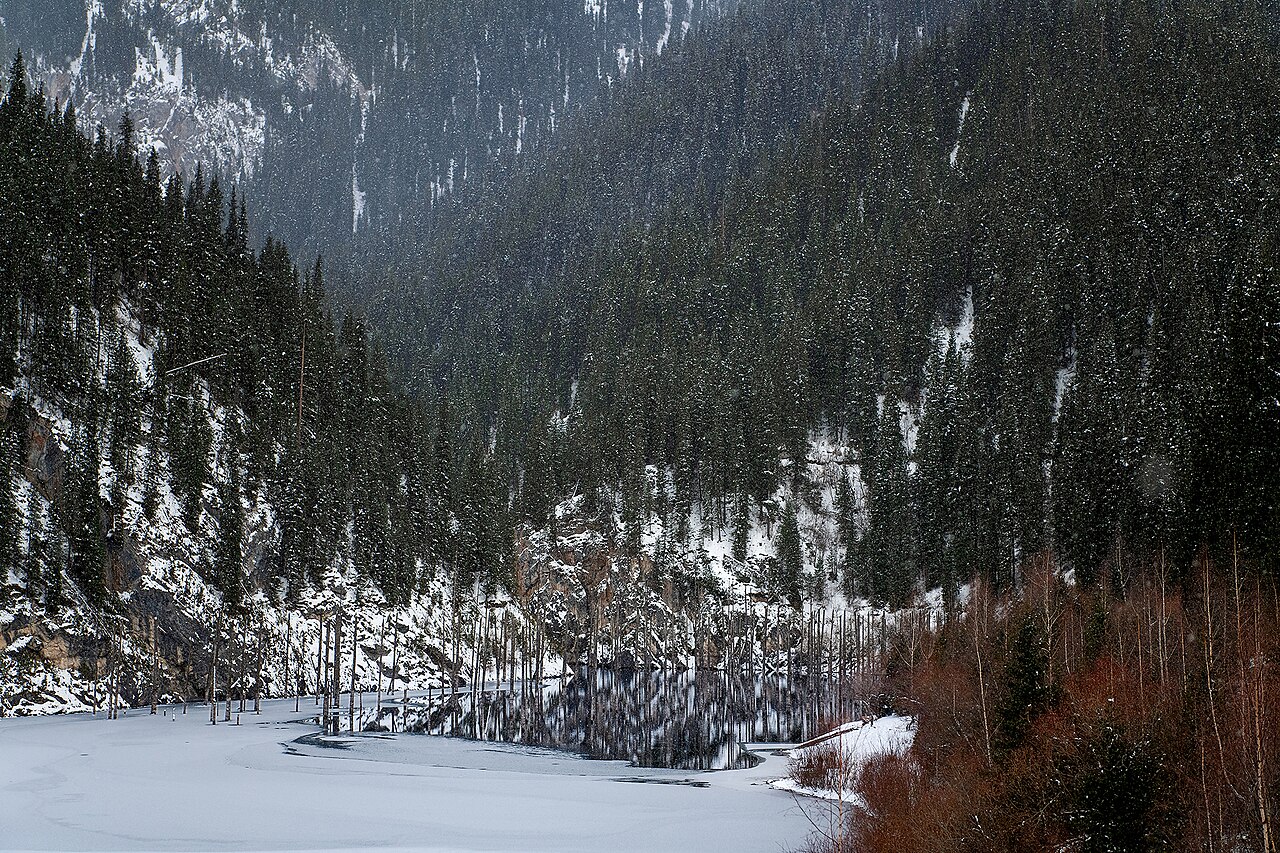
Snow-covered Lower Kolsai
Lower Kolsai — the first and lowest of the three Kolsai lakes — is the one you can actually reach in winter. It sits in a bowl of steep, spruce-covered slopes, and under snow it becomes a white-and-dark-green study in stillness. The boats and paddle-hire of summer are long gone. What’s left is a frozen surface, frosted trees, and, if you’re lucky with the weather, a hard blue sky over it all.
Lake Kaindy in winter — the frozen sunken forest
The earthquake that drowned a forest
The standard story credits the 1911 Kebin (Chon-Kemin) earthquake — an enormous quake that shook this whole region — with triggering the landslide that dammed the gorge and created Kaindy. It’s worth knowing that researchers have since debated the exact event, with recent tree-ring work pointing to an earlier quake as the trigger; the science isn’t fully settled. What isn’t in doubt is the result: a narrow lake roughly 400 metres long, up to about 30 metres deep, with a forest of Schrenk’s spruce standing drowned inside it.
Why the trees survive
The trunks last because the water is cold and mineral-rich year-round — only about four to six degrees even in the warm months — which slows decay to a crawl. The submerged wood is effectively pickled in cold, clean water. Above the surface the trees have lost their bark and branches and stand as pale spikes; below, in summer, divers report the lower trunks still bearing intact limbs.
Ice diving at Kaindy
Here is the winter activity that draws the specialists: ice diving. Because the lake freezes clear and the water beneath is extraordinarily still, under-ice visibility can exceed twenty-five metres, and experienced divers descend among the sunken trunks in a frozen, cathedral-quiet world. It is spectacular — and it is emphatically not a casual tourist activity. It requires proper cold-water and ice-diving certification, a park permit, an experienced dive lead, and a full safety setup. If you are a qualified diver and this is on your list, arrange it in advance through a reputable operator in Almaty; do not turn up expecting to rent a tank at the lake. For everyone else, ice diving is a thing to watch and photograph, not to try on a whim.
Ice fishing
Kaindy and the Kolsai lakes hold trout, and winter brings ice fishing to the region as it does across much of Kazakhstan, where drilling a hole in a frozen steppe or mountain lake is a beloved cold-season pastime. If your driver or guide is into it, it’s a lovely low-key way to spend a frozen afternoon. As always on ice, go with someone who knows the lake.
Kolsai Lakes in winter — what’s realistically reachable
Lower Kolsai, the one you can reach
Of the three Kolsai lakes, only the lower one is a sensible winter destination. The road reaches close to it, and in a capable vehicle with a good driver you can get to the shore, walk a little of the near bank, and take in the frozen bowl. It’s about a kilometre long and, like Kaindy, deep and cold. This is the realistic winter Kolsai experience — a reachable, photogenic, frozen lake, not a multi-lake trek.
Why the middle and upper lakes are off-limits
In summer, fit hikers climb from Lower Kolsai to the Middle lake (around 2,250 metres) and on to the Upper lake (around 2,850 metres), and strong trekkers continue to the Sary-Bulak pass on the Kyrgyz border. In winter, forget it. The trails are buried in deep snow, avalanche risk is real on the steep forested slopes, and the upper valleys are genuinely dangerous without mountaineering skills, avalanche gear and a professional guide. The honest advice is to enjoy the lower lake and Kaindy and leave the high route for a summer return. If you want high-country hiking generally, our guide to hiking in Kazakhstan covers the seasons to aim for.
How to get there in winter (from Almaty)
The route to Saty
From Almaty you head east on the Kuldja highway toward Chilik, then on toward the Kegen/Saty turnoff — roughly a five to six hour drive in good conditions, longer in snow. The main road is paved and generally kept open, but winter weather can slow everything down and the mountain sections demand a careful driver. Fill up on fuel before you leave the larger towns; services thin out fast once you’re past Chilik.

The last leg to Kaindy
The final eleven or twelve kilometres from Saty to Kaindy is the crux. Even in summer it’s a rough dirt track with river fords that wants a high-clearance 4×4; in winter it is frequently snow-blocked, and you need a driver with the right vehicle, snow chains or tracks, and local knowledge of whether it’s passable that day. Sometimes the last stretch is done on foot or by arranged transfer. This is exactly why a knowledgeable local driver, not a rental car, is the right call.
Tours vs self-drive
For nearly everyone, the smart winter option is an organised tour or a hired driver-guide out of Almaty. A good operator handles the vehicle, the road call, the checkpoint, and often a Saty homestay, and turns a logistically fiddly trip into a straightforward one. If you’d rather build your own itinerary, our Kazakhstan itinerary guide and the overview of Kazakhstan’s national parks put the lakes in context with the rest of a trip.
Winter weather and what to expect
Expect real cold and big day-to-night swings. A rough month-by-month feel for the lakes:
| Month | Conditions at the lakes | What you can do |
|---|---|---|
| December | Freezing over; snow building; roads slower | Frozen Lower Kolsai; Kaindy if the track is open |
| January | Deep winter; day around -6 to -8°C, nights to -18°C; lakes solidly frozen | Peak clear-ice season; ice diving; photography |
| February | Still fully frozen; often the most stable, sunny cold | Best all-round frozen-lake conditions |
| March | Ice lingering but thawing later in the month; slushy access | Earlier March fine; late March unreliable — the freeze is ending |
These are directional, not a forecast — mountain weather does what it likes. Check conditions with your operator a day or two out, and build in flexibility. For the wider picture of when to come, see our guides to Kazakhstan in December and January and February.
Safety on the ice
This is the part I won’t soft-pedal. Frozen lakes are beautiful and they are dangerous, and cold-water immersion is life-threatening. A few rules:
- Never walk out onto ice you don’t know. Go with a local guide or driver who understands that specific lake and the season’s conditions. Thickness varies, and inflows, springs and shaded spots can stay thin.
- Ice diving is for certified divers only, with a permit, a proper team and surface support. Do not improvise it.
- There is no casual swimming here. The water is a few degrees above freezing; immersion incapacitates you within minutes.
- Dress for the real temperature, carry spare warm layers in the vehicle, and keep your phone warm so the battery survives (cold kills batteries fast).
- Tell someone your plan. Mobile coverage is patchy to nonexistent up here; don’t rely on it.
Where to stay and winter practicalities
Saty is the base, and the honest news is that many of its guesthouses and homestays close from around October to May, so winter lodging is limited and should be arranged in advance — usually through your tour operator, who will know which family is open. Staying overnight is worth it: it breaks up the long drive, lets you hit Kaindy in the good morning light, and a warm homestay dinner after a frozen day is one of the trip’s pleasures.
Bring cash in tenge — there are no ATMs out here and cards are useless. Download offline maps before you leave Almaty. Fuel up in the larger towns. And keep your expectations flexible: if heavy snow closes the Kaindy track, a good guide will pivot to Lower Kolsai or another frozen spot rather than risk it.
Park fees, permits and passport checks
The national park charges a modest entry fee, payable in cash tenge, and Kaindy and Kolsai are generally ticketed separately at their own checkpoints. Figures drift year to year, so treat any number you read online as a rough guide and confirm current rates on the day. More important than the money is the border-zone reality: carry your original passport for the checkpoint before Saty. For the wider rules on visiting and moving around, our Kazakhstan visa guide is a useful companion.
What to pack for a winter visit
- A proper insulated winter coat, thermal base layers, and a warm hat and gloves — this is serious cold, not city cold.
- Waterproof, insulated boots with grip, plus ice cleats/crampons for walking near the ice.
- Sunglasses and sunscreen — snow glare at altitude is fierce even when it’s cold.
- A thermos, snacks, and more water than you think; and cash in tenge.
- A power bank and a way to keep your phone/camera batteries warm.
Our full Kazakhstan winter packing list goes deeper if you’re building a kit from scratch.
Other frozen-nature add-ons near Almaty
If frozen landscapes are your thing, the lakes pair naturally with a few other winter sights. Charyn Canyon, dusted with snow, is a dramatic, uncrowded winter day trip on the same eastern road. Big Almaty Lake sits much closer to the city and freezes into a turquoise-and-white spectacle (access depends on snow and the checkpoint). And far to the north, Burabay‘s lakes and granite hills are a classic Kazakh winter escape. For the full menu of the country’s water, see our overview of lakes in Kazakhstan.

Frequently asked questions
Can you visit Kolsai Lakes in winter?
Yes, but with limits. Lower Kolsai is reachable in winter with a capable vehicle and a good driver, and it’s beautiful under snow and ice. The middle and upper lakes are off-limits — their trails are buried, avalanche-prone and dangerous. Most winter visitors pair Lower Kolsai with nearby Lake Kaindy.
Does Lake Kaindy freeze?
Yes. Kaindy freezes over roughly from December to March. In the depths of winter the surface can freeze clear enough to see the sunken trunks below, and it becomes a known ice-diving spot. It’s a completely different scene from the turquoise summer lake.
Can you walk on the frozen lakes?
Only with a local guide who knows that lake and the current conditions, and with proper footwear and ice cleats. Ice thickness varies, and springs or inflows can leave thin patches. Never walk out onto unfamiliar ice alone, and never swim — the water is only a few degrees above freezing.
How cold does it get at the lakes?
Cold. In January, daytime highs at Kaindy sit around minus 6 to minus 8 Celsius, with nights dropping toward minus 15 to minus 18. Dress in serious insulated layers and plan for big day-to-night swings.
How do I get to Lake Kaindy in winter?
Drive five to six hours east from Almaty to Saty, then tackle the rough final stretch to Kaindy — which in winter often needs a 4×4 with chains and a driver who knows if the track is open that day. For most travellers an organised tour or hired driver-guide from Almaty is by far the easiest and safest option.
Is it worth visiting in winter rather than summer?
If you want solitude, frozen clear ice and photographs nobody else has, winter is magical. If you want to trek the upper lakes, swim, or keep logistics simple, summer is easier. Many people who’ve done both say the frozen version is the more memorable — just come prepared for real cold.
Final thoughts
The frozen Kolsai and Kaindy lakes are the winter Kazakhstan that doesn’t make the brochures — harder to reach, colder, quieter, and all the better for it. Go with a driver who knows the road, carry your passport and your cash, respect the ice, and give yourself the overnight in Saty so you’re not rushing a five-hour drive both ways. Do that, and you’ll stand on a frozen mountain lake above a drowned forest with nobody else in sight, which is about as close to having Kazakhstan to yourself as it gets. When the slopes get crowded, this is where I’d rather be.
Photo credits
- Frozen Lower Kolsai — Smallishfish, CC BY-SA 4.0, via Wikimedia Commons
- Frozen Lake Kaindy under snow — MariSimonova, CC BY-SA 4.0, via Wikimedia Commons
- Tian Shan above Almaty in winter — Nikolai Bulykin, CC BY-SA 4.0, via Wikimedia Commons
- Charyn Canyon in winter — Maria Simonova, CC BY-SA 4.0, via Wikimedia Commons


